
TL;DR: Dutasteride blocks roughly 90% of DHT versus finasteride's 70%, and in a 917-man randomized trial it beat finasteride on hair count at 12 and 24 weeks. Most men see shedding slow in 3-4 months, real regrowth in 6-12 months, and peak results around 2 years. It isn't FDA-approved for hair loss, which changes how you get it.
What is dutasteride and how does it work for hair loss?
Dutasteride is a 5-alpha reductase inhibitor. It blocks the enzyme that converts testosterone into dihydrotestosterone (DHT), the androgen mainly responsible for shrinking hair follicles in genetically susceptible men and women. That shrinking process is androgenetic alopecia. If you want the full picture of how DHT drives follicle miniaturization, the what causes hair loss explainer covers it.
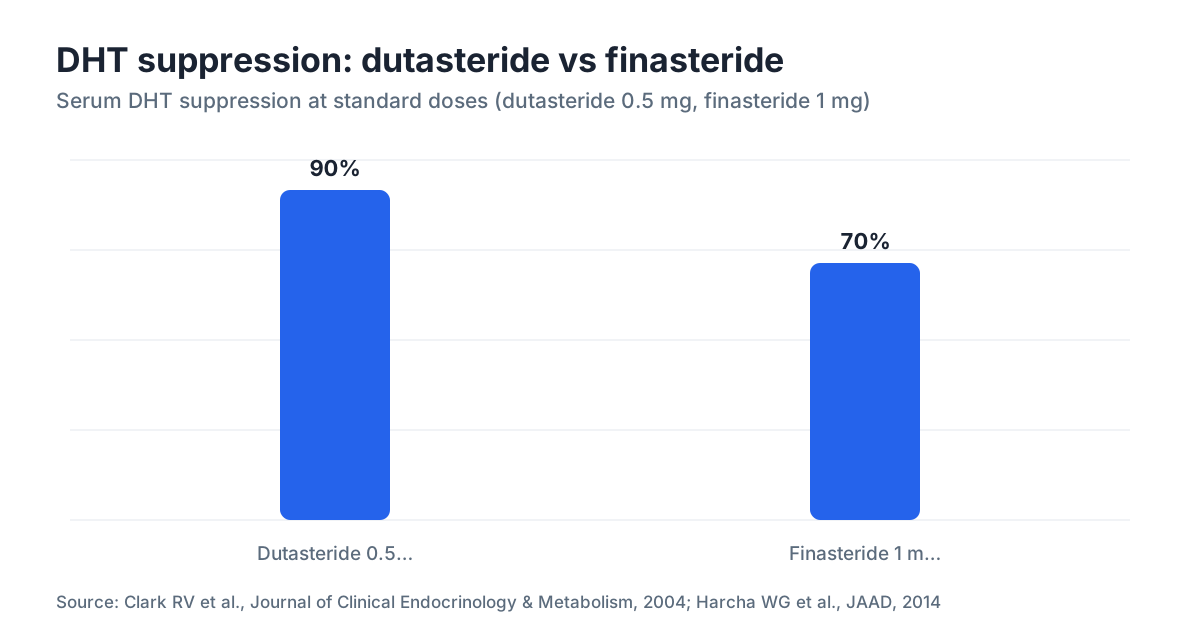
Finasteride, the better-known drug, blocks only the type-2 form of 5-alpha reductase. Dutasteride blocks type-1 and type-2 both. That double blockade is why it drops serum DHT by roughly 90% while finasteride manages about 70% at standard doses. [1]
The FDA approved dutasteride (brand name Avodart) in 2001 for benign prostatic hyperplasia (BPH), not for hair. That's still the only U.S. approval. South Korea's MFDS approved it specifically for androgenetic alopecia in men at 0.5 mg daily in 2009, which is why most of the biggest hair-regrowth trials were run there. In the U.S., dermatologists prescribe it off-label. [2] [9]
Here's the part that changes what you're signing up for. Higher DHT suppression sends a stronger signal to stop miniaturization, but the drug also lingers. Dutasteride has a half-life of about 5 weeks. Finasteride's is 6 to 8 hours. That gap matters for how long side effects can hang around and for what happens when you quit.
How does dutasteride compare to finasteride for hair regrowth?
Dutasteride grows more hair than finasteride in the head-to-head data, but the gap is modest in absolute terms. The most cited trial ran in the Journal of the American Academy of Dermatology in 2014 (Harcha et al.). It enrolled 917 men with androgenetic alopecia and compared dutasteride 0.5 mg daily, finasteride 1 mg daily, and placebo. Dutasteride produced significantly greater hair count increases than finasteride at both 12 and 24 weeks. The stated conclusion: "Dutasteride 0.5 mg was significantly more effective than finasteride 1 mg or placebo in increasing hair count." [3]
A 2017 meta-analysis in the Journal of Dermatology pooled several randomized trials and found dutasteride consistently better than placebo, and better than finasteride, on target-area hair count. [4]
Here's the honest part. "Significantly more hair" in a trial still means a small absolute number. Hair count gains in these studies usually land somewhere around 10 to 30 extra hairs per square centimeter in the target zone. That sounds tiny. It often reads as less see-through scalp in the mirror.
This is the comparison most people actually want:
| Metric | Dutasteride 0.5 mg | Finasteride 1 mg |
|---|---|---|
| DHT suppression | ~90% | ~70% |
| FDA approval (hair loss) | No (off-label in U.S.) | Yes (1997) |
| Half-life | ~5 weeks | ~6-8 hours |
| Head-to-head winner (24-week RCT) | Yes | No |
| Sexual side effect rate (trials) | ~6-12% | ~3-8% |
| Cost (generic, monthly) | $15-60 | $10-30 |
For men who already know finasteride, dutasteride is the more aggressive version of the same mechanism. Whether the extra suppression is worth the tradeoffs is a conversation for you and your prescriber.
Women are a separate case. Finasteride is generally avoided in premenopausal women because of teratogenicity risk. Dutasteride's longer half-life makes it at least as risky around pregnancy. The data in women is thinner too. One small randomized trial showed benefit, but the sample sizes are nowhere near the male trials. [5]
What results can you realistically expect, and on what timeline?
The first thing that usually happens is a shed. New users often notice more hair on the pillow or in the shower around weeks 4 to 8. It's a telogen effluvium shed, where the drug disrupts the follicle cycle before it ends up extending the growth phase. It's almost always temporary. If you want to tell a treatment shed apart from ongoing loss, the telogen effluvium article walks through it.
Months 1-3: the most you can realistically expect is slower shedding. Regrowth isn't visible yet. Some men think their hair looks a touch thicker because miniaturizing hairs are starting to normalize in diameter, but photos at this stage usually show little.
Months 3-6: shedding settles down. Some men see early regrowth, usually fine light-colored vellus hairs that may or may not mature. Trial hair counts start showing statistically significant gains around 12 weeks, but that's hundreds of hairs across a measured scalp zone, not what your bathroom mirror reports at three months.
Months 6-12: this is where most men see something real. Terminal hair regrowth becomes visible, mostly at the vertex (crown) and sometimes at the hairline. The 6-month photo against baseline often shows a genuine difference.
Year 1-2: peak visible results in most trials, and in most people's experience, land between 12 and 24 months of continuous use. The Harcha 2014 trial and its extension showed sustained benefit over that window. [3]
After year 2: dutasteride doesn't restore hair permanently. It holds down DHT for as long as you take it. Stop, and DHT returns to baseline over a few months (the long half-life stretches this out), and the loss resumes. Most drug-related regrowth is gone within 12 to 18 months of quitting.
How well it works depends heavily on how much hair you've already lost. Men at Norwood 2 to 4 see the best results. At Norwood 5 to 7 with widespread follicle death, no drug rebuilds dead follicles. That's where a hair transplant becomes the only way to put hair back on bald skin.
What do dutasteride before-and-after photos actually show?
Trial photos are shot under fixed lighting, from a fixed camera position, often with a tattoo or parting guide so the same scalp patch gets measured every visit. The before-and-after shots you find online almost never have those controls, which makes them close to worthless for judging what a drug does.
With that caveat, one pattern shows up over and over in well-documented cases. The crown responds faster and better than the hairline. This tracks the trial data. Finasteride showed the same regional split, and dutasteride follows it with somewhat more magnitude.
Hairline regrowth does happen. It's just slower and less dramatic. The hairline has fewer follicles left to rescue if they've been miniaturized for years. Catching a receding hairline early, while follicles are shrunken but alive, gives dutasteride its best shot. For what's actually happening at the hairline, read the receding hairline guide alongside this.
Photos also get a boost from shaft thickening. Even where no new terminal hairs appear, existing miniaturized hairs can grow longer and thicker under DHT suppression, which adds visual coverage without adding density by count. That effect is real and useful. It can also make before-and-after photos look more dramatic than a hair count would confirm.
What are the side effects of dutasteride and how common are they?
Dutasteride carries the same class of sexual side effects as finasteride, and the available data suggests they run somewhat higher given the stronger DHT suppression. The FDA label for Avodart (based on BPH trials at 0.5 mg) reports these in the first 6 months: decreased libido in about 3-4%, erectile dysfunction in about 1-3%, ejaculation disorder in about 1-2%, and breast tenderness or enlargement in about 0.5%. [2]
Hair-dose trials (also 0.5 mg) tend to show slightly higher reported rates. Part of that is probably because the BPH population is older and has less baseline sexual function to lose. The 2014 Harcha trial reported sexual adverse events in roughly 6-12% of the dutasteride group across measures. [3]
The persistence question is more heated with dutasteride than with finasteride. The 5-week half-life means the drug takes months to clear after you stop. Whether sexual side effects last beyond that clearance is still argued over. Post-finasteride syndrome (side effects that persist after stopping) shows up in case series, but causality stays disputed. Dutasteride has even less data on this specific point, though the pharmacology suggests effects should resolve once the drug is fully gone.
Dutasteride also moves your PSA. It cuts PSA by roughly 50% after 3 to 6 months. [2] That matters because PSA screens for prostate cancer. Any man on dutasteride has to tell his urologist or GP, who should double the measured value to estimate the real baseline. Skipping that step has led to missed diagnoses.
The same class of dht blocker side effects that apply to finasteride apply here. Both drugs touch hormonal signaling well beyond scalp follicles. Women of childbearing age should not handle crushed or broken dutasteride capsules, because of absorption risk and teratogenicity.
How does dutasteride perform against other hair loss treatments?
The comparisons worth running are against finasteride, minoxidil, and the two combined.
Versus minoxidil alone: dutasteride hits the cause of androgenetic alopecia, which is DHT-driven miniaturization. Minoxidil is a vasodilator that extends the growth phase and enlarges follicles but does nothing to DHT. Different mechanisms, which is exactly why people stack them. In the head-to-head data, 5-alpha reductase inhibitors generally beat topical minoxidil for men with androgenetic alopecia, though that evidence base is thinner than you'd like. If you're weighing minoxidil for men as a standalone, the honest answer is that it works, just less completely for most men than a DHT blocker.
Versus finasteride: dutasteride wins on DHT suppression and on hair count in the head-to-head trials. Whether that gap matters for any one person depends on how they respond. Plenty of men do fine on finasteride and never need to escalate. Others switch to dutasteride after finasteride stalls or falls short.
Combination approaches: the finasteride and minoxidil pairing is the most studied. Dutasteride plus minoxidil has less formal trial data but gets used in practice. Adding oral minoxidil to a 5-alpha reductase inhibitor appears to add benefit based on smaller studies and clinical use. The oral minoxidil guide covers what systemic minoxidil adds and what its side effects look like.
Versus a hair transplant: a transplant moves follicles. It doesn't restore them chemically. Dutasteride can hold existing hair and recover miniaturized follicles, but it can't grow hair where the follicles are already gone. These aren't rivals so much as different tools for different stages of loss.
Is dutasteride FDA-approved for hair loss and how do you get a prescription?
No. The FDA approved dutasteride in 2001 for BPH at 0.5 mg daily. There's no hair loss indication in the U.S. as of this writing. [2]
That has real consequences. Insurance almost never covers it for hair. Prescriptions run off-label, which most dermatologists will do, though some decline on policy. Telehealth prescribers who focus on hair loss can prescribe it in states where they hold a license, but that map shifts as state telemedicine laws change.
The 0.5 mg BPH dose is the same dose used in the hair trials. Some clinicians prescribe less (0.5 mg every other day, or 0.1 mg compounded), on the theory that a smaller dose captures most of the hair benefit with less systemic suppression. No strong randomized data backs a lower dose over 0.5 mg for hair outcomes, so it stays speculative.
Generic dutasteride arrived after patent expiration and dropped prices a lot. Expect roughly $15-60 per month for generic 0.5 mg capsules depending on the pharmacy and whether you use a discount card like GoodRx. Brand-name Avodart runs considerably more.
If you're not sure where your loss stands before chasing a prescription, a baseline photo analysis helps. The free AI hair scan at MyHairline gives you a Norwood stage estimate and flags whether your pattern looks like the type dutasteride tends to help most. That's useful to bring to a doctor's appointment.
Does dutasteride work for women with hair loss?
The data in women is real but much thinner than in men. A 2016 randomized controlled trial in Annals of Dermatology compared dutasteride 0.5 mg to finasteride 1 mg and topical minoxidil 2% in Korean women with androgenetic alopecia and found dutasteride produced greater hair density improvement. [5] But the sample was small, and the field has nothing like the large, multi-center replication that exists for men.
The safety picture is complicated. Dutasteride is Category X for pregnancy. Women who are pregnant, or who might become pregnant, can't use it. The long half-life means it can sit in body fat for months after stopping, which makes timing around pregnancy planning very different from finasteride. Some clinicians say the risk is unacceptable for any premenopausal woman not on reliable contraception.
Postmenopausal women, or women with no pregnancy potential, are a different story. Some dermatologists prescribe dutasteride off-label for female-pattern loss in this group, usually after finasteride or spironolactone hasn't done enough.
For women, dutasteride is a specialist conversation. It isn't a first-line option.
What happens to your hair if you stop taking dutasteride?
People don't ask this until they've gotten results and then life gets in the way. Stopping dutasteride means DHT rises again. With the 5-week half-life, it takes roughly 4 to 6 months for the drug to fully clear. Over that stretch, DHT climbs back toward your natural baseline.
Once DHT normalizes, miniaturization resumes at whatever rate your genetics set. Hair you regrew will progressively shrink and shed. Most studies suggest the bulk of drug-related regrowth is lost within 9 to 18 months of stopping.
You don't end up worse than you started at the follicle level. You return to about where you'd have been if you'd never taken it, plus whatever natural progression happened during your years on the drug. Same dynamic as finasteride. It's maintenance, not a cure.
If you have to stop for medical reasons and want to hold onto some of what you have, topical minoxidil provides some holding effect, though it won't stand in for DHT suppression. Talk through a bridging plan with your doctor before you quit. It's worth the appointment.
What does the research say about long-term dutasteride use for hair?
The longest hair-specific trial data runs to about 24 months, from the Harcha work, which showed sustained improvement with no new safety signals past year one. [3] Long-term BPH data from Avodart extends to 4 years and beyond in prostate studies, so there's a broader safety database for continuous 0.5 mg use.
The prostate cancer question needs airtime. The REDUCE trial (over 8,000 men, 4 years) found dutasteride cut low-grade prostate cancer but was linked to a small rise in high-grade prostate cancer detection. Whether that reflects real risk or a detection artifact has been debated by the FDA and later analyses. [7] The FDA added a high-grade prostate cancer warning to the label in 2011. [2] That doesn't mean dutasteride causes high-grade cancer, but it's a data point your prescriber has to weigh, especially for long-term use.
For hair loss, men typically stay on dutasteride for years or decades if it's working. Here's the honest state of the evidence: we have solid 4-year safety data from prostate trials and about 2-year hair-specific trial data. Beyond that, safety conclusions lean on pharmacological reasoning and post-market surveillance, not randomized trials. Nobody has 10-year hair-specific RCT data, partly because no regulator has ever required it for an off-label use.
One thing to keep in front of you when you weigh long-term use: hair loss doesn't stall on its own. The alternative to staying on dutasteride is ongoing loss at your genetic rate. For a lot of men who responded well and tolerated it, that comparison makes continued use the easy call.
How do you get the best results from dutasteride?
Take it consistently. Missing doses hurts more than it sounds, because you're fighting a long-acting drug that wants steady-state suppression. A skipped day here and there won't wreck things given the half-life, but erratic use is pointless.
Photograph your scalp before you start. Not a phone snap in bad light. Use consistent overhead lighting, a fixed distance, and shoot the same spots (crown, frontal hairline, left and right temples) every 3 months. It's the only honest way to judge whether you're responding, because both loss and gain move too slowly to see day to day.
Don't judge results before 6 months. The number of men who quit at 3 months because "it's not working" and who would have been clear responders at 9 months is large. The biology is slow.
Add minoxidil if you want to push harder. The mechanisms stack. Topical minoxidil twice a day, or oral minoxidil under physician supervision, layers a growth-stimulating effect on top of DHT suppression. The minoxidil side effects and benefit profiles differ between topical and oral forms, so read up before you choose.
Get a PSA test before starting, and tell every doctor you see that you're on dutasteride. The PSA halving effect is not optional knowledge for your prostate care.
If you want an objective read on your pattern and how much follicle coverage you're probably working with before committing to a plan, the free AI hair analysis at MyHairline gives you a starting point from your actual photos.
Sources
- Clark RV et al., Journal of Clinical Endocrinology & Metabolism, 2004
- FDA, Avodart (dutasteride) Prescribing Information
- Harcha WG et al., Journal of the American Academy of Dermatology, 2014
- Shanshanwal SJS and Dhurat RS, Journal of Dermatology, 2017
- Olsen EA et al., Annals of Dermatology, 2016
- FDA, Propecia (finasteride 1 mg) Prescribing Information
- Andriole GL et al. (REDUCE Trial), New England Journal of Medicine, 2010
- American Academy of Dermatology, Clinical Guidelines for Androgenetic Alopecia
- Korean Ministry of Food and Drug Safety (MFDS), dutasteride approval for androgenetic alopecia, 2009
- Eun HC et al., Journal of the American Academy of Dermatology, 2010