TL;DR: Finasteride 1mg is an FDA-approved daily pill for male pattern hair loss. Clinical trials show it stops progression in roughly 83% of men and produces visible regrowth in about 66% over two years. It works by blocking DHT, the hormone that shrinks follicles. Side effects are real but affect a minority. Women of childbearing age cannot take it.
What is finasteride 1mg and how does it work?
Finasteride 1mg is a prescription oral medication the FDA approved in 1997 for androgenetic alopecia, the clinical name for male pattern baldness [1]. It belongs to a drug class called 5-alpha reductase inhibitors. The enzyme 5-alpha reductase converts testosterone into dihydrotestosterone, better known as DHT. DHT binds to receptors in genetically susceptible follicles and gradually miniaturizes them until they stop producing visible hair.
At the 1mg daily dose, finasteride cuts scalp DHT by roughly 60% and serum DHT by around 70% [1]. That drop is enough to slow or stop follicle miniaturization in most men. It does not raise hair that has been dead for years. It rescues follicles that are still alive and shrinking.
The 1mg tablet sells under the brand name Propecia, though generics have been widely available since 2014 and cost a fraction of the brand. The drug also comes at 5mg under the name Proscar, originally approved for benign prostatic hyperplasia. Some clinicians prescribe finasteride between 1mg and 5mg for hair loss off-label, but the 1mg dose is the one with the specific hair loss approval and the most hair-specific trial data.
Want a wider view of where finasteride fits in the treatment picture? The finasteride overview covers dosing comparisons and prescription pathways in more detail. For the DHT mechanism specifically, the dht blocker article is a good follow-up read.
What does the clinical evidence say about how well it works?
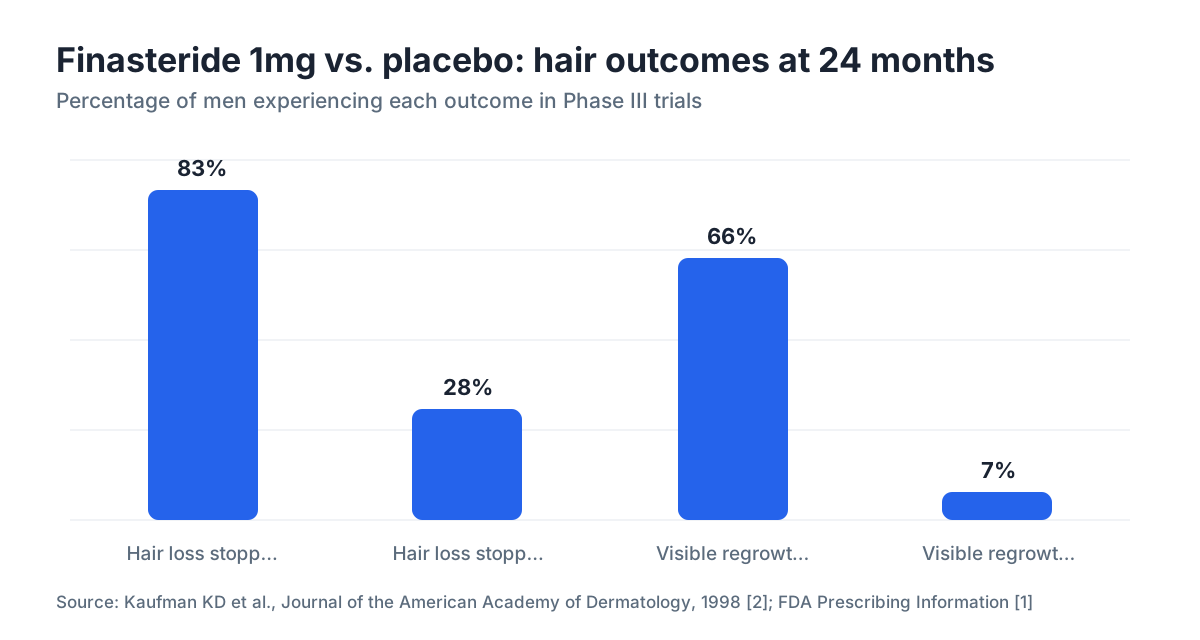
The main trials were large, randomized, placebo-controlled studies run over two years. In the two Phase III trials submitted for FDA approval, men taking finasteride 1mg daily showed a mean gain of 107 hairs per square centimeter at the vertex at 24 months, while placebo users lost ground [1]. Hair loss stopped or reversed in roughly 83% of treated men. Visible regrowth happened in about 66% [2].
A 10-year open-label extension study published in the European Journal of Dermatology followed 118 men who stayed on finasteride 1mg. At the 10-year mark, 84% still had more hair than at study baseline, and only 14% had counts below their original baseline [3]. That is unusually strong long-term data for any hair loss treatment.
| Outcome | Finasteride 1mg | Placebo |
|---|---|---|
| Hair loss stopped or reversed (2 yr) | ~83% | ~28% |
| Visible regrowth (2 yr) | ~66% | ~7% |
| Mean hair count change, vertex (2 yr) | +107 hairs/cm² | -75 hairs/cm² |
| Maintained benefit at 10 yr (open-label) | 84% | N/A |
The drug works better on the crown and mid-scalp than on the frontal hairline. Men with a receding hairline at the temples often see less there, though some frontal benefit is documented. The American Academy of Dermatology's position is that finasteride is effective for male pattern hair loss, and that men should give it at least 12 months of consistent use before judging whether it is working [4].
What are the real finasteride 1mg side effects and how common are they?
This is the part most men research hardest, and reasonably so. The FDA label lists sexual side effects including decreased libido, erectile dysfunction, and decreased ejaculate volume [1]. In the original two-year trials, these hit 3.8% of finasteride users versus 2.1% of placebo users. The drug-attributable rate was roughly 1.7 percentage points above background [1].
For most men in those trials, the effects went away after stopping the drug. A smaller subset reported symptoms that persisted after they quit, a condition sometimes called post-finasteride syndrome. The evidence here is genuinely contested. The FDA added label language in 2012 noting that some sexual side effects may persist after stopping [5]. Researchers have published case series, but no large randomized trial has pinned down a prevalence rate for persistent effects, so any figure you read comes from case reports or retrospective surveys with heavy selection bias.
Other reported side effects: breast tenderness or gynecomastia (under 1% in trials), testicular pain (rare), and in some observational reports, depression and cognitive complaints. The FDA label does not list depression as a common adverse event, but the agency has received post-marketing reports and updated the label in 2019 to include depression as a listed post-marketing reaction [5].
Here is the honest summary. Most men tolerate finasteride 1mg without noticeable side effects. The documented sexual side effect rate in controlled trials is low, though real. The persistent post-discontinuation picture is not well-characterized in terms of prevalence. If you have a personal or family history of depression, or you already deal with sexual dysfunction, raise that specifically with the prescribing clinician before you start.
Side effects are the reason many men research combination therapy. If you are weighing it against a topical, the minoxidil side effects article lays out that drug's profile for comparison.
How long does finasteride take to work, and when will you see results?
Results are slow. That is not a failure of the drug. It reflects how hair growth cycles run. A follicle that pulls out of miniaturization still has to move through a full growth cycle before new visible hair shows up, and a typical anagen cycle runs three to six years.
Most men notice less shedding within three to six months. Some see a temporary uptick in shedding in the first few months as follicles shift cycles. That happens with minoxidil too, and it does not mean the drug is failing. Real regrowth or measurable density gains usually show up around the 9-to-12-month mark. The two-year point in trials is when outcomes are formally assessed.
The AAD guideline states plainly that men should use finasteride for at least 12 months before deciding it has not worked [4]. Quitting at three months because nothing looks different yet is one of the most common mistakes men make.
Stop taking it and the benefit reverses. Studies suggest hair loss resumes within 6 to 12 months of stopping, and within 1 to 2 years most men return to the trajectory they would have been on without the drug.
Who should not take finasteride 1mg?
Women who are pregnant or may become pregnant cannot take finasteride tablets or handle the crushed powder. The drug causes abnormalities in the external genitalia of male fetuses. This is not theoretical. It is documented from animal studies and carries a Pregnancy Category X designation in the FDA label [1]. The label states that women who are or may become pregnant should not use or handle crushed or broken finasteride tablets.
Finasteride is not approved for women with female pattern hair loss either, though some clinicians prescribe it off-label to postmenopausal women who cannot get pregnant, with mixed evidence behind that. It does nothing for hair loss caused by conditions unrelated to DHT, such as telogen effluvium from nutritional deficiencies or illness.
Men with liver disease should talk to their physician, since finasteride is broken down by the liver. There is also a prostate cancer screening angle: finasteride lowers PSA (prostate-specific antigen) levels by roughly 50% after 6 months of use [1]. If you get a PSA test while on finasteride, the lab and clinician need to know, or a low reading could hide an elevated PSA that would otherwise trigger further investigation.
Does finasteride 1mg affect PSA and prostate cancer risk?
This question comes up a lot and deserves a straight answer. The Prostate Cancer Prevention Trial, a randomized study of 18,882 men, found that finasteride at 5mg cut the overall risk of prostate cancer by 24.8% compared to placebo [6]. The catch that drew attention: among men who did develop prostate cancer on finasteride, high-grade tumors (Gleason score 7 or above) appeared at a higher rate in the finasteride group.
Later analysis and a 2013 FDA review concluded this was likely a detection artifact. Finasteride shrinks prostate volume, which makes any remaining cancer easier to catch on biopsy and inflates the share of high-grade tumors found [7]. The FDA updated its label to reflect that. The current scientific consensus is that finasteride does not raise the real risk of high-grade prostate cancer.
For hair loss at the 1mg dose, the prostate cancer trial data does not map directly, since that trial used 5mg. But the PSA halving happens at 1mg too, so the screening caveat still holds. Tell your doctor you are on finasteride before any PSA test.
How does finasteride 1mg compare to minoxidil?
These are the two FDA-approved treatments for hair loss, and people compare them as if you have to pick one. You do not. Finasteride and minoxidil work through completely different mechanisms and are often used together.
Finasteride goes after the root hormonal cause of androgenetic alopecia by blocking DHT. Minoxidil is a vasodilator that stretches out the anagen (growth) phase of the hair cycle. Neither is permanent, and both need indefinite use to hold results.
Head-to-head data: a 2003 study in the Journal of the American Academy of Dermatology compared finasteride 1mg to topical minoxidil 5% over 12 months and found finasteride produced better hair count and patient-rated improvement [8]. The combination beat either drug alone in several smaller trials, and the finasteride and minoxidil article covers that evidence in detail.
Minoxidil is over the counter. Finasteride needs a prescription. Minoxidil works in both men and women; finasteride's hair loss approval is for men only. The side effect profiles differ. For men with straightforward androgenetic alopecia, many dermatologists treat finasteride as the more mechanistically logical first choice, with minoxidil added if needed.
The minoxidil for men article is a useful companion read if you are weighing the two.
What does finasteride 1mg cost, and is it covered by insurance?
Brand-name Propecia runs about $70 to $90 a month at most US pharmacies, though list prices move around. Generic finasteride 1mg is much cheaper. GoodRx and similar discount platforms typically show $15 to $35 a month for a 30-day supply, depending on pharmacy and location.
Telehealth platforms that focus on hair loss often bundle finasteride with a clinical consultation. Prices land somewhere between about $20 and $50 a month all-in, though these services vary widely in the quality of their clinical oversight.
Insurance coverage is inconsistent. Most commercial plans call finasteride for hair loss cosmetic and skip it, even though it is FDA-approved. When finasteride is prescribed for benign prostatic hyperplasia at 5mg, coverage is more common. Some FSA and HSA accounts cover prescription medications, which is worth a check.
The cost math is stark. At $20 to $35 a month, finasteride is one of the cheapest evidence-based hair loss treatments there is. Compare that to hair transplant procedures, which run $4,000 to $15,000 or more depending on graft count and the clinic.
How do you get a finasteride 1mg prescription?
In the US, finasteride is a non-controlled prescription medication, meaning a licensed physician or nurse practitioner has to prescribe it. You can get it through a primary care doctor, a dermatologist, or a urologist. Dermatologists who specialize in hair loss are the most targeted option if you have access to one.
Telehealth made this a lot easier. Several legitimate platforms let you complete an online consultation, upload photos, and receive a prescription if appropriate, without an in-person visit. The FDA has not restricted telehealth prescribing for finasteride as of mid-2025. Quality varies. Look for a platform that requires an actual clinician review (more than a questionnaire that auto-approves), that gives you a way to follow up if you develop side effects, and that is transparent about the prescribing clinician's credentials.
Want to understand the full scope of your hair loss before committing to treatment? Tools like the free AI scan at MyHairline can map your Norwood stage and show how much of the scalp is affected, which is useful context to bring to a consultation.
Finasteride does not require a specialist. A general practitioner comfortable with the drug's profile can prescribe it. The things a prescribing clinician should confirm: that the hair loss is androgenetic, that there are no liver issues or relevant drug interactions, and that you understand the PSA consideration.
Can women use finasteride 1mg for hair loss?
Short answer: not women who are pregnant or could become pregnant, and not as an FDA-approved treatment for anyone with female pattern hair loss. The FDA approval is for men.
For postmenopausal women, some dermatologists do prescribe finasteride off-label, usually at 1mg to 2.5mg daily. The evidence is mixed. A 2000 placebo-controlled trial published in the Journal of the American Academy of Dermatology found no significant difference between finasteride 1mg and placebo in postmenopausal women with female pattern hair loss [9]. Some smaller studies and clinical experience suggest possible benefit in women with elevated androgen levels.
The AAD's position is that finasteride is not recommended as a standard treatment for female pattern hair loss, though it may be considered in select postmenopausal women under specialist guidance [4].
Any woman looking at this should work with a dermatologist who has real hair loss experience, confirm her hormonal profile, and rule out other causes. The what causes hair loss article covers female hair loss causes in more depth.
What happens when you stop taking finasteride?
The effect is not permanent. Once you stop, DHT levels return to normal within about two weeks. Hair loss resumes, and most men return to their pre-treatment trajectory within 6 to 12 months. By the 12 to 24 month mark after stopping, most of the gained hair is usually gone.
Here is a common point of confusion. Men stop finasteride, notice shedding, and assume they are having a drug-related problem. Usually that shedding is just normal androgenetic alopecia resuming without the DHT blockade. It can look alarming because follicles that stayed stable for years suddenly start miniaturizing again.
There is no evidence that stopping finasteride pushes hair loss past the natural rate you would have hit without the drug. You do not end up worse than if you had never taken it. The lost benefit is the DHT blockade you had during treatment. That protection ends when the drug ends.
For men who want a longer-term structural fix, finasteride is sometimes combined with or followed by a hair transplant. The logic: finasteride stabilizes loss first, so a transplant is not undermined by continued loss in the donor and recipient zones afterward. See the hair transplant article for how that planning usually works.
Is generic finasteride 1mg as effective as Propecia?
Yes, under the FDA bioequivalence testing that governs every generic drug approval. The FDA requires generics to deliver the same active ingredient at the same dose with bioavailability within roughly 80% to 125% of the brand-name product under the same conditions [10]. In practice, most generics land within 3% to 5% of the reference drug.
The active ingredient in both is identical: finasteride. The inactive ingredients (fillers, binders, coatings) can differ, which occasionally matters for people with specific allergies, but rarely matters for efficacy.
Generic finasteride 1mg from major manufacturers went through standard FDA approval. The drug went off-patent and generics arrived widely starting around 2014. Propecia and its generics are therapeutically equivalent for hair loss.
So there is no reason to pay brand-name prices for Propecia. Generic finasteride 1mg is the same drug at a much lower cost, and cheaper medication makes it easier to stick with long-term, which matters more than which manufacturer stamped the tablet.
If cost is a concern and you want to see the full menu, the MyHairline hair loss supplements article covers non-prescription options worth understanding alongside prescription ones, though nothing OTC has the trial evidence behind finasteride.
Sources
- FDA, DailyMed label archive: Propecia (finasteride 1mg) Prescribing Information
- Kaufman KD et al., 'Finasteride in the treatment of men with androgenetic alopecia,' Journal of the American Academy of Dermatology, 1998
- Rossi A et al., long-term finasteride 1mg data reported in the European Journal of Dermatology
- American Academy of Dermatology, Hair loss diagnosis and treatment guidance
- FDA, Drug Safety and Availability communications on finasteride label updates for persistent sexual side effects and depression
- Thompson IM et al., 'The Influence of Finasteride on the Development of Prostate Cancer,' New England Journal of Medicine, 2003
- FDA, Drug Safety and Availability: 5-alpha reductase inhibitor prostate cancer review (2011-2013)
- Olsen EA et al., randomized trial of 5% topical minoxidil versus 1% and 0.1% topical finasteride for androgenetic alopecia in men, Journal of the American Academy of Dermatology, 2003
- Price VH et al., 'Lack of efficacy of finasteride in postmenopausal women with androgenetic alopecia,' Journal of the American Academy of Dermatology, 2000
- FDA, Generic Drug Facts
- Finasteride and semen parameters study, Fertility and Sterility, 2013