TL;DR: Finasteride works best when there are still living follicles to protect. Trials show it stops progression in about 87% of men and regrows some hair in roughly 66% over two years. Completely bald patches with scarred or dead follicles don't respond. The earlier you start, the more you keep.
What does finasteride actually do to a balding scalp?
Finasteride is a 5-alpha-reductase type II inhibitor. It blocks the enzyme that converts testosterone into dihydrotestosterone (DHT), the hormone responsible for shrinking genetically vulnerable hair follicles [1]. Take the 1 mg oral tablet once daily and circulating DHT drops by roughly 70% within 24 hours [2]. That removes the main chemical signal telling your follicles to miniaturize.
The follicle doesn't disappear overnight in androgenetic alopecia. It fades slowly. Each hair cycle, the growing phase (anagen) gets shorter, the resting phase (telogen) gets proportionally longer, and the hair shaft itself gets finer. Finasteride interrupts this by removing the DHT stimulus, giving miniaturized but still-viable follicles a chance to recover their anagen length.
What finasteride cannot do is resurrect follicles that have already finished that full miniaturization cycle and been replaced by fibrotic scar tissue. Once the follicle unit is gone, there's no living structure for the drug to act on. That's the core biological limit, and it's why timing matters more with finasteride than with almost any other treatment.
For a broader look at how DHT damages follicles, see our guide on dht blockers.
What do the clinical trials say about hair regrowth?
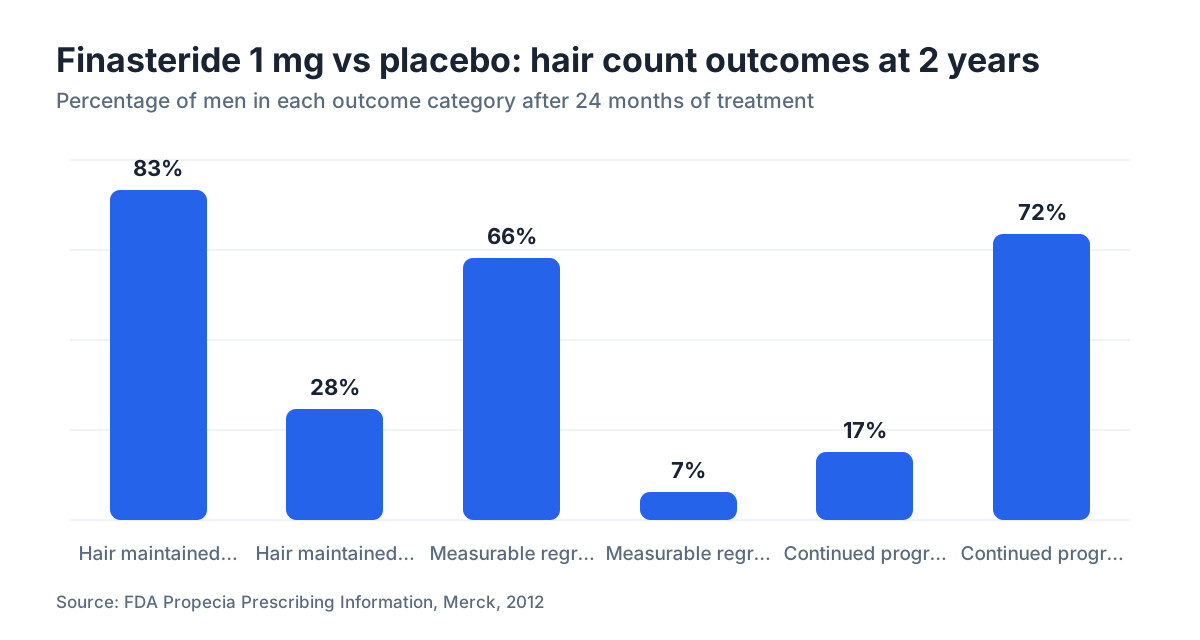
The FDA approval trials for Propecia (finasteride 1 mg) enrolled men aged 18 to 41 with mild to moderate vertex and anterior mid-scalp loss, specifically Norwood-Hamilton types II vertex through IV. After two years, 83% of men on finasteride maintained their hair count versus 28% on placebo, and 66% showed a measurable increase in hair count by standardized photographic and hair count analysis [2].
Mean hair count in the one-inch target zone rose by about 107 hairs over two years in the finasteride group versus a loss of 138 hairs on placebo. That's a swing of roughly 245 hairs in the same patch. Not invisible. Also not a full head of hair.
The five-year follow-up from the same trial program reported that 90% of men who stayed on finasteride maintained or improved their hair count, while the placebo arm kept losing [3]. The drug works over time, but the word "maintained" is doing heavy lifting in that number.
| Outcome | Finasteride 1 mg (2 yr) | Placebo (2 yr) |
|---|---|---|
| Hair count maintained or increased | 83% | 28% |
| Hair count increased (regrowth) | 66% | 7% |
| Mean hair count change (vertex) | +107 hairs | -138 hairs |
| Continued progression | 17% | 72% |
Source: Merck / FDA prescribing information for Propecia, 1997 [2].
Here's the catch. These trials excluded men with Norwood VI and VII, the stages where the top of the scalp is largely or completely bare. The evidence base for finasteride regrowing hair on long-bald crowns simply doesn't exist, because those men weren't in the studies.
Does finasteride work on completely bald areas?
Rarely, and not in the way most people hope. If the bald patch is recent, meaning the scalp has gone smooth within the last two to three years, some follicles may still be in late-stage miniaturization rather than fully dead. In those cases finasteride can occasionally reverse miniaturization enough to bring back visible hair. Dermatologists sometimes describe a faint fuzz returning on recently thinned areas in men who start early.
For areas bald for five, ten, or twenty years? The evidence gives little reason for optimism. One 48-week randomized trial in Japanese men with more advanced loss found improvements concentrated entirely on the front and mid-scalp where residual miniaturized hairs still existed, with no meaningful response in areas of dense follicle loss [4].
The practical test is simple. If you can feel fine, thin hairs on a supposedly bald area, some follicle activity likely remains. If the scalp is smooth and shiny, the follicles are almost certainly gone. A dermatologist with a dermoscope can assess follicle density in about two minutes, and that check should come before any decision about starting finasteride.
Understanding what caused the original loss helps calibrate expectations. Our guide on what causes hair loss covers the genetics and hormonal pathway in detail.
Which Norwood stages respond best to finasteride?
Norwood stages II through IV are where finasteride has the clearest, most consistent evidence. At these stages the hairline has receded and the crown has thinned, but follicle density is still measurable and a reasonable number of miniaturized follicles remain viable.
Norwood IV to V is a gray zone. Some men see meaningful stabilization and modest regrowth, particularly at the junction between thinning and bald areas. Others get mostly stabilization. The variance is wide, and factors like age at onset, rate of prior progression, and family history all shape outcomes in ways no single drug study captures cleanly.
Norwood V through VII, the stages where a large scalp area is bare, are where finasteride's regrowth potential fades sharply. Holding whatever hair remains is the realistic goal. At these stages dermatologists often describe finasteride as a holding action rather than a reversal.
If you have a receding hairline at an early stage and are weighing whether to start, the clinical data points strongly toward acting sooner. The men in the trials who did best were the ones who started with the most residual hair.
How long does finasteride take to show results?
Three to six months before any change is detectable. Much of that early window is the drug making things look temporarily worse. This is the shedding phase, where existing hairs stuck in a prolonged telogen phase get pushed out to make room for newly active anagen hairs. It scares people into quitting too early.
Real regrowth or measurable stabilization usually shows up between months six and twelve. The full effect takes about two years to judge, which is why the major trials ran to that endpoint at minimum. Stopping before two years means you never gave the drug a fair trial.
What happens if you stop? DHT returns to baseline within days. Finasteride has no lasting effect on follicles once you quit; it only works while you take it. Within six to twelve months of stopping, most men return to the trajectory they would have been on without treatment, sometimes with a rapid catch-up shed as follicles react to restored DHT.
The shedding in the first few months is different from a telogen effluvium, though they look similar. If you're losing hair in clumps and it started after a major stressor, that's worth investigating separately before you blame finasteride.
What side effects does finasteride have, and how common are they?
The FDA-approved labeling reports sexual side effects (decreased libido, erectile dysfunction, reduced ejaculate volume) in about 1.8% to 3.8% of men in the Phase III trials, versus 1.3% on placebo [2]. The absolute difference is small but real.
Post-marketing data and real-world cohort studies complicate the picture. A 2011 study in the Journal of Sexual Medicine found a small subset of men reported persistent sexual dysfunction lasting more than three months after stopping the drug, a syndrome sometimes called Post-Finasteride Syndrome, though the exact prevalence and causal mechanism remain debated in the dermatological and urological literature [5]. The FDA added a warning about this to the label in 2012.
Finasteride also carries an FDA label warning about the small but statistically significant increase in high-grade prostate cancer detection seen in the Prostate Cancer Prevention Trial (PCPT), though most urological societies read this as a detection artifact rather than a true increase in cancer risk [6]. If you have a family history of prostate cancer, raise it directly with a physician.
The drug is contraindicated in women who are or may become pregnant, because DHT is needed for normal male fetal genital development. Pregnant women should not handle crushed tablets [2].
For broader context on the treatment landscape, the finasteride overview article covers dosing, generics, and prescription considerations.
Should you combine finasteride with minoxidil for better results?
Yes, if the goal is maximum preservation and regrowth. The two drugs hit different pathways. Finasteride reduces DHT to slow miniaturization, while minoxidil extends the anagen (growth) phase and increases blood flow to follicles. They complement each other rather than overlap.
A 2015 randomized study of 450 men compared finasteride alone, minoxidil alone, and the combination. The combination group had the highest hair count increases at month twelve, beating either drug on its own [7]. The advantage wasn't huge, but it held up across several outcome measures.
The real question is tolerability. Minoxidil can cause scalp irritation, and oral minoxidil carries its own side effect profile including fluid retention and potential cardiovascular effects at higher doses. The topical 5% version is easier for most men to manage.
The finasteride and minoxidil guide walks through the combination protocol, including how to sequence them if you're starting both at once. If you want minoxidil's own risk profile, the minoxidil side effects page covers that.
For men with advanced loss where finasteride and minoxidil hit their biological limits, a hair transplant is often the only way to restore hair to bald areas. Transplants move DHT-resistant follicles from the back and sides to the top, and finasteride is often prescribed afterward to protect the existing native hair.
Does finasteride work differently for women?
This is genuinely complicated, and the honest answer is that the evidence is much thinner. The FDA has not approved finasteride for hair loss in women. The original Propecia trials enrolled men only, partly because of the pregnancy risk.
Observational studies and some smaller randomized trials in postmenopausal women suggest finasteride at 1 mg daily may slow androgenetic alopecia, and a few found modest regrowth. A 2000 trial in postmenopausal women found no statistically significant benefit over placebo at 1 mg, though some dermatologists use higher doses (2.5 mg to 5 mg) off-label in postmenopausal women and report better outcomes [8]. A Cochrane review of female pattern hair loss found the evidence for finasteride limited, with a stronger evidence base behind minoxidil for women [11].
For premenopausal women, finasteride requires strict contraception because of fetal risk, and many dermatologists reach for spironolactone as the first-line anti-androgen for female-pattern hair loss. The hormonal picture in women differs enough from men that the male trial data doesn't transfer directly.
If you're a woman researching hair loss options, understanding the causes that apply to women is the necessary first step. Minoxidil for men has some overlap with women's use, but the approved doses and formulations differ.
Is generic finasteride as effective as Propecia?
Yes. Finasteride 1 mg is finasteride 1 mg. The Propecia patent expired in 2013, and the FDA requires generic manufacturers to prove bioequivalence, meaning the active compound reaches the bloodstream at the same rate and concentration [9]. The generics contain the same active ingredient at the same dose.
The price gap is large. Brand-name Propecia runs roughly $70 to $100 a month in the US without insurance. Generic finasteride runs $10 to $30 a month, and some online prescribing services go lower. There's no clinical reason to pay the brand premium.
One caveat. Inactive ingredients (fillers, binders) differ between manufacturers, and a small number of people report different tolerability between formulations. This is anecdotal and poorly studied, but if you switch manufacturers and notice new symptoms, flag it with your prescriber.
Finasteride 5 mg (Proscar, used for BPH) is sometimes prescribed and cut into quarters to save money, dropping the monthly cost further. This is common practice but technically off-label for hair loss, and cutting the pill makes exact dosing less precise.
When should you consider a hair transplant instead of or alongside finasteride?
Finasteride and hair transplants solve different problems. Finasteride keeps living follicles alive. A transplant moves follicles from a donor site to a bald recipient site. For someone at Norwood VI or VII who is already largely bald, finasteride alone cannot restore hair to bald areas, and a transplant is the primary tool.
The combination makes real sense. A transplant without finasteride in a man with active androgenetic alopecia risks the native hair around the grafts continuing to fall out, leaving transplanted islands ringed by new bald patches. Most transplant surgeons recommend finasteride before and after surgery to stabilize the existing hair.
The best transplant candidate is usually someone who started finasteride early, kept most of their hair, and now wants to restore a specific area (often the hairline or crown). Their donor supply is intact, their remaining hair is stable, and the transplant fills a defined gap.
Transplant costs in the US typically run $4,000 to $15,000 depending on graft count and technique (FUT vs FUE). It's a single procedure with permanent results on the transplanted follicles, but it doesn't stop DHT-driven loss of non-transplanted native hair. That's finasteride's job.
If you're trying to place yourself on the loss spectrum, a free AI-powered hair analysis at MyHairline can map your pattern against Norwood staging before you talk to a surgeon or dermatologist.
What's the honest bottom line: who should take finasteride and who shouldn't bother?
Take finasteride if you're a man with androgenetic alopecia at Norwood II through IV, have been losing hair for less than five to seven years, and still have visible miniaturized hair in the thinning zones. You'll almost certainly slow the loss, and you have a fair shot at recovering some density.
Consider it if you're Norwood IV to V, you understand regrowth is a possible bonus rather than the expected outcome, and you mainly want to keep what you have. The drug is cheap and the side effect risk is real but small. The math usually favors trying.
Be realistic if you're Norwood VI or VII. Finasteride won't grow hair where no follicles remain. It can protect whatever hair is left on the sides and back, which matters if you're pursuing a transplant. Going in expecting your bald crown to fill in sets you up for disappointment.
Skip it if you're planning to father children and worry about semen quality (though studies show sperm parameters return to normal after stopping), if you have a strong personal or family reason for concern about prostate cancer detection, or if the sexual side effect risk feels unacceptable given your situation. All of those are legitimate reasons to choose a different path or simply accept the loss. The American Academy of Dermatology recommends finasteride 1 mg as a first-line treatment for men with androgenetic alopecia, but guidelines don't make decisions for individual people with individual risk tolerance [10].
For men figuring out where supplements fit, hair loss supplements covers what the evidence actually supports.
Sources
- FDA / NCBI Bookshelf: Finasteride Drug Summary
- Kaufman et al., Journal of the American Academy of Dermatology, 1998 (5-year finasteride trial data)
- Irwig MS, Journal of Sexual Medicine, 2012 (persistent sexual side effects after finasteride)
- Hu R et al., Dermatologic Therapy, 2015 (finasteride vs minoxidil vs combination RCT, n=450)
- Price VH et al., Journal of the American Academy of Dermatology, 2000 (finasteride in postmenopausal women)
- FDA: Generic Drug Facts (bioequivalence requirements)
- van Zuuren EJ et al., Cochrane Database of Systematic Reviews, 2016 (interventions for female pattern hair loss)
- Traish AM et al., Journal of Steroid Biochemistry and Molecular Biology, 2015 (Post-Finasteride Syndrome review)