TL;DR: Finasteride has two FDA-approved brand names: Propecia (1 mg, for male pattern hair loss) and Proscar (5 mg, for benign prostatic hyperplasia). Generic finasteride at 1 mg is chemically identical to Propecia and costs roughly 90% less. Both brands are made by Organon (formerly Merck). The drug works the same regardless of the label on the bottle.
What are the brand names for finasteride?
Finasteride has two FDA-approved brand names: Propecia and Proscar. That's it. Every other name you see, whether it's a telehealth company's house label or a pharmacy's store brand, is a generic version of one of those two products.
Propecia is 1 mg finasteride, approved in 1997 specifically for androgenetic alopecia (male pattern hair loss) in men [1]. Proscar is 5 mg finasteride, approved in 1992 for benign prostatic hyperplasia (BPH), the enlarged prostate condition [1]. Both were originally developed and sold by Merck. The brand rights now sit with Organon & Co. after a 2021 spinoff.
The molecule in each tablet is identical. What changes is the dose and the approved use. So when your dermatologist writes a prescription for 'finasteride 1 mg,' they're prescribing the generic equivalent of Propecia. The drug your pharmacy hands you works the same way.
For more background on how the drug itself works, see our full guide to finasteride.
What is Propecia and what is it approved for?
Propecia is the 1 mg dose of finasteride, and it's the only version with an FDA approval specifically for male pattern hair loss (androgenetic alopecia) [1]. The approval covers men only. Women and children are excluded from the label, and Propecia carries a pregnancy warning because finasteride can cause birth defects in male fetuses.
The FDA-approved prescribing information for Propecia states the drug works by inhibiting Type II 5-alpha-reductase, the enzyme that converts testosterone into dihydrotestosterone (DHT) [1]. DHT is the androgen most responsible for shrinking scalp hair follicles in genetically susceptible men. By lowering scalp and serum DHT levels by roughly 60% at the 1 mg dose [2], finasteride slows the miniaturization and, in many men, partly reverses it.
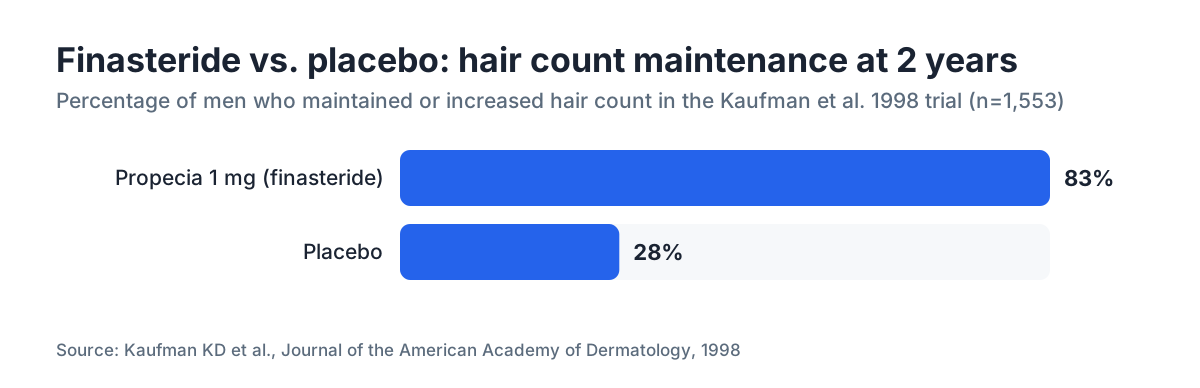
The 1998 trial published in the Journal of the American Academy of Dermatology followed 1,553 men over two years. It found that 83% of men on Propecia maintained or increased their hair count, against 28% on placebo [2]. That study is the core evidence behind the approval and the one dermatologists cite most often when they explain why they recommend it.
Propecia does not regrow all lost hair, and it does not work for everyone. The effect is most reliable at the vertex (crown) and less predictable at the temples. Stop taking it, and DHT levels climb back to normal, with hair loss resuming within 12 months for most men.
What is Proscar and how does it differ from Propecia?
Proscar is 5 mg finasteride, FDA-approved in 1992 for BPH (enlarged prostate) [1]. Urologists prescribe it to shrink prostate size and ease urinary symptoms. It's not FDA-approved for hair loss, though doctors legally prescribe it off-label for that by having patients cut the tablets into quarters.
The 'quarter a Proscar' trick was common because it could be cheaper per milligram than branded Propecia. That math has shifted now that generic finasteride is widely available at both 1 mg and 5 mg.
At 5 mg, finasteride suppresses serum DHT by about 70%, compared to roughly 60% at 1 mg [2]. The hair loss trials found no meaningful extra benefit from the higher dose for most men, which is why 1 mg became the standard. For prostate use, the deeper suppression and the effect on prostate volume do matter clinically.
One thing to know: Proscar tablets have a film coating and a score line, but splitting them into four equal pieces is genuinely hard. If you go the Proscar route for hair loss, a pill splitter helps, but the doses will drift a bit. Most dermatologists today just prescribe generic finasteride 1 mg directly, which removes the need to split anything.
To understand how DHT connects to hair loss more broadly, read our DHT blocker guide.
How much does brand-name vs. generic finasteride cost?
Brand-name Propecia is expensive relative to its generic. As of 2025, a 30-tablet supply of Propecia 1 mg runs about $70 to $100 at most retail pharmacies before insurance, depending on location and pharmacy. Generic finasteride 1 mg for the same 30-tablet supply usually costs $10 to $30 at major chains, and as low as $5 to $15 with discount cards like GoodRx [10].
Proscar 5 mg brand sits well above its generic too. The generic 5 mg tablets run roughly $15 to $40 a month retail.
Telehealth platforms (Hims, Keeps, Roman, Ro) often bundle finasteride into a subscription at $20 to $30 per month, prescription included. Those prices change often and vary by state.
Insurance coverage is inconsistent. Plans rarely cover Propecia for hair loss because it's a cosmetic indication. BPH coverage for Proscar or generic 5 mg is more common under Medicare and commercial plans. If cost is the sticking point, generic 1 mg plus a GoodRx or similar coupon is almost always the cheapest path.
| Product | Dose | Indication (FDA) | Approx. monthly cost (retail, 2025) |
|---|---|---|---|
| Propecia (brand) | 1 mg | Male pattern hair loss | $70 - $100 |
| Generic finasteride | 1 mg | Male pattern hair loss | $5 - $30 |
| Proscar (brand) | 5 mg | BPH | $60 - $90 |
| Generic finasteride | 5 mg | BPH | $15 - $40 |
| Telehealth subscription | 1 mg | Varies by state | $20 - $30 |
Is generic finasteride as effective as Propecia?
Yes. Generic finasteride 1 mg is bioequivalent to Propecia by FDA definition. The FDA requires every generic drug to demonstrate bioequivalence to the reference brand, meaning the active ingredient is absorbed at the same rate and to the same extent within accepted statistical limits [3]. The active molecule is identical. There's no pharmacological reason to pay more for the brand name.
The only caveat is inactive ingredients (fillers, binders, coatings), which can differ between manufacturers. For almost everyone this makes zero practical difference. A small number of people react to specific excipients, but that's rare and not specific to finasteride.
Some men report subjective differences after switching from one generic maker to another. Controlled data on this for finasteride specifically doesn't exist. The closest analogy is the broader generic drug literature, which consistently shows equivalent clinical outcomes across therapeutic categories [4].
If you're on Propecia and your pharmacy switches your generic manufacturer (this happens when a chain's wholesaler changes suppliers), the tablet may look different. That doesn't mean the drug behaves differently. The FDA bioequivalence standard applies to every approved generic no matter who makes it.
Buy the generic. The brand name buys you a more expensive pill and nothing else.
Can women use Propecia or generic finasteride for hair loss?
Women cannot use Propecia. The FDA label explicitly excludes women, and the drug carries a Pregnancy Category X designation, meaning it's contraindicated in pregnant women because animal and human evidence shows a risk of abnormal development of male fetal genitalia [1].
For women with androgenetic alopecia (female pattern hair loss), dermatologists sometimes prescribe finasteride off-label, but only for women who are postmenopausal or who cannot become pregnant and use reliable contraception. This isn't a label-sanctioned use, and the evidence base for women is thinner than for men.
The American Academy of Dermatology's hair loss guidelines acknowledge off-label finasteride use in certain women but stop short of the recommendation strength they give it for men [5]. If you're a woman dealing with hair loss, minoxidil (topical or oral) is the better-studied first-line option. See our piece on what causes hair loss for how female and male pattern loss differ.
Women who handle broken Propecia or finasteride tablets should wear gloves. The FDA label calls this out because the drug can absorb through skin [1].
What are the side effects of finasteride, regardless of brand?
Side effects are the same whether the tablet says Propecia or carries a generic label. The molecule is the molecule.
The most discussed side effects from the FDA prescribing information for Propecia include decreased libido (1.8% vs. 1.3% placebo in clinical trials), erectile dysfunction (1.3% vs. 0.7%), and decreased ejaculate volume (0.8% vs. 0.4%) [1]. These numbers come from the two-year controlled trials. The absolute differences over placebo are small, but they're real.
Post-marketing surveillance added more to the picture. The FDA updated the label in 2012 to note that sexual side effects may persist after stopping finasteride in some men [6]. This phenomenon, sometimes called post-finasteride syndrome, is contested in the medical literature. The label change does not confirm a defined syndrome, but it does acknowledge that persistent effects have been reported.
Finasteride also lowers PSA (prostate-specific antigen) values by roughly 50% at the 1 mg dose [1]. If you're getting PSA testing for prostate cancer screening, tell your doctor you take finasteride. The lab value needs to be doubled to estimate your true PSA, or you'll look lower-risk than you actually are.
The drug carries a small but statistically noted association with high-grade prostate cancer in men taking 5 mg (the Proscar dose) in the Prostate Cancer Prevention Trial, though this finding is still debated and is not established as causal [7].
For a broader look at how to compare medication options, the finasteride and minoxidil guide covers combination approaches.
How long does finasteride take to work for hair loss?
Expect at least three to six months before you see any visible change, and 12 months before you can fairly judge whether the drug is working for you. This holds whether you take Propecia or generic finasteride. The hair growth cycle sets the timeline, not the brand.
Hair follicles cycle through growth (anagen), transition (catagen), and rest (telogen) phases. Finasteride changes the hormonal environment but can't flip follicles from one phase to another overnight. Many men go through a brief shedding phase in the first few weeks to months as the cycle resets. It can be alarming, and it's usually temporary. This is similar to the initial shed with minoxidil. For context on that process, the telogen effluvium article explains the shedding mechanism in detail.
The 1998 Kaufman et al. trial showed statistically significant improvement in hair counts at 12 months, with further gains at 24 months [2]. Most dermatologists want a minimum 12-month trial before calling the drug a failure.
Men who respond typically reach a plateau, then hold that level as long as they keep taking the drug. Stop, and DHT returns, and hair loss resumes, usually back to pre-treatment levels within 9 to 12 months.
Is finasteride available over the counter or do you need a prescription?
Finasteride, whether you call it Propecia, Proscar, or generic finasteride, needs a prescription in the United States. It's a prescription-only drug, not a scheduled controlled substance, and you can't buy it at a pharmacy without a valid prescription from a licensed provider.
Telehealth has made getting that prescription much easier. You complete an online consultation, a physician or nurse practitioner licensed in your state reviews it, and a prescription goes to a partner pharmacy or ships to you directly. This works legally in most states. It doesn't skip the prescription requirement. It just moves the consultation online.
Buying finasteride from sites that don't ask for a prescription is illegal in the US and carries real risks: counterfeit products, undisclosed ingredients, wrong doses. The FDA has warned about unapproved drugs sold online [3].
Outside the US, rules vary. In the UK, finasteride 1 mg is available from registered online pharmacies after a pharmacist consultation. In Canada, it stays prescription-only. Across Europe it depends on the country.
If you're trying to figure out where you stand before pursuing a prescription, the free AI hair analysis at MyHairline can help you identify your loss pattern and think through which options are worth raising with a dermatologist.
How does finasteride compare to minoxidil for hair loss?
These are the two most evidence-backed options for androgenetic alopecia in men, and they work through completely different mechanisms.
Finasteride (Propecia/generic) attacks the hormonal cause by blocking DHT production. Minoxidil (Rogaine/generic) works topically or orally as a vasodilator that extends the anagen (growth) phase of the hair cycle. They aren't rivals so much as partners.
A Cochrane review and several head-to-head studies suggest finasteride tends to outperform topical minoxidil for vertex hair loss in men, but the combination beats either one alone [8]. That's why combination therapy is increasingly what dermatologists recommend for men with moderate to significant loss.
Minoxidil is available without a prescription (topical versions) and is approved for women as well as men. Finasteride carries more hormonal risk considerations but has a stronger mechanism for hitting the root cause in men.
If you're weighing the tradeoffs, the minoxidil for men article breaks down the evidence. The finasteride and minoxidil guide covers combination use directly. And if you're curious about oral minoxidil, which more clinicians are using now, the oral minoxidil article covers what the current research shows.
For men where medications aren't enough, hair transplant is the surgical step many eventually consider.
What happens if you stop taking finasteride?
Hair loss resumes. Finasteride doesn't cure androgenetic alopecia. It suppresses the DHT-driven miniaturization as long as you take it. Stop, and DHT rebounds to pre-treatment levels, and the follicles that had recovered or stabilized start shrinking again.
Most men return to roughly where they'd have been without treatment within 9 to 12 months of stopping [1]. Some of the regrown or maintained hair goes fast. Other hair takes longer. The drop isn't a cliff on day one, but it's steady over time.
Understand this before you start. Finasteride is effectively a lifelong medication if you want the benefit to last. That's a real commitment, and it's worth weighing honestly, especially given the side effect profile some men run into.
If you quit because of side effects, they typically resolve within weeks to months for most men. The small subset who report persistent effects after stopping is the contested post-finasteride syndrome population. The FDA label acknowledges this but doesn't characterize it as a defined medical syndrome [6].
If cost is the reason for stopping, switch from brand to generic instead of quitting entirely. A generic prescription through a discount program often costs less per month than a streaming subscription.
Are there other drugs with similar names that people confuse with finasteride?
A few points of confusion come up regularly.
Dutasteride gets mixed up with finasteride because both are 5-alpha-reductase inhibitors. But dutasteride (brand name Avodart) inhibits both Type I and Type II, while finasteride only hits Type II. Dutasteride suppresses DHT more completely (roughly 90% vs. 60-70%) and has a much longer half-life. It's not FDA-approved for hair loss in the US, though it is approved for hair loss in South Korea and Japan and gets used off-label by some dermatologists here [9]. It's a different drug, not a brand name for finasteride.
Fluconazole, which sounds vaguely similar to the uninitiated, is an antifungal with no relation to finasteride.
Some compounding pharmacies sell finasteride in topical form, sometimes labeled as topical finasteride or bundled into a compounded solution with minoxidil. This isn't an FDA-approved product in the branded sense. It's a compounded preparation. The FDA does not approve compounded drugs the way it approves Propecia or generic finasteride tablets [3]. Topical finasteride has emerging evidence behind it, but it sits in a different regulatory category.
When you see a brand name on a telehealth platform that doesn't say Propecia or Proscar, you're almost certainly looking at their house packaging of generic finasteride 1 mg. The underlying drug is the same.
How should you decide between Propecia, Proscar, and generic finasteride?
For hair loss in men, the practical answer for almost everyone today is generic finasteride 1 mg. It's bioequivalent to Propecia at a fraction of the cost, widely available, and the standard prescription most dermatologists write.
Brand-name Propecia makes sense only if your insurance covers it specifically and the copay comes in below the generic cash price, which is unusual but possible under some plan structures. Outside of that, paying extra for the Propecia label buys you nothing pharmacologically.
Proscar (5 mg) or its generic, cut into quarters, is a route some men take to trim costs further when generic 1 mg tablets are pricey in their area. The math can work, but splitting accuracy is imperfect and the 5 mg tablet isn't labeled for hair loss. Most dermatologists now find it simpler to write for 1 mg generic directly.
For women or anyone exploring off-label finasteride use, the conversation belongs with a physician. This is not a medication to self-prescribe or self-adjust. The hormonal effects are real and need clinical context.
If you're trying to assess your hair loss stage before starting any treatment, the receding hairline guide can help you place yourself on the Norwood scale, which in turn frames the conversation with your doctor about whether medication, surgery, or both make sense. Early in the research process, the what causes hair loss and hair loss supplements articles round out the picture on what evidence-based options actually exist beyond prescription medications.
Sources
- FDA, Propecia (finasteride) prescribing information
- Kaufman KD et al., Journal of the American Academy of Dermatology, 1998, Finasteride in the treatment of men with androgenetic alopecia
- FDA, Generic Drug Facts
- Kesselheim AS et al., JAMA, 2008, Clinical equivalence of generic and brand-name drugs used in cardiovascular disease
- American Academy of Dermatology, Hair loss: Diagnosis and treatment guidelines
- FDA MedWatch Safety Labeling Changes, Propecia 2012 label update
- Thompson IM et al., New England Journal of Medicine, 2003, The Influence of Finasteride on the Development of Prostate Cancer
- van Zuuren EJ et al., Cochrane Database of Systematic Reviews, 2016, Interventions for female pattern hair loss
- Eun HC et al., Journal of the American Academy of Dermatology, 2010, Efficacy, safety, and tolerability of dutasteride 0.5 mg once daily in male patients with male pattern hair loss
- GoodRx, finasteride pricing data