TL;DR: Generic finasteride 1 mg (for hair loss) costs roughly $10, $30 for a 30-day supply at major US pharmacies when you use a GoodRx coupon, down from a typical cash price of $40, $80. Prices vary by pharmacy and zip code. GoodRx is free to use and requires no insurance. The drug itself is FDA-approved for male pattern hair loss at 1 mg daily.
What does finasteride actually cost without insurance?
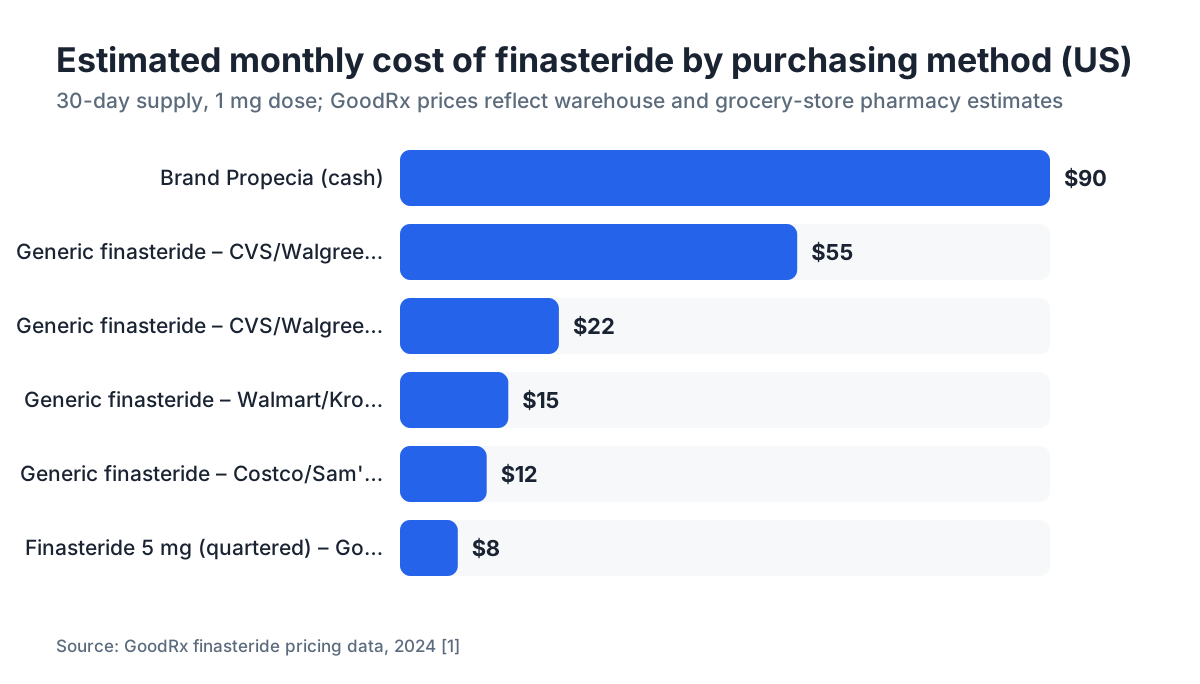
Cash prices for generic finasteride 1 mg (30 tablets) at major US pharmacies run roughly $30, $80 without any coupon or insurance, depending on your location and which chain you walk into. Brand-name Propecia is almost never worth paying for. The active molecule is identical to the generic, and the FDA requires bioequivalence, so you're paying a steep markup for a name. At the time of writing, GoodRx shows cash prices at Costco as low as $10, $15 for a 30-day supply, while CVS and Walgreens typically list higher before the coupon is applied [1].
The variation between pharmacies surprises most people. A Walmart or Kroger pharmacy in the same zip code can be 40 to 60% cheaper than a standalone CVS for the exact same drug and dose. GoodRx aggregates those negotiated rates and surfaces the cheapest ones near you, so it genuinely pays to check before you fill.
For context on what you're treating: finasteride for hair loss works by blocking the conversion of testosterone to DHT, the hormone most responsible for shrinking follicles in androgenetic alopecia. If you want the full mechanism explained, the finasteride overview covers it in depth, and DHT blocker explains why DHT specifically matters.
How much does GoodRx lower the price of finasteride?
GoodRx coupons typically reduce the retail price of generic finasteride 1 mg by 60 to 80% at most major chains [1]. That brings a $50 cash price down to roughly $10, $20 in many markets. The savings are real because GoodRx has negotiated contracts with pharmacy benefit managers (PBMs), and those contracted rates are sometimes lower than what your insurance copay would be anyway.
Here's how the mechanics work. GoodRx is not insurance. It's a coupon service that contracts with PBMs to offer pre-negotiated prices. When you present the coupon (digital or printed) at the pharmacy counter, the pharmacist runs it through the PBM instead of your insurance. You pay the lower negotiated rate directly. The pharmacy still gets paid. GoodRx earns a small fee from the PBM on each transaction.
One practical note: you cannot use GoodRx simultaneously with Medicare Part D for the same prescription. Federal law prohibits combining a manufacturer coupon or third-party discount with federal insurance benefits. If you're on Medicare, check your plan's formulary first before assuming GoodRx is the better deal [2].
The cheapest pharmacies for finasteride with GoodRx coupons are generally warehouse clubs (Costco, Sam's Club) and grocery-store chains (Kroger, Publix, Walmart). Chain drugstores (CVS, Walgreens, Rite Aid) tend to price higher even after the coupon, though this varies by market.
How do you actually use a GoodRx coupon at the pharmacy?
Go to GoodRx.com or the GoodRx app, type "finasteride," select the 1 mg dose and a 30-tablet quantity, and enter your zip code. The site returns a ranked list of nearby pharmacies with their estimated prices after the coupon. Pick the lowest price that's convenient.
You don't need to print anything. On mobile, you show the pharmacist the coupon code on your screen. On desktop, you can print or text yourself the code. When you're at the counter, tell the pharmacist you have a GoodRx coupon before they ring it up, because once a transaction is processed under your insurance, reversing it takes extra steps.
The coupon has a BIN number, a PCN number, and a group code. The pharmacist enters those into the same system they use for insurance cards. The price GoodRx shows online is an estimate; the actual price at the register is sometimes a dollar or two different. It's almost always lower, occasionally the same.
If the pharmacist says the price didn't change, ask them to confirm they entered all three codes. Some older pharmacy systems have quirks. Costco's pharmacy in particular sometimes requires you to specifically say you're not a member and using a third-party coupon, since their member pricing can be competitive on its own.
Is finasteride FDA-approved for hair loss, and what dose do you need?
Yes. The FDA approved finasteride 1 mg (marketed as Propecia) for male pattern hair loss (androgenetic alopecia) in 1997 [3]. The approved dose is 1 mg once daily. Finasteride 5 mg tablets (marketed as Proscar) are FDA-approved for benign prostatic hyperplasia (BPH), not hair loss, though some prescribers do prescribe the 5 mg and have patients cut the tablets, which reduces cost further but is off-label.
The FDA label for finasteride 1 mg states the drug is for use in men only. It is not approved for women or children. The label notes that women who are pregnant or may become pregnant should not handle crushed or broken finasteride tablets because the drug can be absorbed through skin and cause abnormalities in a male fetus [3].
Clinical trial data from the original Merck approval studies found that 83% of men taking 1 mg finasteride daily maintained or increased hair count at two years, compared with 28% on placebo [4]. Hair regrowth was seen in about 66% of treated men. Those numbers come from the Merck trials submitted to the FDA and are the most-cited figures in the literature, though real-world results vary and not everyone responds.
Finasteride is prescription-only in the United States. You need a licensed provider to write the script before you can fill it anywhere, including at the pharmacies GoodRx covers.
Where can you get a finasteride prescription without an expensive office visit?
Traditional dermatology visits for a hair loss consultation can run $150, $400 out of pocket if you're uninsured or if hair loss isn't covered. Telehealth has changed this significantly. Several platforms now offer a provider consultation, a prescription if appropriate, and sometimes mail-order fulfillment for $20, $35/month all-in.
If you want to use GoodRx specifically, the path is: (1) get a prescription from any licensed provider (in-person dermatologist, primary care doctor, or telehealth service), (2) take that paper or electronic prescription to whichever pharmacy GoodRx shows is cheapest near you, and (3) apply the coupon at pickup. You're not locked into any particular pharmacy or service.
Some telehealth platforms write you a prescription you can take anywhere, while others only send it to their own mail-order pharmacy. If cost is your priority, ask before you sign up whether you can transfer the prescription to a local pharmacy of your choice.
For men who are deciding between finasteride and minoxidil or thinking about combining them, the finasteride and minoxidil article covers the evidence on using both together. The short version: most studies show combining them outperforms either alone, and there's no known pharmacological interaction that makes them unsafe together.
What are the real side effects of finasteride you should know before filling?
The FDA label lists sexual side effects as the primary concern: decreased libido, erectile dysfunction, and decreased ejaculate volume, each occurring in roughly 1 to 2% more men on finasteride than on placebo in the clinical trials [3]. Those numbers are often misquoted upward by online forums; the actual trial-reported rates are low, though individual experience varies and the internet naturally amplifies negative outcomes.
Post-finasteride syndrome (PFS) is a contested condition in which some men report sexual, neurological, and psychological symptoms that persist after stopping the drug. The FDA updated the finasteride label in 2012 to include mention of persistent sexual side effects after discontinuation [3]. The prevalence and causation of PFS remain genuinely debated in the medical literature. The Propecia-specific prescribing information is the primary regulatory document on this.
Finasteride also carries a black box warning in the 5 mg (Proscar) form related to prostate cancer detection: it can reduce PSA levels by roughly 50%, which may affect prostate cancer screening interpretation. At the 1 mg hair loss dose, PSA reduction is also observed. Any man over 50 or with prostate cancer risk factors should let their urologist know they're taking finasteride before a PSA test [3].
Rare reports of male breast tenderness or enlargement (gynecomastia) appear in post-marketing data. These are uncommon. Depression has also appeared in post-marketing reports, and the 2012 label update mentions it [3].
If you're also considering topical treatments, the minoxidil side effects article covers what to expect from the other main hair loss drug, since many men use both.
How does finasteride compare to other hair loss options on cost and effectiveness?
The table below compares the main evidence-based hair loss treatments on monthly cost, mechanism, and the strength of evidence behind them.
| Treatment | Est. monthly cost (US) | FDA-approved for hair loss | Evidence level |
|---|---|---|---|
| Generic finasteride 1 mg (GoodRx) | $10, $25 | Yes (men) | Strong: multiple RCTs [4] |
| Generic minoxidil 5% topical | $10, $20 | Yes (men and women) | Strong: multiple RCTs |
| Oral minoxidil 2.5 to 5 mg | $15, $35 | Off-label (pill form) | Growing: several controlled trials [5] |
| Brand finasteride (Propecia) | $70, $100+ | Yes (men) | Same molecule as generic |
| Dutasteride 0.5 mg | $20, $50 | Off-label in US | Strong for BPH; hair loss RCT data exists [6] |
| Hair transplant (one-time) | $4,000, $15,000 | N/A (surgery) | High for coverage; doesn't stop ongoing loss |
| Supplements/biotin | $10, $40 | No | Weak; no large controlled trials |
Finasteride wins on cost-per-evidence-point. No other intervention at $15/month has a 20-year track record in controlled trials. The catch is it only works while you're taking it. Stop the drug and DHT levels return to baseline within about two weeks, and the hair you retained begins to shed again over the following months [4].
For men who want to understand the broader picture of what's driving their hair loss before deciding on a treatment, what causes hair loss is a useful primer. And if you're specifically dealing with a receding hairline, receding hairline covers which Norwood stages tend to respond best to medical treatment.
Can women use finasteride for hair loss, and can GoodRx help?
Finasteride is not FDA-approved for hair loss in women. The FDA label explicitly states the drug should not be used by women, particularly those of childbearing potential, due to teratogenicity risk. Some dermatologists do prescribe it off-label for postmenopausal women with androgenetic alopecia, and there is modest trial data supporting modest efficacy in this population, but it's not the standard first-line recommendation [7].
For women with hair loss, minoxidil 2% or 5% topical is the only FDA-approved topical treatment. If you want to explore what's right for your situation, minoxidil for men explains the product category (much of the mechanism applies to women too, though the approved concentrations differ).
If a provider does write an off-label finasteride prescription for a woman, GoodRx coupons work the same way regardless of the patient's sex. The coupon applies to the drug, not the indication. Cost would be the same as for men.
Does GoodRx work for the 5 mg finasteride tablet used for hair loss?
Some prescribers write for finasteride 5 mg (the BPH dose, sold as Proscar) with instructions to cut each tablet into fourths, effectively giving a roughly 1.25 mg dose at much lower cost. This is off-label for hair loss but widely practiced and discussed in dermatology. The pill-splitting approach can bring the effective cost of a hair-loss dose down to $5, $10/month.
GoodRx coupons absolutely apply to finasteride 5 mg tablets. Because 5 mg is a far more commonly dispensed dose (the BPH patient population is large), pharmacies buy it in higher volume, and the per-tablet cost is lower. A 30-count bottle of 5 mg tablets with a GoodRx coupon at warehouse pharmacies sometimes prices under $10, meaning 120 days of hair-loss doses for under $10 [1].
The downsides of pill-splitting: tablet splitting introduces dose variability (a home pill splitter is imprecise), and the FDA label specifically applies to intact tablets. Discuss this option with your prescriber if cost is a barrier to sticking with treatment.
What should you watch for when comparing GoodRx prices month to month?
GoodRx prices are not locked in. The negotiated rates it shows can change when the underlying PBM contracts are renegotiated. A pharmacy that was cheapest in January may not be cheapest in July. It takes about 30 seconds to re-check before each refill, and it's worth doing.
Generic drug prices also shift with the number of manufacturers in the market. Finasteride has many generic manufacturers now, which generally keeps the price low, but consolidation or manufacturing issues (as happened with many generics during COVID-19 supply disruptions) can cause temporary spikes. The FDA's drug shortage database tracks these in real time if you want to verify [8].
If you're filling a 90-day supply instead of 30-day, the savings per tablet are usually better. Many mail-order pharmacies (including those affiliated with large PBMs) offer 90-day fills at a lower per-day cost. GoodRx also has a mail-order option (GoodRx Gold or partnerships with specific pharmacies) that competes. Run the per-tablet math before defaulting to monthly pickups.
Myhairline.ai offers a free AI hair analysis if you want a clearer picture of where your hairline stands before committing to a long-term medication. Knowing your approximate Norwood stage helps you have a better conversation with your prescriber about whether finasteride alone is likely to be enough.
Is buying finasteride online from international pharmacies a real alternative to GoodRx?
This comes up constantly. Canadian and international online pharmacies advertise finasteride at low prices, and the drug is often available without a prescription in some countries. The risk is real: the FDA has no jurisdiction over drugs manufactured and dispensed outside the US, and counterfeit or subpotent finasteride tablets exist in the international mail-order space. The FDA's own guidance warns consumers about the risks of buying prescription drugs from unverified international sources [9].
The practical reality is that generic finasteride in the US, with a GoodRx coupon at a warehouse pharmacy, is already $10, $20/month. The cost argument for going international is weak when the domestic price is that low. If your prescriber has written you a legitimate US prescription, use it at a US pharmacy and take the GoodRx discount. The risk-adjusted math strongly favors the legal domestic option.
For men who are dealing with hair shedding that feels more sudden than typical gradual thinning, it's worth ruling out telogen effluvium before starting finasteride. TE is a temporary shedding condition that finasteride won't fix, and treating the wrong diagnosis wastes money and time.
How long does finasteride take to work, and how do you know if it's working?
Most dermatologists say give finasteride at least 12 months before making a judgment call on whether it's working [4][7]. The hair growth cycle means that even if the drug is suppressing DHT effectively from day one, you won't see density changes in the mirror for 6 to 9 months. The first visible sign is often that shedding slows. Many men read that as the drug failing. It's usually the opposite.
The original Merck clinical trials measured outcomes at 1 and 2 years. At one year, about 48% of men showed some improvement in hair count versus baseline; at two years that rose to 66% [4]. So a meaningful proportion of the benefit comes in the second year. Stopping at month four because nothing is visible is a common and costly mistake.
Photography is your best tool. Take standardized photos (same lighting, same camera distance, hair parted the same way) at baseline and every three months. Subjective memory of what your hair looked like is unreliable. If after 12 months there is genuinely no change and continued progressive loss, that's a reasonable point to discuss alternatives or additions with your prescriber.
Combining with minoxidil is worth asking about. Minoxidil for men explains the topical options, and oral minoxidil is increasingly popular as an alternative to the foam or liquid. The oral minoxidil article covers the latest evidence on that route.
What happens if you stop taking finasteride?
Stopping finasteride means DHT levels return to pre-treatment levels within about two weeks. The hair you retained on the drug was being maintained by suppressed DHT, so once DHT rises again, follicle miniaturization resumes. Most men who stop report noticeable shedding within three to six months [4].
This is not a side effect of the drug, it's the expected consequence of removing the mechanism that was working. Finasteride is a maintenance drug. The question isn't whether to take it forever, it's whether the benefit of the hair you keep is worth the ongoing cost and any side effects you experience.
If cost was the reason you considered stopping, the GoodRx approach (generic, warehouse pharmacy, 90-day supply) gets you under $10/month in many markets. At that price point, the economic case for stopping is thin if the drug is working and you're tolerating it well.
Men who do stop and lose retained hair may eventually consider surgical restoration. The hair transplant article covers what's realistic from surgery and why most surgeons still recommend continuing finasteride after a transplant to protect non-transplanted hair.
Sources
- GoodRx, Finasteride drug pricing page
- Medicare.gov, Drug coverage (Part D)
- FDA, Propecia (finasteride) prescribing information, accessed via Drugs@FDA
- Kaufman KD et al., Journal of the American Academy of Dermatology, 1998, Finasteride 1 mg clinical trial
- Randolph M and Tosti A, Journal of the American Academy of Dermatology, 2021, Oral minoxidil for hair loss review
- Olsen EA et al., Journal of the American Academy of Dermatology, 2006, Dutasteride vs finasteride for androgenetic alopecia RCT
- American Academy of Dermatology, Clinical guidelines on androgenetic alopecia
- FDA, Drug Shortages
- FDA, Buying prescription medicine online: a consumer safety guide
- van Zuuren EJ et al., Cochrane Database of Systematic Reviews, 2016, Interventions for female pattern hair loss