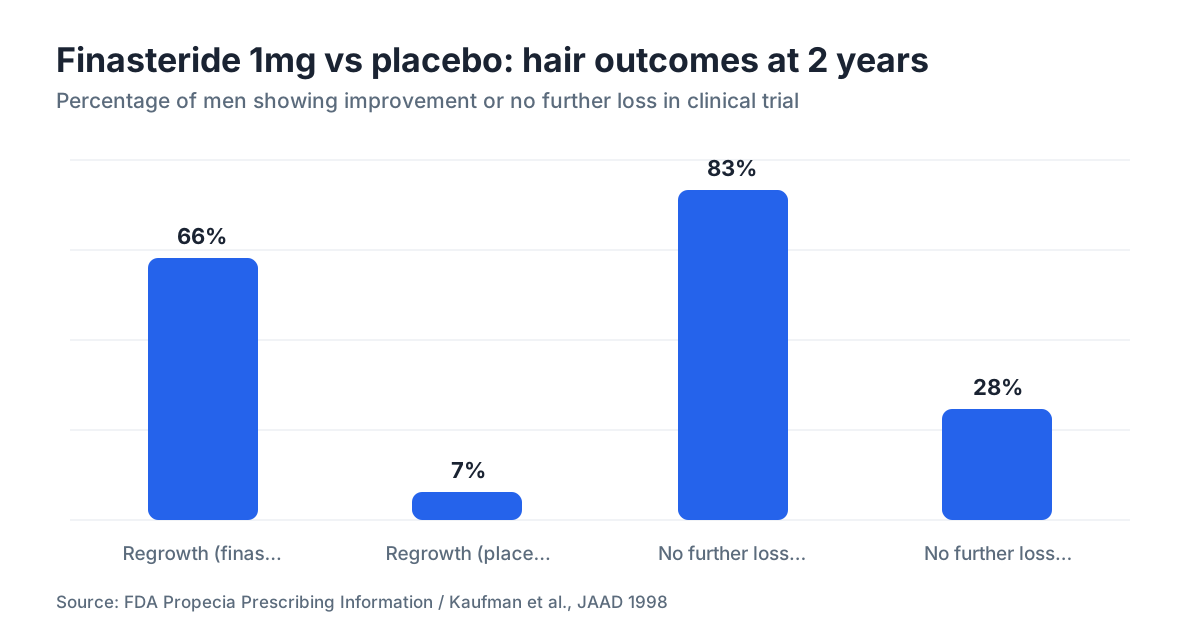
TL;DR: Finasteride 1mg is an FDA-approved oral pill that blocks DHT, the hormone that shrinks hair follicles in male-pattern baldness. About 66% of men see regrowth and around 83% stop further loss within two years. It needs a prescription, takes 3 to 6 months to show anything, and carries a small but real risk of sexual side effects that reverse in most men after stopping.
What is a finasteride pill and what does it actually do?
Finasteride is a 5-alpha-reductase inhibitor. That enzyme converts testosterone into dihydrotestosterone, or DHT, and DHT is the main driver of androgenetic alopecia, the pattern hair loss that hits the hairline, crown, and top of the scalp in genetically susceptible men. By blocking Type II 5-alpha-reductase, finasteride cuts scalp DHT by roughly 60% and serum DHT by about 70% [1].
The pill is small, white, and taken once a day. The 1mg dose is FDA-approved specifically for male-pattern hair loss under the brand name Propecia. A 5mg version (Proscar) is approved for benign prostatic hyperplasia and gets cut into quarters as an off-label money-saving trick, though the dosing precision is imperfect.
Finasteride does not grow hair out of nowhere. It removes a chemical signal that was actively killing follicles. Once that signal drops, follicles that are shrunken but still alive can shift back into a normal growth cycle. Follicles that are completely dead, where the scalp above them looks shiny and scarred, are gone for good. That is why starting earlier produces better outcomes.
Here is the mechanism in plain terms. DHT binds to androgen receptors in the dermal papilla of the follicle and shortens the anagen (growth) phase over successive cycles, until the hair produced is too fine and short to see. Finasteride interrupts that loop. It is the most direct oral treatment for this exact process, and it is why most dermatologists treat it as a first-line option for men with androgenetic alopecia [2]. For the wider picture of what causes hair loss, that DHT loop is the engine behind most male pattern thinning.
Does finasteride actually work? What do the clinical trials show?
Yes, for most men. The 5-year trial published in the Journal of the American Academy of Dermatology followed 1,553 men aged 18 to 41 with mild-to-moderate vertex hair loss. After five years, 48% of men on finasteride 1mg had increased hair count versus baseline, and 42% held their baseline count. In the placebo group, 100% of men lost hair. The authors stated that "finasteride 1mg/day was generally well tolerated and significantly more effective than placebo in maintaining and improving hair growth in men with male pattern hair loss" [3].
A separate two-year trial focused on the frontal hairline and mid-scalp showed improvement in 66% of finasteride users versus 7% on placebo, and 83% of finasteride users had no further loss [1].
Those numbers are clean but they need context. Hair-count studies use standardized macro photography of one fixed target zone, usually the vertex (top/crown). Frontal hairline results run more modest. Men receding at Norwood III or above tend to see the crown respond better than the temples. If your main worry is a receding hairline, being honest about frontal regrowth is honest medicine.
Timing matters too. You will not see meaningful change in the first three months. Most dermatologists tell patients to judge at 12 months, and the full benefit often shows up by 24. Stop taking it and the DHT suppression reverses within weeks, and most men return to their pre-treatment loss path within 9 to 12 months.
See how it stacks up against topical options in our full breakdown of finasteride and minoxidil.
What are the real side effect rates for finasteride pills?
This question stops more men from trying finasteride than any other, so the numbers deserve to be laid out plainly. The absolute risk over placebo is small, roughly 1.7 percentage points across all sexual side effects combined.
The FDA label for finasteride 1mg (Propecia) lists these sexual adverse effects from the original Phase III trials [1]:
| Side effect | Finasteride 1mg | Placebo |
|---|---|---|
| Decreased libido | 1.8% | 1.3% |
| Erectile dysfunction | 1.3% | 0.7% |
| Ejaculation disorder | 1.2% | 0.7% |
| Any sexual adverse event | 3.8% | 2.1% |
In the trial, 58% of men who had side effects saw them resolve while still on the drug. After stopping finasteride, 98% of men whose side effects had not resolved during treatment saw them clear [1].
There is an important caveat. Post-marketing reports and observational studies describe a syndrome called post-finasteride syndrome (PFS), where a subset of men report persistent sexual, cognitive, or psychological symptoms after they quit. The FDA added a label update in 2012 noting reports of decreased libido, ejaculatory disorders, and orgasm disorders continuing after the drug is stopped [4]. The true prevalence of PFS is genuinely unknown, because no randomized trial has been large enough or long enough to measure persistence after discontinuation. If you have a personal or family history of sexual dysfunction or depression, say so plainly to your prescriber before starting.
Finasteride also lowers PSA (prostate-specific antigen) values by roughly 50%, which matters if you are over 40 and your doctor uses PSA to screen for prostate cancer. Your physician needs to know you are on it before reading any PSA result [4].
Breast tenderness and, rarely, breast enlargement (gynecomastia) have been reported. The trial incidence was under 0.5%, but the FDA label lists it.
For context on DHT blockers generally, finasteride has a gentler side-effect profile than dutasteride, which blocks both Type I and Type II 5-alpha-reductase and produces more complete DHT suppression, but with a longer half-life that makes reversibility slower.
Who should and should not take finasteride?
Finasteride 1mg is FDA-approved for men only. It is not approved for hair loss in women, and it is flatly contraindicated in women who are pregnant or could become pregnant. Even handling a crushed or broken tablet carries a pregnancy risk, because the drug absorbs through skin and can cause abnormalities of the external genitalia in a male fetus [4]. The pills are film-coated to block casual skin absorption from intact tablets, but crushed tablets are a real hazard.
Good candidates for men:
- Those with androgenetic alopecia confirmed or strongly suspected (a dermatologist can confirm with a scalp exam or dermoscopy)
- Norwood stages II through V with miniaturized but not fully absent follicles in the target zone
- Men who accept that it needs indefinite use and are fine with that
- Men over 18 (it has been studied down to 18; pediatric use is not appropriate)
Men who should be cautious or may not be good candidates: those with a history of sexual dysfunction, severe depression, prostate cancer, liver disease (finasteride is processed by the liver), or anyone who has reacted badly to the drug before.
Finasteride is prescription-only in the United States. You cannot grab it off a pharmacy shelf, and the online subscription services that prescribe it still require a medical consultation, though how deep that consultation goes varies a lot by platform.
How much do finasteride pills cost and are generics as good?
Brand-name Propecia (finasteride 1mg, 30 tablets) lists around $70 to $100 a month at major US pharmacies, though almost nobody pays that with insurance or a discount program [5].
Generic finasteride 1mg is everywhere and costs far less. GoodRx and similar discount programs show prices as low as $15 to $30 a month for a 30-day supply at national chains as of 2024-2025 [5]. US generics must meet FDA bioequivalence standards, meaning the active ingredient reaches the same blood concentration within an accepted margin. There is no clinical reason to pay brand-name prices.
The 5mg tablet (Proscar or generic 5mg) costs roughly the same per pill as 1mg but holds five times the drug. Some men and prescribers split it into quarters (about 1.25mg per piece) to save money. The savings are real, sometimes $0.30 to $0.50 a day versus $1.00 a day for 1mg tablets. The catch is that tablets do not split cleanly and the dose wanders. Most hair-loss researchers see the dose-response curve as fairly flat between 1mg and 5mg, so this is common in practice even if it is not formally endorsed.
Telehealth companies (Hims, Keeps, Ro, and others) usually charge $20 to $40 a month all-in for generic finasteride with the consult bundled. These are real prescriptions. Compounded finasteride from a compounding pharmacy can go even cheaper, but compounded drugs are not FDA-approved and quality control varies.
If you want a baseline before starting anything, MyHairline's free AI scan can photograph and analyze your hairline pattern for a Norwood estimate and a record to compare against as treatment goes on.
How long does finasteride take to work and what should you expect month by month?
Month 1 to 3: Nothing you can see. DHT suppression starts within days of the first dose, but follicles run on a cycle measured in months. You are resetting the hormonal environment, not flipping a switch. Some men notice more shedding in the first 6 to 12 weeks. That is real: follicles shifting from a shortened anagen phase back toward a longer one can push out old hairs as new ones start. It is temporary and not a sign the drug is failing. If you are unsure whether shedding is finasteride-related or something else, the article on telogen effluvium explains the difference.
Month 3 to 6: The shedding settles. Some men start to see thinning areas look slightly denser or a part that looks less exposed. This is mostly the halt of ongoing loss, not dramatic regrowth.
Month 6 to 12: This is where responders see it. Hair count in the target zone rises, texture improves (miniaturized hairs thickening back toward terminal caliber), and the overall look changes for real. Clinical trials set 12 months as the primary assessment point.
Month 12 to 24: Continued gains in responders. The 5-year trial shows hair count keeps improving relative to placebo through year 2 before it plateaus somewhat, though it stays above baseline through year 5 in men who keep taking it [3].
After 5 years: Randomized data past 5 years is thin. Plenty of real-world patients have taken finasteride for 10 to 20 years and many report lasting benefit, but that is observational. The effect lives and dies with continued use.
Can women take finasteride pills for hair loss?
Finasteride is not FDA-approved for hair loss in women, and its use in women is off-label. The evidence base is genuinely thinner than in men.
For postmenopausal women with androgenetic alopecia, some studies show modest benefit at 1 to 2.5mg daily. A 2012 randomized trial in 37 postmenopausal women found no significant difference in hair counts between finasteride 1mg and placebo, though a larger trial in women with hyperandrogenism looked more promising. The American Academy of Dermatology's 2017 hair-loss guidelines list finasteride as a possible option in postmenopausal women, a Level B recommendation (fair evidence, off-label) [2].
For premenopausal women, the pregnancy risk dominates, and most dermatologists require confirmed reliable contraception. Some prescribers use 2.5 to 5mg in women with polycystic ovary syndrome or hyperandrogenism-related loss.
Bottom line for women: this is a conversation with a dermatologist who specializes in hair loss, not a call to make from internet reading alone. The risk-benefit math differs from men, and the evidence is thinner.
Does finasteride work better combined with minoxidil?
Yes. The finasteride plus minoxidil pairing is probably the most studied combination in hair loss medicine, and the two work better together than either alone.
A 2015 study in Dermatology and Therapy randomized 450 men into four groups: finasteride 1mg alone, 5% minoxidil alone, 1% minoxidil alone, and finasteride plus 5% minoxidil. After 12 months, the combination group had the greatest improvement in hair count and overall assessment scores [6].
The mechanisms complement each other. Finasteride handles the hormonal cause (DHT), while minoxidil is a vasodilator that raises blood flow to follicles and directly extends the anagen phase. Different pathways, which is why combining them adds up rather than just overlapping.
Minoxidil has its own trade-offs, especially oral versus topical. The minoxidil for men guide covers the topical side, and the oral minoxidil article covers the growing evidence for the pill, now commonly prescribed off-label at 2.5 to 5mg daily.
If you are starting fresh and your loss is moderate to severe, most dermatologists who focus on this would start both at once rather than run one, wait, and add the other later. There is no pharmacokinetic interaction between the two drugs.
What happens if you stop taking finasteride?
Here is the part that catches men who think of finasteride as a cure. It is not a cure. It is a suppressive therapy.
Within days of your last dose, your 5-alpha-reductase enzyme is no longer blocked. Testosterone-to-DHT conversion resumes. Serum DHT returns to pre-treatment levels within roughly one to two weeks. The follicles that had recovered feel the miniaturizing signal again.
Most men who stop return to their pre-treatment appearance within 9 to 12 months. Some say their hair looks worse than before they started, though the clinical literature suggests that mostly reflects the resumed loss trajectory rather than any rebound acceleration. A small number report faster-than-expected re-loss in the months after stopping; the honest answer is that this is not well characterized in large trials.
If you had a good response and stop because of a side effect, there are options worth raising with your doctor: dose reduction (0.5mg or every-other-day dosing), switching formulations, or trying topical finasteride, which delivers local scalp DHT suppression with lower systemic levels and possibly less side-effect risk.
For men eyeing finasteride ahead of surgery, the drug is often continued after a hair transplant to protect the non-transplanted native hair, since a transplant does nothing to stop ongoing loss in areas without grafts.
Topical finasteride vs oral finasteride pills: which is better?
Topical finasteride is a compounded solution (usually 0.1 to 0.25%) applied straight to the scalp. It is not FDA-approved as a standalone product in the US but is widely prescribed off-label through compounding pharmacies and some telehealth platforms.
The case for topical: it cuts systemic DHT exposure. A 2014 study found that topical finasteride 0.005% gel produced scalp DHT suppression similar to oral 1mg with much less serum DHT reduction, which points to local action with less systemic hormonal effect [7]. That matters because most proposed mechanisms for the sexual side effects involve systemic DHT suppression and possibly effects on the central nervous system.
The case for oral pills: 30-plus years of data. The efficacy is settled. They are cheaper. They take seconds to swallow. You do not have to apply a liquid to your scalp daily and wait for it to dry.
The honest picture is that oral finasteride 1mg has far more trial evidence behind it. Topical is genuinely promising and a reasonable choice for men who respond to oral finasteride but hit side effects, or who are especially worried about systemic exposure. Most dermatologists would still start with oral unless there is a specific reason not to, purely because the evidence base is so much larger.
How do finasteride pills compare to other hair loss treatments?
Here is where finasteride sits against the main alternatives:
| Treatment | Mechanism | Evidence level | Cost (monthly) | Requires Rx? |
|---|---|---|---|---|
| Finasteride 1mg (oral) | DHT blocker | FDA-approved (men) | $15-$40 | Yes |
| Minoxidil (topical 5%) | Vasodilator / anagen extender | FDA-approved (men & women) | $10-$25 | No (OTC) |
| Oral minoxidil | Vasodilator (systemic) | Off-label, growing evidence | $10-$30 | Yes |
| Dutasteride | DHT blocker (Type I + II) | FDA-approved in some countries, off-label US | $20-$50 | Yes |
| Hair transplant | Surgical redistribution | Permanent for grafts | $5,000-$15,000+ one-time | No (but surgeon required) |
| Ketoconazole shampoo | Weak anti-androgen, antifungal | Adjunct evidence only | $5-$15 | No (OTC at 1%) |
| Hair loss supplements | Varies; mostly nutritional gaps | Limited trial evidence | $20-$60 | No |
Finasteride has no over-the-counter equivalent that works the same way. Products sold as natural DHT blockers or hair loss supplements (saw palmetto, beta-sitosterol, pumpkin seed oil) carry limited and generally lower-quality evidence. A small trial found some signal for pumpkin seed oil at high doses, but effect sizes were small next to finasteride, and none are FDA-approved for this use.
For men at Norwood VI or VII with extensive loss, finasteride alone is unlikely to produce a dramatic visual change, and a conversation about surgery becomes more relevant. See the hair transplant guide for what that actually involves and costs.
How do you get a finasteride prescription and what should you tell your doctor?
You need a prescription. In the US, that means a dermatologist, a primary care physician, or a telehealth platform licensed in your state.
At a dermatologist visit, expect a scalp exam, possibly dermoscopy (a magnifier that lets the doctor read follicle miniaturization), and a walk through your personal and family hair-loss history. If the diagnosis is at all fuzzy, they may order a scalp biopsy or blood work to rule out other causes (thyroid disorders, iron deficiency, autoimmune conditions) first. A clean androgenetic alopecia diagnosis makes the prescription simple.
At a telehealth appointment, you typically submit photos and answer a questionnaire. Depth varies. Some platforms have dermatologists review cases; others use general practitioners. It is a legitimate path, but ask whether a licensed physician or dermatologist reviews your case specifically.
Tell your doctor:
- Your full medication list (finasteride interacts with some drugs)
- Your PSA history if you are over 40
- Any personal or family history of prostate cancer
- Any history of depression, anxiety, or sexual dysfunction
- Whether a partner could become pregnant and how the medication is stored in your household
If you want to track your hairline before and after with a consistent measurement, the MyHairline free AI scan gives you a standardized baseline to compare at 6 and 12 months.
The finasteride hub page covers prescribing considerations, the different formulations, and long-term monitoring in more depth if you want to read up on the clinical side before your appointment.
Sources
- FDA, Propecia (finasteride 1mg) Prescribing Information
- American Academy of Dermatology, Clinical Guidelines for Androgenetic Alopecia
- Kaufman KD et al., Journal of the American Academy of Dermatology, 1998; 5-year finasteride trial in 1,553 men
- FDA MedWatch Safety Communication, 2012 finasteride label update
- GoodRx, finasteride 1mg price comparison
- Hu R et al., Dermatology and Therapy, 2015; combination finasteride and minoxidil RCT in 450 men
- Caserini M et al., International Journal of Clinical Pharmacology and Therapeutics, 2014; topical vs oral finasteride DHT study
- FDA, Proscar (finasteride 5mg) Prescribing Information
- Mella JM et al., Archives of Dermatology, 2010; meta-analysis of finasteride efficacy
- Urysiak-Czubatka I et al., Advances in Dermatology and Allergology, 2014; pumpkin seed oil hair loss trial
- Trueb RM, Dermatology, 2004; finasteride for frontal hairline