
TL;DR: Finasteride 1 mg (Propecia) is FDA-approved for male-pattern hair loss and needs a prescription in the US. You can get one from a dermatologist, your primary care doctor, or a telehealth platform. Most online prescriptions run $15 to $50 a month for generic finasteride. Women who could become pregnant cannot take it safely.
What exactly is finasteride and why does it need a prescription?
Finasteride is a type II 5-alpha-reductase inhibitor. It blocks the enzyme that converts testosterone into dihydrotestosterone (DHT), the androgen that shrinks hair follicles in people with androgenetic alopecia. Less DHT means follicles can keep producing normal, terminal hair instead of progressively thinner vellus hair. You can read more about exactly how that works in our DHT blocker guide.
The FDA approved finasteride 1 mg tablets for male androgenetic alopecia in 1997 under the brand name Propecia [1]. It also approved finasteride 5 mg (Proscar) for benign prostatic hyperplasia in 1992. Because finasteride changes sex-hormone metabolism and carries real side-effect risks, including sexual dysfunction and, at the 5 mg dose, potential fetal harm if a pregnant woman is exposed, it is a prescription-only drug. You cannot legally buy it over the counter in the US.
That prescription step is not bureaucratic theater. The FDA label for finasteride 1 mg states that finasteride "is not indicated for use in women" and notes that the drug is contraindicated in women who are or may become pregnant because of the risk of abnormalities of the external genitalia in a male fetus [1]. That alone is reason enough for a gatekeeper.
Who actually qualifies to be prescribed finasteride?
The straight answer is adult men with androgenetic alopecia. That means the usual pattern of a receding hairline or crown thinning driven by genetics and DHT. Clinically that maps onto Norwood Scale stages 2 through 5. Finasteride works best when follicles are still miniaturizing. It does not regrow hair from scalp that is already bald.
Women are a harder case. The FDA does not approve finasteride for women, and for premenopausal women the risk to a fetus makes it a hard no. Postmenopausal women are sometimes prescribed finasteride off-label, and a randomized trial found a modest benefit in postmenopausal women with female-pattern hair loss, though the evidence base is much thinner than for men [2]. If you are a woman researching your options, your dermatologist is the right person to have that conversation with.
Some people should not take finasteride regardless of gender: anyone with a known allergy to the drug, men with certain liver conditions (finasteride is cleared by the liver), and men already dealing with sexual dysfunction they would not want made worse. Some doctors also hesitate before prescribing it to men with a strong family history of male breast cancer, since the FDA label notes a possible (not proven) association.
Age matters too. There is no good evidence for use in adolescents, and most dermatologists will not prescribe it to men under 18.
How to get a finasteride prescription from a doctor in person
The traditional route is a dermatologist visit. You book an appointment, the doctor examines your scalp, asks about family history and your current medications, and if you are a good candidate they hand you a prescription on the spot. The appointment usually runs 20 to 30 minutes. Dermatologist visits typically cost $100 to $300 out of pocket if you lack insurance, though many plans cover the visit even if they do not cover the drug.
Your primary care doctor can also prescribe finasteride. Many are comfortable with it, especially for patients they already know. The upside is convenience: if you already have a physical scheduled, bring it up then. The catch is that a generalist may be less familiar with hair loss staging and may not sort out whether you are a Norwood 3 vertex versus a Norwood 6, where finasteride alone does much less.
Bring a photo timeline if you have one. Doctors find before-and-after comparisons more useful than a single current photo, and showing that your hairline has moved over the last two or three years is stronger evidence of active loss than a static snapshot.
How does getting a finasteride prescription online actually work?
Online prescribing made finasteride much easier to get starting around 2019. The general flow across platforms like Hims, Keeps, Ro, and similar telehealth services goes like this: fill out a health intake form, upload photos of your scalp, complete a consultation (asynchronous or live) with a licensed physician or PA, and receive a prescription if approved. The process usually takes 24 to 48 hours for async review, sometimes same-day for a video visit.
The prescription is legal and valid. Online providers are real licensed practitioners writing real prescriptions under their state medical license. The pharmacy that fills it operates under normal federal and state pharmacy law. This is not a gray market. It is telehealth applied to a common dermatology need.
The intake forms ask basically what a dermatologist would ask in person. Are you male? How old? How long has your hair been thinning? Any history of liver disease, prostate cancer, or sexual dysfunction? Are you on other medications? Some platforms want scalp photos from several angles, and a few use AI-assisted image analysis to help the clinician stage your loss before reviewing the case.
One honest caution: the quality of the clinical review varies a lot between platforms. The better ones have board-certified dermatologists reviewing cases. Others lean on nurse practitioners or PAs with limited dermatology training. That is fine for a textbook androgenetic alopecia case. But if your pattern is unusual, an intake form can miss what a hands-on exam would catch, like early telogen effluvium, scarring alopecia, or a nutritional deficiency.
How much does a finasteride prescription cost, with or without insurance?
Generic finasteride 1 mg is cheap. Without insurance, a 30-day supply of generic finasteride 1 mg runs roughly $15 to $35 at most major pharmacies when you use GoodRx or a similar discount program [3]. Brand-name Propecia, which is the same molecule, still sells for $70 to $100+ a month, and there is no clinical reason to choose it over generic.
The table below shows typical total monthly costs across different prescription routes.
| Route | Consultation cost | Drug cost/month | Estimated total/month |
|---|---|---|---|
| Dermatologist (no insurance) | $100 to $300 (one-time or annual) | $15 to $35 generic | ~$25 to $60 ongoing |
| Primary care (no insurance) | $75 to $200 (one-time or annual) | $15 to $35 generic | ~$25 to $50 ongoing |
| Telehealth platform | $0 to $30/month (subscription) | $15 to $50 (often bundled) | $20 to $65 |
| Telehealth (finasteride + minoxidil combo) | Included | $30 to $75 | $30 to $75 |
Most insurance plans treat finasteride 1 mg as cosmetic (hair loss) rather than medically necessary and do not cover it. Finasteride 5 mg for BPH is more likely to be covered. Some men ask their doctor to prescribe 5 mg tablets and cut them into quarters, which delivers roughly 1.25 mg daily at a fraction of the cost. That is off-label and not officially recommended, but it is widely practiced, and the pharmacokinetics support it.
If cost is your main barrier, GoodRx coupons and Mark Cuban's Cost Plus Drugs platform (costplusdrugs.com) have both listed finasteride under $10 for a 30-day supply at various points [3].
What does the FDA label actually say about finasteride side effects?
The FDA-approved prescribing information for finasteride 1 mg lists these sexual adverse events from the original controlled trials: decreased libido (1.8% vs 1.3% placebo), erectile dysfunction (1.3% vs 0.7% placebo), and decreased ejaculate volume (0.8% vs 0.4% placebo) [1]. Those numbers come from the original 1-year trials of roughly 1,500 men. The label also notes that in a 5-year open-label extension, "the incidence of each of these adverse effects decreased to ≤0.3%."
Post-marketing surveillance added more. In 2012 the FDA required updated labeling to include reports of persistent sexual dysfunction after discontinuation (sometimes called post-finasteride syndrome or PFS), depression, and decreased libido that continued after stopping the drug [4]. The label states: "Reports of depression, breast tenderness and enlargement, hypersensitivity reactions, testicular pain, and sexual dysfunction that continued after discontinuation of finasteride have been reported in postmarketing experience" [1].
Whether finasteride causes persistent post-discontinuation symptoms is genuinely debated in the literature. Some studies suggest a nocebo effect (side effects arising partly from the expectation of them) contributes. Others argue for a real neuroactive steroid mechanism. Honest answer: the science is not settled. What is settled is that some men do report these persistent effects, which is why the FDA requires the warning [8].
Male breast cancer is another label item. The FDA notes post-marketing reports in users but states that the clinical significance of the finding is unclear. The absolute numbers are very small.
For the full picture of how finasteride works, the evidence base, and side-effect probability in more depth, the finasteride article covers all of that.
Does finasteride actually work? What do clinical trials show?
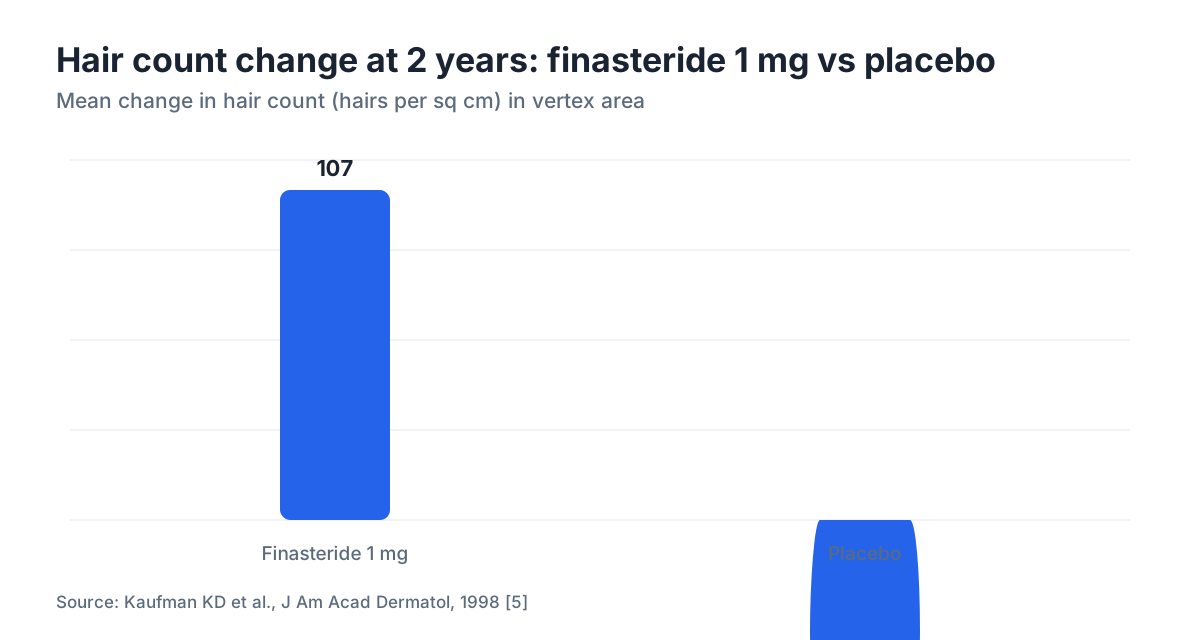
Yes. It works for most eligible men who take it consistently. The two-year randomized controlled trial published in the Journal of the American Academy of Dermatology (Kaufman et al., 1998) enrolled 1,553 men with mild to moderate androgenetic alopecia. At two years, 83% of men on finasteride 1 mg maintained or increased hair count versus baseline, compared with 28% in the placebo group [5]. Hair counts in a defined vertex area rose by a mean of 107 hairs per square centimeter in the finasteride group at 2 years, while the placebo group lost 72 hairs.
The American Academy of Dermatology (AAD) rates finasteride as a Level I recommendation for androgenetic alopecia in men, meaning it has the strongest available evidence [6].
A few caveats, honestly. Finasteride works better at the vertex (crown) than at the temples. Men who are already Norwood 5 or 6 with large bald areas should not expect much regrowth. Think brake pedal, not reverse gear. It also needs ongoing use: most men who stop lose any gained or maintained hair within 12 months.
Combining finasteride with topical minoxidil beats either drug alone [11]. Our finasteride and minoxidil article covers the combination in detail, and our minoxidil for men guide covers minoxidil as a standalone option.
What is the standard finasteride dose and how long does it take to work?
For androgenetic alopecia the dose is finasteride 1 mg once daily by mouth. Take it at roughly the same time each day. Food has no meaningful effect on absorption. No loading dose, no titration, no need for breaks.
It is slow by the standards of most medications. Most men see no noticeable change in the first three to four months. Some notice what feels like increased shedding around weeks 8 to 12. That is usually the growth cycle resetting, and it typically resolves. By month six a small share of men see early regrowth. The meaningful trial endpoints were measured at one and two years.
The AAD recommends a trial of at least 12 months before deciding finasteride is not working for you [6]. Quitting at month four because you see nothing is a common and understandable mistake, but it is genuinely premature.
If you stop, DHT levels return to baseline within about two weeks, and the protection on your follicles disappears. Hair counts usually drift back to pre-treatment levels within nine to twelve months of stopping.
Can women get a finasteride prescription for hair loss?
This is one of the most common questions, and the honest answer has a lot of nuance. The FDA has not approved finasteride for women at any dose. For premenopausal women the fetal risk is the hard blocker: if a premenopausal woman on finasteride becomes pregnant, there is a real risk of ambiguous genitalia in a male fetus. The FDA label lists this as a contraindication.
For postmenopausal women, some dermatologists prescribe finasteride off-label. A double-blind randomized trial found that among postmenopausal women with female-pattern hair loss, finasteride 1 mg daily produced a statistically significant improvement in hair density versus placebo at 12 months, though the effect was smaller than what men typically see [2]. Off-label prescribing is legal and routine in medicine. It just means the doctor is making a clinical judgment without a formal FDA indication [9].
If you are a woman dealing with hair loss, make sure the doctor rules out other causes first. Female hair loss has a broader differential than male hair loss, and what causes hair loss in women often involves iron deficiency, thyroid problems, or telogen effluvium rather than pure androgenetic alopecia.
What questions will a doctor ask before prescribing finasteride?
In person or online, expect a prescriber to work through roughly this checklist.
First, they confirm the diagnosis. Is this androgenetic alopecia or something else? They look at the pattern (vertex and frontal in men), ask about family history of baldness, and check for signs of scarring, scaling, or irregular patches that point to a different cause.
Second, they screen for contraindications. Do you have liver disease? (Finasteride is cleared by the liver.) Do you have or were you treated for prostate cancer? Are you taking anything that interacts, like other 5-alpha-reductase inhibitors?
Third, they cover the sexual side-effect risks openly, because informed consent matters here. Many doctors document that you were counseled on the libido, erectile, and ejaculatory risks and the post-discontinuation reports.
Fourth, for online consultations especially, some prescribers order a baseline PSA (prostate-specific antigen) blood test, because finasteride cuts PSA by about 50% and can mask an early prostate cancer signal if a PSA is drawn later without that context [1]. Not all platforms require this, and a dermatologist with a mostly 20s-and-30s patient base often skips it.
Last, if you are unsure where your hair loss sits on the Norwood scale, a proper read helps set expectations. You can get a baseline with a free AI hair scan at MyHairline before your consultation, which gives you concrete staging to bring to the appointment.
How does telehealth finasteride compare to seeing a dermatologist in person?
For the typical 28-year-old man with a textbook Norwood 3 vertex, telehealth is probably fine and much more convenient. The clinical call is not complicated, the drug is well understood, and getting into a dermatologist can mean a six-to-twelve-week wait in many US cities. Online prescribing cuts that to 24 to 48 hours.
Where in-person wins: atypical presentations, younger men (under 22) where the cause is less certain, anyone with other scalp conditions, or people with complex medical histories. A physical exam catches things a photo cannot, including scalp texture changes, follicular dropout patterns consistent with scarring alopecias, and swollen lymph nodes.
The cost math usually favors telehealth for straightforward cases, since many platforms fold the drug cost into a subscription. But watch for platforms that lock you into proprietary compound formulations at $60 to $80 a month when generic finasteride from a local pharmacy costs $15 to $25. The molecule is the molecule.
One thing a dermatologist gives you that most telehealth platforms do not is a complete hair and scalp exam, sometimes with dermoscopy or, in unclear cases, a scalp biopsy. If your hair loss is rapid, patchy, or you are younger than 25, the in-person visit is the better call.
What if finasteride does not work or you want other options?
About 17% of men in the two-year trial kept losing hair on finasteride [5]. If you have taken it consistently for 12 to 18 months and your loss is still progressing, there are a few directions.
Adding topical or oral minoxidil is the most common next step. Minoxidil works through a different mechanism (vasodilation and direct follicle stimulation), so the two drugs complement each other. The combination is probably the most evidence-supported medical regimen for androgenetic alopecia [11]. Our oral minoxidil article covers the growing evidence for the oral form.
For men already at Norwood 5 or 6 who want to restore density in bald areas, a hair transplant is the only option that reliably fills in bald scalp. Medical therapy and transplants are not either-or. Most surgeons recommend staying on finasteride after a transplant to protect native hair.
Dutasteride (Avodart) inhibits both type I and type II 5-alpha-reductase, versus finasteride's type II only, so it cuts scalp DHT more. It is FDA-approved for BPH but prescribed off-label for hair loss. Some evidence suggests it beats finasteride, at the cost of a somewhat higher side-effect rate.
Hair loss supplements like saw palmetto, pumpkin seed oil, and biotin get marketed hard. The evidence for them is weak to nonexistent next to finasteride. If you are eyeing supplements as an alternative, be honest with yourself about the gap in the data.
Where should you actually get your finasteride prescription?
My honest recommendation depends on your situation.
If you are under 25 or your pattern is unusual in any way, see a dermatologist in person first, at least once. The differential matters at that age, and you want someone who can examine you.
If you are a 28-to-45-year-old man with classic vertex or frontotemporal thinning and no significant medical history, telehealth is genuinely reasonable. Pick a platform that uses licensed physicians (over NPs or PAs if you can verify), shows you who is reviewing your case, and does not push you into a pricey compound product when generic finasteride works just as well.
If you already have a good primary care relationship, bring it up at your next visit. Most PCPs will prescribe it in five minutes for a healthy adult male with obvious androgenetic alopecia.
Before you go anywhere, it helps to know what stage your hair loss is at, how fast it is moving, and whether the pattern fits androgenetic alopecia or something else. A free AI hair analysis at MyHairline (myhairline.ai/scan) gives you a documented baseline and Norwood stage estimate to bring to any consultation, which makes the appointment faster and the conversation more concrete.
Whatever route you take, get there sooner rather than later. Finasteride preserves follicles. It does not resurrect dead ones. The earlier you start relative to your loss trajectory, the more you have to work with.
Sources
- Yeon JI et al., J Am Acad Dermatol 2011, Finasteride in postmenopausal women with female androgenetic alopecia
- GoodRx, finasteride pricing
- FDA Drug Safety and Availability, finasteride label update 2012
- Kaufman KD et al., J Am Acad Dermatol 1998, Finasteride 1 mg in male androgenetic alopecia, 2-year RCT
- American Academy of Dermatology, Hair loss types and treatment guidance
- Irwig MS, JAMA Internal Medicine 2012, Persistent sexual and nonsexual adverse effects of finasteride
- Fertig RM et al., Dermatology and Therapy 2017, Finasteride for female pattern hair loss
- NIH MedlinePlus, finasteride drug information
- Gupta AK and Charrette A, Skin Therapy Letter 2014, Finasteride and minoxidil combination for androgenetic alopecia