TL;DR: No shampoo cures alopecia. But a few formulas, especially ones with ketoconazole, zinc pyrithione, or minoxidil, can slow shedding, calm scalp inflammation, and support regrowth alongside proven treatments like minoxidil or finasteride. The type of alopecia you have decides which shampoo, if any, is worth your money.
What is alopecia and which types might respond to shampoo?
Alopecia is just the medical word for hair loss. It covers many different conditions, each with its own cause, and that difference matters a lot before you reach for a bottle.
Androgenetic alopecia (AGA) is the most common form, affecting roughly 50 million men and 30 million women in the United States [1]. It's driven by dihydrotestosterone (DHT) shrinking hair follicles over time. Alopecia areata is autoimmune: the immune system attacks follicles and leaves patchy loss. Seborrheic dermatitis and scalp psoriasis cause inflammatory shedding tied to yeast overgrowth or immune dysfunction. Telogen effluvium is a stress- or deficiency-triggered shed. Scarring alopecias destroy follicles for good.
Shampoos can do something useful for the first few types. For scarring alopecia, the follicles are already gone, and no topical product changes that.
Here's the honest way to think about it. A shampoo cleans the soil before you plant seeds. It makes a better environment for other treatments to work. It's rarely the treatment itself.
Do any shampoo ingredients have real evidence behind them?
Yes, but the real list is shorter than most product labels want you to believe.
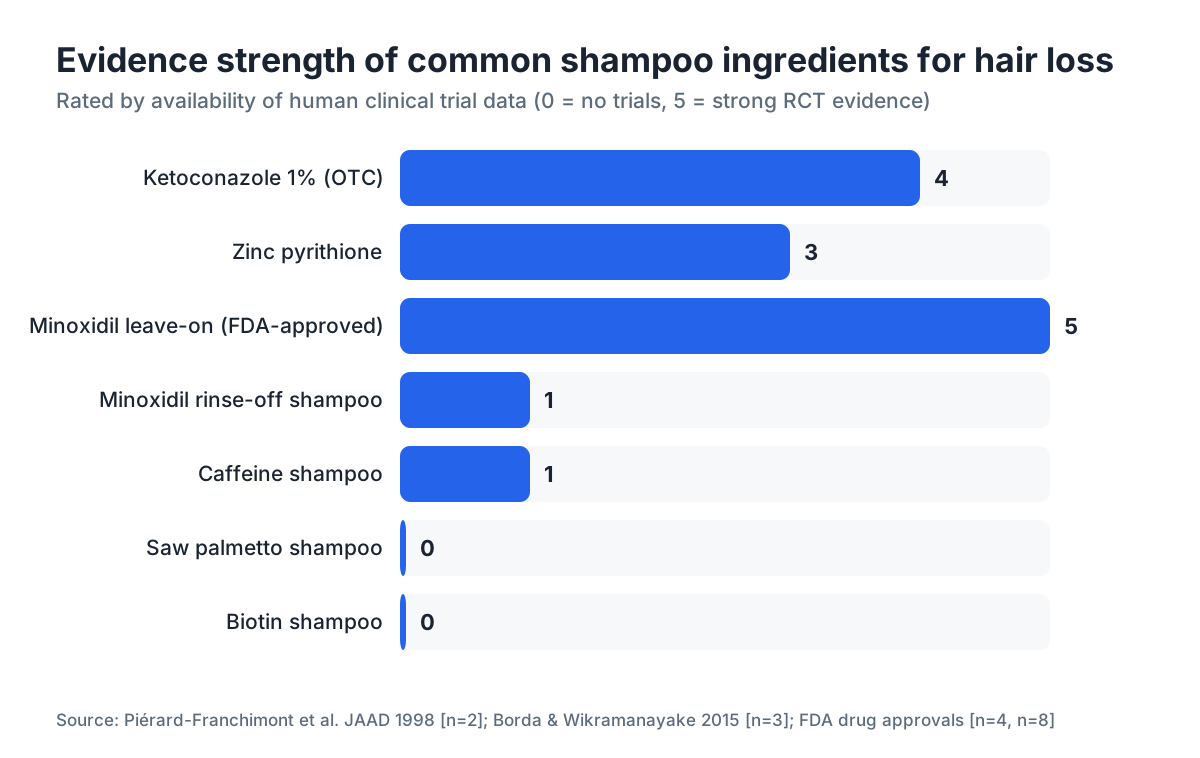
Ketoconazole has the strongest evidence. A 1998 randomized controlled trial in the Journal of the American Academy of Dermatology found that 1% ketoconazole shampoo used every 2-4 days produced hair density gains comparable to 2% minoxidil in men with AGA [2]. The mechanism is partly antifungal (it knocks down Malassezia yeast that inflames the scalp) and partly hormonal, since ketoconazole has mild anti-androgenic activity at the scalp. Prescription 2% ketoconazole shampoo (Nizoral Rx) and over-the-counter 1% versions are both sold in the US.
Zinc pyrithione works along similar lines, targeting Malassezia and calming inflammation. The evidence is thinner than for ketoconazole, but several studies show it cuts shedding in people with seborrheic dermatitis [3]. It's the active ingredient in Head & Shoulders.
Minoxidil shampoo is newer and more contested. Topical minoxidil works well as a foam or solution [4], but the shampoo form gets rinsed off fast, which raises a real question: how much active ingredient actually stays on the scalp long enough to matter? A 2022 review in Dermatologic Therapy noted that rinse-off minoxidil formulas have far less absorption data than leave-on forms, and the authors declined to recommend them as standalone treatments [5]. If you want minoxidil, the foam or solution is the better-studied route. See our guide to minoxidil for men if you're weighing the proven options.
Caffeine shampoos have some in vitro (lab dish) data showing caffeine can reach the follicle and weakly block DHT. Human trial data is sparse, and the effect sizes in the studies that exist are small. Nobody has good long-term data here.
Biotin and keratin shampoos are mostly a marketing play. Biotin deficiency does cause hair loss, but that deficiency is rare, and washing your scalp with biotin doesn't meaningfully raise serum or follicle biotin.
Saw palmetto shampoos get sold as natural DHT blockers. The ingredient has weak evidence as an oral supplement. As a rinse-off shampoo with no absorption data, there's essentially no clinical trial support.
| Ingredient | Evidence level | Mechanism | Available as OTC? |
|---|---|---|---|
| Ketoconazole 1% | Moderate (RCT data) [2] | Anti-fungal + mild anti-androgen | Yes |
| Ketoconazole 2% | Moderate (Rx) | Same, higher dose | Rx only |
| Zinc pyrithione | Low-moderate | Anti-fungal, anti-inflammatory | Yes |
| Minoxidil (leave-on) | Strong (FDA-approved) [4] | Vasodilator, prolongs anagen | Yes (2%, 5%) |
| Minoxidil (rinse-off) | Insufficient | Same mechanism, unclear absorption | Yes (some brands) |
| Caffeine | Weak (lab only) | Weak DHT inhibition | Yes |
| Biotin shampoo | No meaningful evidence | Not absorbed topically | Yes |
| Saw palmetto shampoo | No clinical trial data | Unclear topically | Yes |
Which type of alopecia responds best to shampoo treatment?
Seborrheic dermatitis-related loss is where medicated shampoos earn their keep. When Malassezia overgrowth inflames the scalp, it can push follicles into shedding early. Antifungal shampoos like ketoconazole hit that cause directly [2]. If your scalp is flaky, itchy, and greasy while your hair thins, a ketoconazole shampoo is a genuinely sensible first move.
Androgenetic alopecia responds modestly to ketoconazole, as an add-on, not a substitute. The 1998 Piérard-Franchimont trial showed a benefit, but it compared ketoconazole to minoxidil, not to placebo, and the real-world effect is smaller than minoxidil alone [2]. Treat ketoconazole shampoo as something you add to a regimen, not something that replaces finasteride or minoxidil.
Alopecia areata does not respond to ordinary shampoos. It's autoimmune. The FDA approved baricitinib (Olumiant) for severe alopecia areata in 2022 and ritlecitinib (Litfulo) in 2023, both oral JAK inhibitors [6]. No shampoo touches the autoimmune process driving the loss.
Telogen effluvium, the diffuse shed triggered by stress, illness, or nutritional gaps, usually resolves on its own once the trigger clears. A gentle, sulfate-free shampoo that won't further irritate the scalp is the smart choice. Anti-inflammatory shampoos like ketoconazole or zinc pyrithione may quiet any co-existing scalp inflammation, but they don't reverse the hormonal or nutritional cause. Our guide to telogen effluvium covers the triggers and how long it tends to last.
Scarring alopecias (lichen planopilaris, frontal fibrosing alopecia, central centrifugal cicatricial alopecia) have already destroyed follicles. No shampoo regrows those. Treatment is about slowing further destruction, usually with prescription anti-inflammatory medications.
How do you use a ketoconazole or zinc pyrithione shampoo correctly?
Most people use medicated shampoos wrong, which is a shame, because the way you apply it changes how well it works.
With ketoconazole shampoo, trials left the lather on the scalp for 3-5 minutes before rinsing [2]. Lathering and rinsing right away, the way you'd use ordinary shampoo, cuts contact time to almost nothing. Set a timer. Three minutes feels long in a shower. Do it anyway.
Frequency depends on the condition. For seborrheic dermatitis, dermatologists commonly start at 2-3 times per week, then taper to once weekly for maintenance. For androgenetic alopecia support, the Piérard-Franchimont trial used every 2-4 days [2].
You don't need a medicated shampoo at every wash. Alternating with a gentle, sulfate-free shampoo is fine and cuts the scalp dryness some people get from daily ketoconazole.
Conditioner afterward is fine. Once you've rinsed the ketoconazole out, conditioner doesn't meaningfully undercut it.
Using topical minoxidil solution too? Shampoo first, rinse, dry the scalp, then apply minoxidil. A wet scalp can dilute the minoxidil and drop absorption. If you're starting both at once, check the minoxidil side effects guide, since scalp irritation is the most common complaint and sometimes it's the shampoo, not the minoxidil, causing it.
Can women use the same alopecia shampoos as men?
Yes, with one exception. Ketoconazole and zinc pyrithione shampoos are fine for women. Both are safe in routine use, though the FDA advises anyone who is pregnant or breastfeeding to check with a physician before using ketoconazole-containing products [7].
The exception is any shampoo containing finasteride, or marketed on finasteride-based DHT claims. Finasteride is contraindicated in women who are pregnant or may become pregnant because of the risk of birth defects, specifically feminization of a male fetus [8]. Women shouldn't handle crushed finasteride tablets either, which is why the FDA requires handling warnings on the label. For women with AGA, the path looks different: topical minoxidil, spironolactone (Rx), or low-level laser are the usual options.
Female pattern hair loss tends to show up as diffuse thinning over the crown rather than a receding hairline, and the seborrheic dermatitis inflammation component is just as common in women as in men. Ketoconazole shampoo can be a useful add-on for women with AGA who also have scalp inflammation or flaking.
What's the difference between prescription and OTC alopecia shampoos?
The main difference is ketoconazole strength. OTC is 1%. Prescription is 2%. The 1998 Piérard-Franchimont trial that showed hair density gains used the 1% version, so the over-the-counter formula has trial support [2]. Whether the 2% version does meaningfully better for hair loss specifically (versus treating tinea or severe seborrhea) hasn't been settled in head-to-head hair loss trials.
Prescription shampoos can also carry ingredients like clobetasol propionate (a strong corticosteroid used for scalp psoriasis and some inflammatory alopecias) or selenium sulfide 2.5%. These aren't hair growth drugs. They control inflammatory scalp conditions that worsen hair loss if left alone.
The cost gap is real. OTC 1% ketoconazole shampoos run roughly $10-$20 a bottle. Prescription 2% versions can run $30-$100 or more without insurance. For most people with AGA or seborrheic dermatitis, starting with OTC 1% makes sense. If it hasn't helped after 2-3 months, a dermatologist visit to talk prescription options is the next step.
Generic OTC ketoconazole 1% shampoos have the same active ingredient as brand names at a fraction of the price. The FDA regulates these as drug products, not cosmetics, so the 1% concentration is standardized [7].
Are DHT-blocking shampoos a real thing?
Sort of, but mostly no.
Ketoconazole does have documented anti-androgenic effects, so it can weakly cut DHT activity at the scalp. That's part of why researchers think it helps AGA, beyond the seborrheic dermatitis angle. The effect is mild next to a DHT blocker like finasteride, which cuts serum DHT by about 70% taken orally [8].
Many shampoos sold as "DHT-blocking" lean on saw palmetto, pumpkin seed oil, or reishi mushroom extract. There's some theoretical basis, and saw palmetto has a couple of small oral studies, but as rinse-off ingredients, nobody has shown meaningful follicle-level DHT inhibition in a well-designed human trial. The FTC has acted against cosmetic companies making hair regrowth claims without adequate evidence, though the shampoo category stays a grey area because most brands carefully phrase claims as "supports hair health" rather than making drug claims.
If DHT-driven hair loss is your problem (that's androgenetic alopecia), the evidence-backed options are oral finasteride, topical finasteride, or topical minoxidil. You can read about finasteride, including how it works and what the actual risks are, or about running finasteride and minoxidil together, the combination most dermatologists consider the strongest current approach for AGA.
How long does it take to see results from an alopecia shampoo?
Plan on 3-6 months of consistent use before you'll know if a medicated shampoo is helping.
Hair follicles move slowly. The anagen (growth) phase runs 2-6 years; the telogen (resting/shedding) phase runs about 3 months. When a treatment lowers shedding or improves follicle health, the mirror won't show it for at least a full cycle, roughly 3 months on the short end [9].
The Piérard-Franchimont ketoconazole trial ran 6 months and found meaningful hair shaft diameter gains at that mark [2]. Most hair loss trials use 6-month endpoints for the same reason.
One practical note. Some people see less shedding in the first month, especially if scalp inflammation was a big driver of their loss. Inflammation settles quickly; actual regrowth takes longer. Photo documentation (same lighting, same angle, every 4 weeks) is the only reliable way to judge change without clinical trichoscopy.
No change at 6 months of steady use? A shampoo alone is unlikely to be your answer, and it's time to talk systemic or stronger topical treatments with a dermatologist. Tools like the free AI hair analysis at MyHairline can help you document your hairline over time so you have a baseline to measure against.
What ingredients should you avoid in a shampoo if you have hair loss?
Some ingredients won't cause hair loss in a healthy scalp, but they can make things worse when your scalp or follicles are already vulnerable.
Sulfates (SLS, SLES): Sodium lauryl sulfate and sodium laureth sulfate are the most common foaming agents. They're not proven to cause hair loss, but they can strip the scalp's oil barrier and leave dryness, irritation, and inflammation, which works against you when the whole point is to calm scalp inflammation. Switching to a sulfate-free shampoo for daily washing and saving medicated shampoos for treatment days is a reasonable strategy.
Formaldehyde-releasing preservatives: DMDM hydantoin, diazolidinyl urea, and quaternium-15 release small amounts of formaldehyde. There's a class action lawsuit history around these and hair loss claims, though the FDA has noted that established causation is limited [10]. If your scalp is sensitive, avoiding them costs you almost nothing.
Fragrances: Synthetic fragrance is one of the leading causes of contact dermatitis, which sparks an inflammatory scalp reaction. Inflammation damages follicles. Fragrance-free is the better bet for anyone with a sensitive scalp.
Selenium sulfide: This one is actually an active ingredient in some anti-dandruff shampoos (like Selsun Blue) at OTC strengths of 1%. It's fine for treating seborrheic dermatitis and generally safe, but it can discolor chemically treated or bleached hair. Not a hair loss driver, just a heads-up.
The safest daily shampoo for someone with hair loss is gentle, sulfate-free, fragrance-free, and pH-balanced around 5.5, close to the scalp's natural pH. Use your medicated shampoo (ketoconazole, zinc pyrithione) on treatment days and a gentle formula the rest of the time.
How does shampoo treatment fit into a complete hair loss plan?
A medicated shampoo is rarely the load-bearing part of a hair loss plan. It's a supporting player.
For androgenetic alopecia, the evidence stacks up like this. Oral finasteride and topical minoxidil sit at the top, each with decades of trial data and FDA approval [4][8]. Topical finasteride lowers systemic side effects compared with the oral form. A ketoconazole shampoo adds modest benefit on top of those. Low-level laser therapy (LLLT) holds FDA 510(k) clearance for hair loss, though trial effect sizes are modest. A hair transplant is a permanent fix for stable loss, but it won't stop ongoing miniaturization without medication running alongside it.
For seborrheic dermatitis-driven loss, the shampoo moves closer to center stage. Controlling the inflammatory trigger with ketoconazole or zinc pyrithione can resolve most of the shedding without systemic treatment.
The American Academy of Dermatology recommends that anyone with noticeable hair loss get evaluated by a dermatologist or trichologist before self-treating, mainly to confirm the type of hair loss [1]. Different causes need different treatments, and six months on the wrong one is frustrating and expensive. Learning what causes hair loss first helps you choose right.
If you're also eyeing supplements, our hair loss supplements guide lays out what the evidence actually shows for vitamins, minerals, and botanicals, which is a shorter list than most companies suggest.
What do dermatologists actually recommend for alopecia shampoos?
The AAD's patient-facing resources on hair loss treatment list topical minoxidil, finasteride, and spironolactone as the systemic options with evidence [1]. Medicated shampoos show up in the context of seborrheic dermatitis and scalp health, not as primary regrowth treatments.
In practice, plenty of dermatologists recommend ketoconazole shampoo as an adjunct for AGA patients, especially those who also have dandruff or visible scalp inflammation. The conversation usually runs: get on finasteride and/or minoxidil first, add ketoconazole shampoo if your scalp is inflamed or flaky, and don't spend real money on shampoos that haven't been tested.
A board-certified dermatologist can run a pull test, trichoscopy (scalp microscopy), and a blood panel to separate AGA from alopecia areata, telogen effluvium, iron deficiency, thyroid dysfunction, and scarring alopecias. That diagnosis changes the whole treatment. Someone with telogen effluvium from low ferritin doesn't need ketoconazole. They need to fix the ferritin.
The American Academy of Dermatology's board-certified dermatologist finder at aad.org can help you locate one, which matters, because the shampoo-and-supplement industry targets people who never got a proper diagnosis.
Sources
- American Academy of Dermatology, Hair Loss Overview
- Piérard-Franchimont C et al., Journal of the American Academy of Dermatology, 1998
- Borda LJ, Wikramanayake TC, Journal of Clinical and Investigative Dermatology, 2015 (Seborrheic Dermatitis and Dandruff review)
- FDA, Drugs (Minoxidil topical drug information)
- Ferreira Miot H et al., Dermatologic Therapy, 2022, via PubMed
- FDA, Drug Approvals and Databases: Baricitinib (Olumiant) and Ritlecitinib (Litfulo) for alopecia areata
- FDA, Drug Safety and Availability (ketoconazole OTC and safety communications)
- FDA, Drugs (Finasteride/Propecia prescribing information)
- Wise RP et al., Journal of the American Academy of Dermatology, hair follicle cycling overview
- FDA, Cosmetics (formaldehyde and formaldehyde-releasing preservatives in cosmetics)