
TL;DR: "Hair plugs" is a 1970s, 1980s technique that punched out 4 to 8mm skin grafts, leaving a doll-hair, corn-row look. Nobody reputable does it anymore. Today's procedures, FUT and FUE, move single follicular units for natural results. Costs run $4,000, $15,000 in the US. Regrowth takes 9 to 18 months. Finasteride and minoxidil are still the first step most surgeons recommend.
What were hair plugs, exactly?
"Hair plugs" was the transplant method that ran from the 1950s through the late 1980s. Surgeons used a round punch tool, typically 4 to 8 mm across, to cut circular grafts of scalp from the back of the head, then punched matching holes up front and dropped the grafts in [1]. Each graft carried 15 to 20 hairs. That sounds productive until you picture where those hairs landed: bunched into a circle of scar tissue with bare scalp between each plug. The result was the "doll's hair" or "corn row" look that made hair transplants a punchline for decades.
The biology was rough too. Large grafts have a lot of interior tissue and not much blood-supply edge, so the center of each plug often starved for oxygen while it healed. Survival was a coin flip. Scarring at the donor and recipient sites was heavy.
This wasn't quackery. It was the best tool anyone had at the time, and some patients from that era still have acceptable results 40 years on. But no accredited hair restoration surgeon punches plugs today. The word stuck around in everyday speech even after the procedure itself died out.
How do modern hair transplants differ from the old plugs?
The change came down to one idea: the follicular unit. That's a naturally occurring cluster of 1 to 4 hairs sharing a single sebaceous gland and a common tissue bundle. Move the unit intact instead of a fat punch of skin, and the whole outcome changes [2].
Two methods dominate today.
FUT (Follicular Unit Transplantation), the "strip" method. The surgeon removes a horizontal strip of scalp from the donor area (usually the back and sides, which are genetically resistant to DHT-driven loss), dissects it under magnification into individual follicular units, and places each one into a tiny incision up front. The strip leaves a linear scar, usually hidden by surrounding hair at normal lengths.
FUE (Follicular Unit Extraction). Instead of a strip, the surgeon uses a small motorized punch (typically 0.8 to 1.0 mm, far smaller than the old 4 to 8 mm plugs) to pull individual follicular units out one at a time. No linear scar. It takes longer and costs more. FUE is now the dominant technique in the US and most of Europe [3].
Both methods move grafts of 1 to 4 hairs. The recipient incisions are tiny slits made with needles or blades. Placed well, those single and double units build a hairline that reads as natural, because it copies how hair actually grows.
One more category to know: ARTAS or robotic FUE, where an image-guided robotic arm assists with extraction. Results match skilled manual FUE. Whether the robot adds anything real depends on the human surgeon running it.
Are hair plugs still done anywhere?
Rarely, and not by surgeons with mainstream credentials. Some low-cost clinics, mostly in certain medical tourism markets, still reach for larger punch grafts. Here's the tell: if a clinic quotes a transplant well below market and won't walk you through their method in detail, look harder before you book.
Legitimate surgeons certified by or affiliated with the International Society of Hair Restoration Surgery (ISHRS) or the American Board of Hair Restoration Surgery (ABHRS) haven't offered traditional plugs since the 1990s [3]. If anyone offers you something called "plugs," ask what punch diameter they use. Anything above 2 mm in the hairline zone is a red flag.
The bigger worry today isn't old-style plugs. It's unqualified providers doing FUE badly: wrong angles, wrong density, clumsy hairline design. The technique is sound. The hands running it decide everything.
What does a modern hair transplant actually cost?
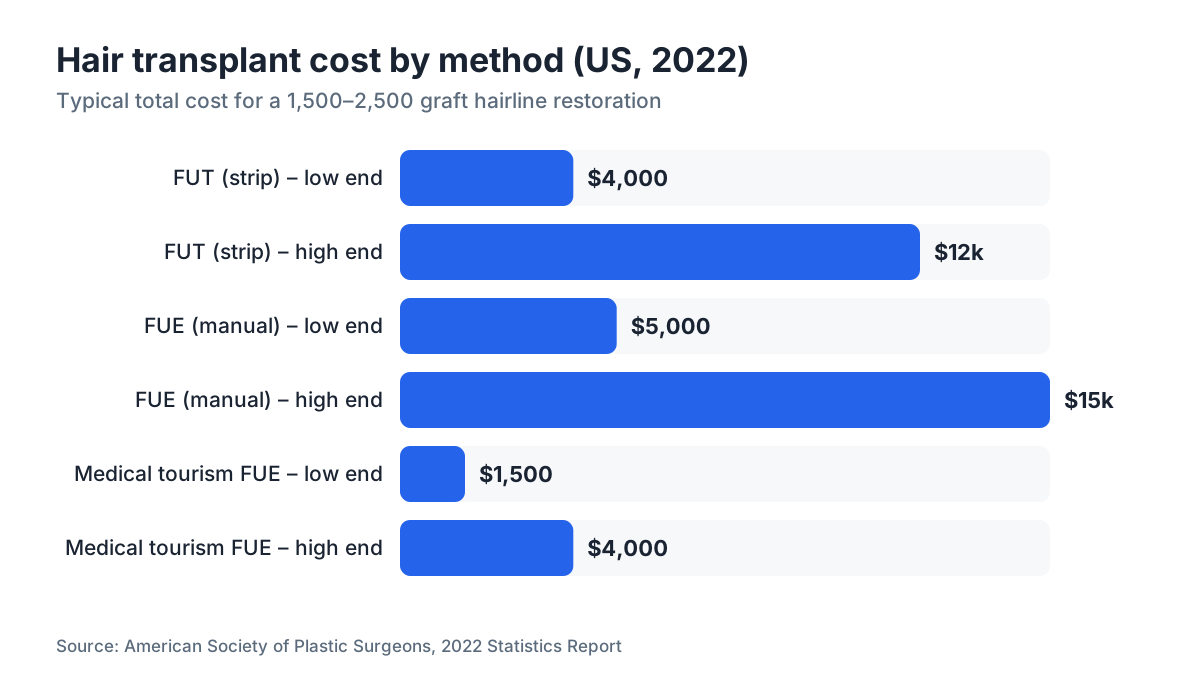
Almost everyone quotes per graft, and your total depends on how many grafts you need. Across the US, the range from the American Society of Plastic Surgeons and multiple independent surveys runs from roughly $4,000 for a small hairline job to $15,000 or more for larger sessions covering the crown and hairline together [4].
Per-graft pricing usually runs $3 to $8 in the US, with most reputable clinics between $4 and $7. A hairline restoration for a Norwood 2 to 3 pattern (frontal recession, no real crown loss) uses roughly 1,500 to 2,500 grafts. A Norwood 4 to 5 case can need 3,000 to 5,000 grafts, sometimes over more than one session.
Medical tourism to Turkey, India, or Mexico drops that number hard, often $1,500 to $4,000 all-in with hotel packages thrown in. Quality varies wildly. There are genuinely skilled surgeons abroad. There are also volume factories running 3,000-graft procedures in under three hours with technician-only teams. The ISHRS reports that a large share of the "botched transplant" revision cases its members see trace back to medical tourism [3].
Insurance almost never covers a transplant, because it's classified as cosmetic. Some practices offer financing.
| Approach | Typical US cost | Graft survival rate | Linear scar? |
|---|---|---|---|
| Old plug technique (1970s, 80s) | N/A (outdated) | Variable, often poor | Circular punches |
| FUT (strip) | $4,000, $12,000 | ~90 to 95% [5] | Yes, linear |
| FUE (manual) | $5,000, $15,000 | ~85 to 95% [5] | No (tiny dots) |
| Robotic FUE | $7,000, $15,000+ | Comparable to FUE | No |
| Medical tourism FUE | $1,500, $4,000 | Highly variable | No |
How many grafts do you need for a receding hairline?
The honest answer: it depends on your Norwood stage, your donor density, and how much of the old hairline you want back versus how low you're willing to go.
Early recession (Norwood 2 to 2A) usually takes 800 to 1,500 grafts to fill the temples and reinforce the front. Norwood 3 runs 1,500 to 2,500. By Norwood 4, with real top-of-scalp loss, a full restoration attempt often climbs past 3,000 grafts.
Here's the math patients miss: your donor supply is finite. The safe donor zone at the back and sides holds a limited number of follicles that stay DHT-resistant for life. Most people have somewhere between 5,000 and 8,000 transplantable grafts, total. Transplant 3,000 of them at 30, then progress to Norwood 6 by 50, and you may not have enough donor hair left for a second procedure.
That's why nearly every serious surgeon pushes you to stabilize your loss with medication first, check the receding hairline guide for staging help, and plan the transplant around your 20-year trajectory rather than today's snapshot.
Does a hair transplant for a receding hairline actually work?
For the right candidate, yes. A well-executed FUE or FUT with experienced surgeons typically hits 85 to 95% graft survival, meaning that share of transplanted follicles establishes blood supply and grows permanently [5]. Those hairs come from DHT-resistant donor zones, so they should keep growing in their new spot for life.
A 2020 review of hair restoration outcomes found patient satisfaction above 80% at 12-month follow-up when certified surgeons did the work [6].
The caveats are real. First, a transplant fixes where hair is missing now. It does nothing for the hair you still have that may keep falling. If you're 28, at Norwood 3, and on no medication, transplanting your hairline while you lose your crown is like painting one wall of a burning house. The surgery won't stop native follicles from shrinking.
Second, results take time. The transplanted hair sheds within the first few weeks (expected, called "shock loss"). New growth starts around 3 to 4 months. Real density shows at 6 to 9 months. Final results, hair thickened and settled, get judged at 12 to 18 months [7].
Third, hairline design is an art. A hairline placed too low, too straight, or without the right irregularity looks fake no matter how many grafts survive. Surgeon judgment matters most right here.
Should you try medication before considering a transplant?
Most credentialed surgeons say yes, and their reasoning holds up.
Finasteride (1 mg daily, brand name Propecia) is FDA-approved for male pattern hair loss. In the clinical trials submitted for approval, 83% of men taking it saw no further loss over two years, and 66% had visible regrowth [8]. It works by cutting dihydrotestosterone (DHT), the androgen that shrinks follicles in genetically susceptible men. Full breakdown at finasteride.
Minoxidil (2% and 5% topical, FDA-approved for men and women; 1 mg oral minoxidil now widely used off-label) works differently, likely by widening blood vessels around the follicle and stretching the growth phase. Dosing detail at minoxidil for men.
Running both together is common. A 2021 trial in the Journal of Dermatological Treatment found combination therapy beat either drug alone on standardized hair counts [9]. More at finasteride and minoxidil.
Medication won't bring back an already-bald patch. That's the transplant's job. But transplanting into an actively receding hairline without stabilizing the loss first is close to universally considered a bad plan. To understand what's driving your loss to begin with, start with what causes hair loss.
Myhairline.ai offers a free AI-powered hair scan at /scan for a quick visual read on where your hairline stands before you book consultations.
What are the risks and side effects of a modern hair transplant?
No procedure is risk-free. The ones that matter:
Shock loss. Transplanted hairs, and sometimes native hairs near the recipient zone, drop into telogen (resting phase) and shed in the first month or two. For most patients it's temporary, but native shock loss can occasionally be permanent if those follicles were already shrinking. See telogen effluvium for what that process looks like.
Infection. Uncommon with proper post-op care (usually a few days of antibiotic prophylaxis), and the scalp's dense blood supply works in healing's favor.
Scarring. FUT always leaves a linear donor scar. FUE leaves tiny circular dots that are nearly invisible above a #2 guard. Poor technique in either can leave worse.
Unnatural results. The most common complaint in revision cases is bad hairline design, wrong angulation (hairs pointing the wrong way), or over-harvesting the donor zone until it's thin and patchy.
Continued native hair loss. The transplanted hairs are permanent. The surrounding native ones aren't. Skip medication and you can end up with a transplanted island in a sea of thinning scalp.
Folliculitis. Small pimples or pustules as new hairs push through. Usually clears on its own or with mild treatment.
Serious complications like arteriovenous fistula, necrosis, or major infection are rare when a trained team does the work in a proper clinical setting [7].
How do you find a legitimate hair transplant surgeon (and avoid bad ones)?
Start with credentials. In the US, look for physicians certified by the American Board of Hair Restoration Surgery (ABHRS) or active in the International Society of Hair Restoration Surgery (ISHRS). The ISHRS keeps a public member directory at ishrs.org [3].
Ask pointed questions at the consult. Who makes the incisions? (Should be the physician, not a technician.) Who designs the hairline? How many grafts get extracted per hour? (Above 1,500/hr for manual FUE is often a pace where quality drops.) Can you see before-and-after photos of patients at your Norwood stage?
Be skeptical of:
- Pricing that seems impossibly low
- Guaranteed graft counts before the surgeon has even checked your donor density
- Clinics pushing you to book the day of consultation
- Results photos that all look like the same patient or use lighting rigged to maximize contrast
Medical tourism isn't automatically bad. Some surgeons in Turkey and elsewhere trained at serious programs and deliver excellent work. The trouble is the variance is enormous, and your ability to get follow-up care or handle a complication from 6,000 miles away is thin.
Get at least two or three in-person or video consults before you commit. A confident, ethical surgeon welcomes hard questions and never pressures you.
Can women get hair transplants for a receding hairline?
Women can and do get transplants, but the picture is more complicated. Female pattern hair loss usually shows up as diffuse thinning across the top of the scalp, not a Norwood-style receding front. The Ludwig scale is the more common way to stage female loss [10].
The surgical catch for women is the donor area. Female pattern loss can hit the donor zone too, so follicles taken from the back and sides might not be reliably DHT-resistant the way they are in men. Any surgeon considering a woman for transplant has to check carefully whether the donor hairs are actually stable.
For women with frontal fibrosing alopecia (a scarring hair loss condition) or a naturally high hairline they want lowered surgically, transplants can work well. Women with androgenetic alopecia get steered toward minoxidil first more often, and sometimes spironolactone or low-dose oral minoxidil.
See what causes hair loss for how the mechanisms differ between women and men. If you suspect a different cause, telogen effluvium covers the most common reversible reason for sudden shedding in women.
What happens if the hair plug or transplant result looks unnatural?
Repair is a real subspecialty. Surgeons who do transplant repair spend a big chunk of their practice fixing old plug work and poorly designed modern jobs.
For old-style plugs, options include: removing the plugs and redistributing the hairs as individual follicular units, camouflaging the plug borders with FUE grafts placed around them, or (for small areas) excising the plug tissue outright. The underlying hairs from old plugs are often still viable and can be reused.
For modern transplants with poor hairline design, revision usually means:
- Adding grafts to soften an artificially straight or low hairline
- Removing or redirecting hairs growing at wrong angles (rare, hard)
- Scalp micropigmentation (tattooing) to blend and fake density between sparse grafts
Revision costs the same or more per graft than the original, and your donor supply is now tighter. Choosing the right surgeon the first time is far cheaper than repairing the wrong one.
What's the difference between a hair transplant, PRP, and other non-surgical options?
A transplant moves donor follicles to a new spot. It's the only option that actually puts hair back where follicles are gone. Everything else either slows loss or works with follicles that still exist but are thinning.
PRP (Platelet-Rich Plasma): blood drawn, spun in a centrifuge to concentrate growth factors, then injected into the scalp. Evidence is mixed. A 2019 meta-analysis in the Journal of Cosmetic Dermatology reviewed 11 randomized controlled trials and found statistically significant density gains versus baseline, but called for larger, standardized trials before firm conclusions [11]. It costs $1,500 to $3,500 per session, usually 3 to 4 sessions a year. It does not regrow hair in bald areas.
Low-level laser therapy (LLLT): FDA-cleared (not FDA-approved as a treatment, a meaningful difference) devices like the HairMax laser cap stimulate follicles that are still in a growth phase. Evidence is modest. Fine as an add-on, weak as a standalone.
DHT blockers and supplements: saw palmetto has some evidence as a mild DHT blocker, far weaker than finasteride. The dht blocker article covers what the evidence really shows. For supplements in general, read the hair loss supplements guide before you spend money on over-the-counter products.
The most evidence-backed non-surgical stack is still finasteride plus minoxidil. For safety information before you start, minoxidil side effects covers the documented risks.
Want a clear picture of your current hairline before you choose anything? Myhairline.ai's free AI scan at /scan helps you track and document your baseline.
Sources
- Bernstein RM, Rassman WR. Follicular Transplantation, International Journal of Aesthetic and Restorative Surgery, 1995
- American Academy of Dermatology, Hair loss: Diagnosis and treatment
- International Society of Hair Restoration Surgery (ISHRS), Practice Census and Membership
- American Society of Plastic Surgeons, Plastic Surgery Statistics
- National Library of Medicine (PubMed), follicular unit graft survival rates in hair transplantation
- National Library of Medicine (PubMed), patient satisfaction after hair restoration surgery
- MedlinePlus (U.S. National Library of Medicine), Hair transplant
- DailyMed (U.S. National Library of Medicine), Propecia (finasteride) Prescribing Information
- Gupta AK, Talukder M., Combination minoxidil and finasteride, Journal of Dermatological Treatment, 2021
- American Academy of Dermatology, Hair loss types and treatment
- Giordano S, et al., Platelet-rich plasma for androgenetic alopecia: does it work? Evidence from meta-analysis, Journal of Cosmetic Dermatology, 2019
- van der Merwe J, et al., Three weeks of creatine monohydrate supplementation affects DHT:testosterone ratio, Clinical Journal of Sport Medicine, 2009