

TL;DR: A receding hairline usually starts at the temples, forming an M-shape or widow's peak that sits visibly higher than it did before. Compare old photos taken in similar lighting. If the hairline has moved back more than 1 cm, if temple corners are thinning, or if you're shedding more than 100 hairs a day consistently, your hairline is likely receding. Early action matters because treatments work best before follicles are gone.
What does a receding hairline actually look like?
A receding hairline does not usually announce itself overnight. It creeps. The first sign most men notice is that their temples thin before anywhere else, leaving a slight triangular indent on each side. Over time those two indentations deepen and the hairline shifts into a recognizable M-shape or a more pronounced widow's peak. Hair at the very front may stay intact for a while even as the corners pull back, which is why a lot of guys dismiss the early changes as "just my hairline" without realizing it is actually moving.
The shape matters as much as the position. A juvenile hairline, the one most people have in their teens, sits low on the forehead and has fairly sharp, dense corners. A mature hairline, which naturally settles about 1 to 1.5 cm higher and is completely normal in men in their mid-twenties, is more gently curved and slightly less dense at the edges [1]. A receding hairline goes further than that and keeps going. That's the difference between normal maturing and actual androgenetic alopecia beginning.
For women the pattern looks different. Female hair loss linked to genetics (female-pattern hair loss) typically starts as a widening part down the center of the scalp rather than a retreating frontal hairline. A receding hairline as men experience it is less common in women, but it does happen, particularly after menopause or with polycystic ovary syndrome [2].
How can I tell if my hairline is receding? The 7 signs to check
You do not need a specialist to do an initial check. You need decent lighting, a mirror, and some old photos.
1. Compare photos taken 2 to 5 years apart. Use a phone photo from several years ago and take a new one in the same lighting, same angle. Look at where the hairline sits relative to your eyebrows and forehead wrinkles. Movement of even 1 cm is visible and meaningful.
2. Check your temples first. Run your finger along the edge of your hairline from your temple toward your ear. If the hair there feels sparse or you can see scalp through it in bright light, that's often the first site of recession.
3. Look for an M-shape. Stand in front of a well-lit mirror and pull your hair straight back. If the front of your hairline forms two peaks separated by a central tuft, you have an M-shape pattern. A straight or gently curved line is normal; a pronounced M is not.
4. Count daily shed hair. The American Academy of Dermatology states that losing 50 to 100 hairs per day is normal [3]. Collect hair from your shower drain and pillow for three consecutive days. Averaging well above 100 consistently, paired with hairline changes, is worth taking seriously.
5. Feel for scalp visibility. Under bright overhead light, look at your hairline from above (use your phone camera). If you can see scalp through the front third of your hair when it's dry and unstyled, the density has already dropped.
6. Note miniaturization. Hairs affected by androgenetic alopecia (the genetic form of hair loss) get progressively thinner and shorter with each growth cycle before they stop growing altogether. If the hairs at your temples look noticeably finer than the rest of your hair, that's miniaturization. A dermatologist can confirm it with a dermoscope [4].
7. Watch the rate of change. A mature hairline settles and stops. A receding hairline keeps changing. If you look at your hairline photos every six months and the line is visibly higher each time, it's receding.
None of these signs alone is definitive, but two or more together make a strong case. A board-certified dermatologist can perform a trichoscopy (scalp dermoscopy) exam to confirm miniaturization and give you a Norwood stage, which is the most useful basis for a treatment conversation [4].
What is a mature hairline vs. a receding hairline?
This trips up a lot of men in their twenties, and for good reason: the line between the two is genuinely blurry at first.
A juvenile hairline is low, with sharp corners and nearly uniform density across the front. Around ages 17 to 29, most men's hairlines naturally mature, meaning the corners soften and the line rises slightly (roughly 1 to 1.5 cm above the highest forehead wrinkle). This is not hair loss. Testosterone is part of what drives it. About 96% of adult men have a mature rather than juvenile hairline [1].
A receding hairline goes past the mature position and keeps going. It also tends to be uneven, with the temples retreating faster than the center. And critically, the hair it leaves behind thins: density at the corners drops even before the overall line moves much. A mature hairline holds its density.
If you are over 25 and your hairline shifted slightly in your early twenties but has been stable for several years, that is almost certainly a mature hairline, not recession. If it has moved in the last one to two years, and you are past your early twenties, that's the conversation to take more seriously.
How do Norwood stages describe a receding hairline?
The Hamilton-Norwood scale is the standard classification system for male-pattern baldness, revised by O'Tar Norwood in 1975 [5]. It runs from Type I (no recession, juvenile hairline) to Type VII (only a horseshoe of hair remaining around the sides and back). The stages most relevant to someone wondering if their hairline is receding are the early ones.
| Norwood Stage | What it looks like |
|---|---|
| I | No recession. Dense, low hairline. |
| II | Slight recession at the temples. Symmetric triangular indentations. |
| IIA | Recession extends across the entire front, more than temples. |
| III | Deep temple recession forming a clear M-shape. First stage Hamilton and Norwood classified as true baldness. |
| IIIА / III Vertex | Recession plus thinning starting at the crown. |
| IV | Significant front and temple recession, larger crown thinning, band of hair between them. |
| V-VII | Progressively merging front and crown loss, narrowing side band. |
Most men reading this article are probably concerned about Stages II through III. That is also where treatment has the strongest evidence. Finasteride (1 mg daily, FDA-approved for androgenetic alopecia in men) showed in a 5-year trial that 48% of men experienced some hair regrowth and 42% had no further loss versus placebo [6]. Minoxidil works best applied before a follicle has been completely dormant. Once a follicle is gone, no currently approved treatment regrows it reliably.
Knowing your approximate Norwood stage helps you have a real conversation with a dermatologist about whether medication, a hair transplant, or just monitoring makes sense for you.
Can shedding look like a receding hairline but actually be something else?
Yes, and this matters because the treatment approach is completely different.
Telogen effluvium is a condition where a large number of hairs shift into the shedding phase at once, usually triggered by a stressor like illness, surgery, crash dieting, or significant emotional trauma. It can produce dramatic shedding (several hundred hairs per day) and make hair look and feel thinner everywhere, including at the hairline. The key difference: telogen effluvium typically resolves on its own within 3 to 6 months once the trigger is removed, and it does not cause progressive hairline recession. It's diffuse, not patterned [7].
Alopecia areata causes patchy, sharply defined bald spots rather than a retreating line. Traction alopecia, common in people who wear very tight hairstyles, can produce hairline recession that mimics androgenetic alopecia but is caused by physical tension on the follicle and can stop (and sometimes partly reverse) when the hairstyle is changed.
Here's the point. If your shedding started suddenly after a stressful event, or if you have patchy loss rather than a moving hairline, don't assume it's genetic. A dermatologist can do a pull test and look at your scalp to distinguish between these causes. Treating telogen effluvium with finasteride or treating androgenetic alopecia by removing a hair tie would both be mistakes.
To understand more about the full range of things that can cause shedding, see our article on what causes hair loss.
Does a receding hairline always mean genetic hair loss?
Usually, but not always.
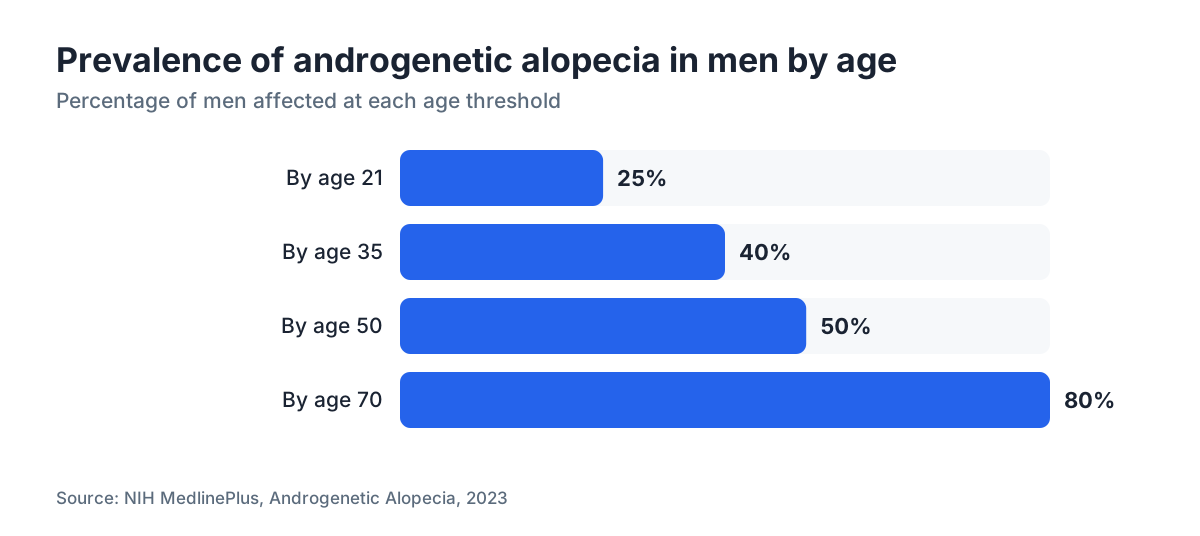
Androgenetic alopecia (genetic hair loss driven by the hormone dihydrotestosterone, or DHT) is far and away the most common cause of a receding hairline. It affects roughly 50% of men by age 50 and up to 80% of men by age 70 [8]. DHT binds to receptors in genetically sensitive follicles and causes them to miniaturize over time. If you have a father or maternal grandfather who went bald, your risk is meaningfully higher, though the genetics are polygenic and nobody can predict your exact trajectory from family history alone.
But a hairline can also recede for other reasons. Chronic traction from tight hats or hairstyles, certain medications (some blood thinners, retinoids, and chemotherapy agents), thyroid disorders, iron deficiency anemia, and lupus can all affect the hairline. Some of these are reversible when the cause is addressed.
If you're also noticing fatigue, weight changes, or skin and nail changes alongside your hair loss, a general blood panel is worth getting to rule out systemic causes before assuming it's genetic. Your primary care doctor can order thyroid-stimulating hormone (TSH), ferritin, and complete blood count as a starting point [12].
How do you know if you have a receding hairline early enough to treat it?
The honest answer: the earlier the better, but there's no hard deadline.
Finasteride and minoxidil for men both work best when some follicles are still active and producing hair, even if those hairs are miniaturized. The clinical evidence for finasteride is especially strong in men at Norwood Stages II through IV. The 5-year Merck trial found that among men who completed the study on finasteride, 66% had visible hair increases versus baseline while men on placebo continued to lose hair [6].
Minoxidil topical solution (2% and 5%) is FDA-approved as an over-the-counter treatment for androgenetic alopecia in both men and women [9]. It works by prolonging the anagen (growth) phase of the hair cycle and increasing blood flow to the follicle. It does not block DHT, which is why many dermatologists recommend combining it with finasteride for men who have both hairline recession and crown thinning. More on that approach here: finasteride and minoxidil.
Catch a receding hairline at Stage II or early Stage III, start a treatment that works for you, and it's genuinely possible to stop the progression and in some cases recover density you've lost. Wait until Stage V or VI and medication can still help, but it won't bring back hair from follicles that have long stopped cycling.
A free AI hair analysis tool like the one at MyHairline can help you see where you are right now and whether your hairline has changed, but it does not replace a diagnosis from a dermatologist.
DHT blockers are at the center of most treatment regimens for androgenetic alopecia, so understanding how DHT drives the process is useful background.
What should you do once you suspect your hairline is receding?
Step one is documentation. Take a clear, well-lit photo from the front and from directly above your head. Do this today. Repeat it every 3 months. Longitudinal photos are the single most useful thing you can show a dermatologist or use yourself to judge whether things are stable or progressing.
Step two is a dermatologist visit. A board-certified dermatologist (ideally one with a focus on hair loss) can do a trichoscopy exam, assess your Norwood stage, check for miniaturization, and run bloodwork if other causes seem plausible. Bring your photos. Bring a list of any medications and supplements you're currently taking.
Step three is understanding your options honestly. The main evidence-based options are:
- Finasteride 1 mg daily (prescription, FDA-approved for men, strong evidence) [6][10]
- Minoxidil topical 5% (OTC, FDA-approved for men) [9]
- Oral minoxidil (off-label, increasingly used by dermatologists, lower-dose versions 0.625 to 2.5 mg show good results in studies)
- Low-level laser therapy (some evidence, weaker than the medications)
- Hair transplant surgery (a permanent, surgical option for the right candidate at the right stage)
Supplements marketed for hair loss are a separate conversation. Most have very limited evidence. Our article on hair loss supplements goes through the data honestly.
Step four: if you decide on a medication, give it time. Both finasteride and minoxidil require at least 6 months to show results, and the full benefit usually takes 12 months. Stopping early is the most common reason people conclude they don't work.
Are there any tools or tests that help you measure hairline recession at home?
No validated, consumer-grade device measures hairline recession with clinical precision. But you can do a rough measurement yourself.
Use a ruler or measuring tape. The generally accepted reference point is the highest forehead crease (the wrinkle that appears when you raise your eyebrows). Measure from that crease to the lowest point of your hairline at the center. In most adult men a mature hairline sits 6 to 8 cm above the highest crease, though this varies significantly with head size and face shape. More useful than a single number is comparing the same measurement six months apart.
The temporal recession index is sometimes used clinically: mark the midpoint of the hairline, then measure the distance to the temple corner on each side. A greater distance on one or both sides compared to an earlier photo suggests temporal recession.
For a more automated approach, the free AI hair scan at MyHairline analyzes your hairline from a photo, estimates your Norwood stage, and lets you track changes over time. It's not a diagnosis, but it does give you a consistent baseline to work from.
Dermoscopy (scalp magnification) done by a dermatologist remains the most reliable non-biopsy method for detecting early miniaturization before it's visible to the naked eye [4].
How does a receding hairline differ in women?
Women do get receding hairlines, but the pattern and prevalence are genuinely different from men.
Female-pattern hair loss (androgenetic alopecia in women) most commonly presents as diffuse thinning over the top and crown of the scalp with the frontal hairline relatively preserved. This is described by the Ludwig scale rather than the Norwood scale. True hairline recession in women is less common but occurs with certain hormonal conditions (PCOS, post-menopause), prolonged traction hairstyles, and frontal fibrosing alopecia, which is a distinct type of scarring alopecia that causes a slowly retreating frontal hairline and eyebrow loss [2].
Frontal fibrosing alopecia is worth knowing about because it gets misidentified as androgenetic alopecia or just assumed to be normal hair loss in older women. It's a scarring condition, meaning once the follicles are damaged the loss is permanent. Early diagnosis matters more there than perhaps anywhere else.
For women concerned about hairline recession, the evaluation is similar to men: compare photos, check for patterned or diffuse loss, look for thinning at the part, and see a dermatologist. Minoxidil 2% topical solution is FDA-approved for women with androgenetic alopecia [9]. Finasteride's evidence in women is more complicated; it's not FDA-approved for women and carries pregnancy risk warnings. A dermatologist can walk through the options.
When should you actually see a doctor about a receding hairline?
If you're losing sleep over it, go sooner rather than later. Hair anxiety is genuinely common and a dermatologist visit can resolve a lot of uncertainty quickly.
Beyond that, see a doctor if: your hairline has visibly moved in the last 12 months; you're under 25 and noticing significant recession; you're losing more than 150 hairs a day consistently; you have patches of complete hair loss rather than diffuse thinning; your scalp is itchy, tender, or scaly near the hairline (which could indicate an inflammatory or scarring condition); or you're a woman with noticeable frontal recession.
The American Academy of Dermatology recommends seeing a board-certified dermatologist for any hair loss that concerns you, noting that early diagnosis improves treatment outcomes [3]. That's more than cautious boilerplate. It reflects the real clinical reality that the window for medication to work its best is earlier rather than later.
If you're still sorting out whether what you're seeing is even real recession or just your eyes playing tricks after reading too much about hair loss online, a free tool can help you get a baseline before you book anything.
Sources
- Journal of the American Academy of Dermatology, Rassman et al. 2006, 'Maturation of the juvenile hairline'
- American Academy of Dermatology, 'Hair loss types: Frontal fibrosing alopecia'
- American Academy of Dermatology, 'Hair loss: Overview'
- International Journal of Dermatology, Rudnicka et al. 2008, 'Dermoscopy of hair and scalp disorders'
- Journal of Investigative Dermatology, Norwood O'Tar 1975, 'Male pattern baldness: Classification and incidence'
- New England Journal of Medicine, Kaufman et al. 1998 / Merck 5-year finasteride trial data, 'Finasteride in the treatment of men with androgenetic alopecia'
- American Academy of Dermatology, 'Hair loss types: Telogen effluvium'
- NIH National Library of Medicine, MedlinePlus, 'Androgenetic alopecia'
- U.S. Food and Drug Administration, 'OTC drug monograph: topical minoxidil'
- U.S. Food and Drug Administration, 'FDA-approved drugs: Propecia (finasteride) 1mg'
- British Journal of Sports Medicine, van der Merwe et al. 2009, 'Three weeks of creatine monohydrate supplementation affects dihydrotestosterone to testosterone ratio'
- Journal of the American Academy of Dermatology, Blume-Peytavi et al. 2011, 'S1 guideline for diagnostic evaluation in androgenetic alopecia'