

TL;DR: Miniaturized follicles are reversible while they still produce hair, even fine, wispy strands, because living dermal papilla cells remain. Once a follicle dies and scar tissue takes its place, only a transplant restores hair there. Clinical signs, a scalp biopsy, and how the area responds to treatment within 6 to 12 months tell you which side of that line you are on.
What is hair miniaturization and why does it matter?
Hair miniaturization is the gradual shrinking of a hair follicle over successive growth cycles. Each time an affected follicle completes a cycle, it produces a slightly thinner, shorter, and lighter strand than the one before. Over months to years, those strands get so fine they become almost invisible to the naked eye, and eventually the follicle stops producing anything at all.
In androgenetic alopecia, the most common cause of hair loss in men and women, the process runs almost entirely on dihydrotestosterone (DHT) [1]. DHT binds to androgen receptors in genetically sensitive follicles and shortens the anagen (growth) phase while lengthening the telogen (resting) phase. Fewer days growing, more days doing nothing. Repeat that for enough cycles and the follicle shrinks past the point of producing a visible hair.
Here is why the distinction matters. The window for reversal is open during miniaturization and closes when the follicle dies. Catching it early is the entire game. A follicle producing a vellus-like hair (under 0.03 mm in diameter) still has living dermal papilla cells and can potentially be rescued. A follicle replaced by fibrous scar tissue cannot be. Where a follicle sits on that spectrum is the question this article answers.
Miniaturization is not the same as telogen effluvium, where follicles shed normal hairs under systemic stress and then regrow them. In telogen effluvium, follicle size stays intact. In miniaturization, the follicle structure itself is breaking down.
What are the signs that miniaturization might still be reversible?
The best sign is a visible mix of thick and thin hairs in the same patch of scalp. Look at your hairline or crown under good light. If you see coarse terminal hairs sitting next to fine, almost translucent ones, the process is active but not finished. A follicle producing anything, even peach-fuzz strands, is still alive [2].
A few specific things to look for:
- Hair that sheds with a small white bulb still attached almost always came from a living follicle. No bulb usually means the strand broke rather than shed.
- The affected area still feels like normal scalp under your fingertips, not slick or unusually smooth. Scalp that has gone atrophic and shiny over years points to follicle loss.
- Your hair loss started fairly recently, within the last one to five years, and the area has not been completely bare for more than a year or two.
- You are younger. Follicles in people under 35 or 40 tend to miniaturize more slowly, which buys you time.
The most reliable real-world test is a trial of proven treatment. Minoxidil and finasteride both work by keeping miniaturized follicles in or near the anagen phase. Start either drug and see a real response within 6 to 12 months (loss stabilizes, some regrowth appears), and that response tells you living follicles were there to respond. No response after 12 months of correct use is a signal that the zone may have lost too many viable follicles to improve [3].
Before you spend money on treatments, the free AI scan at MyHairline can map your miniaturization zones and Norwood stage from your photos, which at least gives you a baseline to measure against.
What are the signs that miniaturization is probably permanent?
Permanent follicle loss looks and feels different from active miniaturization. The area is fully bare with no fine vellus hairs, even under a dermatoscope or magnifying glass. The scalp looks smooth, sometimes slightly shiny, and the skin may feel different from hair-bearing areas because fibrous tissue sits where follicles used to be [2].
Timeline matters a lot here. A patch that has been completely bald for more than roughly five years is far less likely to hold viable follicles than one that went bare in the last year or two. There is no universal cutoff, but most dermatologists treating pattern hair loss approach long-standing complete baldness with appropriate pessimism about medical regrowth.
Other warning signs:
- You started treatment late, after years of ignoring the thinning, and saw zero response across a full year of consistent use.
- A scalp biopsy from the zone shows fibrous tract remnants with no identifiable dermal papilla cells, a finding pathologists report specifically [4].
- You have late-stage Norwood loss (V, VI, or VII) in areas bald for years. The further along the pattern, the more likely those long-bald zones are past rescue.
None of this is a perfect test. Biopsies sample tiny areas and can miss focal surviving follicles. Treatment response gets muddied by inconsistent use. But taken together, these signs push the odds hard toward permanent loss.
How does a scalp biopsy tell you if follicles are still alive?
A 4 mm punch biopsy from the affected scalp, read by a dermatopathologist who knows hair disorders, is the closest thing to a definitive answer short of trying treatment and waiting [4]. The pathologist counts terminal hairs, vellus hairs, and miniaturized follicles per unit area, then looks for fibrous tract remnants, the streaks of collagen where follicles used to sit.
A terminal-to-vellus ratio below 2:1 is abnormal and consistent with androgenetic alopecia [4]. Fibrous tracts without any follicular structures mean the follicle is gone. A high density of miniaturized but structurally intact follicles means there is something left to work with.
The catch is cost and access. Scalp biopsies run roughly $200 to $600 depending on location and insurance, and you need a dermatologist or hair specialist who can perform and read them correctly. Most people get a reasonable answer from a clinical exam plus a treatment trial and skip the biopsy, unless the diagnosis is genuinely unclear (for example, telling androgenetic alopecia apart from scarring alopecia, where the treatment differs completely).
Scarring alopecias like lichen planopilaris or frontal fibrosing alopecia are one situation where biopsy is not optional. These conditions destroy follicles permanently through a different inflammatory mechanism, and mistaking them for common pattern loss means missing an active destructive process that needs to be stopped [5]. If your scalp shows redness, scaling, or tenderness around follicles rather than simple thinning, see a dermatologist before assuming androgenetic alopecia.
Does miniaturization progress at the same rate for everyone?
No, and the spread is wide. Genetics set both your sensitivity to DHT and your baseline follicle resilience. Someone with a strong family history of complete baldness on both sides tends to miniaturize faster and hit permanent loss earlier than someone with a lighter family history [1].
Age of onset is a rough proxy for how aggressive the process will be. Men who see obvious thinning at 18 or 20 are statistically more likely to reach advanced Norwood stages than men whose first signs show up at 40. That is a probability from the epidemiological data, not a guarantee either way.
Androgen levels matter less than most people expect. Plenty of men with normal testosterone and DHT still miniaturize heavily because their follicles are unusually sensitive. Measuring serum DHT rarely changes the plan for typical androgenetic alopecia, though it can be relevant in women, where hormonal causes vary more [6].
Stress, nutritional gaps, thyroid problems, and certain medications can all speed up miniaturization or trigger shedding that unmasks miniaturization already underway. Fixing those contributors does not reverse DHT-driven follicle damage, but it can slow the overall slide and improve the density of surviving hairs. For a fuller picture of what might be driving your loss, the what causes hair loss overview covers the main categories.
Can minoxidil reverse hair miniaturization?
Minoxidil can partly reverse miniaturization in follicles that still have working dermal papilla cells. It mainly prolongs the anagen phase and increases blood supply to the follicle, giving miniaturized follicles more time and resources to grow a thicker strand [3]. The FDA approved topical minoxidil 2% for women and 5% for men specifically for androgenetic alopecia, and the trial data shows modest but real regrowth in a meaningful share of users [7].
In the trials that led to FDA approval of 5% topical minoxidil, men with androgenetic alopecia showed a statistically significant increase in non-vellus hair count at 48 weeks compared to placebo [7]. Regrowth is not dramatic for most people, but stabilization plus some reversal in recently affected follicles is realistic.
What minoxidil cannot do: bring back a follicle already replaced by scar tissue. Once the dermal papilla is gone, no topical vasodilator changes that. Users who try minoxidil, hit the early shed (common in weeks 2 to 8 as resting hairs make way for new anagen hairs), and quit miss the actual benefit window. You have to stay on it.
Oral minoxidil at low doses (0.625 mg to 2.5 mg daily) has shown similar or slightly better results than topical in some studies, with a different side-effect profile. For a full look at the risks, the minoxidil side effects article breaks them down. For a practical guide to the topical form, minoxidil for men covers application and realistic timelines.
Short version. If your follicles are miniaturized but not dead, minoxidil is a reasonable first move. If they are gone, it will not help.
Can finasteride reverse hair miniaturization?
Finasteride works upstream of the follicle. It blocks 5-alpha reductase type II, the enzyme that converts testosterone to DHT, cutting scalp DHT by roughly 60 to 70% [8]. Less DHT means a weaker signal telling sensitive follicles to shrink. For follicles that have miniaturized but still have viable papilla cells, pulling that DHT signal gives them a chance to recover toward terminal-caliber hair.
The 5-year trial data shows finasteride 1 mg daily (Propecia) significantly slowed progression and produced some regrowth in men with mild to moderate androgenetic alopecia [8]. Regrowth ran better at the crown than the frontal hairline in those trials, which matters if your main concern is a receding hairline.
Finasteride does not erase DHT, and it does nothing for follicles already dead. Its real job is capping the damage rate while letting partly miniaturized follicles partly recover. Long-term continuous use is the deal, because stopping usually brings DHT-driven miniaturization back within 6 to 12 months.
For women, finasteride is not FDA-approved for hair loss and is contraindicated in women who are or may become pregnant because of the risk of fetal harm [8]. Women with androgenetic alopecia have other options, including spironolactone, low-level laser therapy, and minoxidil. For a deeper look at how finasteride works and who it helps, the finasteride overview covers mechanism, dosing, and real-world outcomes. Running both drugs together hits the problem from two angles, and the combination has better evidence than either alone, covered in the finasteride and minoxidil piece.
What is the difference between reversible miniaturization and temporary hair shedding?
This is one of the most common points of confusion. Temporary shedding (telogen effluvium) and progressive miniaturization can look alike from the outside, but their causes, timelines, and outlooks differ.
In telogen effluvium, a systemic trigger (crash dieting, major illness, surgery, a postpartum hormone shift, heavy psychological stress) pushes a large batch of follicles into the resting phase at once. Those follicles shed their hairs two to three months after the trigger, causing diffuse thinning across the whole scalp. The follicles themselves are fine. They wake back up, produce normal terminal-caliber hairs, and the person is usually back to baseline within 6 to 9 months of the trigger clearing [9].
In miniaturization from androgenetic alopecia, individual follicles are changing structurally. The hairs they make get finer with each cycle. The loss tends to follow a pattern (temples, crown, top of scalp) rather than spreading evenly. And without treatment, it does not reverse on its own.
A few ways to tell them apart in practice:
- Pattern vs. diffuse: patterned thinning strongly favors androgenetic miniaturization; diffuse favors telogen effluvium.
- Shed hair caliber: normal, full-thickness shed hairs fit telogen effluvium. Many fine, pale, short hairs point to miniaturization.
- Timeline: did a clear stressor hit about 2 to 3 months before the shedding? Telogen effluvium has a trigger. Miniaturization creeps.
- Age and family history: a young man with a strong family history of baldness who notices patterned thinning should assume miniaturization until proven otherwise.
Some people have both at once, which makes the picture harder to read. A dermatologist doing a pull test and examining shed hairs under a microscope can usually sort it out.
How long does it take to know if miniaturization treatment is working?
This is where people slip up most. They start treatment, see nothing at 2 or 3 months, and quit. That is too early.
The hair growth cycle needs roughly 3 to 4 months for anagen to start producing a visible strand after a follicle is stimulated. Minoxidil users should not judge efficacy before 6 months of continuous use, and 12 months is the more honest window [3]. Finasteride trial data shows meaningful separation from placebo emerging between 6 and 12 months, with continued benefit through at least 5 years of use [8].
So the practical timeline reads like this:
- Months 1-3: possible early shed with minoxidil (normal, not a failure sign); no visible regrowth yet.
- Months 3-6: shed resolves; sharp-eyed observers may spot slight density gains; miniaturized hairs may look a bit thicker.
- Months 6-12: the clearest window for judging response; photos under consistent lighting beat memory.
- 12+ months: zero change and zero stabilization after consistent use is a meaningful negative signal.
Photographing the affected area under consistent lighting every 3 months is the most reliable way to track change. Your memory of how your hair looked a year ago is not a useful control.
The MyHairline AI scan lets you lock in a baseline with standardized angles, which makes the 6 and 12-month comparison far more objective than a bathroom mirror.
If treatment fails outright after a proper trial, the honest next conversation is whether the remaining follicles are candidates for a hair transplant, where healthy donor follicles from the back and sides of the scalp move to miniaturized or bald areas.
At what Norwood stage does miniaturization become mostly permanent?
No single Norwood stage guarantees permanent loss, but the clinical picture shifts a lot as the pattern advances.
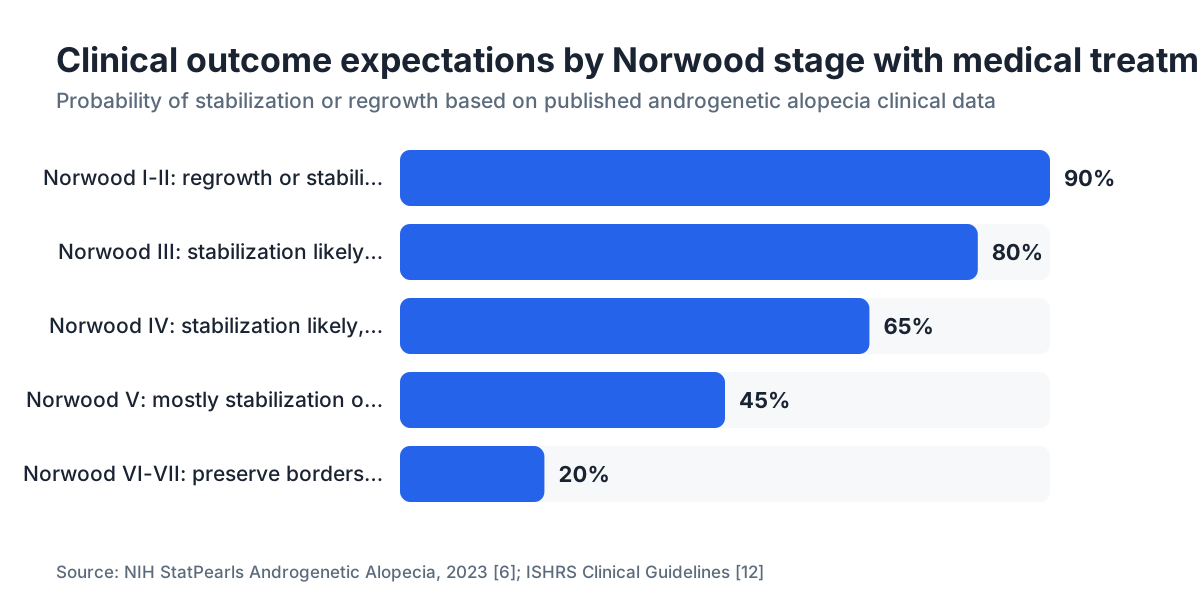
At Norwood I through III, most thinning involves miniaturized but still-living follicles. This is where medical treatment has its best track record. At Norwood IV and V, the crown and mid-scalp zones that have been thinning for a while usually hold a mix of miniaturized-but-viable and truly lost follicles. Treatment can stabilize and partly improve these stages, but total reversal is not realistic.
At Norwood VI and VII, areas bald for years rarely hold viable follicles. Medical treatment here is mostly about preserving what remains in the thinning border zones, not regrowing the bald core. Transplant from donor-zone follicles becomes the main path to coverage, though even transplants need enough donor supply to work.
The table below shows rough clinical expectations by Norwood stage based on published hair restoration literature.
| Norwood Stage | Typical Follicle Status in Affected Zone | Medical Treatment Realistic Outcome |
|---|---|---|
| I-II | Mostly viable, mild miniaturization | Stabilization + meaningful regrowth possible |
| III | Mixed viable and miniaturized | Stabilization very likely, partial regrowth common |
| IV | Mix of miniaturized and lost follicles | Stabilization likely, regrowth limited |
| V | Majority of crown follicles lost | Mostly stabilization of remaining hair |
| VI-VII | Most affected zones have permanent loss | Preserve border zones; transplant for coverage |
These are probability estimates, not guarantees. People vary. Starting treatment at Norwood III leaves you more options than waiting until VI, which is the core practical takeaway.
Are there any treatments that can reverse miniaturization beyond minoxidil and finasteride?
The honest answer: minoxidil and finasteride have the strongest evidence of any available treatment. Everything else sits at a lower tier. That does not mean nothing else works, only that the data is thinner.
Low-level laser therapy (LLLT) devices cleared by the FDA for hair growth show modest efficacy across several randomized controlled trials. The mechanism is thought to involve photobiomodulation stimulating follicular mitochondria, but effect sizes generally run smaller than minoxidil or finasteride [10]. LLLT can work as an add-on, especially for women who cannot use finasteride.
Platelet-rich plasma (PRP) injections have gotten popular at hair clinics. A 2019 systematic review in Dermatologic Surgery found wide variation across trials and called the evidence promising but not definitive [11]. Cost is high ($500 to $1,500 per session, with multiple sessions needed) and no standard protocol exists.
Ketoconazole shampoo (2%) has weak evidence as an adjunct through anti-androgen effects at the scalp. It will not meaningfully reverse established miniaturization on its own, but it may be reasonable to add.
DHT-blocking supplements like saw palmetto have limited, inconsistent trial data. The dht blocker article covers the evidence honestly. The hair loss supplements piece takes on the over-the-counter options and where the data actually supports use.
For women, oral minoxidil at very low doses has gained ground as an option with good tolerability data and possible advantages for diffuse patterned loss.
When should you stop trying medical treatment and consider a transplant?
The honest answer: when you have given medical treatment a real trial (12 months of consistent, correct use) and seen no meaningful response, and when you have scalp areas that are either fully bald or so sparse that density gains from drugs are not plausible.
A transplant does not mean abandoning medical treatment. Most hair restoration surgeons want patients on finasteride or minoxidil before and after surgery, because transplanted follicles come from DHT-resistant donor areas (back and sides of the scalp), but the native miniaturized hairs in the recipient area keep progressing without ongoing medical management [12]. You can lose native hairs around transplanted grafts over time if the underlying process goes untreated.
Transplant candidacy hinges on donor density (how many good follicles you have at the back and sides), how much area needs coverage, and how stable your loss is. Transplanting into actively miniaturizing scalp without stopping the underlying process leads to ongoing loss of surrounding hairs, which is why surgeons prefer patients who are reasonably stable.
The hair transplant article covers FUE vs. FUT, graft survival rates, realistic density expectations, and cost in detail. If you are weighing surgery, that is the right next read.
One more thing. If you genuinely cannot tell from clinical signs whether your follicles are viable, that is a question for a board-certified dermatologist experienced in hair loss, ideally one who uses trichoscopy (dermoscopy of the scalp) in their evaluation. Self-diagnosis is not reliable enough to base major financial decisions on.
Sources
- National Institutes of Health, MedlinePlus: Androgenetic Alopecia
- American Academy of Dermatology: Hair Loss Types: Alopecia Areata Overview
- FDA: Minoxidil Topical Solution Drug Label
- Journal of the American Academy of Dermatology: Histopathology of Androgenetic Alopecia (Whiting DA, 1993)
- American Academy of Dermatology: Cicatricial (Scarring) Alopecia Overview
- National Institutes of Health, StatPearls: Androgenetic Alopecia
- FDA: Minoxidil 5% Topical Approval Data
- FDA: Propecia (finasteride 1 mg) Prescribing Information
- American Academy of Dermatology: Telogen Effluvium Overview
- Lasers in Surgery and Medicine: Low-Level Laser Therapy for Androgenetic Alopecia RCT (Leavitt et al., 2009)
- Dermatologic Surgery: Systematic Review of Platelet-Rich Plasma for Androgenetic Alopecia (2019)
- International Society of Hair Restoration Surgery: Clinical Guidelines