

TL;DR: The earliest signs of male pattern baldness are a receding hairline at the temples, a widening part, increased shedding (more than 100 hairs a day sustained over weeks), and scalp visibility at the crown. The Norwood scale stages this progression from 1 to 7. Catching it at Norwood 2 or 3 gives you the best window to slow it down with proven treatments.
What are the first signs that you're starting to go bald?
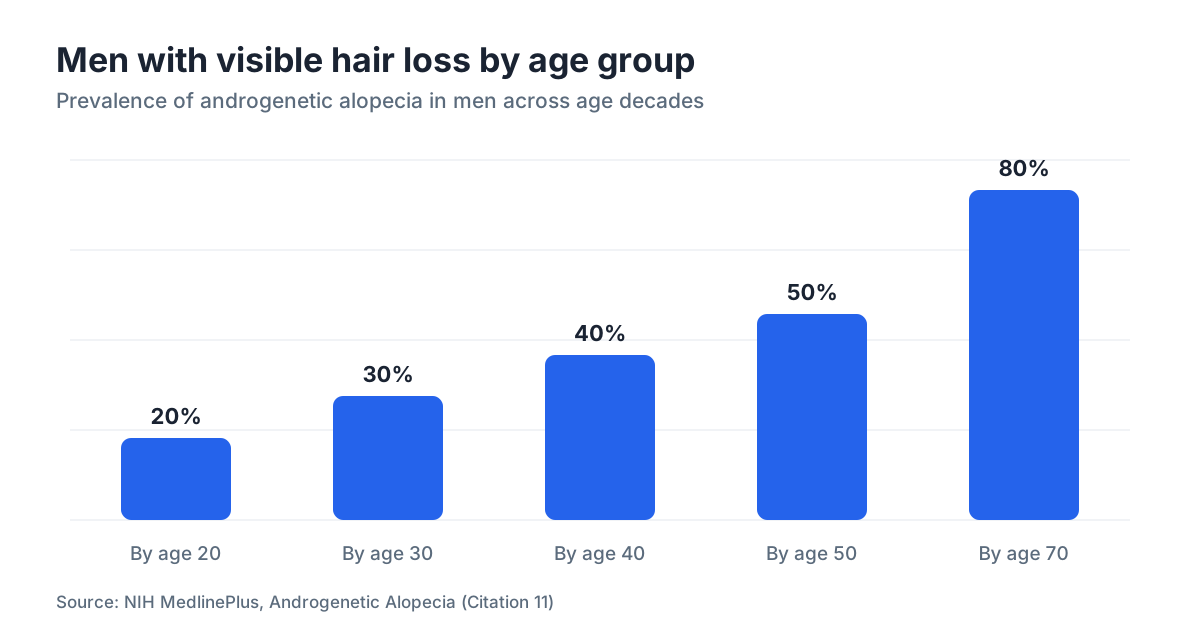
Most men don't notice they're losing hair until about 50 percent of it is already gone. That's not an exaggeration. Hair follicles miniaturize gradually, and your brain is remarkably good at compensating for what it sees in the mirror every day. By the time something looks obviously different, a lot has already happened.
That said, there are real early signals worth paying attention to.
The most common first sign is temple recession. Your hairline starts pulling back at the corners, creating a slight M-shape instead of the relatively straight or gently curved line you had in your teens or early twenties. It can happen slowly enough over two or three years that you dismiss it as normal variation. It usually isn't.
A widening part is the second big one, especially for women. If you're parting your hair and the part looks broader than it used to, that's diffuse thinning on top, more than shedding. Run your finger along your part and look at the scalp underneath. If it's clearly visible through hair that used to feel dense, something is changing.
Increased shedding is the sign people obsess over, but it's also the trickiest. Normal hair loss runs between 50 and 100 hairs per day according to the American Academy of Dermatology [1]. Finding hair on your pillow or in the shower drain isn't automatically alarming. What matters is a sustained change from your personal baseline, especially if it's been going on for more than two or three months.
Scalp visibility at the crown is the fourth early sign. Stand under a bright light and hold your phone camera overhead. If you can see pink scalp through hair that used to look thick back there, that's early vertex thinning.
Hair texture change is one most people skip. Miniaturizing hairs (follicles shrinking due to DHT) get finer and shorter with each growth cycle before they stop growing altogether. If your hair feels noticeably thinner or more limp than it did a few years ago, that's a real sign.
What is the Norwood scale and how does it work?
The Norwood-Hamilton scale is the most widely used classification system for male pattern baldness. Dr. James Hamilton built the original version in the 1950s, and Dr. O'Tar Norwood revised and expanded it in 1975 [2]. It runs from Stage 1 to Stage 7, with a few variant patterns (particularly the Type A variants, where the hairline recedes straight back rather than from the temples first).
Here's what each stage actually looks like:
| Norwood Stage | What you see | Typical treatment window |
|---|---|---|
| 1 | No visible recession, hairline intact | N/A (no treatment needed) |
| 2 | Slight temple recession, M-shape forming | Best time to start prevention |
| 3 | Deeper temple recession, some see early crown thinning (3 Vertex) | Strong window for medical treatment |
| 4 | Obvious hairline recession plus crown thinning, band of hair between | Medical treatment still meaningful |
| 5 | Band of hair between front and crown is narrowing | Medication plus transplant planning |
| 6 | Band disappears, front and crown merge | Transplant-focused options |
| 7 | Only a rim of hair around the sides and back remains | Limited donor hair for transplants |
The scale matters because treatments work best early. Finasteride and minoxidil can slow or partially reverse miniaturization, but they can't regrow hair from follicles that have been gone for years. A man who starts at Norwood 2 has a much better prognosis than one who waits until Norwood 5 [3].
The Ludwig scale is the equivalent for women, running from Grade I (mild thinning on top) to Grade III (severe diffuse thinning). Female pattern hair loss typically spares the frontal hairline, which is the opposite of the male pattern.
How much hair loss per day is normal vs. a warning sign?
The American Academy of Dermatology puts normal daily shedding at 50 to 100 hairs [1]. Some sources stretch that to 150 on heavy wash days. The number itself is less important than context.
Hair grows in cycles: anagen (active growth, 2 to 7 years), catagen (transition, about 2 weeks), and telogen (resting/shedding, about 3 months) [4]. At any point roughly 10 to 15 percent of your hairs are in the telogen phase, which is why some shedding every day is normal physiology, not a crisis.
The warning signs that push shedding from normal into territory worth investigating are:
Shedding that spikes suddenly and stays high for more than 8 to 12 weeks. This pattern often points to telogen effluvium (a stress or illness response) rather than genetic hair loss. Telogen effluvium is usually temporary but can be confused with early androgenetic alopecia.
Shedding accompanied by no regrowth. In normal shedding, a new hair is already growing from the same follicle as the old one falls. In pattern baldness, the replacement hair is finer and shorter each cycle until eventually nothing comes back.
Clumps in the drain rather than individual hairs. Clumping can indicate alopecia areata (patchy autoimmune hair loss) or a sudden telogen effluvium event after a high fever or surgery.
If you're genuinely unsure whether your shedding is elevated, try this: don't wash your hair for 24 hours, then comb through it from front to back over a white towel and count the hairs. Fewer than 60 is generally reassuring. More than 100 on a non-wash day is worth bringing to a dermatologist.
How do you check your own hairline and scalp at home?
You don't need a clinic visit to get a preliminary read on what's happening. Here's what actually works.
The photo method. Take a consistent overhead photo once every 3 months under the same lighting (bright, direct light from above). Your perception of your own hair in a mirror is unreliable because your brain adapts. Photos don't. Compare the part width, the temple corners, and the crown density across images 6 months apart.
The wet hair test. Wet your hair, slick it back flat, and look at it under a bright bathroom light. Wet hair clumps together and makes thinning areas far more visible than dry, styled hair does. Crown thinning especially tends to hide under dry volume.
The part width comparison. Look at photos from 5 years ago versus now. Focus specifically on how wide the part looks and whether the temples have moved. This is often the most obvious objective comparison available to you.
The fingernail test. Run your fingernail lightly along your scalp at the crown. If you can feel individual hair shafts clearly separated with gaps of scalp between them, density has dropped. If it feels like a solid mat of hair, you're probably okay.
For women especially, the ponytail circumference is a useful informal measure. If the circumference of your ponytail has clearly shrunk over a few years, that's diffuse thinning, not normal variation.
If you want an objective baseline faster, tools like the free AI scan at MyHairline can analyze uploaded photos and map your approximate Norwood or Ludwig stage. It's not a clinical diagnosis, but it gives you a starting point before you see a dermatologist.
What causes early balding in men and women?
The dominant cause of early balding in men is androgenetic alopecia, commonly called male pattern hair loss. It's driven by dihydrotestosterone (DHT), a hormone derived from testosterone via the enzyme 5-alpha reductase. In genetically susceptible follicles, DHT binds to androgen receptors and triggers a miniaturization process that shortens the growth phase and shrinks the follicle over years [5].
The genetic piece is polygenic, meaning it comes from many genes, more than one. The old idea that you inherit baldness from your mother's father is an oversimplification. Both parents contribute. If you have multiple close male relatives who went bald early, your risk is meaningfully higher.
For women, the mechanism is similar but the hormone picture is more complex. Androgens still matter, but estrogen also protects follicles, which is why female pattern hair loss often accelerates after menopause. Women with polycystic ovary syndrome (PCOS) frequently experience earlier hair thinning because of elevated androgen levels. Understanding what causes hair loss in your specific case matters because the treatment approach differs.
Other causes that can look like early pattern baldness but are actually different conditions:
Telogen effluvium after illness, surgery, extreme diet, or emotional stress. This is diffuse shedding that typically peaks 2 to 3 months after the trigger and resolves within 6 to 9 months.
Iron deficiency anemia. Ferritin levels below 30 ng/mL have been associated with hair loss in multiple studies, though the causal relationship is still being worked out [6].
Thyroid dysfunction (both hypo and hyperthyroid) can cause diffuse shedding that mimics early pattern loss.
Some supplements and medications can accelerate shedding too. For example, there's ongoing debate about whether creatine causes hair loss by raising DHT levels; the evidence is limited but worth knowing about if you're stacking supplements.
Can you tell early balding from normal shedding or other conditions?
This is where most people get confused, and it's an honest source of confusion because the early signs genuinely overlap.
Pattern hair loss (androgenetic alopecia) follows a predictable map: temples recede, crown thins, and these areas connect over time. The distribution is not random. It follows the Norwood pattern in men and the Ludwig pattern in women almost reliably. The hair that falls is being replaced by progressively finer, shorter hair.
Telogen effluvium doesn't follow a map. It's diffuse. You lose hair uniformly across the scalp, and if you part your hair anywhere, the scalp is more visible everywhere, more than at the crown or temples. It usually has a clear trigger you can identify, and it tends to resolve. A dermatologist can pull 60 to 80 hairs from the scalp (a gentle pull test) and examine whether an elevated percentage are in the telogen (resting) phase.
Alopecia areata shows up as smooth, round or oval patches of complete hair loss. The edges are usually well-defined. This is an autoimmune condition, and it's distinct from pattern baldness both in cause and appearance.
Traction alopecia comes from hairstyles that pull constantly (tight braids, ponytails, extensions). The loss is at the hairline margins, particularly the temples and sides. The good news is it's reversible early if the tension stops.
The practical rule of thumb: if your hair loss follows the Norwood or Ludwig map and you have a family history, pattern baldness is the most likely explanation. If it's sudden, diffuse, patchy, or you've had a recent stressor, illness, or big diet change, something else may be going on. Either way, a dermatologist who does a scalp biopsy or trichoscopy can give you a definitive answer.
Does hair loss in your 20s mean you'll go fully bald?
Not necessarily, but early onset is a meaningful signal about severity. Research on androgenetic alopecia consistently shows that men who start losing hair before age 20 or 21 tend to progress further over their lifetime than men who first notice recession in their 30s or 40s [7]. The earlier the onset, the more aggressive the underlying genetic and hormonal drive tends to be.
That said, progression is not a straight line. Some men lose ground fast in their early 20s and then plateau. Others progress slowly but continuously for decades. Nobody has a reliable way to predict your specific trajectory from a single point in time, which is one honest limitation of the Norwood scale as a tool. It shows you where you are, not where you're headed.
What you can control is the response. Starting finasteride at Norwood 2 in your early 20s has good data behind it. A large multicenter trial found that 83 percent of men on 1 mg finasteride daily had no further hair loss over two years, compared to 28 percent on placebo [3]. That's a big effect, and the earlier you start relative to the amount of hair still present, the more there is to preserve.
Balding young does carry a real psychological weight, and that's worth naming. Studies have found that hair loss in young men is associated with lower self-esteem and increased anxiety [8]. Getting a clear diagnosis and a plan, even if the plan is just watchful waiting, tends to reduce that anxiety significantly compared to uncertainty.
What treatments actually work for early stage hair loss?
Two treatments have strong evidence and FDA approval for androgenetic alopecia. Everything else is a significant step down in evidence quality.
Minoxidil (topical) is FDA-approved for both men and women [9]. The 5% foam or solution applied twice daily is the standard for men. It works by prolonging the anagen (growth) phase and may increase blood flow to follicles. Results take 4 to 6 months to appear, and the hair you gain is lost again if you stop. If you want to understand what you're signing up for, read about minoxidil for men and the full minoxidil side effects profile before starting.
Finasteride (oral, 1 mg daily) is FDA-approved for men only. It works by inhibiting 5-alpha reductase, reducing DHT at the follicle by about 70 percent [5]. The two-year trial data shows strong results, but sexual side effects (decreased libido, erectile dysfunction) occur in roughly 2 to 4 percent of men, and there's ongoing discussion about post-finasteride syndrome in a subset of users [10]. Understand the risk profile honestly before starting. Read more about finasteride and whether finasteride and minoxidil together make sense for your situation.
Oral minoxidil at low doses (0.625 mg to 2.5 mg daily) has growing evidence for both men and women and is increasingly prescribed off-label. Oral minoxidil avoids the scalp application routine but has different side effect considerations, mainly fluid retention and increased body hair.
DHT blockers in topical or supplement form are a broader category worth understanding. Some have real mechanisms, many are marketed far beyond their evidence. See DHT blocker for a breakdown.
Hair transplants are an option for men at Norwood 3 and above with stable donor hair. They don't stop progression, so doing one without medical treatment to slow ongoing loss often leads to a patchy result years later. Read what hair transplant surgery actually involves before factoring cost and recovery into your decision.
Supplements occupy a large market and a small evidence base. Biotin deficiency causes hair loss, but biotin supplementation only helps if you're actually deficient, which most people aren't. Saw palmetto has mild DHT-blocking properties in some studies. Nutrafol and similar products have industry-funded trials but no head-to-head data against finasteride. A realistic breakdown is in hair loss supplements.
How do women identify early hair loss and what's different for them?
Female pattern hair loss (FPHL) is underdiagnosed partly because it presents differently and partly because there's a cultural assumption that thinning is a male problem. It isn't. The American Academy of Dermatology estimates that female pattern hair loss affects roughly 30 million women in the United States [1].
The key difference: women with pattern hair loss almost always keep their frontal hairline. The thinning happens at the top and crown, making the part look wider and the scalp more visible under overhead light. This is the Ludwig Grade I presentation. It progresses to Grade II (clearly visible scalp over a wider area) and Grade III (extensive diffuse thinning).
What women need to watch for:
A consistently widening part over 12 to 24 months.
A ponytail that's measurably thinner in diameter than it was a few years ago.
More scalp visibility at the crown under direct light.
Hair that feels finer and breaks more easily, without any change in products or heat use.
Excessive shedding that persists beyond 3 to 4 months without a clear temporary trigger.
Women should also rule out causes that are more common in women than men: thyroid disorders, iron-deficiency anemia, PCOS, and post-partum shedding. A basic blood panel (TSH, ferritin, CBC, DHEA-S, free testosterone) is a reasonable first step before assuming it's genetic pattern loss.
Treatment options for women include topical minoxidil 2% or 5% (FDA-approved), spironolactone (off-label, blocks androgen receptors), and low-level laser therapy devices (cleared by the FDA as a device). Finasteride is not FDA-approved for premenopausal women because of the teratogen risk in pregnancy.
When should you see a dermatologist about hair loss?
A lot of people wait too long. The general guidance is to get a professional evaluation if:
You're losing what feels like noticeably more hair than usual for more than 2 to 3 months.
You can see clear scalp where you used to have dense hair.
You notice patchy loss (round, irregular, or band-like patches).
You have scalp symptoms alongside the loss: itching, pain, scaling, or redness. These can indicate conditions like lichen planopilaris or seborrheic dermatitis that need different treatment.
You're a woman in your 20s or 30s with diffuse thinning (elevated androgens from PCOS or adrenal sources should be ruled out).
A board-certified dermatologist can do a pull test, dermoscopy, and if needed a scalp biopsy to give you a real diagnosis rather than an educated guess. Board-certified dermatologists who specialize in hair disorders (trichologists with dermatology credentials) can access tools like phototrichogram and trichoscopy that provide quantitative hair density data.
If you want a preliminary sense of where you stand before booking an appointment, MyHairline's free AI scan can analyze photos of your hairline and scalp and give you a Norwood or Ludwig stage estimate to bring into that conversation. Again, it's a starting point, not a diagnosis.
One thing worth saying plainly: stress about whether you're balding tends to make the whole situation feel worse than it is. Getting an actual answer, even if it confirms early loss, is almost always better than months of anxious mirror-checking.
What's the difference between a receding hairline and a maturing hairline?
This is a question a lot of men in their late teens and early twenties have, and it matters because not all hairline change is loss.
A juvenile hairline sits very low on the forehead, sometimes almost at the brow, and has a rounded, smooth edge. Between ages 17 and 25, most men naturally develop what's called a mature hairline. This moves back slightly (typically about 1 to 1.5 cm) and develops more defined corners. This is a normal developmental change, not androgenetic alopecia.
The distinction:
A maturing hairline recedes uniformly and stops. It doesn't progress further. It doesn't thin the hair behind it. The temples may develop slight definition but don't create a deep M.
A receding hairline driven by pattern baldness continues progressing, is usually asymmetric (one temple pulls back faster than the other), and is accompanied by hair miniaturization: the hairs at the recession zone are finer and shorter than the surrounding hair. You can often see this with a magnifying glass or a dermatoscope.
If you're 20 and worried, wait 6 months and take comparison photos. If the change stops and the hair behind the hairline stays dense, you've just matured. If it keeps pulling back and you can see finer hairs at the leading edge, it's worth acting on.
For a more detailed breakdown, the receding hairline guide covers how to distinguish the two and what the treatment options look like for men at the early Norwood stages.
Sources
- American Academy of Dermatology, Hair Loss Overview
- Norwood OT. Male pattern baldness: classification and incidence. Southern Medical Journal, 1975
- Kaufman KD et al. Finasteride in the treatment of men with androgenetic alopecia. Journal of the American Academy of Dermatology, 1998
- StatPearls, National Library of Medicine: Hair Follicle Structure
- Randall VA. Androgens and hair growth. Dermatologic Therapy, 2008
- Trost LB et al. The diagnosis and treatment of iron deficiency and its potential relationship to hair loss. Journal of the American Academy of Dermatology, 2006
- Birch MP et al. Hair density, hair diameter and the prevalence of female pattern hair loss. British Journal of Dermatology, 2001
- Cash TF. The psychosocial consequences of androgenetic alopecia. Journal of the American Academy of Dermatology, 1992
- FDA, Drug Approvals and Databases: Minoxidil
- NIH MedlinePlus, Androgenetic Alopecia