TL;DR: Apply half a capful of 5% minoxidil foam directly to a dry scalp twice daily, at least 8 hours apart. Part your hair to expose the skin, spread with your fingers, wash your hands after. Expect shedding for the first 2-3 months, and meaningful regrowth only after 4-6 months. Missing doses regularly is the main reason the treatment fails.
What is minoxidil foam and how does it differ from the liquid?
Minoxidil foam is a topical over-the-counter treatment for androgenetic alopecia, the pattern hair loss that affects roughly 50 million men and 30 million women in the United States [1]. The FDA approved the foam version in 2006 to give users an alternative to the original liquid drops, which contained propylene glycol, a carrier alcohol that caused scalp irritation and left a greasy residue for many people.
The foam uses a different carrier system, typically alcohol-based, that evaporates faster and leaves less residue. That matters practically: the foam dries in a few minutes rather than leaving your hair looking wet and heavy for an hour. Because it disperses so quickly, it also poses less transfer risk to pillows, partners, or pets than the liquid.
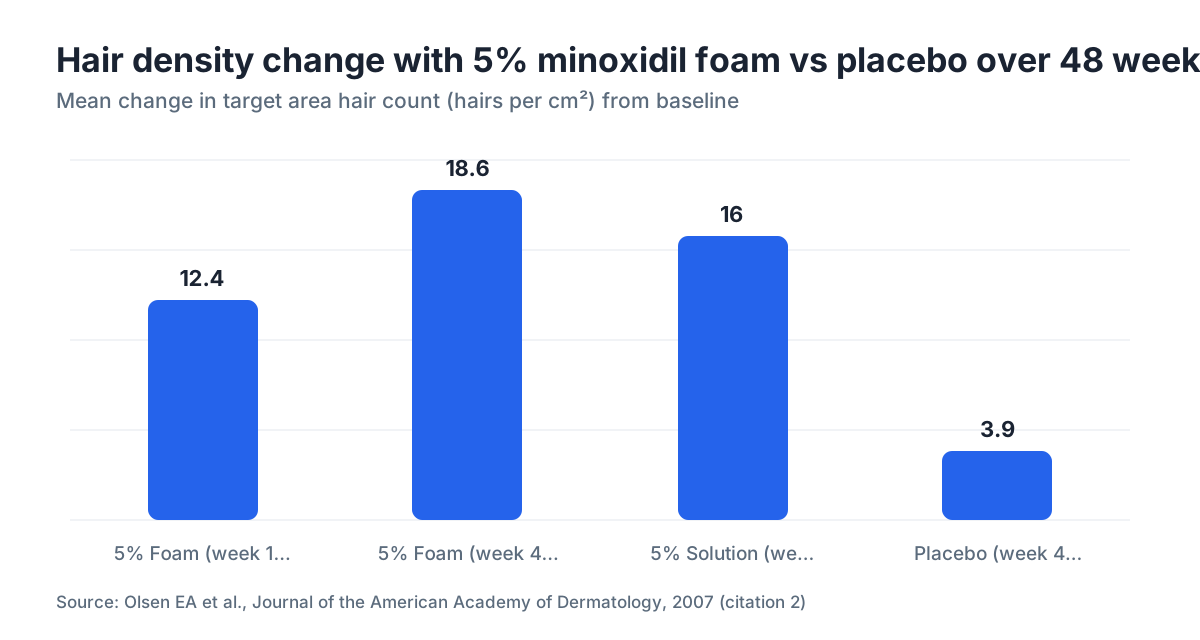
Both formulations deliver the same active ingredient at the same concentration, 5% minoxidil, and the clinical evidence treats them as equivalent in efficacy. A 48-week randomized trial published in the Journal of the American Academy of Dermatology found the foam non-inferior to the solution for vertex hair count, with 5% foam producing a mean increase of 18.6 hairs per cm² versus 16.0 hairs per cm² for the solution in men [2]. The difference was not statistically significant, so pick whichever format you'll actually use consistently.
One real advantage of foam: because it lacks propylene glycol, people who got itching or a rash with the liquid often tolerate it much better. If you tried liquid minoxidil and quit because your scalp burned, foam deserves a second try before you give up on the drug entirely.
What do you need before you start applying minoxidil foam?
Not much. A can of 5% minoxidil foam (the 2% women's version exists but most evidence for regrowth is with 5%), clean dry hands, and a dry scalp. That's it.
You do not need special shampoo, a derma roller, red light devices, or any of the add-ons that get marketed alongside minoxidil. Some of those things have their own evidence base, but minoxidil works without them. Start simple. Add complexity later if you want.
A few things to check before your first application:
- Your scalp should be clean and completely dry. Wet hair dilutes the foam and slows absorption. Wash your hair in the morning, let it dry fully (or blow dry), then apply.
- Read the label on your specific can. FDA-approved over-the-counter labeling [3] requires manufacturers to list contraindications, and the most common one is a history of hypersensitivity to minoxidil or the inactive ingredients.
- If you have heart disease or take prescription medications, talk to a doctor first. Minoxidil was originally a blood pressure drug. At topical doses, systemic absorption is low (roughly 1-2% of the applied dose, per the FDA label), but it is not zero.
- Women who are pregnant or trying to conceive should not use minoxidil. Animal studies have shown fetal harm at high doses, and the FDA label carries this warning explicitly [3].
Set a realistic timeline in your head before you start. The FDA-approved labeling states that hair growth may not be apparent for at least 4 months of twice-daily use [3]. If you're expecting results in four weeks, you'll quit before the drug has done anything.
How do you apply minoxidil foam correctly, step by step?
This is where most people go wrong. They spray or dump foam into their palm and rub it through their hair. That coats the hair shaft, which is dead tissue. Minoxidil works at the follicle level, which sits in the scalp. You need the drug on your skin, not your hair.
Step 1: Start with a dry scalp. Time your application for after your hair has fully dried. If you apply to a wet scalp the foam dissolves and runs off.
Step 2: Cool the can. Minoxidil foam is propellant-driven. If the can is warm (from your shower, a hot bathroom), press the nozzle against a cold surface or run it under cold water for 30 seconds. Warm cans dispense liquid rather than foam.
Step 3: Dispense half a capful. Tip the can upside down, press the nozzle into the cap, and release until the cap is roughly half full. This is one dose. Each dose is approximately 1 gram of foam [3].
Step 4: Transfer to your fingertips immediately. Foam melts quickly. Use your fingers, not your palm, so you can apply it precisely to thinning areas. Work fast.
Step 5: Part your hair to expose the scalp. Use a comb or your fingers to create a part directly over the area you're treating. Spread the foam along the part, directly onto the skin. Repeat with additional parts if your thinning area is wide.
Step 6: Gently spread and massage in. Press the foam into the scalp with your fingertips. You don't need to scrub hard. A gentle, even spread over the treatment area is enough.
Step 7: Wash your hands immediately. Minoxidil absorbed through the hands can cause unwanted hair growth on the face and body. This step is not optional.
Step 8: Leave it alone. Don't rinse your scalp, don't put a hat on right away, and avoid sweating heavily for at least 30-60 minutes. Give the foam time to absorb.
Do this twice a day, roughly 12 hours apart (morning and before bed works well for most people). The FDA label specifies the twice-daily regimen [3]. Once daily is a common shortcut, and while some evidence suggests it beats nothing, twice daily is what the approval is based on.
How much minoxidil foam should you use each time?
Half a capful per dose. That's the FDA-approved amount for men using the 5% foam [3]. Some people read "half a capful" loosely and end up using two or three times that, figuring more works faster. It won't, and it raises the risk of side effects with no added benefit.
Half a capful is about 1 gram of foam. If you're treating a larger area of thinning, you still use that same half capful and spread it over the whole area rather than piling on more.
For women, the originally approved women's foam (2%) used the same half-capful dose once daily. Several dermatologists now use 5% foam off-label for women at a lower frequency. If you're a woman weighing the 5% formulation, that's a conversation to have with a dermatologist rather than a self-adjusting decision, given the pregnancy risk and the different progression patterns of female pattern hair loss.
Nobody has good data on what happens if you consistently overdose topical minoxidil. The closest evidence comes from case reports of excessive systemic absorption causing hypotension and palpitations, which is why staying at the labeled dose matters.
When should you apply minoxidil foam: morning, night, or does it matter?
Timing matters less than consistency. The goal is two applications roughly 8-12 hours apart. Morning and evening (before bed) is the schedule most people stick to because it ties the treatment to habits they already have.
A few practical notes:
Applying at night means minoxidil sits on your scalp for hours uninterrupted, which sounds appealing, but no clinical evidence shows nighttime application beats morning application. What matters is that the foam sits on a dry scalp for at least 4 hours before you wash it off.
If you exercise in the morning, apply after your workout and shower, not before. Sweating right after application rinses the drug off before it absorbs.
If you style your hair with heat tools or products, apply minoxidil first, let it fully dry (about 5-10 minutes), then style. Heat tools don't appear to degrade minoxidil's efficacy, but applying styling products before minoxidil can block absorption.
Don't let perfect scheduling become a reason to skip a dose. An application 6 hours after the previous one beats no application at all.
Why is your hair falling out more after starting minoxidil foam?
This is the question that makes people quit at week 6, right before the treatment would have worked.
Minoxidil pushes resting (telogen) follicles into an active growth phase (anagen). When follicles shift phases, they shed the old hair before growing a new one. The result is what online hair loss communities call a "dread shed," and it's real. Most people see increased shedding between weeks 2 and 8 of starting minoxidil [1][2].
This shedding is not hair loss. It is turnover. The follicle is still alive. It's just cycling. The new hair that grows in after the shed is what you're waiting for.
If shedding is severe, meaning large clumps rather than just more hairs in the drain, or if it continues past week 16, that's worth discussing with a dermatologist. Severe shedding on minoxidil can sometimes unmask an underlying telogen effluvium that was happening anyway, or a scalp condition that needs treatment.
For most people: hold on. Don't quit. The shedding phase is temporary and it's actually a sign the drug is active.
How long does it take for minoxidil foam to work?
The honest answer is longer than the marketing implies.
Hair follicles cycle slowly. Anagen (growth) phase for scalp hair lasts 2-6 years, catagen (transition) lasts about 2 weeks, and telogen (rest) lasts about 3 months [4]. When you start minoxidil, you're working against that biological clock, and you can't speed up the cycle much. What you can do is get more follicles into growth phase and hold them there longer.
Here's a realistic timeline based on the clinical trial data [2]:
| Timepoint | What's typically happening |
|---|---|
| Weeks 1-4 | No visible change; possible increased shedding |
| Weeks 4-8 | Shedding peaks then slows for most users |
| Months 3-4 | Fine, colorless vellus hairs may appear over treated areas |
| Months 4-6 | Vellus hairs thicken into terminal hairs; first visible regrowth |
| Month 12 | Maximum response for most users |
| Ongoing | Must continue use to maintain gains |
The 48-week trial cited above showed statistically significant hair count increases versus placebo by week 16, with continued improvement through week 48 [2]. Some people see results faster, some slower. If you've seen no change at all by month 6 of consistent twice-daily use, you're less likely to be a strong responder, and combination therapy is worth discussing with a doctor.
Some users who aren't getting enough from minoxidil alone find that adding finasteride changes the picture. The two drugs work through different mechanisms, and the combination of finasteride and minoxidil has its own evidence base.
What are the most common mistakes people make with minoxidil foam?
The gap between people who get results and people who don't is almost entirely about application mistakes and consistency, not about individual biology (though biology matters too).
Applying to wet hair. The foam turns liquid on wet skin and hair and mostly runs off. Dry scalp is non-negotiable.
Using too little (or too much). Half a capful per dose. Not a squeeze from your palm, not a full cap.
Applying to hair instead of scalp. Coat your scalp, not your strands. Part the hair, expose the skin, apply there.
Skipping too many doses. Missing an occasional dose is fine. Missing doses 3-4 times a week cuts your total drug exposure roughly in half. The clinical trials were built around twice-daily use every single day.
Quitting during the shed. Explained above. This is the most common and most costly mistake.
Expecting it to work on dead follicles. Minoxidil extends and reactivates follicles that are still alive but dormant. If an area has been completely bald and shiny for many years, the follicles may be too scarred to respond. Receding hairline areas with relatively recent thinning respond better than long-standing bald patches.
Stopping when results appear. When you stop minoxidil, follicles return to their pre-treatment cycle within 3-6 months and most of the regrowth sheds [3]. This is permanent treatment for as long as you want to keep the hair.
Not washing hands. Facial hair growth in unexpected places is a real and documented side effect from hand transfer [5].
Can you use minoxidil foam with other hair loss treatments?
Yes, and in many cases you should consider it.
Minoxidil and finasteride (a prescription oral DHT blocker) work through entirely different pathways. Minoxidil extends the growth phase and increases follicle size. Finasteride reduces the androgen signal that shrinks follicles over time. A 2021 systematic review and meta-analysis in the Journal of the American Academy of Dermatology found that combined minoxidil plus finasteride produced greater hair count improvements than either drug alone [6]. If you're a man with androgenetic alopecia and not on finasteride, this is the combination most dermatologists would reach for first.
Derma rolling (microneedling) is another addition with real evidence. A 2013 RCT published in the International Journal of Trichology found that men using a 1.5mm derma roller plus 5% minoxidil had significantly greater hair count increases at 12 weeks than those using minoxidil alone [7]. If you're going to add a derma roller, apply minoxidil 24 hours after rolling, not immediately after, to avoid pushing the drug into fresh skin breaks.
Where I'd save your money: most hair loss supplements have weak or no evidence next to minoxidil. Biotin at normal doses, in people who aren't biotin-deficient, hasn't been shown to improve hair loss in randomized trials. Spend money on what has evidence.
If you're further along on the Norwood scale and considering surgical options, minoxidil is still worth using before and after a hair transplant. It can slow continued loss in non-transplanted areas and some surgeons use it to support graft survival, though the evidence on post-surgical use specifically is thin.
Before you change your regimen, get an objective picture of where your hair loss stands. A tool like the free AI hair analysis at MyHairline can map your thinning patterns against Norwood stages so you know what you're actually working with before layering treatments.
What side effects should you watch for with minoxidil foam?
Most people tolerate topical minoxidil foam well, and the side effect profile is meaningfully better than the liquid for scalp irritation. Side effects still exist, and some are worth knowing about before you start.
For the full picture, see the dedicated minoxidil side effects article. The short version:
Scalp irritation and dryness. The most common complaint. The alcohol base in foam can dry out the scalp. If this happens, try spacing your applications out slightly or using a gentle fragrance-free moisturizer on the scalp on off days.
Unwanted facial and body hair. Caused by hand transfer or by systemic absorption. It's more common in women and it's the main reason to wash hands immediately after every application [5].
Increased shedding in the first 2-8 weeks. Covered above. Temporary and expected.
Contact dermatitis. Rare, but some people develop a genuine allergic reaction to minoxidil itself rather than just irritation from the carrier. Signs are redness, swelling, and hives rather than just dry skin. Stop use and see a doctor if this happens.
Systemic effects. Fluid retention, rapid heartbeat, dizziness, and chest pain are rare with topical use but documented. The FDA label for topical minoxidil states that systemic absorption is low but not zero [3]. If you develop any of these, stop using and get medical attention.
People with existing cardiovascular conditions should talk to their doctor before starting, not as a bureaucratic formality but because minoxidil is a vasodilator and the interaction is physiologically real.
How do you store minoxidil foam and how long does a can last?
Store minoxidil foam at room temperature, between 68°F and 77°F (20-25°C). Don't leave it in a hot car, near a heat source, or in direct sunlight. The propellant is flammable and the can is pressurized. Serious burns and fires have resulted from aerosol cans exposed to heat; this is on the label for a reason [3].
Don't refrigerate the foam either. Cold temperatures make the foam dispense poorly and can affect the product.
A standard 60g can delivers roughly 60 doses (30 days of twice-daily use). If you're treating a large area and burning through a can faster than that, you're probably using too much per dose.
Check the expiration date. Minoxidil degrades over time, and an expired product likely delivers less active drug per dose. Shelf life is typically 2-3 years from manufacture.
Keep the can away from children and pets. Minoxidil is extremely toxic to cats even in small amounts. A cat grooming minoxidil off your fingers or off a surface where foam has dripped can die from it. This is not a rare event; veterinary toxicology case series have documented it [8].
Does minoxidil foam work for women's hair loss?
Yes, with some important differences from how it works in men.
The FDA originally approved a 2% minoxidil solution for women in 1991 and a 5% foam was later approved for women's use as well [1]. The approved indication for women is androgenetic alopecia showing up as diffuse thinning on the top of the scalp (female pattern hair loss), not a receding hairline.
For women, the 5% foam is used once daily in most approved labeling, not twice daily, though some dermatologists prescribe it off-label at twice-daily. The once-daily regimen for women comes from earlier trials showing similar efficacy with less irritation at that frequency.
Women should not use minoxidil if they are pregnant, trying to become pregnant, or breastfeeding. The FDA label carries a specific warning about this, and animal studies showed increased fetal resorption at high oral doses [3]. This is a real risk, not boilerplate.
Women with hair shedding that isn't from androgenetic alopecia, including telogen effluvium from rapid weight loss, nutritional deficiency, or thyroid issues, may see little to no benefit from minoxidil because the underlying cause is different. Before starting, it helps to understand what causes your hair loss rather than reaching for the first OTC product on the shelf.
For women worried about unwanted facial hair from minoxidil: it does happen, but it's more common with the liquid than the foam, and it resolves after stopping use.
Sources
- American Academy of Dermatology, Hair Loss: Who Gets and Causes
- Olsen EA et al., Journal of the American Academy of Dermatology, 2007 - 5% Minoxidil Foam vs. Solution 48-week RCT
- FDA, Rogaine 5% Minoxidil Foam Prescribing Information and OTC Label
- American Academy of Dermatology, Hair Loss: Diagnosis and Treatment
- FDA MedWatch, Minoxidil Topical Adverse Event Reports: Unwanted Hair Growth
- Gupta AK et al., Journal of the American Academy of Dermatology, 2021 - Systematic review of combination minoxidil plus finasteride
- Dhurat R et al., International Journal of Trichology, 2013 - Microneedling plus minoxidil RCT
- ASPCA Animal Poison Control Center, Minoxidil Toxicity in Cats
- NIH National Library of Medicine, MedlinePlus: Minoxidil Topical
- Headington JT, Journal of the American Academy of Dermatology, 1993 - Hair follicle cycle review