
TL;DR: Apply 1 mL of minoxidil solution (or half a capful of foam) directly to a dry scalp twice daily. Part your hair, apply to the thinning area, and spread with fingertips. Rinse hands immediately. Results take 4 to 6 months. Missing doses slows progress; stopping reverses any gains within 3 to 6 months.
What is minoxidil and how does it actually work?
Minoxidil is a topical (and now oral) drug that started life as a blood pressure medication in the 1970s. Patients taking it by mouth grew unexpected body hair. That side effect led to the topical version now sold as Rogaine and dozens of generics. The FDA approved 2% topical minoxidil for women in 1991 and 5% for men in 1997 [1].
The honest answer to how it works: we still don't fully understand the mechanism. What we know is that minoxidil appears to prolong the anagen (growth) phase of the hair cycle and may widen blood vessels in the scalp, increasing blood flow to follicles. A 2004 review in the British Journal of Dermatology tied its main action to potassium channel opening in the follicular cell membrane and described its effect on prolonging anagen [2].
Minoxidil does not block DHT, the hormone behind pattern hair loss. That's a common misconception. It extends the life of follicles that DHT is trying to shrink, but it doesn't stop DHT from doing the damage. That's why some people pair it with a DHT blocker or with finasteride for a stronger combined effect.
It comes in three main forms: 2% solution, 5% solution, and 5% foam. There's also an oral minoxidil version, which is a separate topic entirely with its own dosing, risks, and benefits.
Who should use minoxidil, and is it right for your hair loss?
Minoxidil works best for androgenetic alopecia, meaning pattern hair loss in men and women. The strongest evidence is for vertex (crown) thinning in men and diffuse thinning at the part line in women. The evidence for frontal hairline recession is weaker [3].
If your hairline is actively receding, minoxidil alone may slow the loss but often won't fully reverse it. Pair it with finasteride or another DHT-blocking approach if frontal recession is your main worry. You can read more about receding hairlines and what the evidence says.
Minoxidil is the wrong choice for some kinds of hair loss. It does not work well for alopecia areata (patchy autoimmune loss), traction alopecia from tight styling, or shedding from thyroid problems, nutritional gaps, or acute stress (called telogen effluvium). Treating the root cause matters more in those cases.
Not sure what type of hair loss you have? Get a clear picture of your pattern before spending money on any treatment. The free AI hair analysis at MyHairline (/scan) reads your loss pattern from a few photos, which gives you something concrete to bring to a dermatologist.
People with cardiovascular conditions, scalp psoriasis, or eczema should talk to a doctor before starting. Minoxidil absorbs through broken or inflamed skin faster than through healthy skin.
How much minoxidil should you use per dose?
This is where a lot of people go wrong. More is not better.
For the liquid solution (both 2% and 5%): the standard dose is exactly 1 mL per application. Most droppers that come with minoxidil solution are marked at 1 mL. Fill it to that line, nothing more [4]. Going over 1 mL does not produce better results and raises your risk of side effects, including scalp irritation and unwanted facial hair from product running onto the forehead.
For the 5% foam: the dose is half a capful (roughly 1 gram). The foam is easier for many people because it dries faster and is less likely to drip.
Here's what the daily volume looks like across the options:
| Form | Dose per application | Applications per day | Daily total |
|---|---|---|---|
| 2% solution | 1 mL | 2 | 2 mL |
| 5% solution | 1 mL | 2 | 2 mL |
| 5% foam | ~0.5 g (half capful) | 2 | ~1 g |
The active drug amount lands similar across the twice-daily regimens for solution versus foam. The 5% concentration just gets you there faster, and if a prescribing doctor moves you to once-daily dosing off-label, twice daily is still the FDA-approved schedule for all topical forms.
Step-by-step: how to apply minoxidil correctly
Technique matters more than most people realize. Minoxidil needs to reach the scalp, not sit on top of your hair.
Step 1: Start with a dry scalp. Apply minoxidil to completely dry hair and scalp. Wet hair dilutes the solution and cuts how much drug actually touches the scalp. Wait at least 30 minutes after showering.
Step 2: Part your hair to expose the thinning area. Use a fine-tooth comb or your fingers to part your hair and expose the scalp where it's thinning. For men with crown thinning, make several radial parts spreading out from the center of the vertex. For women with diffuse thinning at the part, expose a 2 to 3 inch section of scalp along the part.
Step 3: Apply the measured dose. For liquid: fill the dropper to 1 mL, hold it close to the scalp, and slowly place drops directly onto the exposed skin in the thinning zone. Move the dropper tip around so you're spreading the liquid across the area rather than dumping it in one spot. For foam: dispense half a capful onto your fingertips (not directly on your head, since scalp heat melts it too fast), then spread it across the thinning area.
Step 4: Spread with your fingertips. Gently massage the product into the scalp with your fingertips for about 30 to 60 seconds. You don't need to rub hard. The goal is even distribution, not deep massage.
Step 5: Wash your hands immediately. This is non-negotiable. Minoxidil on your hands transfers to your face, and facial hair growth is a real side effect if you touch your face before washing.
Step 6: Let it dry completely before bed or styling. The solution takes 2 to 4 hours to fully dry. The foam dries in about 30 minutes. Don't go to bed with it still wet, both for pillow transfer and because it won't absorb properly if it rubs off first.
Space your two daily doses roughly 8 to 12 hours apart. Morning and evening works well for most people.
When can you expect to see results from minoxidil?
Here's the honest timeline, because the marketing around this is often misleading.
Weeks 2 to 8: Many people go through a shedding phase. It's called dread shed, and it's actually a sign the treatment is working. Minoxidil speeds resting (telogen) hairs into the growth phase, pushing out old hairs to make room for new ones. Alarming, but temporary.
Months 3 to 4: You might start noticing new fine, light-colored hairs (called vellus hairs) in previously bare spots.
Months 4 to 6: If minoxidil is going to work for you, you should see real regrowth or noticeable thickening by this point. The main clinical trials used 4 months as the earliest assessment point [5].
Month 12: Peak response. The best result you'll get from minoxidil usually shows up somewhere between 6 and 12 months of steady use.
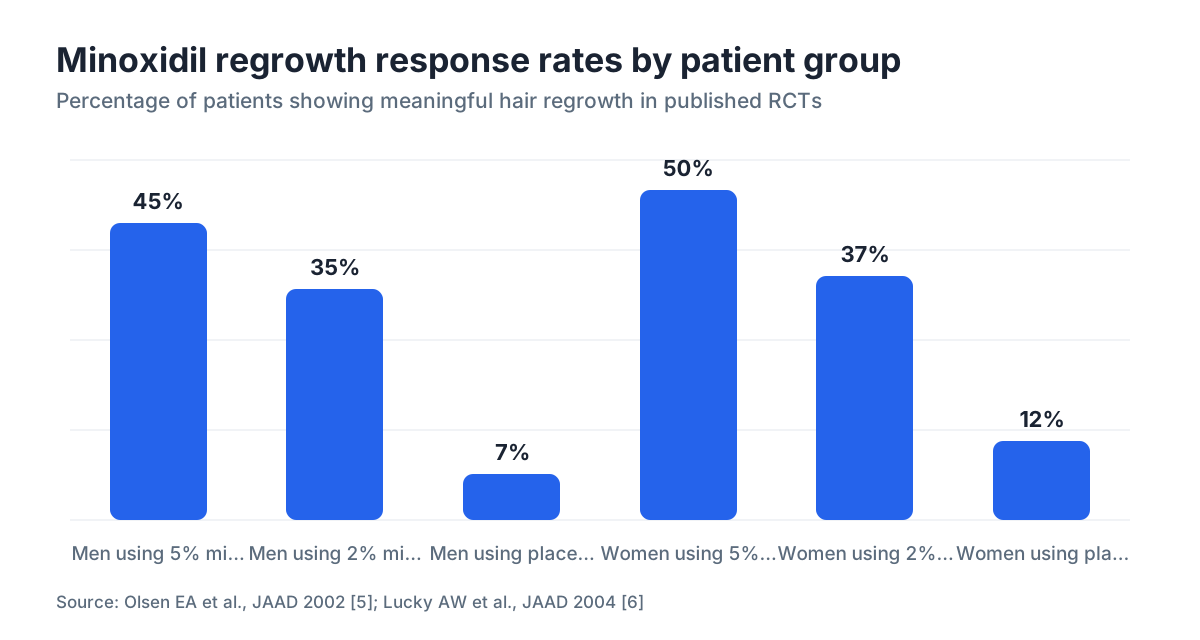
See no change at all by month 6? Two things to weigh: check that you've been applying it correctly and consistently, and accept that minoxidil simply doesn't work for everyone. Studies suggest real regrowth in roughly 30 to 40 percent of men and closer to 50 percent of women with androgenetic alopecia, though response definitions vary across trials [5][6]. The rest see stabilization or no change.
If you're not seeing results and wondering whether something else is driving your loss, reading about what causes hair loss can help rule out other factors.
Can women use minoxidil for men (the 5% version)?
This is one of the most searched questions about minoxidil, and the answer is more nuanced than a flat yes or no.
The FDA has specifically approved 2% minoxidil for women with androgenetic alopecia [1]. The 5% concentration is FDA-approved only for men. But "not FDA-approved for women" doesn't mean it's dangerous for women. It means the formal approval process used the 2% dose for the female indication.
Real-world use and research tell a more complicated story. A randomized controlled trial published in the Journal of the American Academy of Dermatology compared 2% and 5% minoxidil in women and found 5% produced statistically greater hair regrowth [6]. Many dermatologists do prescribe or recommend 5% to women off-label, particularly the foam, which appears to cause less unwanted facial hair than the 5% liquid (probably because the foam dries faster and is less likely to run).
The main risks for women on 5% minoxidil are more facial hair growth (hypertrichosis) and a higher chance of scalp irritation. Pregnancy is a firm contraindication for any form of minoxidil [4].
The honest take: if you're a woman with significant thinning and 2% hasn't worked after 6 months, ask a dermatologist about 5% foam. Don't just grab the men's product off the shelf without that conversation first.
What are the most common minoxidil mistakes to avoid?
Applying to wet hair is the biggest one, and the most common. Wet hair dilutes the concentration at the scalp surface, and you lose a real fraction of the active dose down the shower drain.
Using more than 1 mL hoping for faster results doesn't work and raises your risk of side effects. The dose-response curve for topical minoxidil flattens above the recommended amount.
Skipping days adds up. Minoxidil's benefit depends on maintained drug levels around the follicle. Miss a couple of doses a week, week after week, and your results drop.
Stopping because of the early shedding is why many people quit before the drug ever gets a chance. The shedding phase lasts 2 to 8 weeks for most people. Quit during it and you've lost nothing but time and money.
Not rinsing your hands leads to facial and hand hair growth. The FDA label lists hypertrichosis (unwanted hair growth) as an adverse effect, and hand-to-face transfer is a known route [4].
Applying it and going straight to sleep. If it hasn't dried, it transfers to your pillow and off your scalp. This matters for efficacy and for anyone who sleeps next to you, since minoxidil absorbed through their skin can affect them too.
For a full breakdown of what can go wrong, the minoxidil side effects article covers everything from scalp irritation to the rarer cardiovascular signals worth knowing.
Should you use minoxidil with finasteride or other treatments?
For men with androgenetic alopecia, minoxidil plus finasteride is the most evidence-backed approach short of a hair transplant. They work through completely different mechanisms: minoxidil extends follicle life by extending anagen, finasteride cuts DHT, which slows the shrinking process. A 12-month randomized trial found the combination produced statistically greater hair count increases than either drug alone [7].
The tradeoff is running two treatments, each with its own side effect profile. Finasteride carries real risks, sexual side effects in particular, that you should understand before starting. The finasteride and minoxidil article walks through the combination in detail.
For women, finasteride is generally not a first-line treatment, though it's sometimes used off-label in postmenopausal women. Spironolactone is another DHT-blocking option some dermatologists use for women. Combining minoxidil with those is something to work out with a dermatologist rather than self-managing.
For men who want to avoid finasteride's side effects but still address DHT, there are topical finasteride formulations and some DHT blocker supplements, though the evidence on supplements is much weaker.
Minoxidil also stacks reasonably well with low-level laser therapy (LLLT), though the combined benefit data is thin. If you're already doing LLLT, there's no known interaction problem. If you're considering a hair transplant, starting minoxidil before surgery and continuing after is standard practice to protect non-transplanted native hairs.
How long do you have to keep using minoxidil?
Indefinitely. That's the realistic answer.
Minoxidil doesn't cure androgenetic alopecia, it manages it. Stop, and the hairs that regrew because of it enter telogen and shed within 3 to 6 months, and you land back where you would have been without treatment [4]. The FDA label on this is direct: use the drug continuously to keep the regrowth.
This is one of the most important things to grasp before starting. It's a long-term commitment, and for many people a lifelong one. Factor that in. A month's supply of generic 5% solution usually runs $10 to $25, so it's not a huge financial load, but it is a daily routine you're signing up for forever.
If you decide to stop, don't expect the hair to fall out overnight. The shed usually plays out gradually over those 3 to 6 months. Some people wean down to once daily before stopping, though there's no strong evidence this softens the shed much.
For men who want something more permanent, understanding the hair transplant option alongside continued minoxidil use is worth exploring once you've stabilized your loss pattern.
Are there people who should not use minoxidil at all?
Yes, and the FDA label spells several of them out clearly [4].
Pregnancy and breastfeeding: minoxidil should not be used. It's absorbed systemically even in topical form, and the risk to a fetus or nursing infant is not well characterized. This applies to women and to men whose partners are pregnant, since skin-to-skin transfer is possible.
Children under 18: not approved. Pediatric alopecia areata is sometimes treated with minoxidil under specialist supervision, but that's off-label and not something to do without a dermatologist.
Allergy to minoxidil or propylene glycol: the liquid contains propylene glycol as a carrier, which triggers contact dermatitis in a subset of people. If you have a propylene glycol allergy, the foam (which typically doesn't contain it) may be an option.
Severe cardiovascular disease: minoxidil has systemic absorption even topically, and because it widens blood vessels, people with heart failure, coronary artery disease, or who take other blood pressure medications should check with their cardiologist first.
Large scalp wounds, sunburn, or psoriasis: broken skin raises systemic exposure. Let your scalp heal before starting.
If you want to pin down what actually drives your hair loss before committing to any treatment, the what causes hair loss guide is a useful starting point.
How does minoxidil for men differ from minoxidil for women?
The main differences are concentration, approved dose frequency, and the approved area of application.
For men, the FDA-approved product is 5% solution or 5% foam, applied twice daily to the vertex (crown/top of head) [3][4]. Men tend to have more diffuse or vertex-dominant loss in the earlier Norwood stages, and the 5% concentration was studied against those patterns.
For women, the approved concentration is 2%, applied twice daily to the central scalp. The female pattern loss typical of the Ludwig classification involves thinning along the part with the frontal hairline preserved, and the approved application zone reflects that.
The minoxidil for men article goes deeper into the male-specific evidence, dosing considerations, and how to read your response over time.
In clinical practice, many dermatologists use 5% foam for women off-label, citing the JAAD trial showing better regrowth than 2% [6]. The foam dries faster, which cuts the forehead drip that causes unwanted facial hair. If you're a woman who hasn't responded to 2% after 6 months, that conversation is worth having with a dermatologist.
If you're not sure which category of loss you have, a professional assessment matters more than self-selecting a concentration. A free photo-based tool like the MyHairline AI scan (/scan) can read your pattern before your appointment.
What should you do if minoxidil isn't working?
Give it at least 6 months of consistent, correct application before you call it a failure. Most people who say it didn't work either quit during the shedding phase or weren't applying it to a dry scalp consistently.
If you've genuinely used it right for 6 months and see nothing, a few things are worth checking.
First, confirm the diagnosis. Not all hair loss is androgenetic alopecia. Thyroid disorders, iron deficiency, and other medical conditions cause shedding that minoxidil won't touch. A blood panel is worth the money.
Second, consider adding a DHT blocker. If your loss is DHT-driven and minoxidil alone isn't keeping pace, finasteride or another anti-androgen may be the missing piece.
Third, look at whether something else is speeding up your loss. Hair loss supplements occasionally interfere; some contain ingredients with androgen-modulating effects. Even creatine has been questioned here, though the evidence is limited (see does creatine cause hair loss for a clear-eyed look at that debate).
Fourth, if you've lost significant hair and stabilized your pattern, a consultation about a hair transplant becomes relevant. Transplants move permanent follicles from the back of the scalp to thinning areas, and they work regardless of whether minoxidil ever helped you.
Sources
- FDA, Drugs@FDA: Rogaine (minoxidil) approval history
- Messenger AG, Rundegren J. Minoxidil: mechanisms of action on hair growth. British Journal of Dermatology, 2004
- American Academy of Dermatology, Hair Loss: Diagnosis and Treatment
- FDA, Rogaine 5% Solution Prescribing Information / Drug Label
- Olsen EA et al. A randomized clinical trial of 5% topical minoxidil versus 2% topical minoxidil and placebo in the treatment of androgenetic alopecia in men. Journal of the American Academy of Dermatology, 2002
- Lucky AW et al. A randomized, placebo-controlled trial of 5% and 2% topical minoxidil solutions in the treatment of female pattern hair loss. Journal of the American Academy of Dermatology, 2004
- Khandpur S et al. Comparative efficacy of various treatment regimens for androgenetic alopecia in men. Journal of Dermatology, 2002
- American Academy of Dermatology, Hair loss: Tips for managing