TL;DR: FDA-approved DHT blockers (finasteride, dutasteride) have a strong safety record for hair loss, but roughly 2-4% of men get sexual side effects like lower libido or erectile dysfunction. Topical DHT blockers carry far less systemic risk. Supplements sold as natural DHT blockers have almost no clinical safety or efficacy data. The drug you pick, your age, and your baseline health all shift the risk picture a lot.
What is a DHT blocker and how does it work?
DHT stands for dihydrotestosterone. It's a hormone your body makes when an enzyme called 5-alpha reductase converts testosterone into a stronger androgen. In people who are genetically sensitive to it, DHT binds to receptors in hair follicles and slowly miniaturizes them. That miniaturization is the core engine behind androgenetic alopecia, the medical name for male- and female-pattern hair loss. [1]
A DHT blocker is any compound that interrupts that process. The interruption happens at one of two points. Either it blocks the 5-alpha reductase enzyme so less DHT gets made (that's finasteride and dutasteride), or it competes with DHT at the follicle receptor itself (which some topical agents attempt, with much weaker evidence).
Finasteride targets type II 5-alpha reductase and cuts scalp DHT by roughly 60 to 70%. Dutasteride targets both type I and type II, dropping DHT by around 90%. [2] That gap matters. More DHT suppression means more of the hormone gets knocked down across your whole body, which is part of why dutasteride carries a wider side-effect profile.
Saw palmetto, pumpkin seed oil, and spearmint tea get sold as "DHT blockers" all the time. They show some weak 5-alpha reductase inhibiting activity in test-tube studies. The human clinical evidence is thin. If you want the fuller picture on what's actually documented across dht blocker options, including the supplements, that page covers the whole category.
The safety question splits into three separate conversations depending on what you're asking about: prescription oral drugs, topical formulas, or supplements. They are not the same thing, and lumping them together is how people get bad advice.
Is finasteride safe for hair loss?
Finasteride is FDA-approved for male pattern hair loss at the 1 mg dose (brand name Propecia), cleared in 1997, and it has decades of post-market safety data behind it. [3] Most men who take it tolerate it without real trouble. But "safe" isn't the same as "risk-free," and the FDA has forced label warnings over the years that you need to know before you swallow a pill.
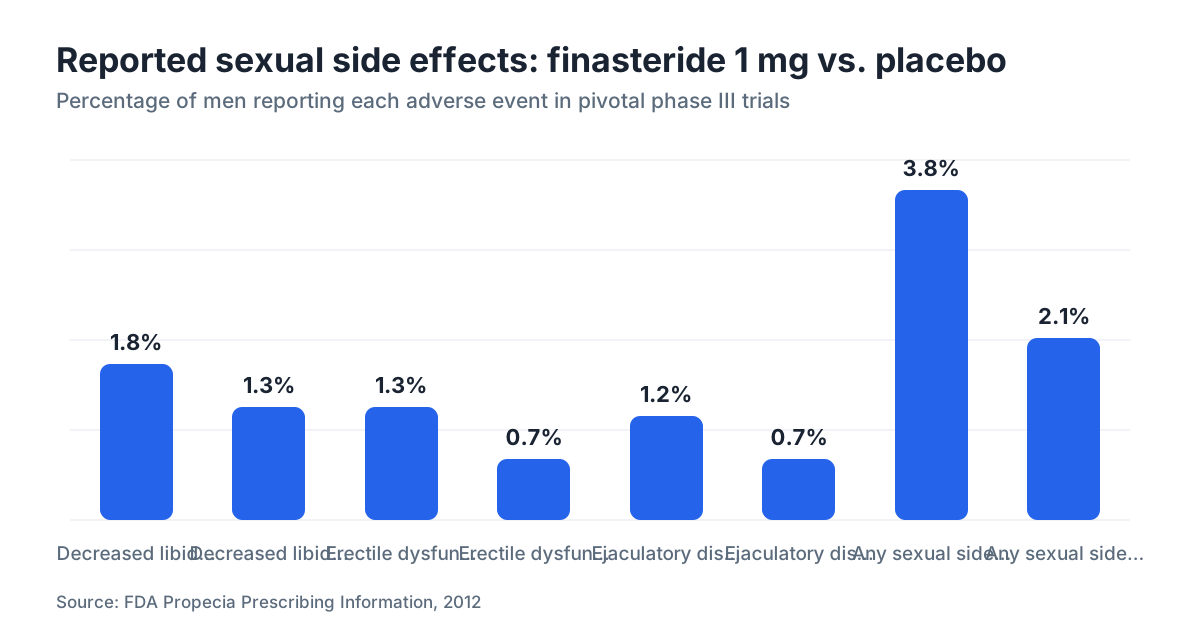
The side effects everyone talks about are sexual: lower libido, erectile dysfunction, and reduced ejaculate volume. In the original phase III trials, these showed up in about 3.8% of finasteride users versus 2.1% on placebo. So the drug-attributable rate sits somewhere around 1 to 2 percentage points above background. [3] For most men who stop, the effects go away. The argument is about a smaller group.
In 2012, the FDA added a warning about post-finasteride syndrome (PFS), a cluster of sexual, neurological, and psychological symptoms that some men report continuing even after they quit the drug. The real prevalence is genuinely contested in the literature, and the biological mechanism isn't nailed down. The FDA label now states: "Reports of depression, and less commonly, suicidal ideation, have been reported in patients taking finasteride 1 mg." [3] Take that warning seriously.
Mood effects are real enough that a personal or family history of depression is worth raising with a prescriber before you start. That's not an automatic reason to skip finasteride. It's a reason to go in with your eyes open.
Long-term data out to five years shows no rise in cardiovascular events, liver toxicity, or bone density loss at the hair-loss dose. The 5-alpha reductase inhibitor class has also been studied heavily in men taking far higher doses (5 mg) for enlarged prostate, which gives a reasonable safety ceiling for the lower hair dose.
You can read a much deeper breakdown of how the drug works, dosing, and the full trial numbers in our finasteride article.
Is dutasteride safe for hair loss?
Dutasteride (brand name Avodart) is FDA-approved for enlarged prostate at 0.5 mg daily and used off-label for hair loss in the United States. It's approved for androgenetic alopecia in South Korea and Japan. [4]
Because it blocks both type I and type II 5-alpha reductase, dutasteride suppresses body-wide DHT harder than finasteride. That's likely why a 2019 meta-analysis in JAMA Dermatology found it beat finasteride for hair regrowth, and also why its side-effect profile gets extra scrutiny. [4]
Sexual side effects show up at similar or slightly higher rates than finasteride. Gynecomastia (breast tissue growth) is documented across the whole 5-ARI class, though it stays uncommon. Here's the difference that actually matters day to day: dutasteride has a half-life of roughly 5 weeks, against finasteride's 6 to 8 hours. [2] So if side effects hit, they take much longer to clear once you stop. That long washout is a practical fact anyone considering the drug should weigh.
Dutasteride is contraindicated in women who are pregnant or may become pregnant. The drug absorbs through skin, which is why the capsules carry a warning against handling by women of childbearing potential. Finasteride carries the same pregnancy contraindication. [3]
Neither drug should be taken by a pregnant woman. Full stop. The birth defect risk to a male fetus is well documented.
Are topical DHT blockers safer than oral ones?
Yes, almost certainly, and by a meaningful margin. Topical finasteride (usually a 0.25% solution painted on the scalp) puts the drug where you want it while keeping blood levels far lower than the oral pill. A 2021 study in the Journal of the American Academy of Dermatology found that topical finasteride 0.25% applied daily cut scalp DHT about as well as oral finasteride, while blood (serum) DHT suppression was significantly lower. [5]
That pharmacokinetic gap is exactly why compounding pharmacies have gotten popular for topical finasteride, and why some dermatologists treat it as a reasonable first choice for men who worry about systemic side effects but still want prescription-strength blocking.
Minoxidil works through a completely different mechanism (it's a vasodilator, not a DHT blocker), but people often pair it with DHT blockers. If you want minoxidil's own risk profile, the minoxidil side effects article covers it separately.
The catch with topical finasteride is that it's mostly compounded, so it isn't FDA-approved as a finished topical product (an approved topical spray has appeared in some markets more recently). Compounded products vary in quality and absorption. There's also far less long-term safety data on the topical route than on the decades of oral data.
For topical "natural" blockers like rosemary oil, ketoconazole shampoo, or saw palmetto topicals, systemic risk sits close to zero because so little absorbs. The honest trade-off is that efficacy is close to nil too.
Are natural DHT blockers safe?
Broadly, yes. Saw palmetto, pumpkin seed oil, spearmint, and green tea extract are well tolerated at normal doses with no serious safety signals. That's the good news.
The less good news: their power as DHT blockers in actual humans is mostly theoretical or propped up by small, low-quality studies. A 2012 randomized controlled trial in ISRN Dermatology found saw palmetto improved hair count in 38% of participants versus 68% for finasteride. That's a modest result at best, well under the prescription benchmark. [6]
Saw palmetto can cause occasional GI upset, and there are rare case reports of liver injury at high doses, though proving cause in those cases is hard. Pumpkin seed oil is very safe by any reasonable measure. Biotin gets taken constantly and has almost no evidence for hair loss unless you have an actual biotin deficiency, which is rare.
One real safety problem with supplements is what's in the bottle. The FDA does not check supplements for efficacy before they hit shelves, and third-party testing keeps finding that contents don't match labels. [7] So even for a generally safe compound, you might not be getting what you paid for.
A more thorough look at what the evidence actually says about hair loss supplements is worth reading before you spend money in this category.
What are the specific side effects of DHT blockers by drug?
Here's a side-by-side of the documented side effect profiles for the main DHT-blocking options.
| Side effect | Finasteride 1 mg (oral) | Dutasteride 0.5 mg (oral) | Topical finasteride 0.25% | Saw palmetto (supplement) |
|---|---|---|---|---|
| Decreased libido | ~1.8% above placebo [3] | Similar or slightly higher [4] | Likely lower [5] | Rare/not established |
| Erectile dysfunction | ~1.3% above placebo [3] | Similar [4] | Likely lower [5] | Rare |
| Ejaculatory disorders | ~1.2% above placebo [3] | Similar [4] | Likely lower [5] | Rare |
| Depression/mood changes | Labeled warning [3] | Labeled warning | Unknown | Not established |
| Gynecomastia | Rare (<1%) | Rare (<1%) [2] | Very rare | Not established |
| Birth defect risk | Yes (pregnancy contraindicated) [3] | Yes (pregnancy contraindicated) [3] | Yes | No |
| Persistence after stopping | Minority of users (PFS) [3] | Longer washout (5-wk half-life) [2] | Unknown | N/A |
The numbers here come from FDA label data and published trials. The placebo rate for sexual side effects in the finasteride trials was 2.1%, so a chunk of what men blame on the drug happens in placebo groups too. That doesn't erase the real drug-attributable events, but the absolute numbers need that context.
If you want help figuring out where you stand before you commit to any of these, the free AI hair analysis at MyHairline can identify your pattern and loss stage, which matters a lot for deciding whether a DHT blocker is even right for you.
Can women safely take DHT blockers?
This is messier than the men's version of the question.
Finasteride is not FDA-approved for hair loss in women. Dermatologists sometimes prescribe it off-label for postmenopausal women with androgenetic alopecia, and some use it in premenopausal women who are on reliable contraception, because the birth defect risk to a male fetus is real and serious. The FDA label is blunt: finasteride is contraindicated in women who are or may become pregnant. [3]
For premenopausal women with female-pattern loss, the usual starting point is topical minoxidil. Spironolactone, which has anti-androgen effects (it blocks androgen receptors rather than DHT production), gets prescribed off-label too and has a longer track record in women. Spironolactone isn't technically a 5-alpha reductase inhibitor, but it acts on a nearby part of the androgen pathway.
Postmenopausal women weighing finasteride off-label should talk it through with a dermatologist or endocrinologist who knows the trial data. Small studies show some benefit. The evidence base is thinner than it is for men.
Natural blockers like saw palmetto sometimes get used by women worried about hair loss. They're generally safe for women who aren't pregnant, but the efficacy data is weak for both sexes.
If you're a woman trying to figure out why you're losing hair in the first place, what causes hair loss walks through the full differential, including conditions like telogen effluvium that have nothing to do with DHT.
Does blocking DHT affect the rest of your body?
DHT does far more than mess with your scalp. It's tied up in prostate health, body composition, bone density, red blood cell production, and brain function. Block it body-wide and you get downstream effects, some of which are the whole point.
Prostate: 5-alpha reductase inhibitors at 5 mg are a first-line treatment for enlarged prostate, so shrinking prostate volume is an expected outcome. At the 1 mg hair dose, PSA levels drop by roughly 50%, which matters because it can mask prostate cancer on a PSA screen. [3] Any man on finasteride who gets a PSA test should tell his doctor, because the lab value has to be read against that baseline drop.
Bone density: no strong evidence of meaningful loss at the 1 mg dose across studies up to five years. The 5 mg prostate literature doesn't show clinically meaningful bone changes either.
Brain and mood: this is where the science argues loudest. DHT has neurosteroid activity, and some researchers propose that dropping it drives the cognitive fog and mood shifts a few men report. Animal studies show finasteride changes brain neurosteroid levels, but human data is limited, and the FDA warning rests on adverse event reports, not a controlled trial proving cause. [3]
Muscle and body composition: DHT feeds muscle development. At the hair dose, most trials haven't found statistically significant changes in lean mass or strength, though anecdotes about weaker gym sessions keep circulating. Good long-term randomized data is missing here.
Creatine users have their own worry. Creatine has been floated as a way to raise DHT through a separate mechanism. If that interests you, the does creatine cause hair loss article picks apart the single study that fuels the claim.
What is post-finasteride syndrome and how common is it?
Post-finasteride syndrome (PFS) is a set of persistent symptoms, mainly sexual dysfunction, cognitive changes, and mood disturbances, that some men report lasting months to years after they stop finasteride. The Post-Finasteride Syndrome Foundation has collected case series, and the FDA has logged adverse event reports.
The honest answer on how common it is: nobody has reliable population-level data. The closest controlled numbers come from the original trials, where the 3.8% of men who had sexual side effects mostly saw them resolve within weeks after stopping. But those trials weren't built to track long-term persistence after discontinuation.
A 2020 review in Sexual Medicine Reviews looked at the PFS literature and concluded the syndrome is likely real in a subset of men, while the prevalence estimates range so widely (from well under 1% to much higher in symptom-reporting databases) that no precise number holds up. The methodological problems include recall bias, nocebo effects, and the absence of pre-treatment baseline assessments in most reported cases. [8]
The FDA label does say: "In clinical studies with PROPECIA, sexual adverse experiences resolved upon discontinuation of therapy in men who reported these events." It also carries the updated mood and depression warning. [3] Both statements are true for different groups of people.
If you're weighing this risk, the sane move is to talk through your baseline sexual health and mental health history with a prescriber before starting, and to lock in a clear check-in at three months.
How do DHT blockers compare to other hair loss treatments in terms of safety?
Every hair loss treatment has its own safety profile, and comparing them honestly means being specific about which risks you're weighing.
Topical minoxidil is very safe systemically for most people. Its risks are mostly local (scalp irritation, contact dermatitis from propylene glycol in some formulas) or cosmetic (unwanted facial hair). Oral minoxidil at low doses (0.25 to 5 mg) is increasingly used off-label and carries cardiovascular considerations including fluid retention and heart rate changes. The oral minoxidil article covers that in detail.
Finasteride plus minoxidil (finasteride and minoxidil together) is probably the strongest medical approach for androgenetic alopecia, but the combined safety picture is basically additive. You take on both drugs' risk profiles at once.
Hair transplant surgery is safe in skilled hands, but it's surgery, which means real if low risks: infection, scarring, poor growth, anesthesia reactions. It also doesn't stop ongoing DHT-driven loss in the hair you didn't transplant, which is why most surgeons want you on a DHT blocker afterward. The hair transplant article walks through the risks.
For a receding hairline specifically, the decision leans hard on your stage. Someone at an early Norwood II may do well on finasteride alone. Someone at Norwood V is probably looking at a combination approach. More on that at receding hairline.
For men whose loss isn't androgenetic at all, DHT blockers do nothing except expose them to side-effect risk with zero payoff. Getting the diagnosis right first matters more than most people think.
Who should not take DHT blockers?
Several groups should avoid prescription DHT blockers or use them only under close medical supervision.
Women who are pregnant or may become pregnant: the birth defect risk to a male fetus is firmly established. Both finasteride and dutasteride carried FDA Pregnancy Category X and are now described under the current labeling rule as contraindicated in pregnancy. [3]
Men with a history of depression or suicidal ideation: the FDA warning on mood changes and suicidal thoughts exists because adverse event data flagged those events. Depression isn't rare in young men, and adding a drug with labeled mood risks without close monitoring is a legitimate worry.
Men with low libido or existing sexual dysfunction: starting a drug that can lower libido further deserves a frank talk with a prescriber first.
Anyone with known liver disease: finasteride is processed by the liver. Severe liver disease can shift drug levels, so liver function should be normal before starting.
Men on active PSA surveillance for prostate cancer should clear finasteride with their urologist first, since the drug halves PSA and can muddy monitoring.
Adolescents: neither drug is approved for or well-studied in men under 18. Hair loss in younger teens often has other causes, and the effect of suppressing DHT during adolescent development hasn't been studied properly.
For most healthy adult men with confirmed androgenetic alopecia, the risk-benefit math for finasteride 1 mg favors the drug based on the evidence. That's a medical opinion backed by multiple clinical guidelines. It's also a personal call, and nobody should pressure you either way.
How can you reduce the risks if you do take a DHT blocker?
If you've decided prescription DHT blockers make sense for you and a prescriber agrees, a few moves cut the risk in real terms.
Start at the lowest effective dose. For finasteride, that's the approved 1 mg for hair loss. No evidence says higher doses grow more hair, and they probably raise side-effect risk.
Consider topical finasteride if sexual side effects are your main fear. The lower systemic absorption in pharmacokinetic studies makes it a rational first option for cautious users. [5]
Give your prescriber your full history upfront, including any depression, anxiety, sexual dysfunction, or liver disease.
Make sure your doctor knows you're on finasteride before any PSA test. The standard guidance is to double your PSA result to estimate your true level. [3]
Set a firm review date. Most clinicians reassess response and tolerability at 3 months, because sexual side effects that do happen usually show up in the first few weeks. If you're having problems at 3 months, you can decide with real information: continue, cut the dose, switch to topical, or stop.
Don't quit cold if you're stable and it's working. Stopping finasteride generally reverses the hair benefit over 6 to 12 months. Some men try every-other-day dosing to manage side effects, though that isn't well-studied for either efficacy or safety.
If you're not sure what stage of loss you have, or whether a DHT blocker even fits your pattern, get an objective read first. MyHairline's free AI hair scan at myhairline.ai/scan can help you understand what you're dealing with before you bring a specific treatment to a prescriber.
Sources
- StatPearls (NCBI Bookshelf), Androgenetic Alopecia
- StatPearls (NCBI Bookshelf), Dutasteride
- FDA, Propecia (finasteride) Prescribing Information
- JAMA Dermatology, 2019, Comparisons of dutasteride with finasteride for androgenetic alopecia (meta-analysis)
- Journal of the American Academy of Dermatology, 2021, Topical finasteride pharmacokinetics study
- ISRN Dermatology, 2012, Randomized trial of saw palmetto vs. finasteride for androgenetic alopecia
- FDA, Dietary Supplements
- Sexual Medicine Reviews, 2020, Post-finasteride syndrome: a review
- FDA, Drug Safety and Availability
- American Academy of Dermatology, Hair Loss: Diagnosis and Treatment
- Journal of Urology, 2013, Effects of finasteride on semen parameters in men with androgenetic alopecia