
TL;DR: DHT (dihydrotestosterone) is the hormone that shrinks hair follicles in men with genetic hair loss. Finasteride is the only oral DHT blocker with strong clinical proof, cutting scalp DHT by roughly 70% and halting loss in about 87% of men. Dutasteride cuts more DHT but isn't FDA-approved for hair. Topical options and supplements exist but have far weaker evidence.
What is DHT and why does it cause hair loss in men?
DHT stands for dihydrotestosterone. It's made when an enzyme called 5-alpha reductase converts testosterone into a more potent androgen. That conversion happens all over the body, but in men with a genetic sensitivity to DHT, it does real damage at the scalp.
Follicles that are genetically sensitive to DHT respond by miniaturizing over time. Each hair growth cycle (anagen) gets shorter. The hairs that grow back come in finer and shorter, until eventually the follicle stops producing visible hair altogether. This process is called androgenetic alopecia, and it's the reason about 50% of men have noticeable hair thinning by age 50 [1].
Here's the part most men miss. DHT doesn't cause the genetic sensitivity. Your genes decide whether your follicles are vulnerable. DHT is just the trigger that switches it on. That's why two brothers can have identical testosterone levels and one goes bald while the other keeps a full head of hair.
For a broader look at why men lose hair, see what causes hair loss.
How do DHT blockers work?
A DHT blocker either stops DHT from being made or stops it from binding to the androgen receptor inside the hair follicle. Most of the clinically studied options work by inhibiting 5-alpha reductase, the enzyme that makes DHT.
There are two types of 5-alpha reductase. Type 1 lives mostly in skin and sebaceous glands. Type 2 sits mainly in the prostate and scalp hair follicles. Different drugs block different types, and that distinction drives both how well a drug works and how likely it is to cause side effects.
A smaller group of ingredients, like saw palmetto, try to block DHT from binding at the receptor level rather than cutting production. The evidence for that mechanism in the human scalp is thin.
One thing worth understanding: blocking DHT systemically lowers your body's total DHT level, more than the scalp's alone. That's why oral DHT blockers cause sexual side effects for some men. Topical formulations try to keep the drug's action local, though how well they actually stay put is still being studied [2].
Which DHT blockers actually have clinical evidence?
Here's where the field splits hard. Two drugs have real trial data. Everything else is a distant third.
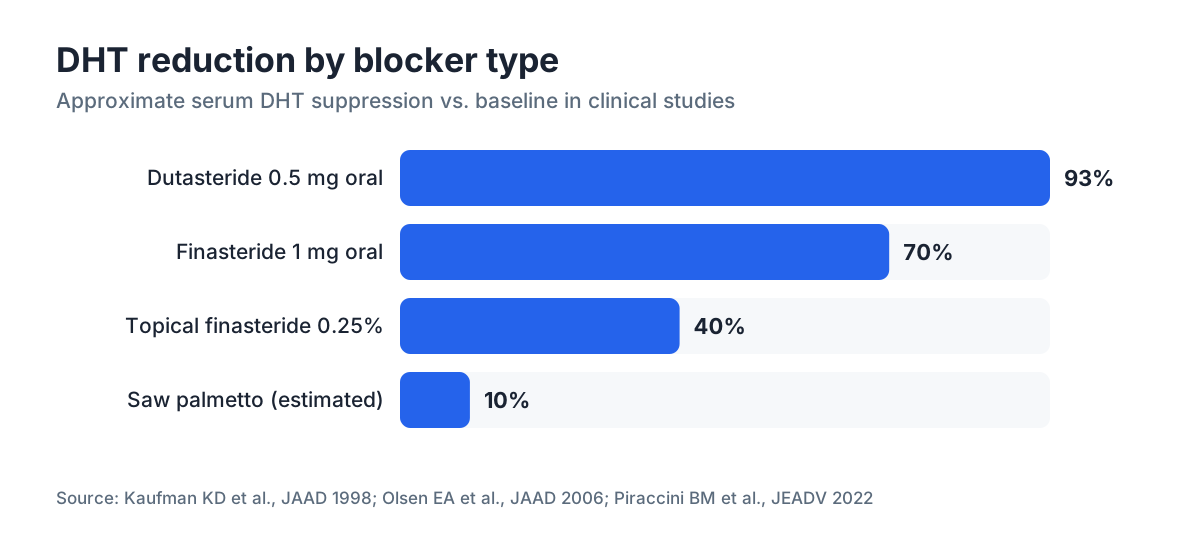
Finasteride (Propecia, generic) is the gold standard. It blocks Type 2 5-alpha reductase, which cuts serum DHT by about 70% and scalp DHT by roughly the same margin [3]. The registration trials found that 83-87% of men maintained or increased hair count over two years, compared to continued loss in placebo groups [3]. It's FDA-approved for male androgenetic alopecia at 1 mg daily. Learn more in our full breakdown of finasteride.
Dutasteride (Avodart) blocks both Type 1 and Type 2 5-alpha reductase, which cuts DHT more aggressively, somewhere around 90-95% [4]. Clinical trials found it outperforms finasteride on hair count at 0.5 mg daily [4]. The catch: the FDA approved it for benign prostatic hyperplasia, not hair loss. Dermatologists do prescribe it off-label for hair, and it's approved for hair loss in South Korea and Japan. If you're considering it, you'll need a prescription and a frank talk about side effects.
Topical finasteride is a newer format, usually compounded at 0.25% concentration, sometimes combined with minoxidil. The idea is to apply it straight to the scalp to lower scalp DHT while limiting how much reaches the bloodstream. A 2022 study found topical finasteride 0.25% once daily cut scalp DHT significantly and produced hair count improvements comparable to oral finasteride, with less serum DHT suppression [2]. That sounds good, but the long-term data is thin. This is an active research question, not a settled one.
For men already using or considering finasteride and minoxidil together, the combination is where most dermatologists land for moderate-to-severe loss.
| DHT Blocker | FDA Approval (hair) | DHT Reduction | Evidence Quality |
|---|---|---|---|
| Finasteride 1 mg oral | Yes | ~70% | Strong (multiple RCTs) |
| Dutasteride 0.5 mg oral | No (off-label) | ~90-95% | Good (RCTs, off-label) |
| Topical finasteride 0.25% | No | Moderate (serum lower) | Emerging |
| Saw palmetto | No | Unclear | Weak |
| Pumpkin seed oil | No | Unclear | Very weak |
What about natural DHT blockers like saw palmetto?
Saw palmetto gets a lot of attention in the supplement aisle, and there is some biological plausibility to it. The fatty acids in saw palmetto extract may inhibit 5-alpha reductase, at least in lab conditions.
The human trial data is modest. A small 2002 study found saw palmetto extract beat placebo for self-reported hair improvement, but the methodology was weak. A tougher head-to-head against finasteride (the CHART study, published in the Journal of Alternative and Complementary Medicine in 2012) found finasteride statistically outperformed saw palmetto on both blinded photographic assessment and hair count, though saw palmetto beat placebo in some measures [5].
Pumpkin seed oil has one small randomized controlled trial (24 weeks, 76 men) suggesting some hair count improvement over placebo [6]. That's a single study with a small sample. Nobody should make a real treatment decision on that alone.
Biotin, zinc, and keratin supplements show up constantly in DHT blocker products. These don't block DHT at all. They may help hair health in men who have a genuine deficiency, but for the typical man losing hair to androgenetic alopecia, they do nothing you'd notice.
If you want to see what the supplement evidence actually shows, the hair loss supplements breakdown is worth reading.
My honest take on natural options: saw palmetto might do something mild for some men, but it's not in finasteride's league. If you want something that visibly slows androgenetic alopecia, the supplement shelf won't get you there reliably.
What are the side effects of DHT blockers men should know about?
The side effects that get the most attention are sexual: reduced libido, erectile dysfunction, and decreased ejaculate volume. In the original finasteride trials, these occurred in about 3.8% of men on the drug versus 2.1% on placebo [3]. The FDA label documents them.
There's a more contested phenomenon called Post-Finasteride Syndrome (PFS), where some men report persistent sexual or cognitive effects after stopping the drug. The FDA updated the label in 2012 to acknowledge reports of persistent sexual dysfunction after discontinuation [7]. Honest answer: the incidence of PFS is unclear, estimates range widely, and the mechanism is debated. The Propecia label itself states that "in clinical studies with PROPECIA... sexual adverse experiences resolved in men who discontinued therapy."
Dutasteride has a longer half-life (about 5 weeks vs 6-8 hours for finasteride), so it stays in your system longer [11]. The side effect profile is similar, but if you want to stop, it takes much longer to clear.
Gynecomastia (breast tissue growth) is listed as a rare adverse effect on both finasteride and dutasteride.
For topical finasteride, less systemic absorption means less serum DHT suppression, which in theory means fewer systemic side effects. But "lower" is not "zero." The 2022 topical study still measured reduced serum DHT, just less than with oral [2].
Men with a history of prostate cancer, liver problems, or who may conceive children (finasteride is a known teratogen) should not use these drugs. This is a prescription medication decision, not a supplement purchase.
How long does it take a DHT blocker to work?
Slow. That's the honest answer, and it catches a lot of men off guard.
Finasteride starts cutting DHT within days of the first dose. But the hair cycle is slow. Miniaturized follicles don't reverse overnight. Most men see the first sign of effect as stabilization, meaning they stop losing hair rather than growing it back. Real hair count improvement, if it comes, usually shows up between 6 and 12 months [3].
The classic mistake is quitting at month 3 or 4 because "it isn't working." Most of the benefit data comes from 12-to-24-month follow-up. Quit early and you'll never know whether you were one of the 83-87% who would have stabilized.
Stop taking a DHT blocker and DHT levels climb back to baseline fast. Hair loss resumes. Most men who quit finasteride return to their pre-treatment loss trajectory within 9-12 months. That makes this an indefinite commitment for as long as you want the benefit.
Dutasteride follows a similar timeline but takes longer to fully clear after you stop, thanks to that long half-life [11].
Should men use a DHT blocker and minoxidil together?
Yes. If you're going to treat androgenetic alopecia seriously, combination therapy makes sense. They work through entirely different mechanisms.
Minoxidil doesn't block DHT at all. It's a vasodilator that stretches the anagen (growth) phase of the hair cycle and improves blood flow to the follicle. A DHT blocker reduces the hormonal signal that miniaturizes follicles. Together, they hit two separate parts of the problem.
Several trials have looked at combination therapy and found it beats either treatment alone on hair count. The FDA has approved minoxidil as a topical treatment for androgenetic alopecia in both 2% and 5% concentrations. Minoxidil for men covers dosing and application in detail.
Oral minoxidil at low doses (0.25-1.25 mg daily) is increasingly used off-label and shows strong results in some studies. If you want to see how that stacks up against topical, the oral minoxidil article walks through the evidence.
The most common regimen in practice: finasteride 1 mg daily plus topical minoxidil 5% once or twice daily. That's where the real-world data is strongest. A hair transplant, if you're weighing one, doesn't hold up well without medical treatment in place to protect the rest of your hair. See hair transplant for how that fits into a longer plan.
Can DHT blockers regrow hair or just stop loss?
Both, but to different degrees and not for everyone.
Finasteride's main effect is halting progression. In the 2-year trials, 83% of men on finasteride held their hair count compared to 28% of placebo [3]. Actual regrowth (a net increase in terminal hair count) happened in a meaningful subset, roughly 66% saw some increase in hair count over two years in one analysis.
How much you regrow depends heavily on how long the follicle has been miniaturized. A follicle that's been pushing out thin, short hairs for two years has a far better shot at recovery than one that's been dormant for a decade. This is why starting early matters so much.
The harsh reality: once a follicle is truly gone, no DHT blocker brings it back. If you have areas of complete baldness with no visible hair, finasteride won't fill them in. That's the domain of hair transplant surgery.
For men in early stages (Norwood 2-3), DHT blockers have the best shot at real preservation and some regrowth. For men at Norwood 5-6, stabilizing what's left is the realistic goal.
Are DHT blockers safe for long-term use?
The long-term safety record for finasteride at 1 mg is reasonably good. The Prostate Cancer Prevention Trial, which used finasteride at 5 mg (the dose for prostate conditions, five times the hair loss dose), ran for 7 years and produced a lot of safety data [8]. At the hair loss dose, men have been using it since its 1997 FDA approval, close to 30 years.
The main long-term concern that comes up is prostate cancer risk. The Prostate Cancer Prevention Trial found lower overall prostate cancer incidence in finasteride users but a slightly higher rate of high-grade cancers, though later analysis suggested this was probably a detection artifact rather than a real biological increase [8]. At the 1 mg hair loss dose, this question isn't well-studied on its own.
For men over 40, regular PSA (prostate-specific antigen) monitoring matters. Finasteride lowers PSA by roughly 50%, which can mask an elevated reading that would otherwise prompt a workup for prostate cancer. Your doctor needs to know you're on it and adjust the interpretation of any PSA test accordingly. The FDA label for finasteride says so explicitly [7].
At the population level, finasteride is one of the more studied hair loss treatments available. That doesn't make it risk-free. It means the risk profile is relatively well-characterized compared to newer or unregulated options.
What about DHT-blocking shampoos?
Ketoconazole shampoo is the one with actual data. A small 1998 randomized trial compared 1% ketoconazole shampoo to 2% zinc pyrithione shampoo and found comparable hair density improvements [9]. Ketoconazole has antifungal properties and may have weak anti-androgenic effects, but the evidence for it as a real standalone DHT blocker is preliminary at best.
Plenty of shampoos are marketed as DHT blockers using saw palmetto, biotin, or peppermint oil. A shampoo sits on your scalp for minutes. The odds that active ingredients penetrate deep enough into the follicle in that window to change DHT activity are very low. There's no trial evidence backing shampoos as a primary treatment for androgenetic alopecia.
Ketoconazole shampoo (2% prescription, or 1% over the counter as Nizoral) is a reasonable add-on for men treating scalp inflammation or seborrheic dermatitis alongside their main treatment. As a standalone DHT blocker? No.
If a shampoo is marketed as "DHT-blocking" without ketoconazole in the formula and without a clinical citation, it's almost certainly a marketing story, not a treatment.
How do I get a DHT blocker prescription?
Finasteride and dutasteride both require a prescription in the United States. You can get one through a primary care physician, a dermatologist, or a board-certified hair restoration specialist. Dermatologists are often the best starting point because they see hair loss patterns every day and can accurately read your Norwood stage and judge whether medical treatment fits.
Several telehealth platforms now write finasteride prescriptions after an online consultation. Quality varies. What matters is that whoever prescribes it takes a reasonable medical history, asks about sexual function at baseline, and explains what to watch for.
Generic finasteride 1 mg is widely available and cheap. GoodRx prices put it around $15-30 per month depending on pharmacy and location. Brand-name Propecia costs much more and offers no clinical advantage over generic.
Before you start, figure out where your hair loss actually stands. Tracking your hairline and density over time gives you a baseline to compare against. Tools like the free AI hair analysis at MyHairline can help you document your current pattern before treatment so you have something to measure at 6 and 12 months.
A receding hairline that's just starting is the ideal time to act. Early intervention has a much higher success rate than trying to rescue hair loss that's been progressing for years.
Does creatine cause hair loss by raising DHT?
This question comes up constantly among men who train. The worry traces back to a 2009 study of college rugby players that found creatine supplementation raised DHT levels by about 56% over three weeks while testosterone stayed steady [10]. That's a real study with a real finding.
But the study didn't measure hair loss. The DHT increase stayed inside the normal physiological range. There are no human trials showing creatine causes or speeds up androgenetic alopecia in men.
For men who already have genetic sensitivity to DHT, the real question is whether creatine-driven DHT bumps make any practical difference to how fast hair falls out. Honest answer: nobody has good data on this. The closest evidence is that single rugby study, and it wasn't built to study hair.
If you're genetically predisposed and worried, the does creatine cause hair loss breakdown covers what the evidence actually shows versus what's speculation.
What should men who can't take finasteride do?
Some men can't or won't take an oral 5-alpha reductase inhibitor. Maybe they're having side effects, or they're planning to have children (finasteride is teratogenic and the label advises against conception while on it), or they simply don't want systemic DHT suppression.
Topical finasteride is one option gaining real use among dermatologists, with lower systemic absorption than oral. It's typically compounded at 0.25% and isn't stocked at most retail pharmacies, so you'd need a prescription and a compounding pharmacy.
For these men, minoxidil becomes the primary drug. It doesn't touch DHT, but it's proven, FDA-approved, and many men do well on it. Oral minoxidil at low doses is increasingly prescribed for men who find topical application a hassle.
Saw palmetto at reasonable doses is unlikely to hurt, and some men use it as a mild complement when finasteride is off the table. The evidence is weak but the short-to-medium-term safety looks fine.
Platelet-rich plasma (PRP) injections are a non-drug option with some clinical trial support, though the cost runs high (usually $1,500-3,000 per treatment course) and the evidence isn't as strong as for finasteride.
If hair loss has progressed a long way, a hair transplant combined with minoxidil is a viable path. Surgery only moves hair you already have, so keeping medical treatment in place to protect the non-transplanted areas still matters.
Sources
- American Academy of Dermatology, Hair Loss Overview
- Piraccini BM et al., Journal of the European Academy of Dermatology and Venereology, 2022 - Topical finasteride 0.25% for androgenetic alopecia
- Kaufman KD et al., Journal of the American Academy of Dermatology, 1998 - Finasteride 1 mg registration trials
- Olsen EA et al., Journal of the American Academy of Dermatology, 2006 - Dutasteride 0.5 mg vs finasteride for hair loss
- Rossi A et al., Journal of Alternative and Complementary Medicine, 2012 - CHART study: saw palmetto vs finasteride
- Cho YH et al., Evidence-Based Complementary and Alternative Medicine, 2014 - Pumpkin seed oil RCT
- FDA, Propecia (finasteride) prescribing information
- Thompson IM et al., New England Journal of Medicine, 2003 - Prostate Cancer Prevention Trial
- Piérard GE et al., Journal of Dermatological Treatment, 1998 - Ketoconazole shampoo for hair density
- FDA, Avodart (dutasteride) prescribing information