

TL;DR: A receding hairline in men is usually androgenetic alopecia, driven by DHT shrinking hair follicles at the temples and crown. It affects roughly half of men by age 50. Two FDA-approved treatments, minoxidil and finasteride, can slow or partially reverse it. Hair transplants can restore it permanently. Early treatment gives much better results.
What's a receding hairline, exactly?
A receding hairline is the gradual retreat of the frontal hairline away from the forehead, usually starting at the temples. The hairline forms an M, V, or U shape instead of sitting in a straight or gently curved line across the top of the forehead. For most men who develop pattern hair loss, this is the first visible sign of androgenetic alopecia, the clinical name for male pattern hair loss.
The retreat happens because hair follicles in certain scalp zones are genetically sensitive to dihydrotestosterone (DHT), a hormone made from testosterone. DHT binds to receptors in these follicles and progressively shortens each hair's growth cycle. Over years, affected hairs grow in thinner, shorter, and lighter until they stop growing at all. The follicle itself doesn't die right away, which is why early treatment can often reverse some of the loss.
Separate this from other types of hair loss. Temporary shedding from stress or illness (telogen effluvium) looks different: diffuse thinning across the whole scalp rather than a patterned retreat at the temples. Alopecia areata causes patchy circular bald spots, not a hairline shift. If your hairline is moving backward symmetrically at the temples, androgenetic alopecia is the overwhelming probability. [1]
How common is a receding hairline in men?
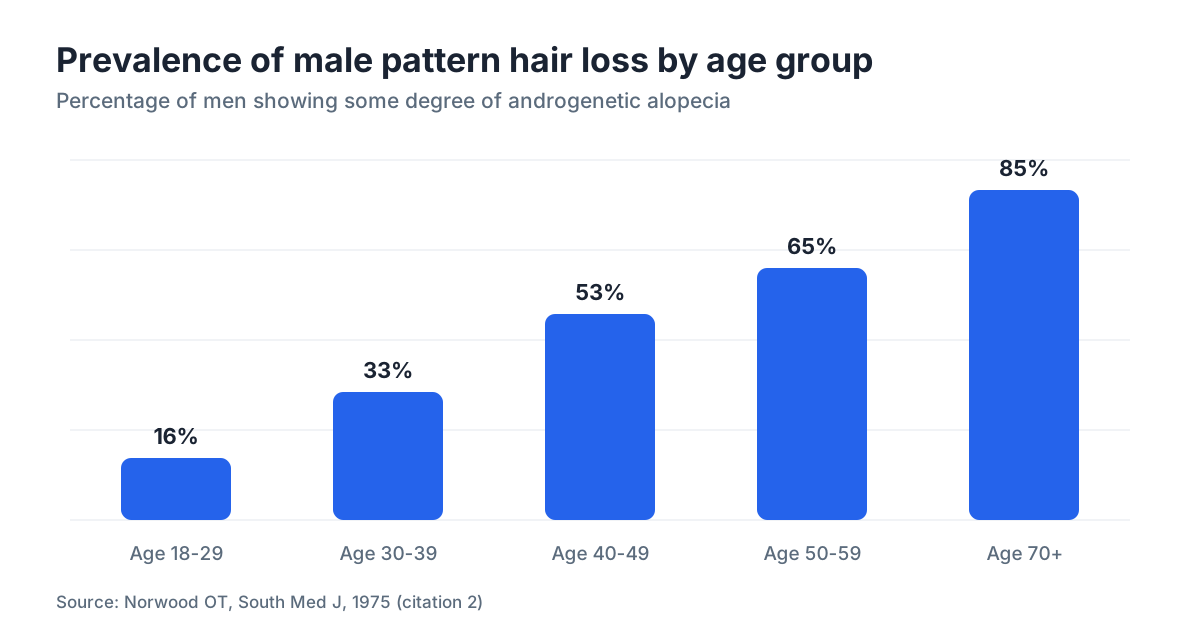
Very common. About 16% of men between 18 and 29 show some degree of male pattern hair loss. That number climbs to roughly 53% by age 40 to 49, and reaches approximately 85% of men by age 70. [2]
Race shifts both likelihood and pattern. Men of European descent have the highest rates of androgenetic alopecia. Men of Asian and African descent tend to have lower rates, though they're far from immune. The genetic predisposition is polygenic, meaning dozens of genes contribute, which is why hair loss can skip generations or hit one brother and not another.
Age of onset matters a lot for eventual severity. Men who start losing hair before 21 tend to progress further on the Norwood scale (the standard staging system) than those who notice their first recession in their 40s. Starting treatment early, before follicles miniaturize completely, is consistently linked to better outcomes in clinical trials.
What causes a receding hairline in men?
The root cause is DHT sensitivity in genetically predisposed follicles. DHT gets produced when the enzyme 5-alpha-reductase converts testosterone in the scalp and other tissues. Men with androgenetic alopecia have follicles in the frontal and vertex scalp that respond to DHT by shortening their anagen (growth) phase, a process called follicular miniaturization. [1]
Genetics sets the stage. The androgen receptor gene on the X chromosome is the strongest known single-gene predictor, which is partly why the old folk wisdom about looking at your maternal grandfather holds a kernel of truth. But the genetics are genuinely complex. Having a bald father raises your own risk too.
Other factors speed up the timeline without being the root cause. Chronic stress raises cortisol and may push follicles into telogen (resting phase) faster. Nutritional deficiencies, particularly low ferritin (stored iron) and low vitamin D, are linked to hair shedding in multiple observational studies, though the evidence that correcting them reverses patterned hair loss specifically is weaker. Scalp health counts: seborrheic dermatitis and chronic scalp inflammation may accelerate miniaturization in already-susceptible follicles.
Some supplements and medications get blamed. Creatine monohydrate, for example, has one small study suggesting it raises DHT levels, though the finding has been debated and never replicated at scale. If this topic interests you, does creatine cause hair loss covers the evidence in detail. Anabolic steroids and certain blood pressure medications (particularly those without DHT-blocking effects) can worsen androgenetic alopecia. See what causes hair loss for a broader breakdown.
How do you stage a receding hairline? The Norwood scale explained
The Hamilton-Norwood scale, developed in the 1950s and refined in 1975, is the standard classification system dermatologists and hair restoration surgeons use. It runs from Type I (no significant recession, essentially a baseline) to Type VII (only a horseshoe-shaped band of hair remaining on the sides and back). [3]
| Norwood Type | What you see |
|---|---|
| I | No recession. Adolescent/young adult hairline. |
| II | Slight recession at temples. Triangular, usually symmetrical. |
| III | Deeper temple recession forming an M shape. Minimum needed for some surgeons to consider transplant. |
| III Vertex | Recession at temples plus thinning at crown, hairline still relatively intact. |
| IV | Significant recession, solid band of hair between front and crown. |
| V | Band narrows. Front and crown loss zones beginning to merge. |
| VI | Front and crown merge, only side and back fringe remains. |
| VII | Horseshoe fringe only. Most advanced. |
Most men who seek treatment sit between Types II and IV, which is exactly the window where FDA-approved medications do the most good. By Type VI or VII, the only effective option is hair transplantation, and even then donor hair supply becomes a planning constraint.
Self-staging isn't always accurate. Photographs taken in consistent lighting, comparing a current photo to one from 3 to 5 years ago, tend to reveal progression that's easy to miss in the mirror day to day.
Which treatments actually work for a receding hairline?
Two medications have FDA approval specifically for male pattern hair loss: topical minoxidil and oral finasteride. Everything else sits somewhere between "probably helpful" and "probably not."
Minoxidil. Originally an oral blood pressure drug, minoxidil was approved by the FDA as a 2% topical solution for men in 1988, with the 5% formulation following in 1997. [4] It works partly by prolonging the anagen phase and partly by widening blood vessels in the scalp, improving follicle oxygenation. Clinical trials for the 5% foam showed 45% of men achieved moderate to dense regrowth over 48 weeks compared to placebo. [4] Minoxidil does not block DHT, so it doesn't address the underlying cause, which means you have to use it continuously to keep results. For a full breakdown of how to use it, see minoxidil for men. The oral form (low-dose 2.5 to 5 mg) is increasingly prescribed off-label and appears effective; oral minoxidil covers the comparison with topical.
Finasteride. Approved by the FDA for male pattern hair loss in 1997 at 1 mg/day, finasteride blocks type-II 5-alpha-reductase, cutting scalp DHT by roughly 60 to 70%. [5] A 5-year clinical trial found 90% of men on finasteride maintained or improved their hair count versus significant loss in the placebo group, and 65% showed visible improvement. [5] It genuinely addresses the hormonal mechanism rather than just compensating for it. The sexual side effects are real but statistically uncommon: the prescribing information cites incidence around 3.8% for sexual dysfunction across trial populations. For the full evidence picture, including the persistent side effect controversy, see finasteride.
Combining both. A 2015 randomized trial in JAMA Dermatology found that combining finasteride and minoxidil produced significantly greater hair count improvement than either drug alone. [6] This is now a common first-line approach for men with Norwood II to IV pattern loss. See finasteride and minoxidil for the dosing details.
DHT blockers and supplements. Saw palmetto, pumpkin seed oil, and ketoconazole shampoo all have some data suggesting modest DHT-blocking effects, but none come close to finasteride's potency or carry FDA approval. Hair loss supplements covers the evidence honestly. DHT blockers compares the options side by side.
Low-level laser therapy (LLLT). A few FDA-cleared devices exist for hair loss. The evidence is generally positive but modest, with trials showing small increases in hair count. It works best as an add-on rather than a standalone treatment.
Platelet-rich plasma (PRP). Increasingly offered in dermatology offices. Some randomized controlled trials show real improvements in hair count and density, but standardization is poor, protocols vary widely between clinics, and long-term data is thin. The American Academy of Dermatology calls it "promising" without endorsing it as a proven standard treatment. [7]
Does a hair transplant fix a receding hairline permanently?
Yes, in the right candidate, a hair transplant is the only option that produces a permanent structural change to the hairline. It moves follicles from the donor area (typically the back and sides of the scalp, which are DHT-resistant) to the thinning frontal zone. Because transplanted follicles keep the genetic characteristics of their donor site, they stay resistant to DHT and keep growing for life in most cases. [8]
There are two main techniques. Follicular Unit Transplantation (FUT) removes a strip of scalp and dissects it into individual grafts, leaving a linear scar. Follicular Unit Extraction (FUE) extracts individual follicular units one at a time using a punch device, leaving tiny circular scars that are less visible with short hair. Results from both are comparable in skilled hands. The choice often comes down to how short you plan to wear your hair and the surgeon's read on your donor density.
Cost in the United States generally runs from $4,000 to $15,000 depending on graft count, technique, and surgeon experience. [8] A modest hairline restoration might need 1,500 to 2,000 grafts. A more extensive case covering recession plus crown thinning can require 3,000 or more.
Here's the catch. A transplant doesn't stop the underlying androgenetic alopecia in native (non-transplanted) hairs. Most surgeons strongly recommend continuing finasteride after a transplant to protect the hairs that weren't moved. Skip the medication afterward and you often get continued loss around the transplanted zone, which can create an unnatural look over time.
For a full breakdown of procedures, recovery, and how to evaluate surgeons, see hair transplant.
How fast does a receding hairline progress?
Slowly for most men, though this varies enormously. Progression is typically measured in years to decades, not months. Some men move from Norwood II to III over 5 to 10 years. Others go from II to V in the same period. There's no reliable way to predict individual rate of progression from genetics alone right now.
The main observable signal of faster progression is age of onset. Research consistently shows that men who begin losing hair in their early 20s tend to reach more advanced Norwood stages by midlife than men who start in their 40s. This probably reflects higher androgen sensitivity in the follicles, not simply more years of exposure.
Physical stressors can trigger a sudden increase in shedding, called telogen effluvium, layered on top of pattern loss. Illness, surgery, crash dieting, and severe psychological stress have all been documented as triggers. This kind of acute shedding can look alarming but usually resolves within 3 to 6 months of the stressor ending. The underlying pattern loss keeps going on its own timeline regardless.
If you're trying to track your own progression, consistent overhead photographs in natural light every 3 months beat the mirror. Smartphone apps or AI tools can help make meaningful comparisons. MyHairline's free AI scan (/scan) can stage your hairline against the Norwood scale from a photo, which some men find useful as a baseline before starting treatment conversations with a dermatologist.
Can you stop a receding hairline without medication?
Honestly, no, not if the cause is androgenetic alopecia. Lifestyle changes can make the environment better for healthy hair growth, but they can't block DHT or change follicular sensitivity to it.
That said, some things genuinely matter. Nutritional deficiencies can accelerate shedding in people who are already predisposed to hair loss. Ferritin levels below roughly 40 ng/mL are linked to increased shedding in multiple studies. Getting a basic blood panel (ferritin, vitamin D, thyroid) before assuming everything is DHT-driven is worth doing, especially if shedding is diffuse rather than patterned.
Scalp health counts more than most guides admit. Chronic seborrheic dermatitis creates scalp inflammation that some researchers believe accelerates follicular miniaturization. A ketoconazole shampoo (like Nizoral 1%) a few times a week has decent evidence for managing seborrheic dermatitis, plus some preliminary data suggesting a mild anti-androgen effect at the follicle. It won't stop serious androgenetic alopecia on its own, but it's a low-cost, low-risk addition.
Hair care habits don't cause receding hairlines. Tight hairstyles (high-tension ponytails, tight braids) can cause traction alopecia, but that's a different condition with a different pattern. Washing your hair daily doesn't speed up DHT-driven hair loss. Neither does wearing a hat.
What do minoxidil's side effects look like and are they serious?
Topical minoxidil's most common side effect is scalp irritation, including dryness, itching, and flaking. This is often a reaction to propylene glycol in the solution formulation rather than to minoxidil itself, and many men find the foam formulation (which doesn't contain propylene glycol) easier to tolerate. [9]
An important and frequently misunderstood side effect is initial shedding, sometimes called the "minoxidil shed." This happens because minoxidil pushes follicles that were in telogen phase into a new anagen cycle, so older hairs shed before new growth emerges. It typically lasts 2 to 8 weeks and is a sign the medication is working, not failing. Many men quit at this point and never see the benefit.
Hypertrichosis (unwanted hair growth on the face or other areas) shows up in some users, particularly with topical application, and is more common in women. Contact dermatitis to minoxidil itself, rather than the vehicle, is rare but documented.
For oral minoxidil, fluid retention and low blood pressure are the main concerns, which is why starting at a low dose (1.25 to 2.5 mg/day) and having blood pressure monitored is standard practice. See minoxidil side effects for the full clinical picture.
How do you choose the right treatment for your stage of hair loss?
The right answer depends on three things: how far your hairline has receded, how much you care about stopping versus restoring it, and your personal tolerance for medication side effects.
For Norwood II to III (mild to moderate recession), the evidence strongly supports starting finasteride and topical or oral minoxidil together. This combination has the best data for slowing progression and getting some regrowth. A dermatologist can prescribe both, and the cost is genuinely modest compared to letting loss advance to the point where a transplant becomes necessary.
For Norwood IV to V (significant recession with front and crown involvement), medication can still help protect remaining hair and may produce some density improvement, but keep expectations for hairline restoration from medication alone modest. A consultation with a hair restoration surgeon becomes reasonable to add to the conversation, even if you're not ready to act right away.
For Norwood VI to VII (advanced loss), medication has limited ability to do much because follicles in these areas have often miniaturized past the point of recovery. Hair transplantation is the primary effective option, though donor supply at this stage needs careful assessment.
Age shapes how aggressively to approach this. A 23-year-old at Norwood II with a strong family history of advanced loss has a much stronger case for starting finasteride early than a 58-year-old whose hairline has been stable for a decade. The earlier you start relative to the progression, the more follicles you protect before they miniaturize completely.
MyHairline's AI tool at /scan can give you a Norwood stage estimate from a photo as a starting point, but a board-certified dermatologist or trichologist should make the final call on your treatment plan, particularly if you're considering finasteride.
What does a receding hairline look like at different stages? (And how to tell if yours is just a mature hairline)
Not every hairline that's moved back is a problem. A mature hairline is a normal part of development for most men, happening in the late teens to early 20s. It involves the hairline shifting about 1 to 1.5 centimeters back from the juvenile hairline and settling into a slightly higher, more angular position. This is normal, stable, and not the beginning of pattern baldness.
The distinction that matters: a mature hairline is symmetrical, has consistent density across the frontal band, and doesn't keep progressing after it settles. A receding hairline keeps moving. The temples deepen year over year. Individual hairs in the affected zone become thinner and shorter over time (miniaturization). The hairline turns asymmetrical or develops a pronounced M or V shape that deepens annually.
If you're genuinely unsure, the single most useful thing you can do is take overhead and front-facing photos in the same lighting, in the same location, 6 months apart. Real recession shows up clearly in comparison photos. Panic about a stable mature hairline, which many men feel, leads to a lot of unnecessary anxiety and sometimes unnecessary treatment.
Signs that it's probably androgenetic alopecia and more than a mature hairline: progressive temple deepening over 1 to 2 years, visible thinning at the crown on top of the temples, hair that's noticeably finer in the recession zone, and a family history of pattern baldness on either side of the family.
Sources
- Norwood OT. Male pattern baldness: classification and incidence. South Med J. 1975;68(11):1359-1365.
- Norwood OT. Male pattern baldness: classification and incidence. South Med J. 1975.
- FDA, Rogaine (minoxidil) 5% Topical Aerosol label
- Hu R et al. Combined treatment with oral finasteride and topical minoxidil in male androgenetic alopecia. JAMA Dermatology. 2015.
- International Society of Hair Restoration Surgery, Practice Census 2022
- Messenger AG, Rundegren J. Minoxidil: mechanisms of action on hair growth. Br J Dermatol. 2004;150(2):186-194.
- Sinclair R et al. Ferritin and hair loss: observational evidence for a threshold effect. J Eur Acad Dermatol Venereol. 2009.
- Trost LB et al. The diagnosis and treatment of iron deficiency and its potential relationship to hair loss. J Am Acad Dermatol. 2006.