
TL;DR: Oral minoxidil 2.5 mg is a prescription tablet first approved for high blood pressure, now used off-label for hair loss. Most dermatologists start men at 2.5 mg daily and women at 0.625 to 1.25 mg. A 2022 randomized trial found the 2.5 mg pill matched 5% topical minoxidil for pattern hair loss. It needs a prescription and blood pressure monitoring.
What is a minoxidil 2.5 mg tablet?
A minoxidil 2.5 mg tablet is a prescription oral form of minoxidil, a drug the FDA first approved in 1979 as a blood pressure medication under the brand name Loniten [1]. The 2.5 mg and 10 mg tablets have been sold for decades to treat hypertension. Using them for hair loss is off-label, meaning the FDA never reviewed that specific use, but a doctor can legally prescribe any approved drug for any indication they judge appropriate.
For hair loss, 2.5 mg sits in the middle of the range dermatologists actually use. Men usually get 2.5 mg once a day. Women start much lower, often 0.625 mg or 1.25 mg, because they get the same vessel-widening effect at a fraction of the dose. More milligrams doesn't mean more hair, and the side effects get worse as the dose climbs.
The tablet is small, white, and scored so it can be split. The original brand was never made below 2.5 mg, so pharmacists compound lower doses into smaller capsules or liquid for patients who need them. If your dermatologist writes for 1.25 mg, you'll probably get a compounded product, not a half-tablet snapped off a commercial bottle.
This is a different animal from topical minoxidil, the liquid or foam you rub on your scalp, which the FDA has approved over the counter for pattern hair loss. The oral route sends minoxidil through your whole bloodstream, so it reaches every follicle on your body, not only the patch you painted. That's the coverage advantage. It's also why the safety conversation gets more serious.
How does oral minoxidil work for hair loss?
Minoxidil is a potassium channel opener. It relaxes the muscle in blood vessel walls, which widens the vessels and drops blood pressure. That same action appears to push more blood and oxygen to hair follicles, though the exact pathway still isn't fully worked out after more than 40 years of use [2].
The drug also stretches out the anagen (growth) phase of the hair cycle, either directly or through better blood supply to the follicle. Hairs that had drifted into shrinking and shedding get shoved back into active growth. You don't grow brand-new follicles. You rescue the ones that still work.
There's a second mechanism that matters for the pill specifically. Minoxidil is a prodrug. Enzymes in the scalp called sulfotransferases convert it into minoxidil sulfate, the active form. Some people have low scalp sulfotransferase activity, so topical minoxidil fizzles because the conversion never happens where it's applied. With the oral form, the liver does the conversion and the active metabolite circulates everywhere, skipping the scalp enzyme bottleneck. That's why some people who got nothing from topical respond to the tablet [3].
Here's the limit. DHT (dihydrotestosterone) is the hormone that actually shrinks follicles in pattern hair loss, and minoxidil does nothing to it. Minoxidil doesn't touch the hormonal cause. That's why it works better paired with a DHT blocker like finasteride than it does alone. Stop taking it and the hair you gained usually sheds within three to six months.
What does the clinical trial evidence say about 2.5 mg specifically?
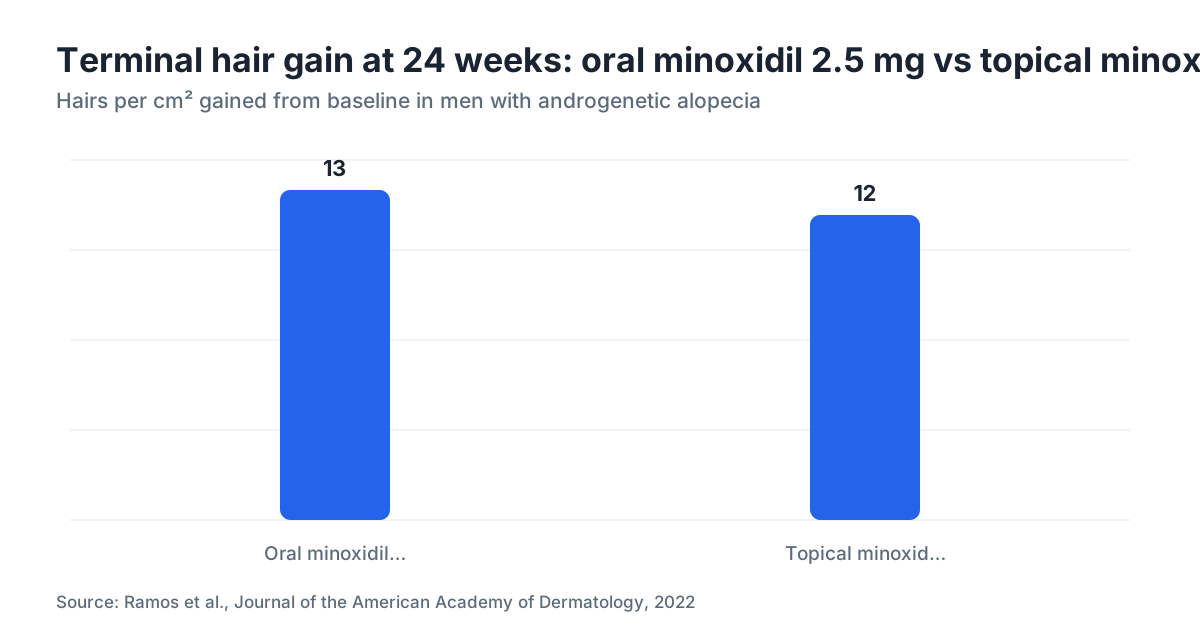
The most cited head-to-head trial at this exact dose is a 2022 randomized controlled trial in the Journal of the American Academy of Dermatology. Researchers put oral minoxidil 2.5 mg once daily against 5% topical minoxidil twice daily in men with pattern hair loss over 24 weeks. The stated conclusion was that "oral minoxidil 2.5 mg once daily was non-inferior to topical minoxidil 5% twice daily in improving hair density" [4]. That matters because it means the tablet keeps up with the gold-standard topical without twice-daily smearing.
Hair count data from that trial had both groups gaining roughly 12 to 13 terminal hairs per cm² from baseline, measured by phototrichogram. Neither pulled dramatically ahead. The oral group grew modestly more body and facial hair (hypertrichosis), which some men found annoying.
A 2021 retrospective study from the Mayo Clinic reviewed 90 patients on low-dose oral minoxidil for various kinds of hair loss. They saw improvement in 84% across diagnoses, including pattern hair loss, alopecia areata, and telogen effluvium, at doses from 0.25 mg to 5 mg daily [5].
For women, a 2020 Brazilian randomized trial compared 1 mg oral minoxidil to 5% topical in female pattern hair loss. Both groups improved. The oral group reported better tolerability and higher adherence, partly because they skipped scalp greasiness and daily application time [6].
Say this part plainly. Most of these trials are small, run six months or less, and lean on hair counts or physician grading rather than validated patient-reported outcomes. The evidence is genuinely promising and better than hype, but it isn't the depth of evidence behind topical minoxidil, which has been in randomized trials since the 1980s.
Who is a candidate for the 2.5 mg tablet?
The classic candidate is a man with pattern baldness who either got little from topical minoxidil or would rather take a once-daily pill than smear his scalp twice a day. If you have a receding hairline or crown thinning and your dermatologist has ruled out other causes, oral minoxidil is a fair next conversation.
People who failed topical because of low scalp sulfotransferase activity are especially good candidates, though there's no simple test for it in a normal clinic. If you gave topical a fair 12-month shot and saw nothing, the tablet is worth discussing before you quit on the drug class entirely.
Women start well below 2.5 mg. The typical female starting dose is 0.625 mg or 1.25 mg, and some studies use 1 mg. A 2.5 mg dose in women carries a higher risk of unwanted body hair and a bigger blood pressure drop.
Some people shouldn't take it at all: anyone with significant heart disease, low baseline blood pressure, a history of pericardial effusion, or a known allergy to minoxidil. Pregnancy rules it out. Older patients and anyone already on blood pressure medication need extra caution, because the combined pressure drop can cause dizziness or fainting [1].
A board-certified dermatologist or a physician who treats hair loss should make this call. This is not a drug to self-prescribe or order from a sketchy online pharmacy with no bloodwork and no pressure check.
What are the side effects of 2.5 mg oral minoxidil?
The side effects split into two piles: the expected ones (the drug doing exactly what it does throughout your body) and the rare but serious ones.
Hypertrichosis tops the complaint list. Because oral minoxidil reaches your entire circulation, hair can grow faster everywhere: legs, arms, face, back. In low-dose oral minoxidil trials, hypertrichosis showed up in roughly 15% to 35% of patients depending on dose and length of use [5]. At 2.5 mg in men it's noticeable but manageable for most. In women it can be a dealbreaker, which is the whole reason the dose stays low.
Fluid retention is next. Minoxidil makes your body hold onto sodium and water, which can show up as ankle swelling or puffiness, mostly in the first few weeks. Some dermatologists add a low-dose diuretic, though that isn't standard at hair-loss doses.
Blood pressure changes are real. Even at 2.5 mg, some people see a meaningful drop in systolic pressure, which brings lightheadedness, especially when standing up fast (orthostatic hypotension). Checking your pressure before you start and at follow-ups is not optional.
A fast heart rate (tachycardia) and palpitations happen less often. The original FDA Loniten labeling warns specifically about reflex tachycardia, because the body speeds the heart up to compensate for the widened vessels [1].
Pericardial effusion (fluid around the heart) is rare at hair-loss doses but sits among the serious warnings on the FDA label for the higher hypertension doses. At 2.5 mg daily the risk looks low based on available data, which is why a cardiologist only gets pulled in occasionally.
For a dose-by-dose rundown of both topical and oral effects, the minoxidil side effects guide covers the full range.
How does 2.5 mg oral minoxidil compare to topical minoxidil and other treatments?
| Treatment | Approved for hair loss? | Typical dose | Proven hair count gain | Main downside |
|---|---|---|---|---|
| Topical minoxidil 5% (men) | Yes (OTC) | Twice daily | ~12 hairs/cm² at 6 months [4] | Application, scalp greasiness |
| Oral minoxidil 2.5 mg | No (off-label) | Once daily | ~12 to 13 hairs/cm² at 6 months [4] | Systemic effects, Rx required |
| Finasteride 1 mg | Yes (Rx) | Once daily | ~10 to 15 hairs/cm² at 12 months [7] | Sexual side effects, Rx required |
| Oral minoxidil + finasteride | No (off-label combo) | Daily each | Additive; trial data limited | Both sets of side effects |
| Hair transplant | Surgical | One-time or staged | Permanent in grafted area | Cost, surgery, donor limits |
Oral minoxidil 2.5 mg isn't dramatically better than topical at the same checkpoint, based on what we have. The case for it comes down to three things: one pill a day beats two applications a day, better scalp-to-follicle delivery for poor topical responders, and coverage of diffuse thinning across the whole scalp instead of one targeted zone.
Finasteride goes after the cause of pattern hair loss by blocking DHT conversion, which makes it the more logical standalone. Most hair loss specialists treat the two as teammates, not rivals. The finasteride and minoxidil combination is the strongest evidence-backed non-surgical regimen we have right now.
On the surgical side, a hair transplant is the only way to permanently restore density in a specific spot, but it does nothing to slow ongoing loss in the areas you didn't graft. Most surgeons want patients on medical therapy before and after the procedure anyway.
How long does it take to see results from the 2.5 mg tablet?
Expect nothing for the first four to eight weeks. The drug needs time to stretch the growth cycles, and the hairs coming out of dormancy take a while to break the surface.
Some people shed more in weeks four through twelve. In most cases that's a good sign, not a bad one. It means the growth phase is resetting, and it's sometimes called a dread shed or telogen shed. It clears up on its own, but it rattles people who weren't warned.
Most trial endpoints land at six months, and that's when real density change shows up in photos and measurements. The 2022 JAAD trial measured at 24 weeks and found roughly 12 to 13 terminal hairs per cm² gained in the oral 2.5 mg group [4]. In practice, gains often keep coming through 12 months before flattening.
At 12 months with nothing to show, most dermatologists call it a non-response. That's the moment to question the diagnosis: is it actually pattern hair loss, or something like telogen effluvium that might clear on its own, or an inflammatory condition that needs a different drug?
Accept one thing up front. This is a daily, open-ended commitment. Stop the drug, lose the hair. There's no weaning off and no finishing a course.
Do you need a prescription for a minoxidil 2.5 mg tablet?
Yes, in the United States. Oral minoxidil tablets are prescription-only at every dose. The FDA approved them for high blood pressure, not hair loss, and they aren't sold over the counter. You need a licensed prescriber: a dermatologist, a primary care physician, or in some states a telehealth prescriber working under a valid patient-provider relationship [1].
Telehealth has made access much easier over the last few years. These services connect you with a physician who reviews your history, checks contraindications, and sends a prescription to a pharmacy. Some compounding pharmacies fill the lower doses (0.625 mg, 1.25 mg) that aren't sold commercially. Compounded products don't go through the same FDA quality checks as commercially manufactured tablets, which is worth knowing before you order.
Cost swings a fair bit. Generic oral minoxidil tablets (2.5 mg, 60 count) usually run $15 to $40 at major US pharmacies, sometimes less with GoodRx or a similar discount card. Compounded formulas from specialty pharmacies often land at $30 to $80 a month depending on dose and pharmacy. Telehealth consult fees are separate and vary widely.
If you're still trying to figure out whether your pattern even warrants this conversation, a free AI hair scan at MyHairline.ai gives you a baseline read on your Norwood stage and thinning pattern before you book the appointment.
What monitoring do you need while taking 2.5 mg oral minoxidil?
Blood pressure is the main thing to track. Most dermatologists check it at baseline, again at 4 to 8 weeks after you start, then periodically. If you're already running low or you take blood pressure medication, the schedule should tighten up.
A basic metabolic panel, or at least a creatinine and electrolyte check, is reasonable given how minoxidil moves fluid and sodium around. Some prescribers order an echocardiogram at baseline if there's any cardiac history, but that isn't routine for a healthy young adult.
Listen to your body. Swollen ankles, unusual shortness of breath, or a racing heart at rest are reasons to call your doctor before the next scheduled visit, not reasons to wait it out. The serious heart effects are rare at 2.5 mg, but they aren't theoretical.
Photography is underrated as a monitoring tool. Take a standardized photo under the same lighting every three months. It's the only honest way to tell whether the drug is working, because the change is slow enough that day-to-day mirror checks lie to you.
Can women take a 2.5 mg oral minoxidil tablet?
Most women shouldn't start at 2.5 mg. The standard female starting dose in practice is 0.625 mg or 1.25 mg. Studies in female pattern hair loss have used doses from 0.5 mg to 2.5 mg, but the risk-benefit math tilts the wrong way as the dose climbs, because women tend to be more sensitive to both the blood pressure drop and the extra body hair.
The 2020 Brazilian RCT that compared 1 mg oral minoxidil to 5% topical in women found both effective, with the 1 mg pill matching the topical for hair density [6]. That's the closest thing we have to a clean trial at a woman-appropriate dose.
If a woman gets nothing from 1.25 mg after six to twelve months, some dermatologists try a careful step up to 2.5 mg, but only with close monitoring and an honest talk about the hypertrichosis risk. Unwanted facial hair in particular is a quality-of-life problem that's hard to wave off.
Women of childbearing age also need reliable contraception. Minoxidil is teratogenic in animal studies, and there isn't enough human data to call it safe in pregnancy. The FDA labeling puts it in a category where use during pregnancy requires that the benefit clearly outweigh the risk [1].
For women looking at pattern hair loss more broadly, what causes hair loss in female patients pulls in hormonal, nutritional, and autoimmune factors that may or may not call for minoxidil at all.
Is the 2.5 mg tablet better than topical minoxidil for you personally?
This is the question that actually matters, and the honest answer is that it depends on your situation and what you'll realistically stick to.
If you're a man who has been faithfully applying topical minoxidil twice a day for 12 months and seeing almost nothing, the pill is a fair switch. Part of the logic is the sulfotransferase argument, and part is that you've already proven the topical isn't working for you.
If sticking with it is your weak spot, one pill a day beats two applications a day for most people. Adherence is one of the biggest real-world predictors of how any hair loss drug turns out.
If you run low blood pressure, have a borderline heart issue, or already deal with unwanted body hair, topical is the safer pick. Systemic exposure is genuinely lower when you keep it on the scalp.
If your thinning is diffuse across a wide area, the pill has the coverage edge, since it doesn't ask you to hit specific zones.
No single form of minoxidil wins for everyone. The 2022 JAAD trial showed equal outcomes at 24 weeks [4]. The right choice is the one you'll take every day without side effects you can't live with.
If you want a read on your own pattern before you decide where to start, a free AI-powered analysis at MyHairline.ai maps your thinning and helps frame the conversation with your dermatologist.
Sources
- FDA, Loniten (minoxidil tablets) prescribing information
- American Academy of Dermatology, hair loss treatment overview
- Badawi et al., Dermatology and Therapy 2021, sulfotransferase activity and minoxidil response
- Ramos et al., Journal of the American Academy of Dermatology 2022, oral vs topical minoxidil RCT
- Randolph and Tosti, Journal of the American Academy of Dermatology 2021, low-dose oral minoxidil retrospective
- Pereira et al., JAAD 2020, oral minoxidil 1 mg vs topical 5% in female pattern hair loss RCT
- Kaufman et al., Journal of Investigative Dermatology 1998, finasteride 1 mg RCT
- FDA, Drug Applications for Over-the-Counter Drugs (OTC), minoxidil topical approval history
- National Institutes of Health MedlinePlus, minoxidil oral
- Gupta and Talukder, Journal of Cosmetic Dermatology 2022, review of oral minoxidil for hair loss