TL;DR: Minoxidil 2% solution is FDA-approved for women with androgenetic alopecia. Clinical trials show it regrows or stabilizes hair in roughly 40-60% of women who use it consistently for at least 4 months. Men generally need 5%. Results stop when you stop using it. It does not cure hair loss.
What exactly is minoxidil 2% and what is it approved for?
Minoxidil 2% is a topical solution containing 20 mg of minoxidil per milliliter of liquid. The FDA approved it specifically for women with androgenetic alopecia (female-pattern hair loss) in 1991, making it one of only two treatments with that approval [1]. The 5% formulation came later and was approved for men first, then women in 2014.
The mechanism is not fully understood, but minoxidil is a potassium channel opener. It appears to prolong the anagen (growth) phase of the hair cycle and increase blood flow around the follicle. It does not block dihydrotestosterone, so it works differently from dht blocker approaches like finasteride.
The 2% dose was studied and labeled for women partly because early data suggested women were more sensitive to minoxidil's systemic effects, particularly unwanted facial hair growth, at higher concentrations. That concern has evolved over time, but the 2% label for women remains the FDA's original approved dose [1].
Important: minoxidil is a treatment, not a cure. The American Academy of Dermatology states that hair loss typically returns within a few months of stopping the drug [2]. You're committing to ongoing use if you start.
How does minoxidil 2% compare to 5%?
The honest answer is that 5% works better in most head-to-head studies, including in women, but the FDA only recently extended the 5% label to women (for the foam formulation). Here's what the numbers look like:
| Formulation | Approved for | Hair count increase vs placebo | Notes |
|---|---|---|---|
| Minoxidil 2% solution | Women | ~13-17 nonvellus hairs/cm² [3] | Original women's label |
| Minoxidil 5% solution | Men (women off-label) | ~20+ nonvellus hairs/cm² [3] | Higher efficacy, higher side-effect risk |
| Minoxidil 5% foam | Men and women | Comparable to 5% solution | Lower alcohol content, less scalp irritation |
A 48-week randomized trial published in the Journal of the American Academy of Dermatology found that 5% minoxidil solution produced significantly greater hair regrowth than 2% in women with androgenetic alopecia [3]. Both beat placebo. So if your dermatologist offers you 5% foam, there's solid evidence behind that choice.
Still, 2% is meaningfully effective, costs less, and may cause fewer issues for women who get facial hair growth on higher doses. If you've tried 5% and found it irritating or saw unwanted hair elsewhere, 2% is a reasonable step down rather than quitting altogether.
For men, 2% is generally considered underdosed. The minoxidil for men evidence base is built on 5% data, and most dermatologists would start men at 5% unless there's a specific reason not to.
Does minoxidil 2% actually regrow hair, or just stop shedding?
Both, depending on the person and how advanced the loss is.
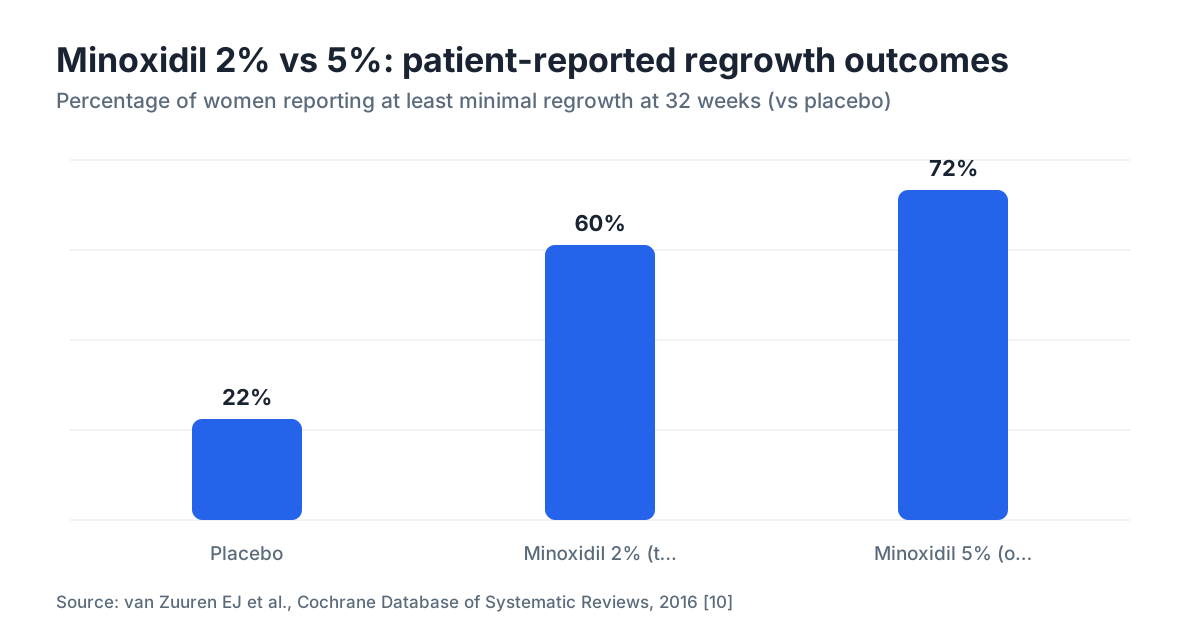
In the trials used for FDA approval, roughly 40% of women using 2% minoxidil reported moderate to dense regrowth at 32 weeks, and more than 60% reported at least minimal regrowth [3]. The rest saw stabilization or no change. A small percentage reported continued shedding despite treatment.
For hair that has been miniaturized for years, regrowth is harder. Minoxidil can thicken miniaturized hairs and potentially reverse them if the follicle isn't fully dead, but it cannot revive a follicle that has been replaced by scar tissue. That's why starting earlier generally produces better results.
The first 6-8 weeks often bring a paradoxical increase in shedding. This is called a telogen effluvium shed, and it happens because minoxidil pushes resting hairs out to make room for new growth. It's alarming if you don't expect it. If you want more detail on that phenomenon, the telogen effluvium article walks through why it happens and how long it lasts.
A fair verdict on whether 2% minoxidil is working for you takes at least 4-6 months of consistent use, twice daily. Judging it at 6 weeks is too early.
How do you use minoxidil 2% correctly?
The standard FDA-approved dosing is 1 mL applied directly to the scalp twice daily, once in the morning and once at night [1]. That's it. Most bottles come with a dropper or pump calibrated to 1 mL.
Apply it to a dry scalp, not wet hair. Part your hair to expose the area of thinning, apply the solution directly to the scalp (not the hair), and then spread it gently with your fingertips. Don't use a hair dryer right after. Let it air dry for at least 4 hours.
Do not exceed 2 mL per day. More is not better and increases the amount absorbed systemically.
Wash your hands thoroughly after applying. Minoxidil on your hands can transfer to your face and cause unwanted hair growth there.
Timing matters for consistency more than for biology. Pick times you can reliably maintain. Many people do morning after showering and night before bed. Skipping doses regularly undermines the effect, since maintaining adequate follicle exposure depends on twice-daily application.
What side effects should women using 2% minoxidil expect?
The most common side effect is scalp irritation: itching, dryness, or flaking. This is often from the propylene glycol carrier in the solution formulation, not the minoxidil itself. Switching to a foam (which uses different carriers) sometimes resolves it [4].
Unwanted facial hair, especially on the forehead and cheeks, affects some women. This happens when the solution runs down the face or transfers from hands. Careful application and hand washing reduce but don't eliminate the risk. The 2% dose carries a lower risk of this than 5%, which is one practical reason some women prefer to stay at the lower dose.
Systemic absorption is low but real. Minoxidil was originally developed as an oral blood pressure medication, and even topical use produces detectable blood levels. The FDA label includes a warning to avoid use if you have heart disease without medical supervision [1]. Dizziness or rapid heartbeat, while uncommon, should prompt stopping use and calling a doctor.
For the full picture on side effects across all formulations and doses, see the minoxidil side effects article, which covers the rarer but serious ones worth knowing before you start.
Pregnancy: minoxidil is classified Pregnancy Category C by the FDA. It should not be used during pregnancy or breastfeeding [1].
Who is minoxidil 2% actually the right choice for?
Women with androgenetic alopecia, particularly those in the early to mid stages of female-pattern hair loss, are the primary indicated population. If you're noticing widening at the part line or general thinning at the crown, that's the presentation the trials enrolled.
Women who tried 5% and got significant facial hair growth or scalp irritation. Stepping down to 2% often reduces those effects while preserving some benefit.
Women who are cost-sensitive. Generic 2% solutions are among the cheapest hair loss treatments available, sometimes under $15 for a month's supply at major pharmacy chains.
People with other causes of hair loss, like alopecia areata or scarring alopecias, are not well served by minoxidil. It was studied and labeled for androgenetic alopecia. Using it off-label for other conditions isn't wrong, but the evidence base is thinner.
Understanding what causes hair loss in your specific case matters before starting any treatment. Minoxidil won't help if the driver of your shedding is thyroid disease, iron deficiency, or a medication side effect.
Can men use minoxidil 2%?
They can, but the evidence says it's not the best starting point. The original FDA approval for men was based on 5% data, and direct comparison studies show 5% outperforms 2% in men consistently [3].
There are a few scenarios where a man might reasonably use 2%. If 5% causes significant scalp irritation and the foam formulation hasn't helped, 2% beats stopping altogether. Some men doing oral minoxidil (a separate topic covered in oral minoxidil) use a lower topical dose as a supplement. These are edge cases.
For most men with a receding hairline or vertex thinning, 5% is the starting point. The minoxidil for men article has the full dosing discussion.
How long does minoxidil 2% take to show results?
You will not see results in the first month. The initial shedding phase (weeks 2-8) can actually make things look worse before they improve.
Most studies measure outcomes at 16-32 weeks. The 32-week mark in the FDA approval trials showed the biggest between-group differences. That's about 8 months from starting.
Here's a rough timeline based on the clinical trial data:
- Weeks 1-8: Possible initial shedding. No visible regrowth.
- Weeks 8-16: Shedding stabilizes. Some finer hairs may appear.
- Weeks 16-32: Measurable increase in hair count and thickness for responders.
- Month 12+: Maximum benefit for most users; maintenance thereafter.
If you've used it correctly twice daily for 6 months and see no change at all, book a dermatologist visit. You may be a non-responder, or there may be a diagnosis issue worth investigating.
Does minoxidil 2% work better combined with other treatments?
For women, combination with finasteride is sometimes used off-label, though finasteride carries serious risks for women of reproductive age (it is teratogenic) and requires careful medical supervision. The pairing of topical minoxidil and oral finasteride is more studied in men, where finasteride and minoxidil together outperform either alone in several trials.
Microneedling (dermaroller) combined with minoxidil has modest evidence behind it. A 2013 randomized trial in the International Journal of Trichology found that minoxidil plus microneedling produced significantly more hair growth than minoxidil alone in men with androgenetic alopecia [5]. The proposed mechanism is that microneedling turns on growth factors and may improve minoxidil penetration.
Low-level laser therapy combined with minoxidil is another option with some evidence, though effect sizes are modest and devices are expensive.
For women specifically, spironolactone (an oral anti-androgen) is often used alongside topical minoxidil by dermatologists. This falls outside what the 2% label addresses, but it reflects how clinicians actually manage female-pattern hair loss in practice.
If you're thinking about supplements alongside minoxidil, be realistic about their evidence base. The hair loss supplements article is direct about what has data and what doesn't.
What happens if you stop using minoxidil 2%?
The hair you gained (or kept) from minoxidil will shed within 3-4 months of stopping. This isn't a rebound. The drug is simply wearing off, and the follicles return to their genetically programmed miniaturization trajectory.
The AAD is direct about this: minoxidil requires ongoing use to maintain results [2]. There is no finite treatment course after which you're done.
That's a real practical consideration before starting. If you think you'll use it for a year and then stop, the net result is likely a return to where you started, possibly after a significant shed. Going in with that understanding beats being caught off guard.
For people who want a treatment that addresses the hormonal driver of loss rather than just maintaining follicle function, the dht blocker class of drugs is worth understanding. Whether that's right for you is a conversation with a dermatologist.
If you're weighing long-term medical treatment against surgical options, the hair transplant article lays out what transplants actually involve, what they cost, and who's a realistic candidate.
Where should you buy minoxidil 2% and what does it cost?
Minoxidil 2% is available over the counter in the US. You do not need a prescription. It sells at most major pharmacy chains (CVS, Walgreens, Walmart) under generic labels and brand names.
Generic 2% solution typically runs $10-20 for a 60 mL bottle, which is roughly a one-month supply at twice-daily dosing. Name brands like Women's Rogaine cost more for identical active ingredients.
Online pharmacy services and telehealth hair loss platforms also dispense minoxidil, sometimes in compounded formulations that combine it with other actives. Compounded products are not FDA-approved the way the commercial solution is, so you're relying on the prescribing physician and compounding pharmacy's quality controls.
If you want an objective picture of where you're starting from before spending money on a treatment protocol, MyHairline's free AI hair analysis at myhairline.ai/scan can give you a baseline assessment of your hair loss pattern, which is genuinely useful for tracking change over time.
One thing worth knowing: generic is fine. The active ingredient is identical. The FDA's generic drug approval process requires bioequivalence to the original [6]. Paying a premium for a branded 2% solution does not get you better minoxidil.
Is minoxidil 2% safe for long-term use?
The safety record over more than 30 years of over-the-counter use is reasonably reassuring for healthy adults without cardiovascular conditions. Post-market surveillance hasn't produced signals of serious long-term harm from topical use at the approved doses.
That said, "safe for most people" is not the same as "safe for everyone." The FDA label lists contraindications including cardiovascular disease, and the drug is not cleared for pregnancy [1].
Scalp health is worth watching. Chronic application of propylene glycol-containing solutions can cause contact dermatitis in some users. If persistent irritation develops, switching to a foam formulation or taking a break and re-evaluating is reasonable.
Dermatologists don't typically set a maximum treatment duration. Long-term users (10-20 years) exist without reported systematic problems, but this is observational data, not controlled trial data. Nobody has run a 20-year randomized trial on topical minoxidil.
Annual check-ins with a dermatologist or your primary care provider are a reasonable habit if you're on long-term minoxidil, particularly to watch for any cardiovascular symptoms and to assess whether the treatment is still doing what you need it to do.
Sources
- FDA, Minoxidil Topical Solution 2% prescribing information (Drug Label)
- American Academy of Dermatology, Hair Loss: Diagnosis and Treatment
- Olsen EA et al., 'A randomized clinical trial of 5% topical minoxidil versus 2% topical minoxidil and placebo in the treatment of androgenetic alopecia in men', Journal of the American Academy of Dermatology, 2002
- Blume-Peytavi U et al., 'A randomized, single-blind trial of 5% minoxidil foam once daily versus 2% minoxidil solution twice daily in the treatment of androgenetic alopecia in women', Journal of the American Academy of Dermatology, 2011
- Dhurat R et al., 'A randomized evaluator blinded study of effect of microneedling in androgenetic alopecia: a pilot study', International Journal of Trichology, 2013
- FDA, Generic Drugs: Bioequivalence overview
- National Library of Medicine, MedlinePlus, Minoxidil Topical
- Messenger AG, Rundegren J, 'Minoxidil: mechanisms of action on hair growth', British Journal of Dermatology, 2004
- FDA, Rogaine Women's 2% Topical Solution OTC label
- van Zuuren EJ et al., 'Interventions for female pattern hair loss', Cochrane Database of Systematic Reviews, 2016