TL;DR: Topical minoxidil comes in 2% and 5% concentrations applied twice daily (1 mL each application). Oral minoxidil is used off-label at 0.625 to 2.5 mg per day for hair loss. Higher doses do not reliably produce faster results and increase side-effect risk. Most people see measurable regrowth after four to six months of consistent use.
What is the standard minoxidil dosage for hair loss?
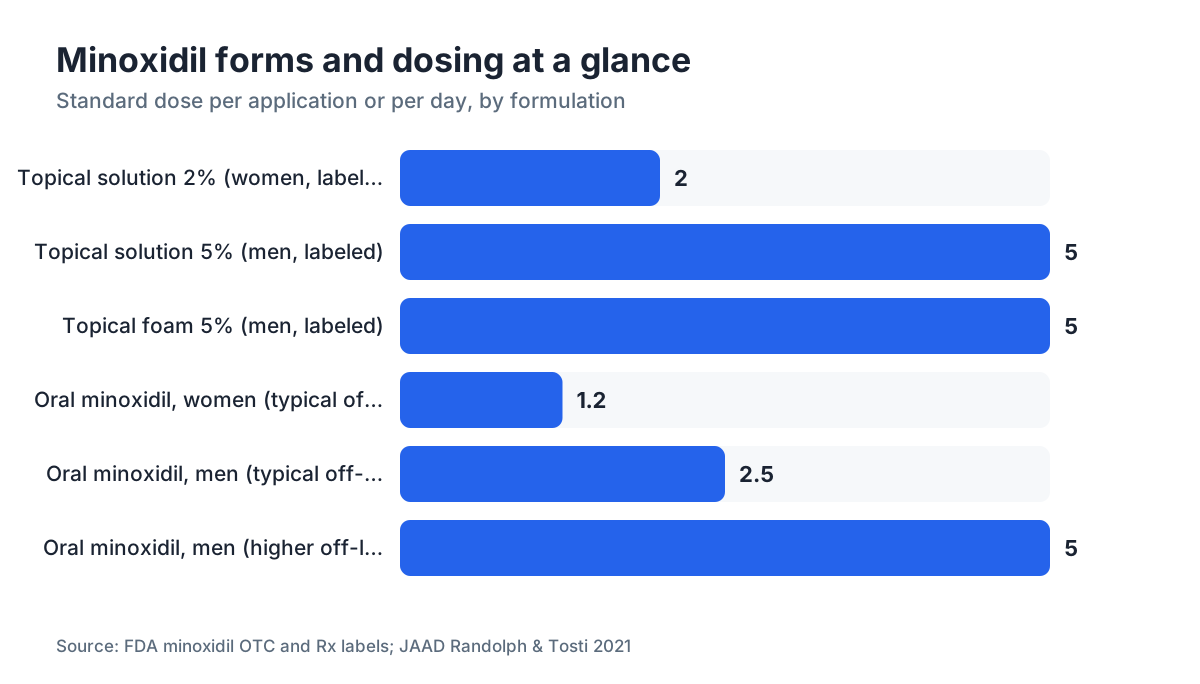
The FDA-approved topical dose for androgenetic alopecia is 1 mL of solution rubbed directly onto the scalp twice a day, roughly twelve hours apart. That holds for both the 2% and 5% concentrations. The foam version is half a capful (about 0.5 mL of a denser product) twice daily, which delivers a similar total dose of active drug. Stick to those amounts. Using more liquid does not increase absorption into the follicle in any way that matters clinically, and it mostly just runs down your forehead.
No oral minoxidil product is currently FDA-approved specifically for hair loss [1]. Off-label oral use, which has become mainstream in dermatology clinics, typically ranges from 0.625 mg to 2.5 mg per day for hair purposes. A few dermatologists go up to 5 mg for women or men with severe loss, but that starts to look like the cardiovascular dosing range and demands closer medical supervision.
The two forms work by different routes. Topical delivers drug to the follicle directly with minimal systemic absorption (plasma levels run roughly 1 to 2% of oral systemic levels). Oral sends a steady blood-level signal to every follicle on your scalp, which is part of why some clinicians argue it works better on diffuse thinning across the crown than on a defined patch.
What is the difference between 2% and 5% minoxidil?
The FDA approved 2% minoxidil solution for women and 5% for men, based on the trials submitted in the late 1980s and early 1990s. The 5% formulation was later studied in women too. A 2004 trial published in the Journal of the American Academy of Dermatology found that 5% solution produced 45% more nonvascular hair regrowth than 2% at 48 weeks, though scalp irritation and facial hair growth were more common at the higher concentration [2].
For men, the choice is simple. 5% topical is the standard. The extra concentration gives meaningfully better results without much higher risk in most people.
For women, the picture is less tidy. The FDA label historically pointed women toward 2%, and that label still reads that way. But many dermatologists now prescribe 5% off-label for women, especially the foam, because the foam's propylene-glycol-free base causes less scalp irritation and less unwanted facial hair than the alcohol-based solution. If you're a woman deciding between them, this is genuinely a conversation to have with a dermatologist rather than self-selecting to the higher dose.
| Form | Concentration | FDA-approved population | Typical application |
|---|---|---|---|
| Topical solution | 2% | Women (and original men's label) | 1 mL twice daily |
| Topical solution | 5% | Men | 1 mL twice daily |
| Topical foam | 5% | Men; often used off-label in women | Half capful twice daily |
| Oral tablet | 0.625 to 2.5 mg | Off-label for both | Once daily |
One practical note: generic 5% solutions and foams sell for under $15 a month, so cost is rarely a reason to choose 2%.
How does oral minoxidil dosage compare to topical?
Oral minoxidil for hair loss is genuinely different pharmacology, more than a pill version of the same thing. The drug was originally developed as a blood pressure medication at doses of 10 to 40 mg per day. Hair doses are a fraction of that, which is how the safety profile stays manageable [3].
A widely cited 2021 review in the Journal of the American Academy of Dermatology analyzed 16 studies covering over 600 patients on low-dose oral minoxidil for hair loss. The authors reported a "favorable efficacy and tolerability profile" at doses between 0.25 mg and 5 mg daily, with fluid retention and hypertrichosis (unwanted body hair) being the most common adverse effects [4]. The same review noted that most studies used 1.25 mg for women and 2.5 mg for men as starting doses.
How does efficacy compare? Nobody has run a large head-to-head randomized trial with identical follow-up comparing 5% topical to low-dose oral. The closest published data suggest oral at 2.5 mg performs similarly to or better than 5% topical on scalp hair density, but that comes from small studies and indirect comparisons. What oral clearly wins on is convenience. Once a day, no sticky residue, no worrying about whether you sweated it off. Adherence tends to be better, and with a drug that only works if you keep taking it, that matters a lot.
If you are curious whether oral minoxidil might suit you better than topical, the honest answer depends on your cardiovascular health, your tolerance for body hair changes, and how reliably you apply topical products.
For context on combining oral or topical minoxidil with a DHT blocker, see finasteride and minoxidil.
Can you use minoxidil once a day instead of twice?
You can, and some people do, but the FDA-approved regimen is twice daily and that is what the efficacy data is built on. The drug's scalp half-life is roughly 22 hours, so once-daily dosing does maintain some drug presence. A small study published in Dermatologic Therapy in 2011 found that once-daily 5% foam was non-inferior to twice-daily 2% solution in women over 24 weeks, but that comparison involved both a concentration difference and a frequency difference, so it's hard to isolate frequency alone [5].
Here is the practical reality. Twice-daily topical dosing is annoying. It clashes with styling routines, and many people quietly drop to once a day on their own. Most dermatologists say if the choice is between once daily and stopping altogether, keep going once daily. Missing the second application now and then is not going to reverse your progress. Applying only once consistently is probably less effective than the labeled regimen, but it beats nothing.
Oral minoxidil, by contrast, is once-daily by design, partly because its systemic half-life is much longer.
How long does minoxidil take to work, and does dosage affect the timeline?
Almost everyone who starts minoxidil sheds some hair in the first four to eight weeks. This is telogen effluvium, and it happens because the drug pushes hairs that were in a prolonged resting phase into active cycling, which makes them fall out before new growth comes in. It's alarming but not a sign the drug is failing. Read more about telogen effluvium if you want to understand why this happens.
Regrowth starts to become visible around three to four months. Most clinical trials measure their primary endpoints at 16 to 24 weeks (four to six months). The original FDA approval trial for 5% topical in men showed statistically significant increases in nonvascular hair count by 16 weeks [1].
Higher doses do not meaningfully speed up the timeline. The hair follicle cycle is biological, not linearly dose-responsive past a certain threshold. Going from 1 mL of 5% to 2 mL does not get you to regrowth in half the time. It mostly just raises side-effect risk and wastes product.
Figuring out whether minoxidil is working for you realistically takes 6 to 12 months of consistent use. If nothing has changed by 12 months at the correct dose, that is when the conversation with a dermatologist should shift to alternative or add-on treatments.
What happens if you use too much minoxidil?
Going past the labeled dose is a real problem, more than a theoretical one. The most common consequence of topical overuse is local irritation: burning, flaking, and contact dermatitis from the alcohol or propylene glycol in the vehicle. That's unpleasant but not dangerous.
More seriously, applying too much can push systemic absorption high enough to cause cardiovascular effects. The FDA label warns of hypotension (low blood pressure), rapid heart rate, and fluid retention. These are the same effects the drug was originally used to treat hypertension with, just at much higher doses [1]. Most healthy adults would have to dramatically exceed the recommended dose before hitting those levels topically, but people who apply minoxidil to large body surface areas, apply it to broken skin, or run topical and oral at the same time face a meaningfully higher risk.
Miss a dose of topical minoxidil? Skip it and return to schedule at the next application. Do not double up.
For a complete picture of adverse effects at standard dosing, minoxidil side effects covers the full range, including the rare cardiac events and the hypertrichosis that worries most users.
Does minoxidil dosage differ for women vs. men?
Yes, and the difference is real rather than just regulatory caution. The original approval pathway for women used 2% solution, and the FDA-approved labeling still reflects that. Women's scalps can be more sensitive to the higher-concentration formulations, and the unwanted facial hair (hypertrichosis) side effect shows up more often in women on 5% liquid solution.
For minoxidil for men, 5% is the standard starting point. Men's androgenetic alopecia tends to follow a more defined pattern (receding hairline, crown thinning) and the higher dose has a clearer demonstrated benefit in that population.
For oral dosing in women, 0.625 mg to 1.25 mg per day appears frequently in the dermatology literature as the starting range. For men, 2.5 mg is a typical starting oral dose. Some protocols go to 5 mg for men, but that is not a first-line move.
Women who are pregnant or trying to become pregnant should not use minoxidil in any form. The drug is Pregnancy Category C (animal studies show fetal harm) and is classified as Category X under some international guidelines [1]. This is not a risk to wave off.
How do you apply minoxidil correctly to get the full dose?
Technique matters because the drug has to reach the scalp, not sit on your hair. For liquid solution, part your hair to expose the thinning area and apply the 1 mL directly with the dropper or applicator nozzle. Then spread it with your fingertips across the affected area. Let it dry fully (20 to 30 minutes) before applying styling products or going to sleep, otherwise you're just transferring it to your pillowcase.
For foam, dispense half a capful onto your fingertips (not directly onto the scalp, since it melts fast on warm skin and you'll waste it). Work section by section through the thinning area. Foam absorbs faster than solution, usually 10 to 15 minutes to dry.
Hair should be clean and dry, or at least towel-dried, before application. Applying to a wet scalp dilutes the concentration and cuts absorption. Don't wash your hair for at least four hours after application if you can help it.
Wash your hands thoroughly after applying liquid solution. Accidentally transferring it to your face over and over is a common source of unwanted facial hair in women.
If you're working out a broader plan and thinking about your receding hairline specifically, know that minoxidil tends to do better on the crown and vertex than at the temples. The hairline is harder to push forward.
Should you combine minoxidil with finasteride or other treatments?
Pairing topical or oral minoxidil with a 5-alpha-reductase inhibitor like finasteride is the most studied combination for male androgenetic alopecia. The two drugs work by different mechanisms. Minoxidil is a vasodilator that appears to prolong the anagen (growth) phase of the follicle, while finasteride reduces DHT, the hormone that miniaturizes the follicle in the first place. They don't conflict, and there's decent evidence they work better together than either alone.
A 2002 study in the Journal of Dermatology found that the combination of 5% topical minoxidil and 1 mg oral finasteride produced significantly greater hair count increases than either drug used alone over 12 months [6]. The effect sizes weren't enormous, but they were real.
Read the detailed breakdown at finasteride and minoxidil if you're thinking about combining them. For more on how finasteride works on its own, or whether a DHT blocker approach fits your pattern, those articles lay out the evidence without the sales pitch.
Combining minoxidil with a hair transplant is also common. Transplanted follicles are DHT-resistant by nature, but the surrounding native hair keeps miniaturizing without treatment. Using minoxidil after a transplant helps protect the hair you still have.
That said, piling on treatments without a clear picture of what's driving your loss can waste money. If you want to understand your specific pattern before spending, the free AI hair analysis at MyHairline gives you a Norwood or Ludwig staging from a photo, which at least tells you what you're dealing with.
What if minoxidil stops working or you want to stop?
Minoxidil is not a one-time fix. You have to use it indefinitely to keep its effects. Stopping causes the new growth it supported to shed, usually within three to six months of quitting. This is not the drug "leaving your system" in any harmful way. The follicles that responded to minoxidil simply return to their androgenetic trajectory without it.
If minoxidil seems to have stopped working after a stretch of effectiveness, a few things could explain it. Your androgenetic alopecia may be progressing faster than minoxidil can compensate for. You may have slipped on application consistency. Or you may be seeing a temporary shed from unrelated stress or illness (look up telogen effluvium for what normal triggered shedding looks like versus drug failure).
The honest answer on long-term efficacy is that minoxidil usually shows its best results in years one and two. Maintenance after that may mean holding ground rather than gaining more. Some users see continued improvement for longer, but the trajectory tends to flatten.
If you're at the point of questioning whether to continue, this is also when a hair transplant evaluation makes sense, not as a replacement for minoxidil but alongside it.
Is there a higher-dose minoxidil option, and is it worth trying?
Yes. Compounding pharmacies produce topical minoxidil above 5%, commonly 8%, 10%, or even 15%, often mixed with other agents like tretinoin, azelaic acid, or finasteride in the same vehicle. None of these are FDA-approved formulations. Tretinoin sometimes gets added because it may improve minoxidil penetration through the skin barrier, though the evidence there is preliminary and mostly from small studies.
Is a compounded 10% topical worth trying if 5% hasn't worked? Probably not as a first move. The evidence base for concentrations above 5% topical is thin. Irritation risk from higher concentrations in alcohol-based or propylene-glycol-based vehicles climbs fast. And if standard 5% didn't move the needle after 12 months of proper use, the issue is more likely your follicle's sensitivity to DHT or the degree of miniaturization than an insufficient dose.
A dermatologist who specializes in hair loss is genuinely the right person to make that call. They can assess miniaturization with a dermoscope and tell you whether the follicles are still viable targets for minoxidil at any dose.
For context on where minoxidil fits against other options, reading about what causes hair loss first can help you figure out whether you're even dealing with androgenetic alopecia (where minoxidil has proven use) or something else entirely.
Sources
- FDA, Rogaine (minoxidil) 5% Topical Solution prescribing information / OTC label
- Journal of the American Academy of Dermatology, Olsen et al. 2004: 5% vs 2% minoxidil in women
- FDA, Loniten (oral minoxidil) prescribing information
- Journal of the American Academy of Dermatology, Randolph & Tosti 2021: low-dose oral minoxidil review
- Dermatologic Therapy, Blume-Peytavi et al. 2011: once-daily 5% foam vs twice-daily 2% solution in women
- Journal of Dermatology, Khandpur et al. 2002: combination finasteride and minoxidil vs monotherapy
- American Academy of Dermatology, hair loss treatment guidelines
- National Library of Medicine / MedlinePlus, minoxidil topical drug information
- FDA, drug approval history for minoxidil topical solution
- Dermatology and Therapy, Vañó-Galván et al. 2022: oral minoxidil for hair loss systematic review