TL;DR: CVS stocks both 2% and 5% minoxidil under its store brand and national names like Rogaine, priced roughly $20, $35 for a one-to-three month supply. The 5% foam is the standard for men with androgenetic alopecia; women are generally told to start with 2%. Neither formula cures hair loss. Both need indefinite daily use to keep any regrowth.
What minoxidil options does CVS actually carry?
CVS carries minoxidil in three main forms: a 2% liquid solution, a 5% liquid solution, and a 5% foam. You'll find them under CVS Health's own store-brand label and under Rogaine, the original branded version from Johnson & Johnson. In most stores the CVS brand and Rogaine sit on the same shelf, inches apart.
The active ingredient is identical. CVS store-brand minoxidil 5% foam contains 5% minoxidil by weight, the same concentration Rogaine launched with. The inactive ingredients differ a little (different alcohols, propellants, or moisturizers depending on the manufacturer), but there's no published evidence those differences change how well the drug works [1].
Prices swing with the store and the promotion. As of mid-2025, a 3-month supply of CVS-brand 5% foam runs roughly $25, $32, while Rogaine for the same supply usually runs $35, $50. The 2% liquid tends to cost a few dollars less than the 5% foam at any brand. CVS ExtraCare coupons and app deals push prices lower, and the store runs the occasional buy-one-get-one-50%-off on hair care.
You can also order from CVS.com for delivery or in-store pickup, handy if your local store runs out of foam. Foam sells faster than liquid in most locations. No prescription is required. Topical minoxidil has been sold over the counter in the United States since the FDA switched its status in 1996 [2].
Is CVS minoxidil the same quality as Rogaine?
Yes, for any purpose that matters. Generic minoxidil sold at CVS meets the same FDA labeling and manufacturing standards as the branded product. Under the FDA's over-the-counter monograph system, topical minoxidil products must conform to the agency's standing rules for the active ingredient and be made under current Good Manufacturing Practice regulations [10].
The honest difference is this: some people find the foam less greasy or easier to apply, and different inert ingredients can hit your scalp differently. If one brand's formula irritates you, switching to a brand with different excipients sometimes fixes it. That's a formulation preference, not a quality gap.
Rogaine spent decades and millions in clinical trials proving minoxidil works. The CVS store brand rides on that research, which is exactly how generics are supposed to work. Paying extra for the Rogaine name buys you nothing clinically. If money is tight, the store brand is a fine choice [1].
One thing to check. Make sure the product is labeled for topical use and lists minoxidil as the only active ingredient. Some combination shampoos and topical blends put minoxidil alongside other ingredients; those aren't covered by the same OTC monograph and are less well studied.
Which minoxidil strength should you use, 2% or 5%?
The FDA-approved labeling is specific. The 5% solution and 5% foam are labeled for men with androgenetic alopecia (male pattern hair loss) at the vertex, meaning the crown [2]. The 2% solution is labeled for women. That's the official on-label split.
The evidence behind it is solid. A randomized controlled trial in the Journal of the American Academy of Dermatology found 5% minoxidil produced significantly more regrowth in men than 2% over 48 weeks, with 45% more hair regrowth at week 48 in the 5% group [3]. For men, 5% simply works better.
For women the picture is messier. The 2% liquid is the FDA-labeled option. Dermatologists do use 5% foam off-label in women, mostly in more advanced loss, and a 2011 study in the same journal found 5% foam beat 2% solution in women without more side effects [4]. That's not permission to self-select the higher dose. The label exists for a reason, and hypertrichosis (unwanted facial hair growth) shows up more often in women using the 5% concentration.
So: men, buy the 5% foam. Women, start with the 2% liquid per the label and see a dermatologist if it isn't working after six months.
For a closer look at how the drug works for men, see our guide on minoxidil for men.
How do you apply minoxidil correctly?
The FDA label for 5% foam says to apply half a capful to the affected area of a dry scalp twice daily [2]. For the 2% liquid, it's 1 mL per application, twice daily, dropped straight onto the scalp, not the hair.
A few things that actually matter in practice.
Apply to dry hair. Wet hair dilutes the solution and changes how much reaches the scalp. Let it sit at least four hours before you wash. Don't blast the foam with a hairdryer right after applying; heat breaks the active ingredient down faster.
For foam: dispense onto your fingers first, not directly onto your scalp where the propellant makes it hard to control, then work it in with your fingertips. Wash your hands right away. Minoxidil absorbed through the skin of your hands can cause unwanted hair growth or systemic effects at high enough amounts, though that's unlikely from a single normal application.
For liquid: the dropper lets you aim, useful for women or anyone targeting one spot rather than the whole crown. The liquid contains propylene glycol, which irritates some people. The foam doesn't.
Twice daily is the schedule the trials used. Some people drop to once daily and get partial benefit, but the evidence supports the twice-daily regimen [3].
Want the full list of problems to watch for? Read the minoxidil side effects guide before you start.
When can you expect to see results from minoxidil?
In the first four to eight weeks, expect no new hair. Expect shedding instead. It's normal and it's maddening. Minoxidil pushes follicles from the resting (telogen) phase into the growth (anagen) phase, and those telogen hairs fall out first to make room [8]. This is telogen effluvium, a sign the drug is doing something, not a reason to quit. More on that phase in our article on telogen effluvium.
Real regrowth usually becomes visible between three and six months. The 48-week trials found hair counts still climbing out to week 48 [3]. If you've seen nothing at six months, that's the point to see a dermatologist, because somewhere between 30 and 40% of people are non-responders, and grinding away on something that isn't working for you is a waste.
Gains hold only as long as you keep using it. Stop minoxidil and the hairs it was sustaining typically shed within three to four months, dropping you back to wherever you'd have been untreated [8]. That's not a side effect. It's the mechanism. The drug doesn't touch the genetic cause of hair loss; it keeps affected follicles making hair only while it's on your scalp.
What does minoxidil cost at CVS compared to other options?
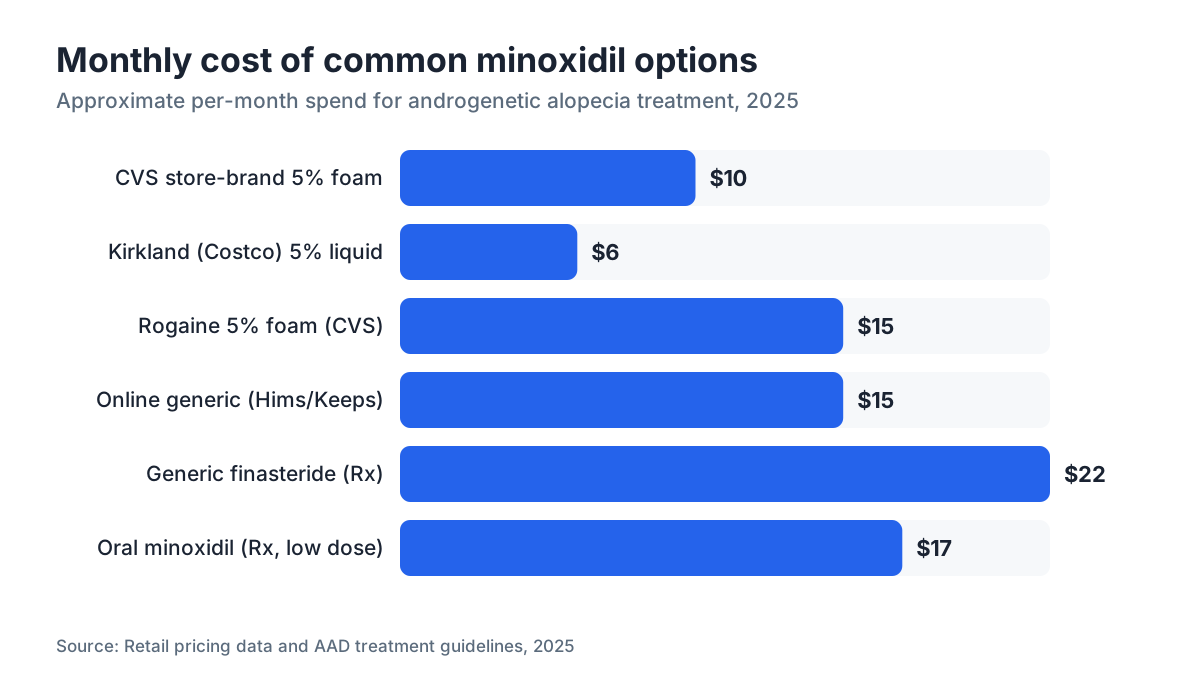
Here's a realistic cost comparison across the main places you can buy topical minoxidil and the alternatives.
| Option | Monthly cost (approx.) | Rx required? | Notes |
|---|---|---|---|
| CVS store-brand 5% foam | $8, $11/mo | No | Based on 3-mo supply price |
| Rogaine 5% foam (CVS) | $12, $17/mo | No | Same active ingredient |
| Kirkland (Costco) 5% liquid | $5, $7/mo | No | Liquid only, no foam |
| Online generics (Hims, Keeps, etc.) | $10, $20/mo | Sometimes | Often bundled with telehealth |
| Finasteride (generic) | $15, $30/mo | Yes | Oral DHT blocker, different mechanism |
| Oral minoxidil (Rx, low dose) | $10, $25/mo | Yes | Off-label, growing evidence base |
| Hair transplant (one-time) | $4,000, $15,000 total | No | Surgical, permanent |
CVS is genuinely competitive on price for OTC minoxidil, especially with the store brand and coupon stacking. The real question isn't which retailer. It's whether topical minoxidil is the right tool for your stage of loss.
For men with moderate-to-significant loss, most dermatologists would say minoxidil alone isn't enough. Pairing it with finasteride, which addresses the hormonal cause, produces better outcomes than either drug alone, per a 2015 comparative trial [6]. You can't buy finasteride at CVS without a prescription, but CVS MinuteClinic locations mean you might get an evaluation in the same trip.
For the bigger picture of what drives loss in the first place, what causes hair loss covers the full landscape.
Are there any risks or side effects specific to buying OTC minoxidil?
The most common side effects are local: scalp irritation, dryness, flaking, and itching. These show up more with the 2% and 5% liquid solutions (which contain propylene glycol) than with the foam. If the liquid is irritating your scalp, switch to foam, or the other way around, before you quit [8].
Systemic side effects, meaning effects on the rest of your body, are rare with topical use at standard doses. Minoxidil started life as an oral blood pressure drug, and cardiovascular effects like a racing heart or fluid retention have been reported in people using large amounts topically or who have pre-existing heart conditions [8]. That's why the FDA label says to consult a doctor before use if you have heart disease.
Unwanted hair growth, either where the product spreads by accident or systemically in some people, is real but uncommon. Women are more prone to facial hair growth, one reason the labeling differs by sex.
Buying OTC means no physician is checking whether minoxidil fits your situation. Fine for most healthy adults with straightforward androgenetic alopecia. Less fine if your loss has an odd pattern, came on suddenly, or you haven't confirmed the cause. Sudden or patchy loss deserves a diagnosis before you assume it's pattern hair loss and start self-treating. See what causes hair loss for how many things can mimic pattern loss but aren't.
Want to size up your own pattern before buying anything? MyHairline's free AI scan (/scan) gives you a baseline read on your hairline and Norwood stage in about two minutes.
Can women use CVS minoxidil, and which product?
Yes. CVS stocks the 2% liquid solution, the FDA-labeled formula for women with androgenetic alopecia. Look for products labeled for women, or check that the label reads 2% minoxidil and mentions women's hair loss.
Same mechanism, different dose. Women apply 1 mL of the 2% solution to the affected scalp twice daily. The timeline to visible results matches men's: three to six months of consistent use before you judge whether it's working [8].
Women buying OTC minoxidil should know two things. It's not recommended during pregnancy or breastfeeding; if there's any chance you're pregnant, talk to your doctor first. And hair loss that looks like pattern thinning is sometimes something else, like thyroid dysfunction, iron deficiency anemia, or polycystic ovary syndrome. Minoxidil won't fix those causes. A blood panel before starting is worth the 15 minutes.
The 5% foam, while dermatologists sometimes use it off-label in women, is not something to self-select at the drugstore. The evidence base is still growing and the risk of hypertrichosis is real.
Does CVS sell oral minoxidil?
No. Oral minoxidil requires a prescription in the United States. CVS pharmacies will fill one if your doctor writes it, but you can't grab it off the shelf.
Low-dose oral minoxidil (typically 0.625 mg to 2.5 mg daily for women, 2.5 mg to 5 mg for men) has become a common off-label treatment for androgenetic alopecia. A 2021 review in the Journal of the American Academy of Dermatology found it effective for multiple hair loss conditions with a generally tolerable side effect profile at low doses [7]. Some dermatologists now prefer it over topical for patients who struggle with compliance, because once-daily oral beats twice-daily topical for staying on track.
If oral minoxidil interests you, you'll need a telehealth visit or an in-person appointment. Some CVS MinuteClinic providers can prescribe it, but call ahead, because prescribing practices vary by state and by provider. For how oral compares to topical, see oral minoxidil.
Generic oral minoxidil tablets started as a blood pressure drug, so they're widely available and cheap. Through a CVS pharmacy the cash price is often under $10 a month with a GoodRx coupon, though it depends heavily on dose and quantity.
What should you do if minoxidil from CVS stops working?
First, confirm you've actually used it consistently for at least six months. Missed doses, applying to wet hair, or using too little are the usual reasons people see nothing. The drug has a narrow window per application, and inconsistency produces inconsistent results.
If you've been genuinely consistent for six months and see no change, or if you had good results for a year or two and then watched the drug hold less and less, it's time to rethink the plan.
Androgen-driven hair loss is progressive. Minoxidil doesn't stop the progression; it only supports follicle function. Over time the underlying genetic process can outrun what minoxidil is doing. At that point, adding a DHT blocker like finasteride is the most evidence-backed next step. The minoxidil-plus-finasteride combination has been studied head to head and beats either alone in men with androgenetic alopecia [6].
For women, dutasteride and spironolactone are sometimes used off-label under a physician's care when minoxidil alone isn't enough.
If the loss is severe, talk to a hair restoration specialist about hair transplant candidacy. Minoxidil is most useful for early-to-moderate loss. Once follicles are fully miniaturized and gone, no topical drug brings them back. For how using both drugs works day to day, finasteride and minoxidil walks through it.
Curious how your current pattern lines up against standard progression? MyHairline's AI scan (/scan) maps your hairline to Norwood stages and gives you a reference point.
How does a receding hairline change what you should buy at CVS?
This is where a lot of men slip up. The FDA-labeled indication for 5% minoxidil targets the vertex, the crown of the scalp. The label was written from clinical trials focused on the crown, because that's where the drug was tested most rigorously [2].
Minoxidil gets used off-label on the hairline and temples, and there's evidence it can slow recession there, but results at the hairline are generally less dramatic than at the crown. The hairline is also where androgenetic alopecia usually shows first, so treating it early matters.
If your worry is mostly a receding hairline rather than crown thinning, minoxidil alone probably won't fully solve it. The hairline moves because DHT is acting on genetically sensitive follicles, and a DHT blocker (finasteride or dutasteride) hits that cause directly. At the hairline, minoxidil earns its keep as part of a combined approach, not as a standalone answer.
Applying minoxidil to the hairline is safe. Just keep it off your forehead, where the skin is more permeable and facial hair growth is a genuine risk.
Sources
- FDA, 'Generic Drugs' program overview
- FDA, Drugs section (OTC minoxidil labeling and status)
- Olsen EA et al., Journal of the American Academy of Dermatology, 2002: 'A randomized clinical trial of 5% topical minoxidil versus 2% topical minoxidil and placebo in the treatment of androgenetic alopecia in men'
- Blume-Peytavi U et al., Journal of the American Academy of Dermatology, 2011: '5% minoxidil foam vs 2% minoxidil solution in women with female pattern hair loss'
- American Academy of Dermatology Association, hair loss patient information
- Hu R et al., Journal of the American Academy of Dermatology, 2015: 'Combined treatment with oral finasteride and topical minoxidil in male androgenetic alopecia: a randomized and comparative study'
- Randolph M and Tosti A, Journal of the American Academy of Dermatology, 2021: 'Oral minoxidil treatment for hair loss: A review of efficacy and safety'
- National Institutes of Health MedlinePlus, 'Minoxidil Topical'
- American Academy of Dermatology Association, hair loss types overview
- FDA, Drugs section (OTC monograph process, including topical minoxidil)