TL;DR: Minoxidil foam (5% concentration) is FDA-approved for androgenetic alopecia and works as well as the liquid in head-to-head trials, with less scalp irritation and faster drying time. The main trade-off is cost: foam runs about $30-50 for a month's supply versus $10-20 for generic liquid. Both take four to six months before visible regrowth appears.
What is minoxidil foam and how does it work?
Minoxidil foam is a topical hair-loss treatment that delivers 5% minoxidil in a propellant-based foam carrier instead of the propylene-glycol-heavy liquid most people know. You apply it directly to the scalp, it collapses on contact with skin warmth, and the active ingredient absorbs into the follicle bed.
Minoxidil is a potassium-channel opener. Doctors first used it as an oral blood-pressure drug in the 1970s, and hypertrichosis (unwanted hair growth) turned up as a side effect in patients taking it systemically [8]. Researchers then tested it on the scalp for androgenetic alopecia, and it became the first FDA-approved topical hair-loss treatment in 1988. The foam formulation came later, gaining FDA approval in 2006 under the Rogaine brand [2].
At the follicle level, minoxidil appears to prolong the anagen (growth) phase of the hair cycle and may enlarge miniaturized hairs. Nobody has nailed down the exact mechanism. The vasodilatory effect and potassium-channel activity are the leading explanations in the literature [8].
If you want a broader look at what drives hair loss in the first place, what causes hair loss covers the full picture.
Does minoxidil foam actually work for hair loss?
Yes, with a realistic ceiling. The registration trial behind FDA approval of 5% topical minoxidil showed significantly more hair regrowth versus placebo in men with androgenetic alopecia, and later trials confirmed similar results in women using 2% and 5% formulations [1][2].
For the foam specifically, a 2007 multicenter, randomized, double-blind trial in the Journal of the American Academy of Dermatology compared 5% minoxidil foam used once daily against 2% minoxidil solution used twice daily in men with androgenetic alopecia. The foam group matched or beat the solution on hair counts despite the lower dosing frequency [3].
Here's what the data won't let you forget: minoxidil is a maintenance drug, not a cure. It keeps follicles that are still alive producing hair. Stop, and the hair you gained typically sheds within three to four months. You're back where you started. Nobody should buy this expecting a permanent fix.
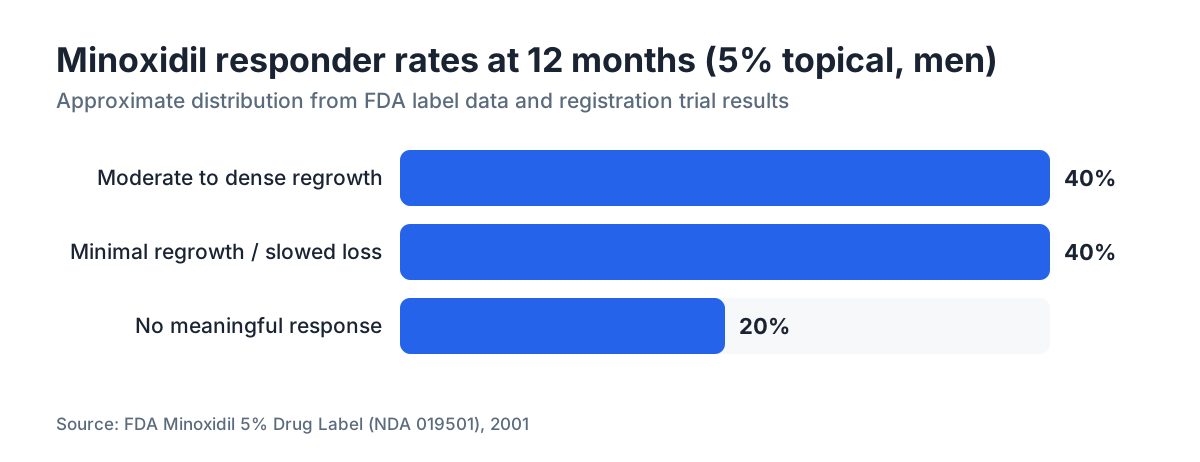
Response rates vary widely. Roughly 40% of men who use 5% minoxidil consistently for a year report moderate to dense regrowth. Another 40% or so see slowed loss with minimal regrowth. About 20% don't respond meaningfully [1]. Those numbers come from FDA label data, not marketing copy.
For men dealing with a receding hairline specifically, minoxidil has weaker evidence at the temples than at the vertex (crown). The original trials focused on the vertex, and that's where the drug performs best.
Minoxidil foam vs liquid: what's the actual difference?
The active ingredient is identical: 5% minoxidil. The difference is the carrier system, and the carrier matters more than most people expect.
The liquid uses propylene glycol as its main solvent. Propylene glycol pushes minoxidil into the skin well, but it irritates some scalps and leaves a greasy residue. It also transfers easily to pillowcases and a partner's skin, which can trigger unwanted facial hair on someone who gets repeated contact [2]. The foam swaps most of the propylene glycol for alcohol and a hydrocarbon propellant, which is why it dries in a minute or two instead of the 30-plus minutes the liquid can take.
The 2007 Olsen trial in the Journal of the American Academy of Dermatology, the same study above, found lower scalp irritation scores in the foam group and better patient-reported tolerability [3].
Here's a direct comparison:
| Feature | Foam (5%) | Liquid (5%) |
|---|---|---|
| FDA-approved formulation | Yes | Yes |
| Propylene glycol | Minimal/none | Yes |
| Drying time | 2-5 minutes | 20-40 minutes |
| Scalp irritation risk | Lower | Moderate |
| Transfer to partner | Less likely | More likely |
| Generic availability | Limited | Widely available |
| Monthly cost (approx.) | $30-50 | $10-20 |
| Application ease | Moderate | Easy |
The foam needs a slightly different technique. Dispense it into a cap or your palm (not directly onto the scalp, since hand heat collapses the foam immediately), then work it into the part. Most people get the hang of it within a week.
For minoxidil for men, the 5% concentration in either form is what the evidence supports. The choice between foam and liquid comes down to your scalp sensitivity, how fast you need to get out the door, and your budget.
Is minoxidil foam safe? What are the side effects?
Topical minoxidil at 5% is one of the better-studied over-the-counter treatments in dermatology, and its safety record is solid. Side effects are still real, and worth knowing before you start [4].
The most common ones with the foam are local: scalp dryness, flaking, and occasionally a mild itch or redness. Because the foam carries less propylene glycol, these reactions happen less often than with the liquid. They still happen in some users.
Initial shedding (telogen effluvium) trips a lot of people up. Two to eight weeks after starting minoxidil, many users notice more shedding. This is not the drug failing. It's the drug pushing telogen-phase hairs out early to make room for new anagen growth. It usually clears within four to eight weeks. If you panic and stop, you'll never learn whether it would have worked. Telogen effluvium explains the mechanism if you're worried about it.
Systemic absorption is low with topical use but not zero. The FDA label warns that people with heart conditions should consult a doctor before use because minoxidil is a vasodilator [2]. Significant cardiovascular effects from topical minoxidil are rare in healthy adults, but the warning is there for a reason.
Unwanted facial or body hair is possible, especially if the product runs down the forehead during application. Applying only to a dry scalp and staying upright afterward cuts that risk.
A full rundown of risks is at minoxidil side effects. Read it before you decide.
How do you apply minoxidil foam correctly?
Application technique matters more than most people think, and it's where a lot of users quietly wreck their own results.
The steps for foam:
- Start with a dry or nearly dry scalp. Wet hair dilutes the concentration and slows absorption.
- Hold the canister upside down and dispense half a capful (about 1 gram) into the cap or onto a cool surface like the back of your hand near the wrist.
- Part your hair in the affected area to expose the scalp. Work the foam onto the scalp, not the hair shafts.
- Use your fingertips to spread and gently massage it in for about 60 seconds.
- Wash your hands right after.
- Wait at least four hours before washing your hair. The FDA label recommends holding off that long for adequate absorption [2].
Twice daily is the standard dose from the FDA label: once in the morning, once in the evening. Some people use it once daily for convenience and accept that efficacy may drop, but the trials that proved it worked used twice-daily dosing.
Don't apply more than directed hoping for faster results. Doubling the dose doesn't double the effect. It just raises the side-effect risk and burns through product.
Consistency is everything. Minoxidil has an unforgiving pharmacology: miss enough doses and the benefit fades. Set phone reminders if that's what it takes.
Who should use minoxidil foam, and who should avoid it?
Minoxidil foam is approved for adults with androgenetic alopecia, the genetically driven pattern baldness most people mean when they say "hair loss." That covers the classic Norwood pattern in men (vertex and front-mid scalp thinning) and the diffuse frontal-to-crown thinning typical of women with the condition [2].
It's a better pick than the liquid if:
- Your scalp is sensitive or easily irritated
- You color-treat your hair and don't want heavy residue
- You need to style quickly in the morning
- You share a bed with a partner who's reacted to your old liquid
Talk to a doctor first if you have any cardiovascular condition, since minoxidil is a vasodilator and the systemic absorption, though small, is real [2]. Pregnant women and women trying to conceive should skip it. The animal data on fetal safety isn't reassuring, and topical minoxidil isn't FDA-labeled for use during pregnancy.
Minoxidil won't do much if something other than androgenetic alopecia is causing your loss. Alopecia areata, scalp infections, nutritional deficiencies, and thyroid-related shedding all need different treatments. If you're unsure what's driving your loss, a dermatologist visit is worth the co-pay before you spend months on a drug that can't help your situation.
For men who want to address the hormonal side of androgenetic alopecia at the same time, combining minoxidil with finasteride is the evidence-based pairing most dermatologists recommend. There's more on the combined approach at finasteride and minoxidil.
How long does it take for minoxidil foam to work?
This is the question that causes the most drop-off, because the honest answer is: longer than you want it to be.
The typical timeline runs like this:
Weeks 1-8: Possible increased shedding. No visible regrowth. This is where most people either panic or decide the product is fake. It's neither.
Months 2-4: Shedding normalizes. Some users start noticing thicker vellus (fine, downy) hairs where terminal hairs were miniaturizing. You probably won't spot this without a magnified photo.
Months 4-6: The first visible changes for responders. Hair count and diameter measurements in clinical trials show statistically significant improvement at the 16-week and 24-week marks [1][3].
Month 12 and beyond: Maximum benefit. The effects plateau around the one-year mark for most users. Hair count gains in the original 5% minoxidil trials peaked around 48 weeks and then held steady [1].
The practical takeaway: don't judge whether it's working until you've used it consistently for at least six months. That's the minimum honest evaluation window. If you're still losing net hair at six months, check in with a dermatologist about adding finasteride, switching to oral minoxidil, or other options.
Photography is your best tool here. Take a standardized photo (same lighting, same parting, same distance) every four weeks. The human brain is terrible at noticing slow change. Photos aren't.
How much does minoxidil foam cost, and is the generic worth buying?
Brand-name Rogaine 5% foam runs roughly $40-55 for a month's supply (two 2.11-oz canisters) depending on the retailer. Kirkland Signature foam (Costco's house brand, also 5%) is usually $25-35 for a three-month supply, which makes it the best value for foam users [5].
Generic foam options are thinner on the ground than generic liquid because the foam formulation is harder to manufacture consistently. Liquid generics are dirt cheap: $10-20 per month for 5% minoxidil liquid from any pharmacy.
If cost is a real constraint, the liquid works. The evidence doesn't support paying a 3-4x premium for the foam if you can tolerate the propylene glycol. But if propylene glycol irritates your scalp, or the drying time genuinely wrecks your routine, the foam premium is defensible.
A 60-milliliter bottle of liquid minoxidil 5% holds about 60 doses at 1 mL per dose. A 2.11-oz (about 60-gram) foam canister holds about 30 doses at the half-capful recommended dose. Do the math before you buy.
Subscription programs through major retailers often bring the monthly foam cost down to $30-35. Worth comparing.
For context on whether supplements are worth layering in alongside minoxidil, hair loss supplements breaks down what has actual evidence and what doesn't.
Can women use minoxidil foam?
Yes. The FDA approved 5% minoxidil foam for women in 2014, with once-daily application (the label for women says once daily, not twice) [2]. Before that, women using topical minoxidil were usually pointed to the 2% liquid.
A clinical trial comparing 5% foam once daily in women against 2% solution twice daily found the 5% foam at least as effective, with similar tolerability [6]. That matters in practice: once-daily dosing is easier to keep up.
Women should know the unwanted facial hair risk is real if the product runs onto the face. Applying it to a completely dry scalp, in a parted section, while tilted forward so it doesn't migrate toward the forehead, cuts that risk a lot.
Pregnancy is an absolute contraindication. Stop minoxidil before trying to conceive and don't use it while pregnant or breastfeeding. The drug carries a Pregnancy Category C classification based on animal data, meaning fetal risk can't be ruled out [2].
If you haven't figured out why your hair is thinning, what causes hair loss covers the female-specific causes (hormonal shifts, postpartum telogen effluvium, thyroid issues) that minoxidil alone won't fix.
What happens if you stop using minoxidil foam?
The hair you kept or regrew on minoxidil sheds within about three to four months of stopping [1][10]. This isn't a myth or a scare tactic. It's a direct consequence of how the drug works.
Minoxidil doesn't touch the genetic program driving androgenetic alopecia. It creates a friendlier environment for follicles to stay in the growth phase. Remove that environment, and the follicles revert. The underlying miniaturization kept progressing the whole time, masked by minoxidil's effects, so you often end up looking worse than if you'd never started.
This is the single most important thing to understand before you start. Minoxidil is a long-term commitment. People who treat it as a short-term fix and quit are usually disappointed.
If you decide to stop, the least bad approach is switching to another treatment (finasteride, a hair transplant if you're a candidate) before you stop, rather than quitting cold and waiting to see what happens.
For men worried about the genetics side of this, DHT blocker explains how finasteride and similar medications hit the hormonal driver that minoxidil doesn't touch.
Is minoxidil foam better when combined with other treatments?
For men with androgenetic alopecia, combining minoxidil with finasteride is the best-studied multi-drug approach and what most hair loss specialists recommend over either drug alone. A 12-month randomized trial in Dermatologic Therapy found the combination produced significantly greater hair count improvement than either monotherapy [7].
The logic holds up: minoxidil stimulates growth at the follicle, while finasteride cuts the DHT that causes miniaturization. Different mechanisms. Using both covers more ground.
Platelet-rich plasma (PRP) injections are sometimes paired with topical minoxidil in clinical practice, and some small trials show added benefit. The evidence base for PRP is much weaker and the cost is high (typically $1,500-3,500 per course). Treat it as experimental.
Low-level laser therapy (LLLT) devices (combs, helmets) are FDA-cleared for hair loss, and some small trials suggest modest added benefit alongside minoxidil. The effect sizes are small and the devices cost a lot. Reasonable add-on if budget allows. Not essential.
If you use MyHairline's free AI hair scan at myhairline.ai/scan, the output gives you a baseline read on your pattern and severity to bring into a more specific conversation with a dermatologist about mono versus combination therapy.
Some users ask about combining minoxidil with hair loss supplements like biotin or saw palmetto. Biotin has no good evidence for androgenetic alopecia in people who aren't biotin-deficient. Saw palmetto has very weak DHT-blocking data. Neither replaces minoxidil or finasteride.
Where can you buy minoxidil foam, and do you need a prescription?
In the United States, 5% minoxidil foam is available over the counter without a prescription. You can buy it at any pharmacy (CVS, Walgreens, Rite Aid), warehouse clubs (Costco, Sam's Club), and online through Amazon or the manufacturer's website [2].
The 2% liquid formulation for women switched to OTC status years ago too. No U.S. prescriptions are needed for any topical minoxidil concentration currently sold.
Oral minoxidil is a different story. Low-dose oral minoxidil (0.625mg-5mg daily) is increasingly used off-label for hair loss and shows strong results in the emerging literature, but it needs a prescription and cardiovascular monitoring. That's covered in depth at oral minoxidil.
Outside the U.S., rules vary. In the UK, topical 5% minoxidil is available over the counter. In Australia and Canada, it's OTC as well. Always buy from a licensed pharmacy or major retailer to make sure you get a correctly formulated product. Counterfeit minoxidil sold through gray-market websites is a real problem.
If cost is a barrier, GoodRx coupons can drop generic liquid minoxidil to as little as $8-12 per month at most major pharmacies. The foam generics don't get the same dramatic coupon discounts, but they still beat brand-name Rogaine on price.
Sources
- FDA, Minoxidil Topical Solution 2% and 5% Drug Label (NDA 019501)
- FDA, Rogaine 5% Minoxidil Foam OTC Drug Label
- Olsen EA et al., 'A randomized clinical trial of 5% topical minoxidil foam once daily versus 2% topical minoxidil solution twice daily in the treatment of androgenetic alopecia in men', Journal of the American Academy of Dermatology, 2007
- American Academy of Dermatology, Hair Loss: Diagnosis and Treatment
- Costco Wholesale, Kirkland Signature Minoxidil 5% Foam product page
- Blume-Peytavi U et al., 'A randomized, single-blind trial of 5% minoxidil foam once daily versus 2% minoxidil solution twice daily in the treatment of androgenetic alopecia in women', Journal of the American Academy of Dermatology, 2011
- Hu R et al., 'Combined treatment with oral finasteride and topical minoxidil in male androgenetic alopecia: a randomized and comparative study on efficacy and safety', Dermatologic Therapy, 2015
- NIH National Library of Medicine, MedlinePlus: Minoxidil Topical
- American Academy of Dermatology, Androgenetic Alopecia: Overview
- Shapiro J, 'Current Treatment of Alopecia', Journal of Drugs in Dermatology, 2013