TL;DR: Minoxidil is an FDA-approved topical (and now off-label oral) treatment for androgenetic alopecia. In controlled trials, 5% topical minoxidil regrows or stabilizes hair in roughly 40 to 60% of users after 16 to 48 weeks. It does not cure hair loss. Stop using it and your gains reverse within months. It works better started early, and it works best paired with finasteride.
What is minoxidil and why does it affect hair?
Minoxidil started as an oral blood pressure drug in the 1970s. Doctors noticed an odd side effect: patients grew hair in places they hadn't expected. That observation led to topical formulations, and in 1988 the FDA approved 2% topical minoxidil for androgenetic alopecia, the first drug ever cleared for hair loss. [1] The 5% concentration for men followed in 1991, and a 5% foam for women in 2014. [1]
How it works at the scalp is still not perfectly understood. The leading explanation is that minoxidil opens potassium channels. It widens blood vessels in the scalp, which may improve oxygen and nutrient delivery to hair follicles. It also appears to extend the anagen (growth) phase of the hair cycle and may stimulate follicle cells directly. [2] None of these mechanisms touches the hormonal process driving androgenetic alopecia, which is mostly dihydrotestosterone (DHT) shrinking follicles over time. Minoxidil works around that problem. It doesn't solve it.
Because the cause is untouched, the drug only works while you use it. Stop, and the follicles that responded drift back to their pre-treatment trajectory within roughly 3 to 4 months for most people. [3]
What does the clinical evidence actually show for androgenetic alopecia?
The evidence base for minoxidil is genuinely solid, at least by hair loss standards, which is a field with more hope than data.
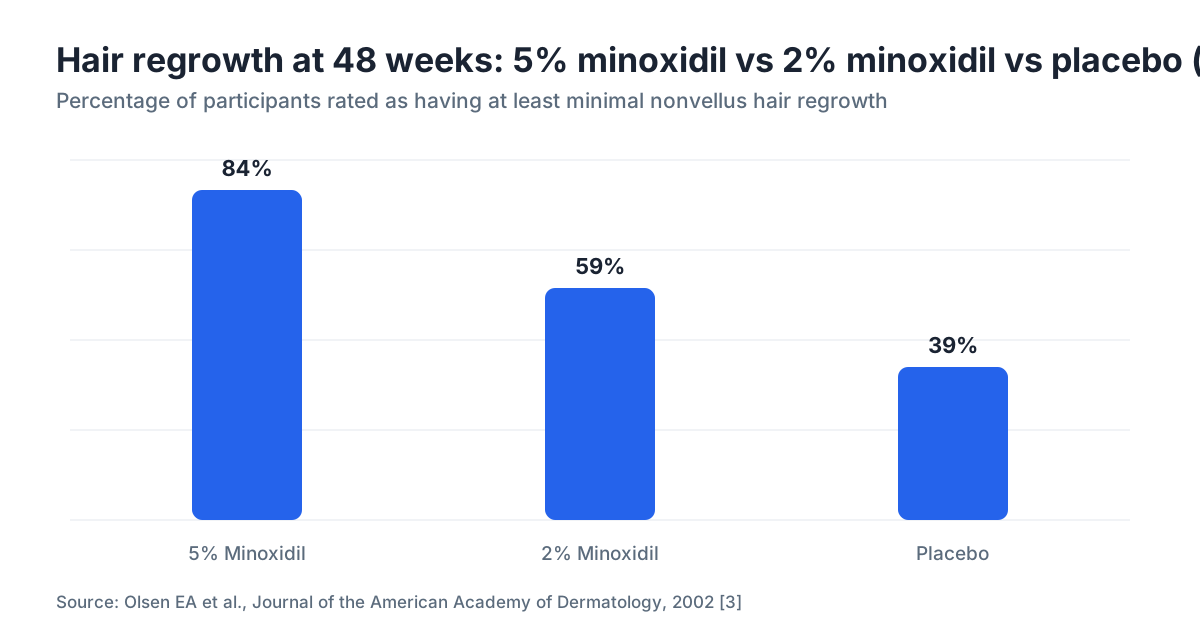
The most cited registration trial for 5% topical minoxidil in men ran 48 weeks. Men using 5% minoxidil had a mean increase of 18.6 nonvellus hairs per cm² versus 5.1 in the placebo group. Investigators rated 84% of 5% users as having at least minimal regrowth, versus 39% of placebo users. [3] That placebo number is real and humbling. Hair counts fluctuate, and a big share of people talk themselves into believing a placebo is working. The drug effect is real. For many individuals it's also modest.
A 2002 randomized trial in the Journal of the American Academy of Dermatology compared 5% and 2% minoxidil in men and found 5% produced 45% more hair regrowth than 2% at 48 weeks, with a faster onset. [3] That's one reason most dermatologists start patients at 5%.
For women, a 32-week trial found that those using 2% minoxidil twice daily had significantly greater increases in total and nonvellus hair counts than placebo. [4] Later studies showed 5% foam once daily was non-inferior to 2% solution twice daily, with fewer tolerability problems, which is why the 5% foam largely replaced the 2% solution for women in practice. [4]
Here's the honest bottom line. You can expect loss to stabilize in most users and some visible regrowth in roughly half. You will not go from Norwood 5 to Norwood 2. The further your hair loss has progressed, the harder it is to get results that look meaningful to you in the mirror.
How do the different formulations compare: topical solution, foam, and oral minoxidil?
There are three main ways people take minoxidil now.
| Formulation | Concentration | Typical dose | FDA-approved for AGA? | Main pros | Main cons |
|---|---|---|---|---|---|
| Topical solution | 2% or 5% | 1 mL twice daily | Yes (men and women) | Low cost, widely available OTC | Propylene glycol irritates some scalps; greasy |
| Topical foam | 5% | Half a capful once or twice daily | Yes (women 5%, men 5%) | Less irritation, dries faster | Slightly pricier than solution |
| Oral (tablet) | 0.625 to 5 mg | Once daily | No (off-label) | Better systemic absorption, easier to stay consistent | More side effects possible; needs a prescription |
The topical solution and foam are sold over the counter in the US. [1] Oral minoxidil is an off-label use. Dermatologists have prescribed it at low doses (typically 0.625 to 2.5 mg/day for women, 2.5 to 5 mg/day for men) for several years, and observational data plus small randomized trials suggest it matches or slightly beats topical minoxidil for some patients. A 2021 review in the Journal of the American Academy of Dermatology reported that 5 mg daily oral minoxidil was non-inferior to twice-daily 5% topical minoxidil in women at 24 weeks, with higher patient satisfaction. [5] The full oral minoxidil guide covers this approach in depth.
The tradeoff with oral is higher systemic absorption, so side effects like fluid retention, low blood pressure, and unwanted facial or body hair show up more often. At low doses these are usually mild or absent. Anyone with cardiovascular concerns needs to talk to their doctor before starting.
How long does minoxidil take to work?
Expect nothing visible for the first two to three months. That's not the drug failing. That's the hair cycle doing what hair cycles do.
Soon after starting, many users notice more shedding. This is a telogen effluvium, and it happens because minoxidil pushes resting follicles back into anagen, ejecting the old club hair first. [6] More hair on your pillow in weeks two through eight usually means the drug is reaching your follicles. It's temporary. The telogen effluvium article explains why this happens in detail.
Typical timeline:
- Weeks 1 to 8: possible increased shedding
- Months 2 to 4: initial fine vellus hairs may appear
- Months 4 to 6: vellus hairs begin converting to slightly thicker terminal hairs in responders
- Months 6 to 12: peak effect in most studies
- Month 12 and beyond: maintenance; continued use sustains the response
The FDA label for 5% topical minoxidil says results are typically seen after four months of twice-daily use. [1] Don't bail at month two because of shedding.
Who responds best to minoxidil for androgenetic alopecia?
Minoxidil works better on some people than others, and the predictors matter before you commit to a year of daily application.
Follicle age matters a lot. Follicles that are still alive but miniaturized respond. Follicles gone long enough to be replaced by fibrous tissue cannot be revived by any topical. The lesson is simple: start earlier. Someone at Norwood 2 or 3 with diffuse thinning almost always responds better than someone at Norwood 5 or 6 who has had bald areas for a decade. [2]
Genetics likely explains some of the variation. A minority of people appear to lack enough sulfotransferase enzyme activity in the scalp, which is what converts minoxidil to its active form, minoxidil sulfate. [11] A hair-plucking sulfotransferase test can detect this, though it's not part of standard care and the evidence on its predictive value is still limited.
Women with androgenetic alopecia who present with diffuse thinning at the crown (Ludwig scale I to II) tend to respond well. [4] Women with complete frontal hairline loss respond less predictably.
If your hair loss sits mainly at the hairline, the receding hairline article covers how topical minoxidil applies to frontal loss specifically.
What is the right way to use minoxidil topically?
The FDA-approved label instructions are specific, and they matter for both results and safety. [1]
For the solution: apply 1 mL directly to the dry scalp over the thinning area twice daily, roughly 12 hours apart. Spread it with your fingers, not a comb. Wash your hands right after. Don't rinse it out for at least four hours (overnight application is fine). Don't use more than 2 mL per day. More does not mean more growth, and it does mean more absorption.
For the foam: part the hair, apply half a capful to the scalp (not the hair), and massage it in lightly. The foam is less messy, but the product still needs to reach scalp skin rather than sit on hair.
A dry scalp matters because absorption climbs when the skin barrier is wet or broken. That sounds helpful, but it mostly raises irritation risk. Apply to a wet scalp and systemic absorption goes up unpredictably. [1]
Don't apply right before a heavy workout. You'll just sweat it off. Morning and bedtime are the two schedules people actually stick to.
The minoxidil for men article covers concentration choices and hair type considerations if you want that level of detail.
Does minoxidil work better when combined with finasteride?
Yes, and by a meaningful margin.
Minoxidil and finasteride work through completely different pathways. Minoxidil stimulates follicle activity through vasodilation and direct cellular effects. Finasteride blocks 5-alpha reductase, cutting scalp DHT by roughly 60 to 70%, which slows or stops the hormonal signal that shrinks follicles in the first place. [7] Using both hits two separate mechanisms at once.
A 12-month randomized trial in the Journal of Dermatology found that oral finasteride plus topical 5% minoxidil produced significantly greater hair count increases than either drug alone. [8] Most dermatologists treating moderate androgenetic alopecia in men recommend combination therapy as the first move.
The finasteride and minoxidil article breaks down how the two drugs interact, dosing, and the combination evidence.
Finasteride is not typically recommended for women of childbearing potential because of teratogenicity risk. Women who want combination therapy usually pair topical minoxidil with a topical antiandrogen like spironolactone, or discuss oral spironolactone with their doctor.
For the wider view on DHT, the DHT blocker article covers options beyond finasteride.
What are the main side effects and who should avoid minoxidil?
Topical minoxidil at approved doses has a good safety record over 35-plus years of OTC use. That doesn't mean it's effect-free.
The most common topical side effect is scalp irritation: itching, flaking, redness. Propylene glycol, the vehicle in the solution, causes most of it. Switching to the propylene glycol-free foam clears this up for most people. [1]
Hypertrichosis (unwanted hair growth away from the scalp, especially on the face) affects roughly 3 to 5% of women using topical minoxidil, and it's dose-dependent. [4] It usually regresses when you stop. Applying carefully and washing your hands well reduces accidental transfer to facial skin.
Contact dermatitis is possible. Significant redness or a rash means stop and see a dermatologist.
Cardiovascular effects at topical doses are rare but not impossible. The FDA label lists tachycardia and fluid retention as rare adverse events. [10] Anyone with cardiovascular disease should get physician clearance first.
The label lists contraindications: use under 18, use on an irritated or sunburned scalp, and pregnancy (Category C for both topical and oral). Nursing mothers should not use it. [10]
The minoxidil side effects article walks through each adverse effect and what to do about it.
How much does minoxidil cost and where can you get it?
Generic topical minoxidil is cheap. A one-month supply of 5% solution (two 60 mL bottles) runs about $8 to $20 at major US pharmacies and online as of 2025. [9] The foam costs more, roughly $20 to $35 a month for 5%. Brand-name Rogaine runs about double the generic price for the same active ingredient at the same concentration.
Oral minoxidil tablets (usually 2.5 mg or 5 mg) are off-label and need a prescription. Through a doctor and a regular pharmacy, generic oral minoxidil costs about $10 to $30 a month at hair loss doses. [9] Telehealth platforms usually add a consultation fee on top of the medication.
You don't need a prescription for OTC topical minoxidil in the US. You need a pharmacy or an Amazon account.
Insurance rarely covers minoxidil for hair loss because it's classified as cosmetic. A few insurers will cover oral minoxidil if the listed indication is hypertension, but that's inconsistent and ethically murky ground.
When should you consider a hair transplant instead of or in addition to minoxidil?
Minoxidil is a maintenance drug, not a reconstruction tool. It can't rebuild a bald scalp. If you have significant hairline recession or large bald patches, no topical will restore density where follicles are already gone.
A hair transplant moves DHT-resistant follicles from the back and sides of the scalp into bald or thinning areas. Transplanted follicles are genetically programmed to resist DHT and usually stay put. But a transplant does nothing to stop ongoing androgenetic alopecia in the surrounding native hair. That's exactly why transplant surgeons almost universally tell patients to keep using minoxidil (and often finasteride) after surgery, to protect the non-transplanted hair that would otherwise keep thinning.
A rough decision framework: if you still have significant native hair and your goal is to slow loss and thicken what's there, medication comes first. If you have a clearly recessed hairline or defined bald patches and medication has plateaued, a transplant consultation makes sense. The two aren't mutually exclusive.
If you're not sure where your hair loss stands, the free AI hair analysis at MyHairline can map your Norwood or Ludwig stage from a photo and help you see which options fit your pattern before you spend money on anything.
What happens if you stop using minoxidil?
This is the single most important thing to understand before starting, and most OTC packaging undersells it.
Minoxidil does not cure androgenetic alopecia. The follicles you kept alive or regrew are still DHT-sensitive. Stop the drug and the supportive effect disappears, so those follicles resume miniaturizing. Most people who quit return to their baseline pattern within 3 to 6 months. [3] Some shed the regrown hairs in one fast wave before settling back at baseline, which looks alarming.
This isn't unique to minoxidil. Finasteride does the same thing. Stop taking it, DHT recovers within days, and hair loss resumes over the following months.
So starting minoxidil is a long-term commitment. If you're only willing to try it for three months, you're setting yourself up for disappointment and a discouraging shed when you quit. If you start, plan to use it indefinitely, or until something more permanent like a transplant is on the table.
For why androgenetic alopecia is so stubborn in the first place, see the what causes hair loss article.
Are there any alternatives if minoxidil doesn't work for you?
Minoxidil doesn't work for everyone. Non-response estimates vary widely across studies, but somewhere between 40 and 60% of users see meaningful regrowth, which means a real share do not. [3] What then?
Finasteride (or dutasteride, a stronger 5-alpha reductase inhibitor) is the next evidence-backed option for men. Women have fewer approved drug options, but spironolactone (off-label) and platelet-rich plasma (PRP) injections have accumulating data. Low-level laser therapy devices (FDA-cleared, not FDA-approved for efficacy the way drugs are) have modest support from small trials. Ketoconazole shampoo at 1 to 2% has weak but real data for a mild anti-androgenic effect at the scalp, as an add-on, not a standalone.
Hair loss supplements are a popular category with thin evidence for most products. Biotin sells well, but the data only supports it in people who are actually biotin-deficient. Correcting iron and zinc deficiency genuinely helps deficient patients. Past that, the evidence gets sparse.
The honest answer: if topical minoxidil hasn't helped after 12 months of consistent use, talk to a dermatologist. Combination therapy, switching to oral minoxidil, or adding finasteride are the moves most likely to change something. MyHairline's AI scan can track changes objectively over time, so the conversation with your doctor starts with actual data.
If you're curious about compounds people argue about online, like creatine and its supposed effect on DHT, the does creatine cause hair loss article covers the evidence there.
Sources
- FDA, Rogaine 5% Minoxidil Topical Solution prescribing information and OTC label
- American Academy of Dermatology, Hair loss types: androgenetic alopecia
- Olsen EA et al., 'A randomized clinical trial of 5% topical minoxidil versus 2% topical minoxidil and placebo in the treatment of androgenetic alopecia in men,' Journal of the American Academy of Dermatology, 2002
- Olsen EA et al., 'Global photographic assessment of women with female-pattern hair loss treated with topical minoxidil 2% or placebo,' Journal of the American Academy of Dermatology, 1993; and 5% foam non-inferiority data
- Randolph M, Tosti A, 'Oral minoxidil treatment for hair loss: A review of efficacy and safety,' Journal of the American Academy of Dermatology, 2021
- Mysore V, 'Telogen effluvium and minoxidil-induced shedding,' International Journal of Trichology, 2009
- Rossi A et al., 'Finasteride, 1 mg daily administration on male androgenetic alopecia in different age groups: 10-year follow-up,' Dermatology and Therapy, 2011
- Khandpur S et al., 'Comparative efficacy of various treatment regimens for androgenetic alopecia in men,' Journal of Dermatology, 2002
- GoodRx, minoxidil pricing page
- National Library of Medicine MedlinePlus, Minoxidil Topical
- Shapiro J, Price VH, 'Hair regrowth: therapeutic agents,' Dermatologic Clinics, 1998