TL;DR: Minoxidil shampoo products exist, but no rinse-off shampoo formulation has FDA approval for hair regrowth. Approved minoxidil is a leave-on topical applied directly to the scalp. Shampoos that list minoxidil as an ingredient typically rinse away before absorption can occur, so the clinical evidence for them is thin to nonexistent.
What is minoxidil shampoo and how is it different from regular minoxidil?
Minoxidil shampoo is a wash-out hair product that contains some concentration of minoxidil, the vasodilator originally approved for blood pressure that later became the first FDA-approved topical hair loss treatment. The idea sounds appealing: get your hair loss treatment during your daily shower, skip the separate leave-on step. The pharmacology doesn't cooperate with that convenience story.
FDA-approved minoxidil (sold as Rogaine and dozens of generics) is formulated as a 2% or 5% solution or a 5% foam, all designed to sit on the scalp for hours. The absorption window matters. Studies supporting minoxidil's efficacy are all based on leave-on formulas applied twice daily and left in contact with the scalp. [1]
A shampoo, by definition, is rinsed off after one to five minutes. The skin on your scalp needs sustained contact for minoxidil to penetrate the follicle and do its vasodilatory work. Washing it away almost immediately is the problem no marketing language can solve.
The category splits into two things that often get confused. First, there are rinse-off shampoos that list minoxidil in the ingredient deck, sold mostly as general hair-thickening products. Second, there are compounded or branded leave-on scalp serums sometimes called "minoxidil shampoos" by mistake. If a product tells you to rinse it out, it is not a clinically validated hair regrowth treatment regardless of what's on the label.
Does minoxidil shampoo have FDA approval?
No. The FDA has approved minoxidil in two topical leave-on forms only: a 2% topical solution (approved for women in 1991) and a 5% topical solution plus a 5% foam (approved for men in 1996 and 2006 respectively). [1] There is no approved minoxidil shampoo formulation.
The FDA's drug approval process requires a manufacturer to prove that the specific formulation, at the specific concentration, delivered in the specific way, produces the claimed benefit in controlled trials. A shampoo maker would need its own clinical data showing its rinse-off product regrows hair. Nobody has produced that data because the pharmacokinetics make it implausible.
Here's the practical read. When you see "minoxidil" on a shampoo bottle, you're looking at a cosmetic or a drug claim that hasn't been substantiated the way Rogaine's was. The FDA has warned companies about making unapproved drug claims on cosmetic hair products. [2]
For men specifically, the only scalp-applied treatments with real regulatory backing remain topical minoxidil solutions and foam, plus finasteride taken orally. If you're researching your options, minoxidil for men covers the approved formulations in detail.
Can minoxidil even absorb through the scalp in a shampoo?
This is the core scientific question, and the answer is almost certainly no, not in any clinically meaningful amount.
Minoxidil absorption through skin depends on contact time, vehicle (the carrier liquid or foam), and scalp condition. Research on topical minoxidil pharmacokinetics shows that systemic absorption from the approved 2% solution is roughly 1.4% of the applied dose after prolonged contact. [3] The drug has to sit there. Percutaneous absorption is slow.
A shampoo rinse gives you maybe two to five minutes of contact, assuming water isn't diluting the formula the whole time. The stratum corneum, your skin's outermost barrier layer, limits how quickly anything penetrates. Even if a shampoo contained 5% minoxidil (most don't disclose concentrations, and many contain far less), the fraction reaching hair follicles in that timeframe would be negligible.
One frequent counterargument is that some compounding pharmacies create minoxidil shampoos with penetration enhancers added. In theory, an enhancer like propylene glycol or certain fatty acids could speed absorption. In practice, there are no peer-reviewed randomized controlled trials showing that any rinse-off minoxidil shampoo achieves follicular drug concentrations high enough to stimulate regrowth. That absence isn't proof of failure. It's also not a reason to spend money on it over proven options.
If you're curious about what happens when minoxidil does absorb (even from legitimate leave-on products), the minoxidil side effects article walks through the real risk profile.
What do the clinical studies on minoxidil shampoo actually show?
Thin. That's the honest summary.
The foundational minoxidil trials, including the multicenter placebo-controlled studies used for FDA approval, all tested leave-on topical solutions. A study in the Journal of the American Academy of Dermatology found that 5% minoxidil solution produced significantly greater hair regrowth than placebo, with 45% of men showing moderate to dense regrowth at 48 weeks. [4] None of that data applies to a rinse-off product.
For shampoo specifically, the literature is sparse. A handful of small, often industry-funded studies have looked at shampoos containing ketoconazole (an antifungal with weak anti-androgenic properties) or saw palmetto, not minoxidil. A study in the Journal of Dermatology found ketoconazole 1% shampoo produced some increase in hair density compared to placebo, but the effect size was modest and the mechanism is unrelated to minoxidil. [5]
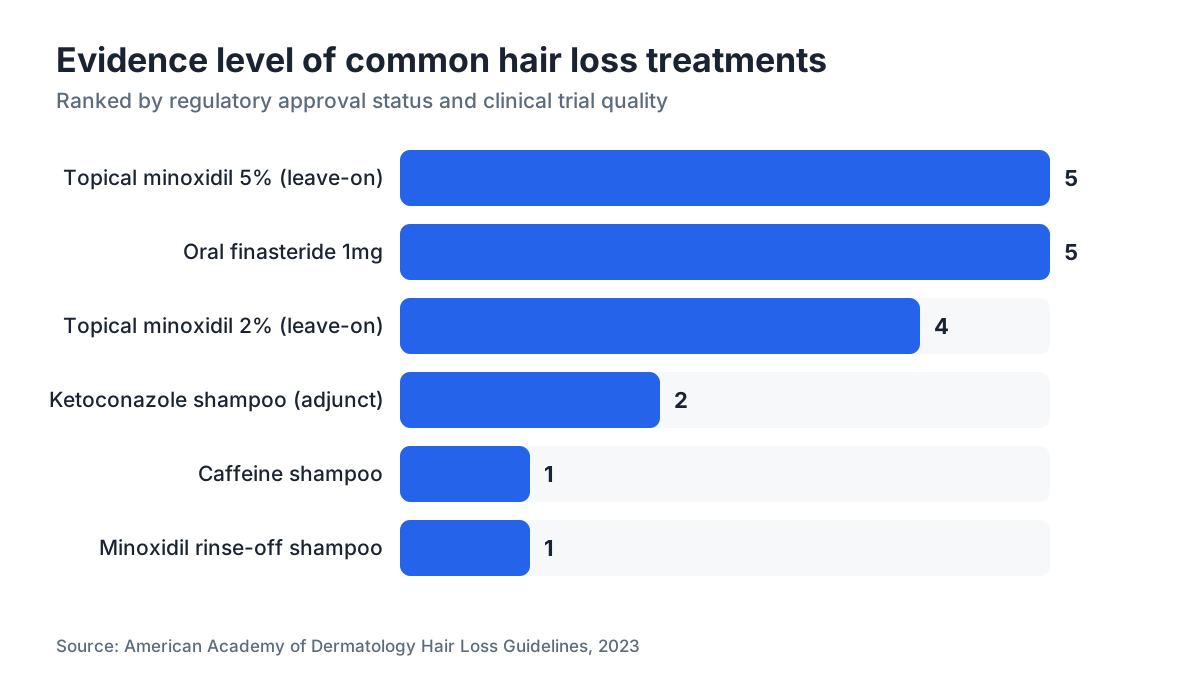
Minoxidil shampoo as a standalone category lacks randomized controlled trial evidence. No major dermatology guideline, including those from the American Academy of Dermatology, recommends rinse-off minoxidil shampoo for androgenetic alopecia. The AAD's clinical practice guidelines recommend topical minoxidil (leave-on) as a first-line treatment for men and women with pattern hair loss. [6]
If you're early in your research and wondering what's actually driving your hair loss, what causes hair loss gives you a grounded starting point.
How do minoxidil shampoos compare to approved hair loss treatments?
| Treatment | FDA Approved | Form | Evidence Level | Avg. Monthly Cost (USD) |
|---|---|---|---|---|
| Topical minoxidil 5% foam | Yes | Leave-on | RCT, Level 1 | $15-$40 (generic) |
| Topical minoxidil 2% solution | Yes | Leave-on | RCT, Level 1 | $10-$25 (generic) |
| Oral finasteride 1mg | Yes | Pill | RCT, Level 1 | $10-$40 (generic) |
| Minoxidil shampoo (rinse-off) | No | Rinse-off | No RCT data | $15-$50 |
| Ketoconazole shampoo | No (hair) | Rinse-off | Small trials | $10-$30 |
| Hair loss supplements | No | Oral | Mixed, weak | $20-$60 |
The cost column tells the story. Minoxidil shampoos often cost as much or more than generic topical minoxidil, for a product with no trial-backed evidence of efficacy. Generic 5% minoxidil foam runs about $15 to $25 a month at major pharmacies. [7]
For most people dealing with pattern hair loss, the decision tree is simple: start with topical minoxidil (leave-on), consider adding oral finasteride if you're male and medically suitable, and revisit more advanced options like hair transplant surgery only after exhausting conservative treatments. A minoxidil shampoo as a replacement for any of those steps isn't justified by evidence.
Finasteride and minoxidil are often used together. finasteride and minoxidil covers the combination data if you want to understand whether adding both is worth it.
Are there any ingredients in hair loss shampoos that do have some evidence?
Yes, a few. The evidence is thinner than for approved topical minoxidil, but these aren't complete fiction either.
Ketoconazole. The antifungal ingredient has weak evidence for modest hair density improvements, likely because it has some DHT-blocking properties at the scalp level. The Journal of Dermatology study mentioned above found ketoconazole 1% produced comparable hair density increases to 2% minoxidil solution in a small sample, though that study had methodological limits and hasn't been replicated at scale. [5] Ketoconazole 2% shampoo (Nizoral) is FDA-approved for dandruff, not hair loss, but many dermatologists suggest it as an adjunct.
Saw palmetto. Some small studies show it inhibits 5-alpha reductase (the enzyme that converts testosterone to DHT) when applied topically. The data is inconsistent and effect sizes are small. If you want to understand DHT's role in hair loss more broadly, dht blocker explains the mechanism.
Caffeine. In vitro studies (cell cultures in a lab, not human scalps) show caffeine may extend the anagen phase of hair growth. Human clinical evidence is limited. A few small trials have shown modest effects but nothing close to the evidence base for approved minoxidil. [8]
Biotin shampoos. Biotin deficiency can cause hair loss, but the vast majority of people with pattern hair loss aren't biotin deficient. Applying biotin topically in a rinse-off formula has essentially no evidence behind it. hair loss supplements covers oral biotin and other supplements if you're curious about that angle.
None of these ingredients in a rinse-off shampoo replaces topical minoxidil for androgenetic alopecia.
What about minoxidil shampoo for women?
Women facing hair loss often find topical minoxidil solutions irritating, partly because the propylene glycol carrier in the solution causes scalp irritation in some users. That's a real problem, and it makes a gentle shampoo-based option sound attractive.
The pharmacology issue is the same regardless of sex. A rinse-off product cannot deliver sustained scalp contact. Women's pattern hair loss (female androgenetic alopecia) responds to leave-on 2% or 5% minoxidil, per AAD guidelines, and the 5% foam is often better tolerated because it has less propylene glycol. [6]
If scalp sensitivity is driving the interest in a shampoo format, the better move is switching to the foam formulation of minoxidil rather than trying a rinse-off shampoo with minoxidil. The foam is leave-on, it absorbs quickly, and it actually has the clinical data behind it.
For women dealing with sudden diffuse shedding rather than pattern thinning, the cause may be telogen effluvium, a stress or hormonal trigger that's distinct from androgenetic alopecia and typically resolves without minoxidil at all.
Could minoxidil shampoo cause any side effects even if it doesn't absorb well?
Possibly, and this is an underappreciated point. If a minoxidil shampoo has a high enough concentration and good enough penetration (especially on an irritated or abraded scalp), some systemic absorption could occur. With most rinse-off products this is unlikely to matter, but it's not zero.
Known minoxidil side effects from approved topical use include scalp irritation, itching, flaking, and in some users, unwanted facial hair growth (particularly in women who apply it and then touch their face). Systemic effects at high doses include fluid retention and tachycardia, though these are far more associated with the older high-dose oral minoxidil used for hypertension. [9]
Then there's the initial shedding phase. When you start minoxidil, many people shed more for the first four to eight weeks as follicles cycle. If someone started a rinse-off minoxidil shampoo and saw this, they'd likely blame the product rather than recognize a normal transitional phase.
For a complete picture of what minoxidil does and doesn't cause, including the shedding issue, minoxidil side effects is the right next read.
How should you pick a shampoo to use alongside proven hair loss treatment?
This is actually the right question. A shampoo cannot replace minoxidil, but a good shampoo can support a healthy scalp environment where hair follicles function better. That's a real and modest goal.
Scalp health matters. Seborrheic dermatitis, buildup of DHT-laden sebum, and inflammation can all worsen hair loss. A shampoo that addresses these issues isn't a hair regrowth treatment, but it's a reasonable adjunct.
For most people, a few practical criteria narrow the field.
If you have dandruff or scalp flaking alongside hair loss, a ketoconazole 1% shampoo (available OTC) or 2% (prescription) is a defensible choice with at least some evidence. Use it two to three times per week, not daily.
If your scalp is healthy and you just want something gentle that won't strip your hair, look for a sulfate-free formula with neutral pH. Harsh surfactants can damage already-weakened hair shafts, which makes thinning look worse even if follicle function isn't affected.
Avoid shampoos that promise hair growth with a wall of ingredients at undisclosed concentrations. Proprietary blends with vague claims are a marketing strategy, not a treatment.
If you're not sure where your hair loss stands and want to understand your situation before spending money on any product, the free AI scan at MyHairline can tell you where you fall on the Norwood scale and what treatment tier your pattern typically calls for. That context makes product decisions a lot more rational.
What's the difference between a minoxidil shampoo and a compounded minoxidil product?
Compounding pharmacies have started producing minoxidil in novel delivery vehicles, including some shampoo-adjacent leave-on scalp formulations. These are different from the rinse-off shampoos sold at drugstores. A compounded minoxidil scalp spray or leave-on serum could theoretically work if the concentration and contact time are adequate, but these products lack the safety and efficacy data of approved formulations.
The FDA does not approve compounded drugs the same way it approves manufactured products. Compounding fills a legitimate gap (customized dosing, alternative vehicles for sensitive patients) but it means the buyer is largely trusting the compounder's quality control rather than a standardized manufacturing process. [10]
Oral minoxidil has emerged as another alternative for people who find topical application inconvenient or irritating. Low-dose oral minoxidil (0.625 mg to 2.5 mg daily) has real clinical data and is increasingly used off-label by dermatologists. oral minoxidil covers that data and its risk profile in detail. If convenience is the driver behind interest in minoxidil shampoo, oral minoxidil is a far better-evidenced convenience option.
What if my hair loss isn't from androgenetic alopecia at all?
Minoxidil, whether leave-on or shampoo, works primarily for androgenetic alopecia (pattern hair loss). It's also used off-label for alopecia areata and some other conditions, but it's not a universal hair loss fix.
If your shedding came on suddenly, is diffuse across the scalp rather than patterned, or followed a physical or emotional stressor, illness, or major dietary change, you might be dealing with telogen effluvium rather than pattern loss. Minoxidil shampoo or even leave-on minoxidil won't fix telogen effluvium; the follicles are healthy and the shedding typically resolves once the trigger is addressed. telogen effluvium explains how to tell the difference.
If you're male and your hairline is receding at the temples, that's the most classic sign of androgenetic alopecia, and that is exactly what approved minoxidil (and finasteride) targets. receding hairline covers the staging and options if you're trying to figure out how far along you are.
Getting the diagnosis right before buying any product saves money and time. A dermatologist can do a pull test and scalp exam. If cost or access is an issue, a detailed AI pattern analysis is a reasonable first filter, and that's what the free scan at MyHairline is built for.
For men whose pattern loss is more advanced, hair transplant outlines when surgery becomes the most practical path forward.
Sources
- FDA, Rogaine (minoxidil topical solution) drug label
- FDA, Cosmetics Guidance: Distinguishing Cosmetics from Drugs
- Buhl AE et al., 'Minoxidil stimulates mouse vibrissae follicles in organ culture,' Journal of Investigative Dermatology, 1992
- Olsen EA et al., 'Five vs. two percent minoxidil,' Journal of the American Academy of Dermatology, 2002
- Piérard-Franchimont C et al., 'Ketoconazole shampoo,' Journal of Dermatology, 1998
- American Academy of Dermatology, Hair Loss Clinical Guidelines
- GoodRx, minoxidil foam 5% price data
- Fischer TW et al., 'Effect of caffeine and testosterone on the proliferation of human hair follicles in vitro,' International Journal of Dermatology, 2007
- FDA, minoxidil topical solution prescribing information, adverse reactions section
- FDA, Compounding and the FDA: Questions and Answers
- Rossi A et al., 'Minoxidil use in dermatology,' Dermatologic Therapy, 2011
- NIH National Library of Medicine, finasteride drug information