TL;DR: Minoxidil shedding is a temporary increase in hair loss that hits most new users, usually starting 2-8 weeks after the first application and resolving within 3-4 months. It happens because minoxidil pushes resting follicles into an active growth phase, forcing out old hairs to make room for new ones. It is not a sign the drug is failing.
What is minoxidil shedding and is it real?
Yes, it's real. Minoxidil shedding is a well-documented jump in hair fall that most people hit when they start topical or oral minoxidil. It has a formal name in the dermatology literature: telogen effluvium induced by minoxidil. The FDA-approved prescribing information for Rogaine (minoxidil 2% and 5% topical solution) lists increased hair loss as an expected early event, not a side effect to worry about, though it understandably alarms almost everyone who goes through it [1].
The reason it happens is mechanical. Your scalp holds follicles in different stages of the hair cycle at any given time: anagen (active growth), catagen (transition), and telogen (rest). When you apply minoxidil, it shortens the telogen phase and nudges follicles back into anagen growth. Those follicles can't start growing a new hair shaft until they shed the old club hair sitting in the follicle. So you lose old hairs faster than usual for a stretch. New growth follows, but it lags by weeks.
This is different from the progressive, permanent loss caused by androgenetic alopecia. Shedding is a phase. The old hairs that fall were already at the end of their cycle. You're not losing ground. You're temporarily surfacing dormant hairs ahead of schedule. That distinction matters a lot when you're standing over the shower drain counting strands.
What causes the shedding phase on minoxidil?
The short version: minoxidil is a potassium channel opener that increases blood flow to the scalp and prolongs the anagen phase of active hair follicles [2]. When it reactivates follicles that were sitting in resting telogen, those follicles produce new anagen hairs. But each follicle can only hold one hair shaft at a time. The club hair from the previous telogen cycle gets pushed out by the incoming anagen hair. That's the shed.
A useful analogy: think of a factory line where each station was idle. Restart the line, and the old unfinished parts get pushed off before new ones can move through. The shed is the old parts clearing the belt.
A 2004 review in the Journal of the American Academy of Dermatology described minoxidil-induced telogen effluvium as follicular synchronization, where a large group of follicles enter anagen at the same time and produce a temporary, synchronized shed [3]. In other words, the drug is working on many follicles at once, which makes the fallout look dramatic. If minoxidil recruited only one or two follicles at a time, you'd barely notice.
Oral minoxidil can produce a heavier shedding episode than topical because systemic absorption is higher and the follicular response tends to be broader [9]. If you've recently switched from topical to oral, or started oral for the first time, expect the same sequence but potentially with more volume in the early weeks. More on oral minoxidil here.
When does minoxidil shedding start and how long does it last?
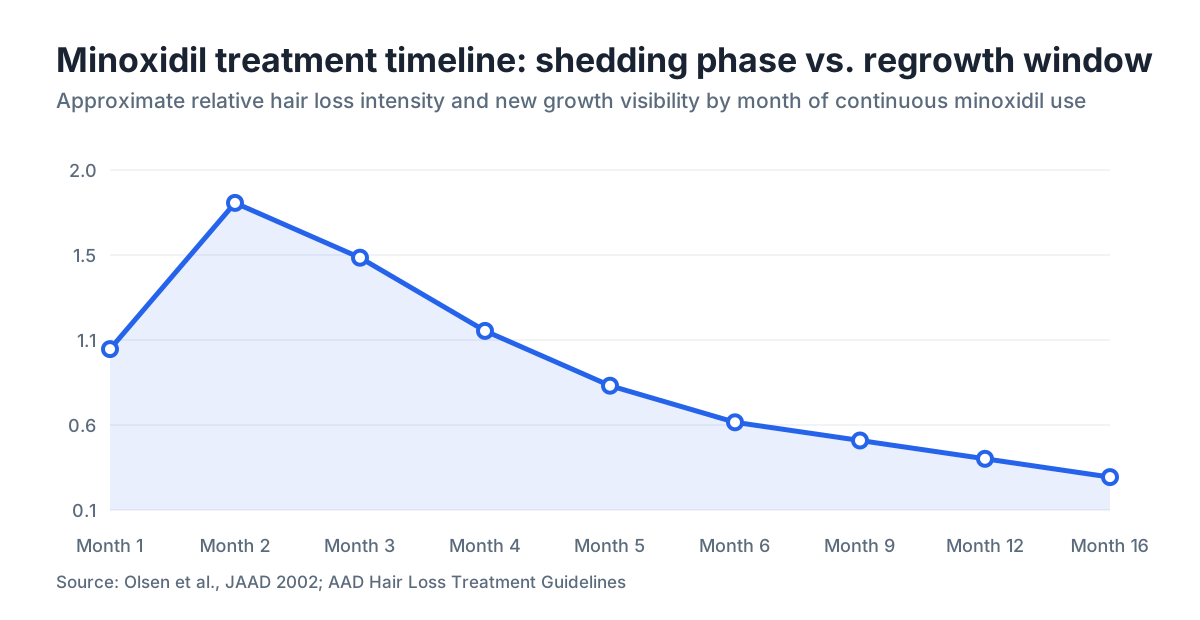
Most people notice shedding within 2 to 8 weeks of starting minoxidil. The exact onset depends on where your follicles were in their cycle when you began. If most were already in late telogen, shedding can start as early as two weeks in. If your follicle population was spread more evenly across phases, onset might be closer to six or eight weeks.
The shedding phase usually lasts 2 to 3 months, sometimes up to 4 months in people who started with a higher share of resting follicles. By month 4 to 6, most users see the shed resolve and new fine vellus hairs starting to emerge. Those vellus hairs slowly thicken into terminal hairs over the following months.
Here's the timeline in plain terms:
| Timeframe | What's happening |
|---|---|
| Weeks 1-2 | Normal hair loss, no change noticeable |
| Weeks 2-8 | Increased shedding begins, can feel alarming |
| Weeks 8-16 | Shedding peaks then gradually tapers |
| Months 4-6 | Shedding resolves, early regrowth visible as fine hairs |
| Months 6-12 | Regrowth thickens, meaningful density improvement begins |
If heavy shedding is still happening at 5 or 6 months with no new growth visible, that's worth raising with a dermatologist. It doesn't automatically mean the drug isn't working, but it warrants a look to rule out another cause, like nutritional deficiency or thyroid dysfunction driving ongoing telogen effluvium on top of the minoxidil response [4].
How much shedding is normal on minoxidil?
Average daily hair loss without any treatment runs roughly 50 to 100 hairs per day for most adults, according to the American Academy of Dermatology [5]. During the minoxidil shedding phase, that number can climb noticeably, though quantifying "how much more" is genuinely hard, because most people don't count individual hairs in real life.
Clinical trials count hairs in a defined scalp area rather than shed counts, so direct daily shed-count data from controlled minoxidil trials are thin. Estimates that get repeated put the increase somewhere around 20-50% above baseline during peak weeks, but nobody has solid data on precise absolute numbers across a large population. The closest published work, Olsen et al. (2002) in the Journal of the American Academy of Dermatology, found that in 5% minoxidil foam trials, early hair-count increases after week 16 pointed to strong follicular activity that likely followed a prior transitional shed [6].
In practical terms: if you're losing noticeably more in the shower, on your pillow, or when you run your fingers through your hair in the first two months, that's expected. If you're losing clumps, developing new bald patches, or losing hair from eyebrows and body sites (which topical minoxidil doesn't reach), something else is going on and it's worth getting checked.
For perspective on what else might be driving hair loss, the what causes hair loss guide covers the broader differential.
Does shedding mean minoxidil is working?
Not necessarily, but it often does. Shedding is a sign that minoxidil is reaching and activating follicles, which is the first step in the process. A follicle that's truly dead or permanently scarred wouldn't respond to minoxidil at all, so it wouldn't shed.
That said, you can shed and still not get meaningful regrowth if your follicles are too far miniaturized to recover, or if the hormonal driver (DHT-driven miniaturization in androgenetic alopecia) is too strong without a blocker in the mix. Shedding is necessary but not sufficient proof of a good response.
Some people barely shed and still respond well. A mild or absent shedding phase doesn't mean the drug isn't working. Individual variation in the resting-to-active follicle ratio at the start explains most of this.
The clearest signal comes 6 to 9 months in: visible new coverage, finer hairs thickening, or at minimum a halt to further recession [10]. That's the metric that matters, not shed intensity. If you want to maximize response, pairing minoxidil with a DHT blocker like finasteride addresses the hormonal root cause while minoxidil handles the growth stimulus. The combination is covered in detail here.
What happens if you stop minoxidil during the shedding phase?
This is where a lot of people make a costly mistake. Stopping minoxidil because of the shed sends your follicles back to their previous resting state, and you never collect the regrowth that was coming. Worse, stopping and restarting triggers another shedding episode when you resume.
Minoxidil needs continuous use to hold results. Stop for any reason after achieving regrowth, and you'll lose that regrowth within 3 to 6 months as follicles return to their miniaturized or resting state [1][7]. The American Academy of Dermatology says plainly that hair loss returns after you stop minoxidil, which is why it's a maintenance drug, not a cure [5].
The practical message: the shedding phase is the hardest psychological stretch of minoxidil treatment. You're losing more hair, you're not seeing results yet, and stopping feels logical. It isn't. If the shedding is genuinely distressing, talk to a dermatologist about the timeline and whether adding a second treatment makes sense, but don't quit at week 6 and conclude the drug failed.
There's also a secondary shed some people hit when they stop and restart. The follicles slip back into telogen during the off period, then get activated again when minoxidil resumes, which sets off another synchronized shed. Same mechanism, just on repeat.
Does minoxidil cause permanent hair loss?
No. The hairs lost during the minoxidil shedding phase were already on their way out. Minoxidil speeds their exit from the follicle but does not damage the follicle itself or cause permanent loss [1][2]. Once the telogen effluvium phase resolves, follicles that minoxidil activated produce new hair shafts. European evidence-based guidelines flag minoxidil-induced shedding as a recognized initial phase that does not signal permanent follicular damage [8].
The myth that minoxidil causes permanent loss usually comes from people who quit during or right after the shed, never reach the regrowth phase, and blame the drug. In reality, their underlying androgenetic alopecia kept progressing after they stopped, and the shed took the fall.
That said, minoxidil is not a reversal agent for follicles that are already scarred or fully miniaturized (as happens in advanced Norwood stages). It works best on follicles that still function, even if miniaturized. Once a follicle is truly gone, no topical brings it back. That's the territory where a hair transplant becomes the relevant option.
For the full picture of what minoxidil can and cannot do beyond shedding, the minoxidil side effects page covers the complete safety profile, including cardiovascular and skin reactions.
Is minoxidil shedding different for women?
The mechanism is identical. Women go through the same telogen effluvium phase when starting minoxidil, usually with the same 2-8 week onset and 3-4 month duration. What differs is context.
Women are more likely to be using the 2% formulation (though the 5% foam is FDA-approved for women too), and more likely to have diffuse thinning rather than the patterned recession common in men. So the shedding phase can feel especially alarming in women with already-diffuse loss, because there's no "good" area to compensate visually.
One distinction matters: women are more likely to have concurrent causes of telogen effluvium unrelated to minoxidil, including iron deficiency, thyroid dysfunction, postpartum hormonal shifts, and chronic stress [4]. If a woman starts minoxidil and hits heavy, prolonged shedding, ruling out these causes is worth doing. Not because minoxidil is more likely to cause permanent harm in women, but because treating an underlying deficiency can sharply improve outcomes on top of whatever minoxidil is doing.
Women should also know that oral minoxidil at higher doses carries a risk of unwanted facial hair growth (hypertrichosis), which is why doses used for female pattern hair loss are lower (typically 0.25 to 1.25 mg daily off-label) than those used in men.
For men specifically, minoxidil for men covers dosing, formulations, and response rates in more depth.
Can you reduce or prevent minoxidil shedding?
Not entirely, and you probably shouldn't try. The shedding is the transitional mechanism that produces the regrowth. There's no established protocol that reliably blunts the shed without also blunting the response that follows.
Still, a few strategies come up:
Starting with a lower concentration and stepping up (for example, 2% topical before moving to 5%) may spread out follicular recruitment and make shedding feel less intense. No large trial has confirmed this cuts total shed volume, but the logic holds.
Keeping your scalp healthy helps. Minoxidil in a dry, inflamed, or flaky scalp absorbs unevenly and can cause localized irritation that adds non-specific hair loss on top of the expected transitional shed. A mild shampoo, and managing seborrheic dermatitis if you have it, keeps the confounders down.
Avoiding other known shedding triggers during the first few months makes things easier to read. Crash dieting, high physical stress, and starting or stopping hormonal medications can each add independent telogen effluvium [4] on top of the minoxidil phase, which muddies interpretation and makes the whole thing harder to sit through.
If you've uploaded photos to a tool like the free AI hair scan at MyHairline, you can track density over time, which sometimes makes the shedding phase easier to tolerate because you have a baseline to compare against. Documenting your starting point before treatment is genuinely useful.
How do you tell minoxidil shedding apart from worsening hair loss?
This is the hardest practical question, and the honest answer is it can be tough to call for several weeks. Both look like more hair on the floor. But there are signals that point one way or the other.
Minoxidil shedding: starts 2-8 weeks after beginning the drug, involves hairs with a white bulb at the root (telogen club hairs), stays relatively diffuse across the treated area, and tapers within 3-4 months.
Worsening androgenetic alopecia: progresses gradually over months to years, follows the expected pattern for your Norwood stage or female pattern, and speeds up at times of hormonal shift. It doesn't track the timeline of when you started minoxidil.
Other causes of sudden increased shedding (iron deficiency anemia, thyroid disease, high fever, surgery, or major psychological stress) can land right when you start minoxidil and amplify what would have been a mild shed into something dramatic. The AAD lists these as the main causes of sudden diffuse telogen effluvium [5].
If you genuinely can't tell whether you're looking at the expected transition or something new, a board-certified dermatologist can do a hair pull test, trichoscopy, or basic bloodwork to settle it. Don't spend six months anxious when a 20-minute appointment can answer the question. The receding hairline guide has photos and descriptions of patterned loss that can also help you judge whether recession is actually advancing.
What should you expect after the shedding phase ends?
Once the shed tapers, usually around months 3-4, the follicles minoxidil activated start producing new hair shafts. These show up first as fine, almost colorless vellus hairs, often called peach fuzz. Over the following months, with continued minoxidil use, those vellus hairs convert to thicker, pigmented terminal hairs.
Peak cosmetic improvement from topical 5% minoxidil generally shows up around 12 to 16 months of continuous use [6]. Stop before that point and you're quitting before the drug has shown its full effect.
Realistic expectations matter here. A 2002 randomized controlled trial in the Journal of the American Academy of Dermatology found that 5% topical minoxidil produced statistically significantly more regrowth than 2% at 48 weeks, with mean hair counts improving from baseline in both groups [6]. But "improvement from baseline" in a trial doesn't mean full restoration of density. Most people get partial but meaningful regrowth, not a return to their pre-loss density.
Minoxidil's job is to preserve and partly recover what you have, while something like finasteride works on the hormonal mechanism driving ongoing loss. The two together, when appropriate, outperform either alone in clinical studies. That's a conversation worth having with a dermatologist if you're at an early to mid stage of loss.
One last thing. Once you reach a place where your density is stable and you're happy with it, you're still taking minoxidil for as long as you want to keep those results. That's not a flaw in the treatment. It's the nature of the condition. Budget and plan for it.
Sources
- FDA, Rogaine (minoxidil 2%) labeling
- StatPearls (NCBI Bookshelf), Minoxidil
- Messenger AG, Rundegren J. JAAD 2004; 50(3):396-407
- Phillips TG, Slomiany WP, Allison R. Am Fam Physician. 2017;96(6):371-378
- American Academy of Dermatology Association, Hair loss: who gets and causes
- Olsen EA, Dunlap FE, Funicella T, et al. JAAD 2002; 47(3):377-385
- National Institutes of Health, MedlinePlus: Minoxidil topical
- Blumeyer A, Tosti A, Messenger A, et al. JDDG 2011;9(Suppl 6):S1-57
- Sinclair RD. IJDVL 2015; 81(5):460-469
- AAD, Hair loss: diagnosis, treatment, and outcome