TL;DR: Minoxidil spray is a topical form of minoxidil, sold in 2% and 5% concentrations, applied straight to thinning scalp. In the 48-week trial behind the 5% approval, 45% of men rated their regrowth moderate to dense. Results take 3 to 6 months to show. Stop using it and the new hair falls back out.
What exactly is minoxidil spray?
Minoxidil spray is a liquid or aerosol topical form of minoxidil, the only FDA-approved over-the-counter hair regrowth ingredient for both men and women. [1] The spray bottle is different from the foam most people picture, though both deliver the same active compound. You pump or press the nozzle, aim at the thinning area, and the liquid lands on your scalp instead of your hands.
The original topical minoxidil was a dropper-based liquid, patented in the early 1980s and approved by the FDA in 1988. [1] The spray nozzle is a delivery change, not a reformulation. Some brands use a fine-mist pump. Others use a trigger sprayer. The goal never changes: get the minoxidil onto your scalp with less mess and (arguably) better coverage than a dropper.
Concentration matters here. OTC sprays come in 2% (historically marketed to women, though men use it too) and 5% (marketed mostly to men, with evidence of faster and denser results). [1] Compounding pharmacies also prepare stronger formulas like 10% or 15%, sometimes mixed with other ingredients, but those need a prescription and lack the same FDA review as the labeled OTC products.
How does minoxidil spray actually work on hair follicles?
Minoxidil is a potassium channel opener. Opening those channels widens blood vessels, which is how minoxidil was first discovered in the 1970s as an oral blood pressure drug. On the scalp, it appears to increase blood flow to miniaturized follicles and, separately, to stimulate the follicular cells that produce hair. [2]
The mechanism still isn't fully understood, even in 2025. The most cited explanation is that minoxidil prolongs the anagen (growth) phase of the hair cycle and shortens the telogen (rest) phase, giving follicles more time to produce a visible strand. [2] It also seems to enlarge the dermal papilla, the cluster of cells at the base of each follicle that controls growth. Bigger dermal papilla tend to produce thicker, longer hairs.
One nuance changes everything for some people: minoxidil has to be converted to its active form, minoxidil sulfate, by a scalp enzyme called sulfotransferase. People with low sulfotransferase activity respond poorly no matter how much they apply. That's why a small share of users see almost nothing after six months of faithful use. A sulfotransferase enzyme test can sometimes flag this, though it isn't standard practice yet. [3]
If you want the follicle-level biology before your loss gets worse, what causes hair loss walks through it.
What does the clinical evidence say about minoxidil spray results?
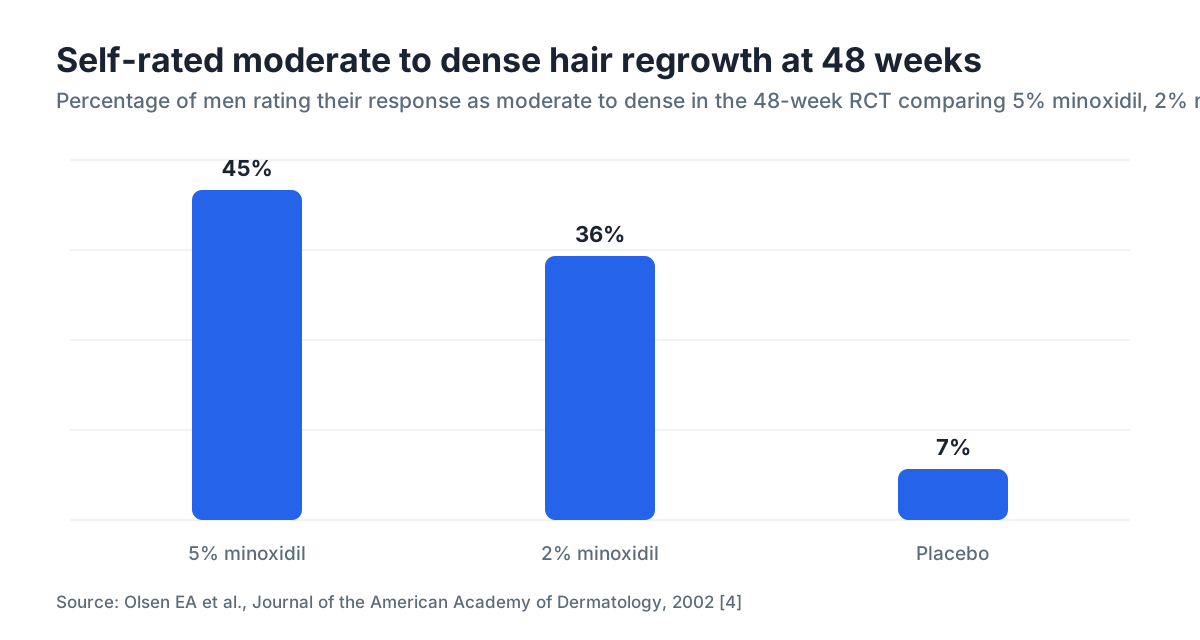
The strongest evidence comes from the 48-week trial that supported FDA approval of 5% topical minoxidil for men, published in the Journal of the American Academy of Dermatology. Researchers found 5% was significantly more effective than 2% at both 16 and 48 weeks, with 45% of men in the 5% group rating their response as moderate to dense regrowth versus 36% in the 2% group. [4] In the placebo group, about 7% reported any meaningful regrowth.
For women, the evidence base is thinner. The FDA-approved concentration for women is 2%, based on a randomized controlled trial showing a statistically significant rise in total hair count versus placebo at 32 weeks. [1] The 5% concentration is FDA-approved for men only as an OTC product, though dermatologists use it off-label in women with female pattern hair loss.
Nobody has tested the spray nozzle against the dropper head-to-head in a randomized trial. That's a real gap. Pharmacokinetic studies show comparable scalp absorption when the spray is applied correctly, but the assumption that spray equals foam equals dropper in daily use is not 100% confirmed. [5] Most dermatologists treat them as interchangeable on efficacy, with format coming down to coverage and lifestyle.
One finding people miss: shedding in the first 4 to 8 weeks of minoxidil use is expected and signals the drug is working, not failing. This is telogen effluvium, where resting hairs get pushed out to make room for new anagen hairs. [6] If you see early shedding, read the telogen effluvium explainer before quitting.
Minoxidil spray vs foam vs liquid: which should you choose?
The three formats share the same active ingredient, but the carrier matters.
| Format | Carrier | Propylene glycol | Best for |
|---|---|---|---|
| Liquid (dropper) | Ethanol + propylene glycol | Yes | Precise targeting, full coverage |
| Spray | Ethanol + propylene glycol (most brands) | Usually yes | Larger coverage area, faster application |
| Foam | Ethanol, no propylene glycol | No | Sensitive scalps, itching-prone users |
Propylene glycol is the ingredient most likely to cause scalp irritation, itching, or allergic contact dermatitis. [7] If liquid minoxidil has irritated your scalp, foam is the next thing to try because it drops the propylene glycol. Most sprays still contain it, which puts them in the same irritation-risk category as liquid.
Spray has one practical edge over the dropper: coverage. A dropper deposits minoxidil one spot at a time. A spray can hit a diffuse thinning zone, like the top of the scalp in early androgenetic alopecia, in a few pumps. For a man with a large affected area, that saves real time. For a woman with diffuse crown thinning, spray can be easier to target through a part than foam.
Foam dries faster, which most people prefer. Liquid and spray usually need 2 to 4 hours to fully absorb. Step into wind or rain shortly after applying liquid or spray and you dilute your dose.
If you're a man sorting through options, minoxidil for men breaks it down by hair loss pattern.
How do you use minoxidil spray correctly?
Dry scalp first. Minoxidil spray on wet hair gets diluted and doesn't absorb as well. Some people apply after a shower, towel-dry, wait 10 to 15 minutes, then spray. That's fine.
Most 5% spray formulas are dosed at 1 mL per application, twice daily, for 2 mL total per day. That's usually 6 to 8 sprays depending on pump size. The FDA-approved labeling for topical 5% minoxidil solution specifies 1 mL applied to the scalp twice daily. [1] If your spray delivers 0.167 mL per pump (a common spec), six pumps equals 1 mL.
Apply to the scalp, not the hair shaft. The active compound has to reach the skin and follicle, not coat the strand. Spread with your fingertips if needed, but don't scrub. Let it air dry completely before bed, or minoxidil transfers to your pillow and you absorb less.
Twice daily is the FDA-approved regimen. Some people do once daily and get partial results. Once daily is generally what dermatologists suggest when someone can't tolerate the twice-daily routine. [2] Don't double up if you miss a dose. Missing one application won't ruin your progress. Stopping for weeks will.
Wash your hands after. The small amount absorbed through your fingertips is unlikely to cause systemic effects, but you don't want to rub your eyes with minoxidil on your hands.
How long does minoxidil spray take to show results?
Four months minimum before you draw any conclusion. Most people see the first new growth, often fine colorless vellus hairs, around months 3 to 4. Those vellus hairs thicken and darken over the following months if you keep going.
The clinical trials show peak response around 12 to 16 months of continuous use. [4] Hair counts keep climbing through the first year. After that you're in maintenance: minoxidil holds what it grew and slows further miniaturization, but it won't keep adding new hairs forever.
If you've used it correctly, twice daily, for six straight months and seen nothing, that's a fair point to reassess. You may be a poor metabolizer of minoxidil due to low sulfotransferase activity. [3] Seeing a dermatologist then is worthwhile, because there are alternatives and combinations worth trying.
The timeline in plain terms:
| Month | What to expect |
|---|---|
| 1 to 2 | Possible initial shedding (normal) |
| 3 to 4 | First fine new hairs may appear |
| 6 | Visible improvement in responders |
| 12 to 16 | Strongest response |
| Ongoing | Maintenance; results reverse within months of stopping |
What are the side effects of minoxidil spray?
The most common side effect is scalp irritation: itching, redness, flaking, or a burning feel. This is usually the propylene glycol in the carrier, not the minoxidil itself. [7] Switching to foam (propylene glycol-free) often clears it.
Unwanted facial hair growth is real, especially for women. Minoxidil stimulates growth wherever it touches skin, so if the spray runs down your forehead or temples, you may see new fine hairs there. Keep application to the scalp and wipe any drips right away to cut that risk.
Systemic effects are rare with topical use but possible in people who apply too much, have a broken skin barrier, or use very high concentrations. Symptoms can include low blood pressure, rapid heartbeat, or fluid retention. [1] These are more tied to oral minoxidil than to topical spray at standard doses.
Initial shedding in weeks 1 to 8 isn't a harmful side effect, but it startles almost everyone. It's follicles cycling, not damage. The full rundown on what can go wrong and how common each effect actually is lives in the minoxidil side effects guide.
Minoxidil is pregnancy category C. Women who are pregnant or may become pregnant should not use it. The FDA label states minoxidil is contraindicated in pregnancy. [1]
Should you combine minoxidil spray with finasteride or other treatments?
Combining minoxidil with finasteride is the most evidence-backed approach for male androgenetic alopecia. They work through entirely different mechanisms: minoxidil stimulates follicle activity directly, while finasteride cuts scalp DHT by blocking the 5-alpha reductase enzyme that converts testosterone to DHT. [8]
A 2015 randomized controlled trial in the International Journal of Dermatology found the combination of topical minoxidil and oral finasteride produced significantly greater hair count increases at 12 months than either agent alone. [9] Mechanistically that's no surprise, since you're hitting the problem from two directions.
For women, finasteride is used off-label (it's not FDA-approved for female pattern hair loss) and is generally avoided in women of childbearing potential because of teratogenicity risk. Women combine minoxidil with other approaches, including antiandrogens like spironolactone in some cases.
The finasteride and minoxidil article covers the combination protocol in detail, including what to ask your prescriber. If you're unsure whether finasteride is right for you, dht blocker explains how DHT suppression fits the wider picture.
Minoxidil can also run alongside low-level laser therapy (LLLT), ketoconazole shampoo, or hair loss supplements. The evidence for those combinations is weaker, but they generally don't interfere with minoxidil. What doesn't combine well: other topical scalp products applied in the same window, especially anything that films over the scalp and blocks absorption.
Is minoxidil spray right for a receding hairline?
Here you need to be honest with yourself about expectations. The FDA indication for topical minoxidil is androgenetic alopecia at the vertex, meaning the crown and top of the scalp. [1] The hairline, particularly the temples, is a different zone.
The evidence for minoxidil at the temples and hairline is much weaker than at the crown. Some studies show modest improvement, but hairline loss tends to be more hormonally driven and less responsive to minoxidil's mechanism than crown thinning. Clinical experience broadly agrees: minoxidil is better at holding and partially restoring a thinning crown than at pushing a receded hairline forward.
That doesn't mean you shouldn't use it if your hairline is receding. It means set realistic expectations. If your goal is stopping further recession, minoxidil combined with finasteride gives you a better shot than minoxidil alone. If your goal is restoring real hairline density after heavy recession, hair transplant is the only intervention with reliable evidence for that specific outcome.
For a close look at where a receding hairline goes untreated and what each stage means for your options, see receding hairline.
Want a free starting point before you talk to a dermatologist or pick a product? The AI hair analysis at MyHairline (myhairline.ai/scan) can read your hair loss pattern from photos and tell you whether it's the type that typically responds to minoxidil.
How do you pick a minoxidil spray product?
The active ingredient is generic. Any 5% minoxidil spray from a reputable manufacturer delivers the same molecule as Rogaine or any branded product. The FDA-approved concentration and formulation are what matter, not the name on the box.
Check the label for concentration (2% or 5%), active ingredient listed as minoxidil, and whether it's an FDA-approved drug or marketed as a supplement or cosmetic (a red flag). Generic topical 5% minoxidil solution is widely stocked at pharmacy chains for roughly $15 to $25 a month at standard dosing. [10] Branded versions often run $30 to $50 or more for the same dose.
Want propylene glycol-free? Switch to foam. There aren't many well-validated propylene glycol-free spray formulas on the OTC market yet. Compounded versions exist but aren't FDA-reviewed the same way.
For higher concentrations or combination formulas (minoxidil plus finasteride topically, or minoxidil plus retinol), you'll need a telehealth or in-person prescription. Those formulas can work, but they carry more complexity, and the evidence for compounded combinations is thinner than for the standard OTC products.
The one thing to avoid outright: any topical product making dramatic claims about regrowing hair faster than minoxidil, with an ingredient list that doesn't include minoxidil. No OTC ingredient matches its level of evidence. [1]
What happens if you stop using minoxidil spray?
The hair you gained comes back out. This is not negotiable.
Minoxidil doesn't fix the underlying cause of androgenetic alopecia. It manages it. Stop, and the follicles that had been stimulated go back to miniaturization. Most people notice shedding within 8 to 16 weeks of quitting, and by 6 months they're largely back to where they would have been without treatment. [2]
That's why starting minoxidil is a long-term commitment. Before you open the first bottle, be honest about whether you can keep this routine going for years, probably decades. Use it for a year, grow meaningful hair back, then stop, and you lose that hair.
If you're eyeing oral minoxidil as an alternative because twice-daily topical feels unsustainable, that's a legitimate conversation to have with a doctor. Low-dose oral minoxidil (0.625 mg to 2.5 mg daily in women, 2.5 mg to 5 mg in men, off-label) has a growing evidence base and may suit people who struggle with topical adherence. Same caveat: stopping oral minoxidil reverses the results too.
For people who want to reduce long-term minoxidil dependence, the finasteride combination is the strongest strategy. Finasteride attacks the hormonal driver; some users find they can drop minoxidil frequency once their loss is stable on finasteride. Talk to a dermatologist before cutting doses.
Is minoxidil spray FDA-approved, and is it safe long-term?
Yes. Topical minoxidil is FDA-approved as an OTC drug for androgenetic alopecia in men (5% and 2%) and women (2%). [1] The FDA drug label spells out the approved indications, dosing, and contraindications. This is a drug, not a supplement.
Long-term safety data goes back to the late 1980s. The FDA OTC approval in 1988 rested on clinical data, and post-market surveillance across more than 35 years hasn't turned up major long-term safety problems with topical use at standard doses. [1]
The worry that comes up is cardiovascular: minoxidil started as a blood pressure drug, so people wonder about systemic absorption from topical use. Studies measuring plasma minoxidil after topical application find levels well below those used in oral blood pressure therapy in most users, and clinical cardiovascular effects are rare at standard topical doses. [5] The FDA label still flags cardiovascular effects as possible, which is why people with heart disease or significant hypertension should check with a doctor first.
The American Academy of Dermatology treats topical minoxidil as a first-line treatment for androgenetic alopecia in men and women, calling it safe and effective when used as directed. [2]
Sources
- FDA, Minoxidil Topical Solution OTC Drug Label
- American Academy of Dermatology, Hair Loss Treatment
- Goren A et al., Journal of Dermatological Treatment, 2014, Sulfotransferase activity predicts minoxidil response
- Olsen EA et al., Journal of the American Academy of Dermatology, 2002, 5% vs 2% minoxidil RCT
- Blume-Peytavi U et al., Journal of the European Academy of Dermatology and Venereology, topical minoxidil pharmacokinetics
- Malkud S, Journal of Clinical and Diagnostic Research, 2015, Telogen Effluvium: A Review
- Mochizuki M et al., Contact Dermatitis, propylene glycol contact dermatitis
- National Library of Medicine, MedlinePlus, Finasteride
- Hu R et al., International Journal of Dermatology, 2015, Combination minoxidil and finasteride RCT
- GoodRx, Generic Minoxidil Topical Solution Price Range