
TL;DR: Minoxidil tablets are low-dose oral pills taken once a day for hair loss. The drug started as a blood pressure medicine, but at 0.25 to 5 mg (far below the 10 to 40 mg cardiac range) it wakes up hair follicles. Studies show roughly 60 to 80% of users get real regrowth. Side effects include fluid retention and unwanted body hair. It's off-label but prescribed everywhere.
What are minoxidil tablets and how are they different from the topical?
Minoxidil tablets are pills that contain the exact same molecule in Rogaine foam and generic topical solutions. What changes is how the drug reaches your follicles. Rub minoxidil on your scalp and only a small fraction gets into your blood. Swallow a tablet and it circulates everywhere, reaching every follicle on your head and body at once.
The FDA approved oral minoxidil in 1979 for severe high blood pressure, under the brand name Loniten [1]. Those approved doses run 10 mg to 40 mg a day. Hair loss doctors work in a totally different range: 0.25 mg to 5 mg daily. At those amounts, effects on blood pressure are usually trivial.
This is off-label use. The FDA has never approved oral minoxidil for androgenetic alopecia, which matters for insurance and how it gets prescribed, though off-label prescribing is legal and routine in dermatology. The oral minoxidil page goes deeper on the pharmacology.
So why swallow a pill when sprays and foams exist? Compliance is the honest answer. Plenty of people find twice-daily topical greasy, slow, or easy to forget. One pill with breakfast is simpler. Scalp absorption from topicals also swings a lot depending on how much hair you have, how you apply it, and how much you sweat, so a pill sidesteps that guesswork.
How does oral minoxidil actually regrow hair?
Minoxidil is a potassium channel opener. It widens blood vessels, which is why it started life as a blood pressure drug. At the follicle, the leading idea is that this vasodilation pushes more blood and nutrients to the dermal papilla, the cluster of cells at the base of a follicle that runs the hair cycle [2].
There's also evidence it stretches out the anagen (active growth) phase and may nudge follicular cells to multiply. Here's the part people miss: minoxidil itself isn't the active compound. An enzyme called sulfotransferase converts it into minoxidil sulfate, mostly in the liver when you swallow it and in the scalp when you rub it on. People with lots of scalp sulfotransferase respond well to topical. People who barely respond to topical often do better on the pill, because the conversion happens elsewhere in the body.
Minoxidil does not block dihydrotestosterone (DHT). It leaves the androgen-driven miniaturization behind male and female pattern hair loss completely untouched. That's the key limit. If you want the biology of why DHT drives hair loss, the what causes hair loss article lays it out. Minoxidil makes the surviving follicles work harder. It does nothing to stop the process shrinking them.
That's exactly why most dermatologists treating real androgenetic alopecia pair oral minoxidil with finasteride. Two different mechanisms, additive results. The full breakdown is at finasteride and minoxidil.
What does the evidence say about how well minoxidil tablets work?
The research on low-dose oral minoxidil (LDOM) has piled up fast since about 2017. The most cited review, published in the Journal of the American Academy of Dermatology in 2021, pooled 17 studies and 634 patients with androgenetic alopecia or other hair loss. It concluded that "low-dose oral minoxidil is an effective and well-tolerated treatment for hair loss," with response rates generally landing between 60 and 80 percent depending on dose and patient group [3].
A 2020 randomized trial by Perez-Mora and colleagues in Dermatology and Therapy compared 1 mg oral minoxidil daily against topical 5% twice daily in women with female pattern hair loss. Both groups gained hair density over 24 weeks, but the oral group had roughly half the nonadherence rate of the topical group [9]. That's the whole point: a treatment people actually take beats a theoretically equal one they skip.
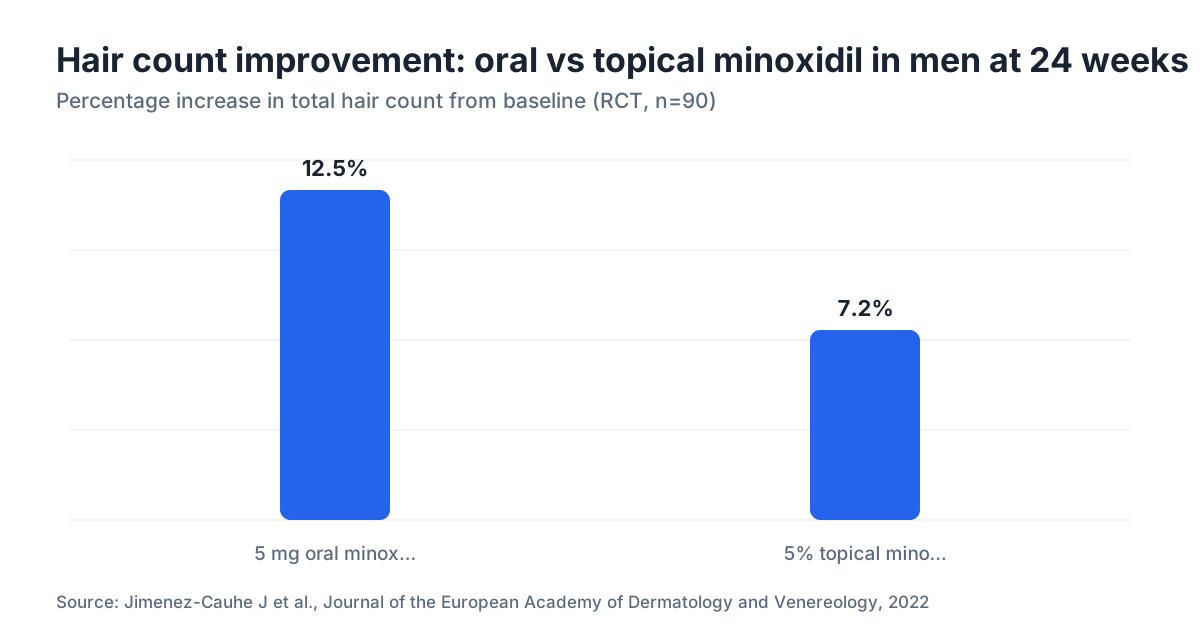
For men, a 2022 randomized trial in the Journal of the European Academy of Dermatology and Venereology put 5 mg oral minoxidil against topical 5% once daily. Total hair count at 24 weeks rose about 12.5% in the oral group versus about 7.2% in the topical group. More hair, from a tablet.
Nobody has strong long-term data past five years for the low-dose oral form specifically. Topical minoxidil has 40 years of post-market evidence, so you know what you're buying there. The oral track record is shorter. That doesn't mean it fails long-term (same drug, after all), but the honest position is that the controlled trial data mostly reaches 12 to 24 months.
Results vanish if you quit. Hair grown or held on minoxidil sheds within three to six months of stopping, oral or topical. This is a maintenance drug, not a cure.
What doses are doctors actually prescribing?
The range you'll see in practice is 0.25 mg to 5 mg a day, almost always one morning dose. Here's how it tends to split by patient:
| Patient group | Typical starting dose | Common maintenance dose |
|---|---|---|
| Women (androgenetic alopecia) | 0.25 mg, 1 mg | 1 mg, 2.5 mg |
| Men (androgenetic alopecia) | 1 mg, 2.5 mg | 2.5 mg, 5 mg |
| Women (alopecia areata, other) | 0.5 mg, 1 mg | 1 mg, 2.5 mg |
| Men with cardiovascular concerns | 0.25 mg, 1 mg | 1 mg (with monitoring) |
Compounding pharmacies are usually the source, because 0.25 mg and 1 mg strengths don't exist as commercial hair-loss products (Loniten comes in 2.5 mg and 10 mg tablets for blood pressure). Some dermatologists write for the 2.5 mg Loniten tablet and tell patients to cut it in half or quarters. Others send scripts to compounding pharmacies for exact doses in capsules.
Dose escalation is gradual. Many physicians start at 0.5 mg or 1 mg and bump it up after three months if the patient tolerates it and wants faster results. Jumping straight to 5 mg raises the odds of side effects without a matching jump in hair benefit for most people.
There are no FDA-approved dosing guidelines for hair loss, because it's off-label. The protocols above come from published trials and expert consensus papers, not FDA labeling [3].
What are the side effects of minoxidil tablets?
This is where oral parts ways with topical. Systemic exposure means systemic side effects, and you should know them cold before you start.
Fluid retention is the most common. At blood pressure doses (10+ mg) it causes swelling bad enough that doctors add a loop diuretic. At hair loss doses, mild ankle swelling or puffiness around the eyes shows up in roughly 6 to 10 percent of users across most studies [3]. For most people it's a cosmetic nuisance, not a medical danger. A low-sodium diet helps. If it's significant, your doctor may add a low-dose diuretic or cut your minoxidil dose.
Unwanted body hair (hypertrichosis) hits around 15 to 20 percent of women and fewer men at hair-loss doses. Hair grows faster or darker on the face, forearms, or legs. It's dose-dependent and usually reverses after you stop, but it takes months to fade.
Heart rate changes. Minoxidil can cause reflex tachycardia, an elevated heart rate. At low doses this is usually subclinical, but anyone with existing arrhythmias or cardiovascular disease needs a careful look before starting.
Blood pressure effects. At 1 to 5 mg, a real drop is uncommon in people with normal blood pressure, though dizziness on standing (orthostatic hypotension) happens now and then. Morning dosing with food cuts that down.
Initial shedding. Like topical, the pill can trigger a temporary shedding spike in the first four to eight weeks as follicles cycle into a fresh anagen phase. It's a sign the drug is working. It passes.
For the full list including rarer events, the minoxidil side effects article covers each with frequency data from trials.
Who should be careful or avoid it? People with pericardial effusion, significant heart failure, kidney failure, or a history of minoxidil hypersensitivity. The FDA label for Loniten carries a boxed warning about these risks at blood pressure doses [1]. At hair-loss doses the risk profile is different, but the cautions are real.
How do minoxidil tablets compare to topical minoxidil?
The honest read: they're close in effectiveness for most people, oral has a small edge in head-to-head trials at matched doses, and each form carries a different side-effect profile.
| Factor | Oral minoxidil tablet | Topical minoxidil |
|---|---|---|
| FDA approval for hair loss | No (off-label) | Yes (2% and 5%) |
| Dosing frequency | Once daily | Once or twice daily |
| Systemic absorption | High (deliberate) | Low to moderate |
| Fluid retention risk | Present (6 to 10%) | Minimal |
| Hypertrichosis risk | ~15 to 20% women | Lower |
| Scalp irritation / flaking | None | Common (especially solution) |
| Hair greasiness | None | Yes (solution form) |
| Adherence in trials | Higher | Lower |
| Cost (monthly, US) | $15, $60 (compounded) | $20, $50 (generic) |
| OTC availability | No (Rx only) | Yes |
Topical's real advantages: it's over the counter, it has decades of large-scale safety data, and it keeps the drug out of your bloodstream. If you're young, healthy, and fine with the routine, topical is the lower-risk place to start. If six months of topical hasn't done much, or you honestly won't use it every day, oral is a fair alternative to raise with a dermatologist.
For men specifically, minoxidil for men covers how doctors sequence treatment by Norwood stage.
Do minoxidil tablets work for women too?
Yes, and the evidence for women is some of the strongest there is. Women with female pattern hair loss (FPHL) had thin options for years (only the 2% OTC topical was approved for women in the US until fairly recently), and dermatologists picked up low-dose oral minoxidil for them with real enthusiasm.
A 2020 study of 100 women with FPHL treated with 1 mg oral minoxidil daily for 12 months found 84% had a positive treatment response, defined by patient report plus clinical assessment [10]. Doses in women's studies run consistently lower than men's, usually 0.25 mg to 2.5 mg, which also means fewer side effects.
Hypertrichosis is the main worry for women. At 1 mg the incidence in published studies sits around 10 to 15 percent; at 2.5 mg it climbs. Plenty of dermatologists handle this by starting female patients at 0.25 mg or 0.5 mg.
Women who could become pregnant need to know minoxidil is contraindicated in pregnancy (FDA Category C, possible fetal harm) [1]. Reliable contraception is required, and the drug should stop before trying to conceive.
How long does it take to see results from minoxidil tablets?
Realistic timeline: most people see the first signs around three to four months. Visible density changes usually land at six months. Results keep improving through 12 months and may inch up out to 18 to 24 months.
Here's what the road actually looks like:
Months 1 to 2: Possible initial shedding. Nothing to celebrate yet. This stretch is discouraging but normal as follicles reset.
Months 3 to 4: Vellus hairs (fine, colorless baby hairs) start showing up at the hairline or in thinning spots. First real signal.
Months 5 to 6: Those vellus hairs thicken and pigment. Hair density measurably improves in most responders by month six in trial data [4].
Months 6 to 12: Peak visible improvement for most people. Take photos every month. The changes creep, and they're easy to miss week to week.
Beyond 12 months: Maintenance. The job shifts from growing new hair to keeping what you grew. Missing multiple weeks of doses risks that progress.
If you see nothing at all after six months on a steady dose, your dermatologist may raise the dose, add finasteride, or rethink the diagnosis. Not everyone responds. Low sulfotransferase activity is one reason some people don't respond to minoxidil in any form, though testing for it isn't standard outside research yet.
How much do minoxidil tablets cost and do you need a prescription?
Oral minoxidil needs a prescription in the US and most other countries. There's no OTC tablet for hair loss. You get it one of two ways: your doctor writes for Loniten (generic minoxidil, in 2.5 mg and 10 mg tablets) or sends a script to a compounding pharmacy for the exact hair-loss dose.
Generic minoxidil 2.5 mg tablets from a retail pharmacy run roughly $30 to $70 for a 30-day supply, though prices swing by pharmacy and insurance. Some GoodRx coupons pull it under $20. The 10 mg tablets show up in higher-dose protocols and cost similarly per pill.
Compounded minoxidil in 0.5 mg or 1 mg capsules typically runs $30 to $60 a month from licensed compounding pharmacies. Telehealth platforms that prescribe it often charge $40 to $80 a month including the visit.
Insurance coverage is rare because the hair loss indication is off-label. Medicare and Medicaid generally don't cover it for hair loss. A few commercial plans might if your doctor codes it toward the hypertension approval, but don't plan on it.
Stack that against a hair transplant at $4,000 to $15,000 and up out of pocket [5], and a pill under $60 a month is far cheaper as long-term maintenance, especially if it keeps you off the operating table for years.
If you want to know where you sit on the hair loss spectrum before picking a path, the free AI hair analysis at MyHairline reads your approximate Norwood or Ludwig stage from photos, which sharpens the talk with your doctor.
Can you combine minoxidil tablets with other hair loss treatments?
Pairing oral minoxidil with finasteride is the most common and best-supported combination. They hit different pathways: finasteride cuts DHT (going after the cause of androgenetic alopecia) while minoxidil drives follicle activity (making up for the damage). A 2021 study found the combination beat either drug alone on hair density in men with androgenetic alopecia [6]. Most academic dermatology practices treat this as the standard medical regimen for men with moderate to advanced male pattern baldness.
Combining oral with topical minoxidil is rare and thin on evidence. You'd double the systemic load (topical does absorb some) with no clear extra benefit to the hair, plus more side effect exposure. Most physicians pick one route.
Ketoconazole shampoo sometimes gets added as a third layer. The evidence for it as a standalone treatment is weak, but at 2 to 3 times a week it may bring a mild anti-androgenic and anti-inflammatory effect to the scalp that complements minoxidil and finasteride, with no meaningful systemic effects [7].
Platelet-rich plasma (PRP) injections are increasingly paired with oral minoxidil, especially for women who can't or won't take finasteride. The PRP evidence is still early, but the combination is generally considered safe.
If you're weighing the full picture for a receding hairline, the receding hairline article maps treatment options by how far back the line has already moved.
What should you ask your doctor before starting minoxidil tablets?
A handful of questions that actually matter:
First, is my hair loss the kind minoxidil treats? Androgenetic alopecia (pattern baldness) is the main target. Minoxidil also has evidence for alopecia areata and some traction loss. It does nothing for scarring alopecias, and if your loss traces to thyroid disease, iron deficiency, or another condition, that comes first. See what causes hair loss for the map of types.
Second, should I get a baseline heart check? At hair-loss doses this is low-risk for healthy adults, but if you have any history of heart disease, kidney disease, or you're over 60, a baseline blood pressure and heart rate check makes sense. Some clinicians order a basic metabolic panel and ECG for patients over 50.
Third, what dose am I starting on and when do we increase it? You want the plan clear from day one.
Fourth, what's the plan if I get hypertrichosis or fluid retention? Knowing up front that those effects are manageable and usually reversible keeps you from panic-quitting at the first sign.
Fifth, do you recommend adding finasteride? If you're a man with androgenetic alopecia and no contraindication, this is worth a straight conversation. The combination is meaningfully more effective than either drug alone.
You can run the free AI scan from MyHairline before your appointment to walk in with clearer information about your loss pattern, which makes the visit more efficient.
Are minoxidil tablets the right choice for you or is something else better?
Oral minoxidil fits you well if you want a once-daily pill, you've hit adherence or scalp irritation problems with topical, you're a woman after a lower-dose systemic option, or you're a man who wants maximum medical therapy before a transplant.
Topical probably makes more sense if you want zero systemic exposure, you'd rather grab an OTC product without a prescription visit, or you have a heart or kidney history that argues for caution with a systemic drug.
Finasteride alone (for men) fits if your main goal is stopping further loss rather than regrowing what's gone, though most dermatologists combine it with minoxidil anyway.
A hair transplant comes into play once medical therapy (minoxidil plus finasteride) has run at least a year and either failed or didn't give enough. Transplants restore density permanently but don't stop ongoing loss, so medical therapy usually continues afterward to protect the native hair. See hair transplant expenses for the real cost breakdown before you go there.
Supplements with biotin, saw palmetto, and the like are popular, but the evidence is thin next to minoxidil and finasteride. The hair loss supplements article is honest about what works and what's marketing.
For telogen effluvium (diffuse shedding from stress, illness, or nutritional gaps) rather than pattern loss, minoxidil isn't always the first tool. That type is covered at hair loss telogen.
The short version: oral minoxidil is genuinely effective, reasonably safe, and cheap. It deserves serious thought for anyone whose hair loss is active and not held in check by topical alone.
Sources
- FDA, Loniten (minoxidil) prescribing information and boxed warning
- National Library of Medicine (NIH), StatPearls: Minoxidil
- Randolph M, Tosti A. Journal of the American Academy of Dermatology, 2021: Oral minoxidil treatment for hair loss systematic review
- Jimenez-Cauhe J et al. Journal of the European Academy of Dermatology and Venereology, 2022: Oral 5 mg vs topical 5% minoxidil in men
- American Society of Plastic Surgeons, hair transplant cost statistics
- Vano-Galvan S et al. Journal of the American Academy of Dermatology, 2021: Oral minoxidil + finasteride combination retrospective study
- Blume-Peytavi U et al. Journal of the American Academy of Dermatology, 2011: S3 guideline for androgenetic alopecia
- American Academy of Dermatology Association, hair loss overview and treatment guidance
- Perez-Mora N et al. Dermatology and Therapy, 2020: Oral 1 mg vs topical 5% minoxidil in women with FPHL
- Ramos PM et al. Journal of the American Academy of Dermatology, 2020: 1 mg oral minoxidil in 100 women with FPHL
- NIH MedlinePlus, minoxidil oral drug information