TL;DR: Natural DHT blockers are plant compounds that either reduce dihydrotestosterone (DHT) production or block it from binding to hair follicles. Saw palmetto and pumpkin seed oil have the most human trial evidence, though neither matches prescription finasteride. Most natural options are low-risk and low-potency. They work best as early-stage support, not as standalone treatment for real hair loss.
What does a DHT blocker actually do to your hair follicles?
A DHT blocker either stops your body from making DHT or keeps the DHT you already have from latching onto follicles. That's the whole job. It slows follicle shrinkage. It does not regrow hair that's been gone for years.
DHT, dihydrotestosterone, is the hormone that shrinks hair follicles in people with androgenetic alopecia. An enzyme called 5-alpha-reductase converts testosterone into DHT, and follicles in the scalp's frontal and crown regions carry androgen receptors that respond to it by miniaturizing over time. Smaller follicles push out thinner, shorter hairs until they stop producing a visible shaft at all.
A blocker interferes with that in one of two ways. It inhibits 5-alpha-reductase so less DHT gets made, or it competes with DHT at the receptor so less of the DHT that exists can attach and signal. Prescription finasteride takes the first route, dropping DHT in the blood by roughly 70% [1]. Natural compounds tend to work the same way, just with far less force.
Reducing DHT doesn't grow hair on its own. What it can do is slow or stall miniaturization, which keeps the hairs you still have thicker for longer. That distinction decides everything. Chasing regrowth on a spot that's been bald for years? A DHT blocker alone won't get you there. Catching the problem early and trying to hold what you have? Now the math is more reasonable. The DHT pathway is only one of several roads to thinning hair, so it helps to know what causes hair loss more broadly.
What are the most studied natural DHT blockers?
Not every "natural DHT blocker" carries the same evidence. Some have randomized controlled trials in humans. Others have a test tube and a hopeful marketing team. The table sorts the main candidates by what the research actually shows.
| Compound | Mechanism | Best human evidence | Strength of evidence |
|---|---|---|---|
| Saw palmetto (Serenoa repens) | 5-alpha-reductase inhibition | RCT 2012, 38% self-assessed improvement [2] | Moderate (small samples) |
| Pumpkin seed oil | 5-alpha-reductase inhibition | RCT 2014, 40% increase in hair count vs 10% placebo [3] | Moderate (single trial) |
| Rosemary oil | Microcirculation + possible AR activity | RCT 2015, comparable to 2% minoxidil at 6 months [4] | Moderate (one trial, small n) |
| Zinc | Cofactor reducing 5-alpha-reductase activity | Observational only | Weak |
| Green tea (EGCG) | 5-alpha-reductase inhibition in vitro | No RCTs in humans for hair | Very weak |
| Spearmint tea | Androgen-lowering effect (women, PCOS context) | Small RCT for testosterone reduction, not hair [5] | Weak for hair specifically |
| Beta-sitosterol | 5-alpha-reductase inhibition | One small RCT (60 men), 60% reported improvement [6] | Weak (high bias risk) |
| Reishi mushroom | Inhibits 5-alpha-reductase in lab models | No human hair trials | Very weak |
Saw palmetto and pumpkin seed oil are the two I'd take seriously if you want to try a supplement. The rest have either no human trial data or data so thin that recommending them would be a guess dressed up as advice.
One honest caveat sets the tone for this whole article. Most natural supplement trials for hair loss are small (under 100 participants), short (under 12 months), and often paid for by the companies selling the product. The evidence quality sits well below what exists for finasteride or minoxidil. That doesn't mean these compounds do nothing. It means you should treat the effect sizes with a raised eyebrow.
Does saw palmetto actually work for hair loss?
Saw palmetto beat placebo in one well-known trial but lost badly to finasteride. That's the short version. It comes from the berries of Serenoa repens and has been studied mostly for benign prostatic hyperplasia, because it inhibits 5-alpha-reductase in prostate tissue. The mechanism carries over to hair in theory.
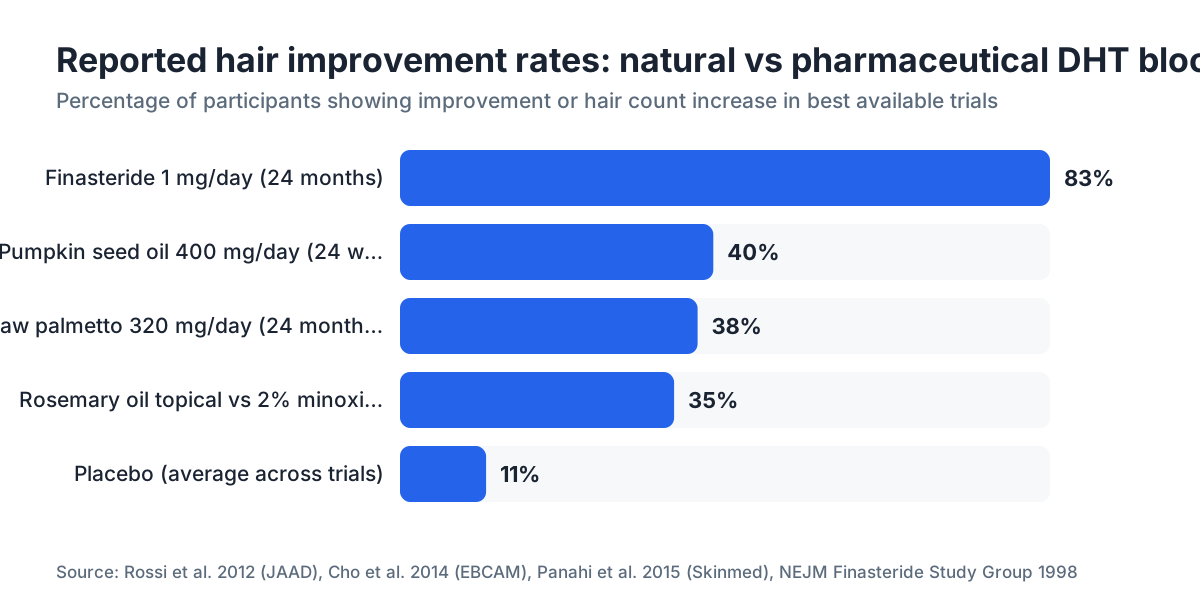
The most-cited human hair trial compared saw palmetto extract (320 mg/day) to finasteride (1 mg/day) in 100 men with androgenetic alopecia over 24 months. In that trial, 68% of finasteride users improved versus 38% of saw palmetto users [2]. The gap is real. Finasteride won. But the saw palmetto group still beat placebo on self-assessment, and 38% is not nothing, especially given the gentler side-effect profile.
A 2020 systematic review in Skin Appendage Disorders looked at all available saw palmetto trials for androgenetic alopecia and called the evidence "limited but encouraging," with most studies showing modest gains in hair density and thickness [7].
Study doses run from 200 mg to 320 mg per day of a standardized extract. Raw berry or non-standardized products won't deliver a consistent concentration. If you're trying it, pick a standardized extract that lists its fatty acid content.
Side effects stay mild for most people, usually occasional stomach upset. There are case reports of liver injury and bleeding problems at high doses, so it isn't zero-risk, particularly on blood thinners. Saw palmetto also carries some androgen-lowering activity, so men stacking it with anabolic agents or testosterone therapy should watch for interactions.
What is the evidence for pumpkin seed oil as a DHT blocker?
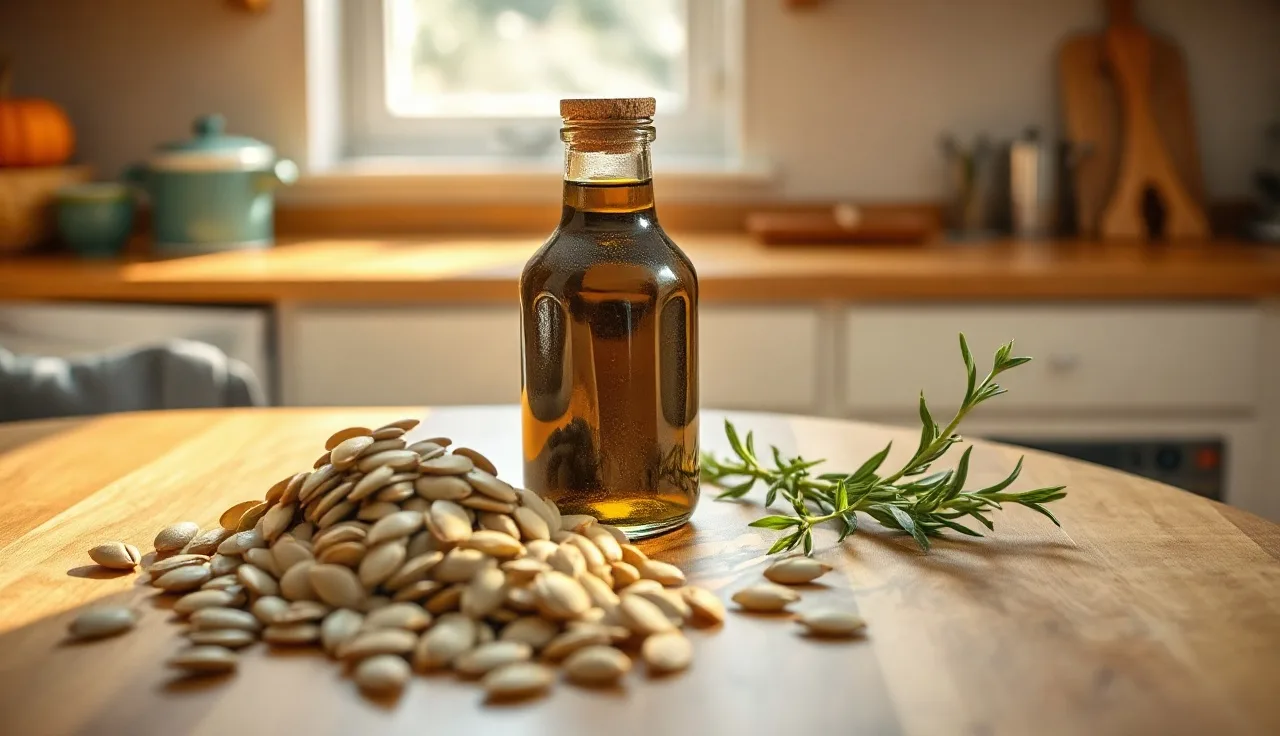
Pumpkin seed oil (Cucurbita pepo) is the most underrated natural DHT blocker in the research. A 2014 randomized, double-blind, placebo-controlled trial in Evidence-Based Complementary and Alternative Medicine gave 76 men with mild to moderate androgenetic alopecia either 400 mg/day of pumpkin seed oil or placebo for 24 weeks [3]. The oil group showed a 40% increase in hair count from baseline. Placebo managed 10%. That's a statistically significant result from a decently built trial.
The proposed mechanism is 5-alpha-reductase inhibition, likely through the oil's phytosterols, specifically delta-7-sterols that are fairly rare outside pumpkin seed. Unlike saw palmetto, almost no follow-up trials exist to confirm or knock down this result. One study, even a good one, leaves real uncertainty.
The trial dose was 400 mg/day of an encapsulated oil. Drizzling pumpkin seed oil on your salad won't hit that dose reliably. Topical formulations exist with no trial support behind them.
Safety looks clean. No significant adverse events showed up in the trial. Allergic reactions are possible if you react to seeds. If cost and safety are your main worries, pumpkin seed oil stacks up well against the other natural options.
Can rosemary oil block DHT, or is it doing something else?
Rosemary oil probably isn't a true DHT blocker at all. Its main effect looks like improved scalp blood flow, with maybe some androgen-receptor activity, rather than direct 5-alpha-reductase inhibition. So the label fits loosely.
A 2015 randomized trial in Skinmed compared rosemary oil to 2% minoxidil topical solution over six months in 100 patients with androgenetic alopecia [4]. Both groups saw similar hair count increases by month six, and rosemary oil caused far less scalp itching than minoxidil. Genuinely interesting. But this is one small trial, and 2% minoxidil is the weaker formulation, not 5%.
Itching aside, this isn't a clean win for rosemary. 2% minoxidil has decades of large-scale evidence behind it. One trial against its older, weaker version doesn't make rosemary oil equal to minoxidil overall. Still, if you want something topical and low-risk, rosemary oil in a carrier oil is a reasonable addition to a minoxidil for men routine, not a substitute for it.
Rosemary oil goes on the scalp, not down the hatch, so the supplement question doesn't apply here. Dilute it in a carrier oil like jojoba or coconut at 1 to 3% concentration, which is standard. Undiluted essential oil can burn and irritate the scalp.
Are natural DHT blockers different for women than for men?
The biology is identical, but the clinical picture for women is messier. Female pattern hair loss (FPHL) often involves DHT, but it also involves other androgens, estrogen shifts, thyroid trouble, and nutritional gaps that have nothing to do with DHT. A woman losing hair from iron deficiency or a thyroid problem gets zero benefit from any DHT blocker, natural or otherwise. Getting a real diagnosis first matters more for women than for men.
For women with confirmed androgen-sensitive hair loss, saw palmetto sometimes stands in for spironolactone, the main anti-androgen prescribed off-label to women in the US. There are no large RCTs of saw palmetto specifically for FPHL. That's a real hole in the evidence.
Spearmint tea has lowered androgens in women with polycystic ovary syndrome (PCOS). A small RCT found reduced free testosterone after twice-daily spearmint tea over 30 days [5]. Whether that drop translates into less scalp DHT, and then into thicker hair in FPHL, has never been tested. The logic holds. The hair evidence doesn't exist yet.
Women who are pregnant or trying to conceive should skip most DHT-blocking supplements. Same reason finasteride is banned in pregnancy: 5-alpha-reductase inhibition can interfere with fetal development, especially in male fetuses. The warning applies to herbal inhibitors too, arguably with more uncertainty than the pharmaceuticals carry.
Before buying supplements, a woman wondering whether DHT is really the culprit should see a dermatologist for hormonal bloodwork. That's the better first move. You can also get a rough read on your pattern with the free AI hair scan at MyHairline before deciding whether to book a clinical workup.
What is the best natural DHT blocker supplement you can actually buy?
There's no single "best," because no head-to-head trial has ever compared these compounds under proper controls. What I can give you is the products with the most evidence behind their active ingredients, plus what to read on the label.
For saw palmetto, look for a standardized extract with a stated fatty acid and sterol content, usually 85 to 95% fatty acids. 320 mg/day is the dose from the best-designed trial. Quality swings hard between brands, and the US supplement industry gets no FDA approval before it hits shelves [8]. The FDA regulates supplements under the Dietary Supplement Health and Education Act (DSHEA) of 1994, which makes manufacturers responsible for safety but doesn't require them to prove a product works before selling it.
For pumpkin seed oil, 400 mg/day of an encapsulated, cold-pressed oil matches the trial dose. Again, check for a standardized product, not a generic grocery-store oil poured into a softgel.
Third-party testing counts for more here than in almost any other category. Look for a USP Verified, NSF Certified for Sport, or ConsumerLab.com Approved seal, which at least confirms the bottle contains what the label claims. FDA labeling guidance is clear that structure/function claims are allowed but disease claims are not [8].
Combination products sold as "DHT blockers" usually stack saw palmetto with zinc, biotin, pygeum, and beta-sitosterol. The zinc and biotin rarely hurt but carry weak hair-specific evidence. Pygeum (from Prunus africana bark) shares saw palmetto's mechanism and has some prostate data, with almost nothing for hair. These blends aren't necessarily worse than a single ingredient, but they make it impossible to tell which component, if any, is doing the work.
For a wider look at supplements sold for hair, see our piece on hair loss supplements.
How do natural DHT blockers compare to finasteride and minoxidil?
Finasteride wins on potency and evidence by a wide margin. Natural blockers win on safety. That's the trade you're actually weighing.
Finasteride (1 mg/day oral) is FDA-approved for androgenetic alopecia in men and cuts serum DHT by about 70% [1]. In a two-year trial, 83% of men on finasteride maintained or increased hair count versus 28% on placebo [9]. Those are large, replicated numbers across multiple studies.
Minoxidil doesn't touch DHT. It works as a vasodilator and potassium channel opener that stretches out the anagen growth phase. Pairing a DHT blocker with minoxidil makes sense because they hit different parts of the problem. The combination of finasteride and minoxidil beats either one alone in most trials.
Natural blockers land well below finasteride on potency. The strongest single-compound natural result, pumpkin seed oil, showed a 40% jump in hair count from baseline, but that came from one trial of 76 men, not the multi-thousand-person evidence base standing behind finasteride.
Finasteride carries real risks for some men, including sexual side effects in roughly 2 to 8% of users in clinical trials, plus a smaller but documented risk of symptoms that persist after stopping [9]. Men who want to address DHT without accepting those odds sometimes reach for a natural approach as a lower-potency alternative. That's a rational call, as long as you go in knowing the potency is lower.
A receding hairline at Norwood 2 to 3 with active progression is exactly the setting where this trade-off conversation with a dermatologist earns its keep. A Norwood 5 to 6 with years of settled baldness is a setting where natural supplements alone almost certainly won't move the needle, and where a hair transplant consult is the more honest conversation to have.
How long does it take for natural DHT blockers to show results?
Give it six months before you judge anything. Hair growth is slow by design. The anagen phase (active growth) lasts two to six years, telogen (resting) lasts two to three months, and a new hair takes months to become visible after its follicle wakes up. Any intervention, natural or pharmaceutical, needs at least three to six months before it tells you anything real.
In the pumpkin seed oil trial, the significant difference in hair count showed up at 24 weeks [3]. The saw palmetto trial ran 24 months [2]. Rosemary oil matched 2% minoxidil at 6 months [4].
Set the expectation now. If you're going to test a natural DHT blocker, commit to at least six months of consistent use before you draw a conclusion. Photography under fixed conditions (same light, same angle, same time of day, same amount of washing) is the only reliable way to catch subtle density changes.
No change or continued shedding at six months is itself useful information. Either the compound isn't working for you, or your hair loss has a cause other than DHT that no supplement can fix. In that second case, figuring out whether you're dealing with telogen effluvium, a nutritional gap, or something else becomes the job.
Are there any side effects or risks with natural DHT blockers?
"Natural" and "risk-free" are not the same word. Every bioactive compound can do something you didn't ask for.
Saw palmetto: case reports exist of cholestatic hepatitis and bleeding problems at high doses. The rate looks very low, but it isn't zero. GI complaints (nausea, diarrhea) are the most common issue in trials. Because it lowers androgens slightly, there's theoretical concern about use during male puberty, plus the pregnancy warning above.
Pumpkin seed oil: generally well tolerated. No significant adverse events in the one human trial. Seed allergies can trigger reactions.
Rosemary oil (topical): scalp irritation, worst when undiluted. Keep it out of your eyes.
Beta-sitosterol: generally well tolerated at standard doses. High doses may interfere with cholesterol absorption.
Zinc: supplemental zinc above the tolerable upper intake level of 40 mg/day for adults can cause copper deficiency, nausea, and immune suppression [10]. Plenty of hair supplements pack zinc right at or above that line. Add up the total dose across everything you take.
Green tea extract (EGCG): concentrated supplement doses have caused liver toxicity, and both the FDA and the European Food Safety Authority have warned about high-dose green tea extracts [11]. Two or three cups of brewed tea is a completely different risk than an 800 mg standardized capsule.
On any prescription, including blood thinners, hormone therapy, or statins, run your chosen supplement past a pharmacist or physician first. Herb-drug interactions are real and badly documented.
Can diet and foods act as natural DHT blockers?
Some whole foods carry compounds that inhibit 5-alpha-reductase in lab models, but eating them delivers far less than any supplement trial used. Pumpkin seeds hold the same phytosterols as pumpkin seed oil, yet a daily handful won't come near the 400 mg of concentrated oil equivalent.
Diet still shapes the DHT pathway in indirect ways that get ignored. Excess body fat raises aromatase activity and shifts your sex hormone balance. High-glycemic eating may push androgens up in susceptible people. A diet rich in zinc-containing foods (oysters, beef, legumes) supports the cofactors that tune 5-alpha-reductase activity.
Lycopene (tomatoes, watermelon) and isoflavones (soy) show some in vitro 5-alpha-reductase inhibition, but human hair trials don't exist.
I wouldn't build a hair loss diet around blocking DHT through food. The effect sizes are too small next to your genetics. But eating in a way that keeps insulin, inflammation, and body fat in a healthy range is good for hair anyway, even when DHT isn't the main lever.
If you want a case study in weighing androgen-adjacent claims without getting spun, our article on does creatine cause hair loss walks through exactly that kind of skepticism.
Should you use natural DHT blockers alone or alongside other treatments?
Use them alone only if your loss is early. Norwood 1 to 2, or early female pattern with recent onset, is the case where a natural DHT blocker as a solo move while you monitor with consistent photography is reasonable and low-risk. Waiting a few months to see whether it does anything costs you little when you catch loss early.
Moderate to significant loss (Norwood 3 and up, or a clearly set female pattern) is a different story. Leaning on a natural supplement alone is probably not enough and burns time you don't have. Follicles miniaturized for years are far harder to revive than follicles just starting to decline.
The combination that makes the most practical sense given today's evidence: minoxidil (topical or oral) as the main growth stimulant, plus a natural DHT blocker like saw palmetto as an add-on for the androgen-suppression side, for people who won't or can't take finasteride. No clinical trial has tested this exact stack, but it's mechanistically coherent and low-risk.
Anyone with rapid or patchy shedding should rule out other causes before assuming androgenetic loss and reaching for DHT-targeting supplements. A dermatologist can read the pattern and order basic labs (ferritin, thyroid, DHEA-S, total and free testosterone in women) that either confirm the androgen theory or point somewhere else.
To document what you're seeing before a clinical appointment, MyHairline's free AI hair scan can help you record the pattern and flag whether it matches a typical androgenetic presentation.
Sources
- FDA, Propecia (finasteride) prescribing information
- Rossi A et al., Journal of the American Academy of Dermatology, 2012: saw palmetto vs finasteride RCT
- Cho YH et al., Evidence-Based Complementary and Alternative Medicine, 2014: pumpkin seed oil RCT
- Panahi Y et al., Skinmed, 2015: rosemary oil vs 2% minoxidil RCT
- Grant P, Phytotherapy Research, 2010: spearmint tea and androgens in PCOS
- Prager N et al., Journal of Alternative and Complementary Medicine, 2002: beta-sitosterol for androgenetic alopecia
- Evron E et al., Skin Appendage Disorders, 2020: systematic review of saw palmetto for hair loss
- FDA, Dietary Supplements: What You Need to Know
- Finasteride Male Pattern Hair Loss Study Group, New England Journal of Medicine, 1998
- NIH Office of Dietary Supplements, Zinc Fact Sheet for Health Professionals
- NIH Office of Dietary Supplements, Green Tea Fact Sheet
- American Academy of Dermatology, Hair Loss: Diagnosis and Treatment