

TL;DR: The Norwood scale (technically the Hamilton-Norwood scale) sorts male pattern baldness into 7 stages, from Type I (no meaningful loss) to Type VII (only a horseshoe band of hair remains). Roughly 50% of men show significant Norwood progression by age 50. Your stage matters because it decides which treatments are realistic and which are a waste of money.
What is the Norwood scale and who created it?
The Norwood scale is the standard classification doctors and hair transplant surgeons use to describe how far male pattern baldness has gone. It maps hair loss across seven types, each with a defined pattern of recession at the temples, thinning at the crown, or both.
The original version came from James Hamilton in the 1950s, who published a classification of male pattern baldness based on observations across thousands of men. O'Tar Norwood revised and expanded it in 1975, adding intermediate stages and the "A" variants, which is why you'll see it called the Hamilton-Norwood scale in most dermatology literature [1]. Norwood's 1975 paper in the Southern Medical Journal is still the reference cited in transplant planning today.
The scale matters for one practical reason: androgenetic alopecia (male pattern hair loss) doesn't progress randomly. It follows predictable spatial patterns driven by dihydrotestosterone (DHT) sensitivity in specific follicle populations. The scale captures those patterns so a clinician can compare your current state to historical progression data, estimate trajectory, and pick treatments accordingly. Without a staging system, you're just describing hair loss in vague terms that can't be measured or tracked over time.
What does each Norwood stage actually look like?
Here's what you'd see at each stage, from hairline to mirror:
Type I: A full, adolescent hairline with no recession. This is the baseline. Most men in their teens and early twenties sit here. No treatment needed or warranted.
Type II: Slight recession at the temples, forming a very shallow M-shape. Some men stay here for decades. Others move through it quickly, especially with a strong family history of early loss. The hairline has moved back, but it still reads as a mature hairline to most observers rather than classic "balding."
Type III: This is where most people first notice something is wrong. The temples have receded significantly, creating a pronounced M, U, or V shape. The receded areas are mostly bare or very thinly covered. Type III is the earliest stage most dermatologists would classify as clinically significant hair loss [1].
Type III Vertex: A variant of Type III where the main visible change is thinning at the crown (vertex) rather than heavy temporal recession. Some men have both; the vertex variant captures those where crown thinning dominates. This is where the norwood scale crown balding stages become a distinct track.
Type IV: Recession has pushed deep into the frontal scalp and the crown thinning is now obvious. There's still a band of hair separating the front and crown zones, but it's getting narrow. From above, you'd see two distinct bald zones that aren't yet connected.
Type V: The bridge of hair between the front and crown is thin and shrinking. The two bald zones are starting to merge. The overall bald area is much larger than in Type IV. This is often when men who've been watching and waiting start seriously considering treatment, which is unfortunately late in the game for maximum medication benefit.
Type VI: The bridge is gone. Front and crown bald zones have merged into one large area. Only the sides and back (the "safe zone" of DHT-resistant follicles) remain. Medication can't do much here; the follicles in the bald zones are almost certainly dead.
Type VII: The most advanced stage. The horseshoe-shaped band of hair around the sides and back of the scalp is all that remains, and even that band may be sparse and fine. This is the endpoint of androgenetic alopecia for the most aggressively affected men.
The "A" variants: Norwood also described Type IIA through IVA, where the hairline recedes uniformly from front to back rather than leaving an island of hair at the front. These are less common but clinically important because the pattern changes transplant planning.
A few things worth knowing about staging: it's not always clean. Real scalps don't match a diagram perfectly. A good clinician stages you on your dominant pattern, and the read can shift with how your hair is styled, the lighting, and whether your hair is wet or dry. If you want an objective read on where you sit, MyHairline's free AI scan can give you a starting point before you see a dermatologist.
How common is each Norwood stage by age?
Male pattern baldness is extraordinarily common, and it speeds up through middle age.
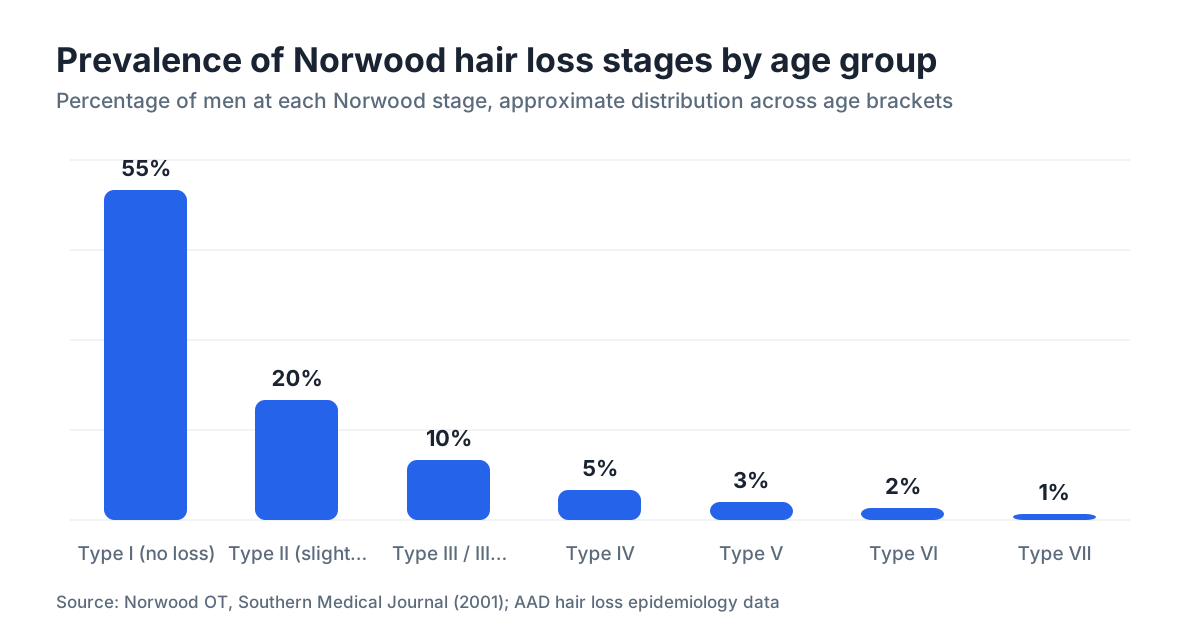
The most widely cited prevalence data comes from a 2001 study by Norwood himself published in the Southern Medical Journal, drawing on survey data across American men [2]. That analysis of Caucasian men found roughly these prevalence figures by age:
| Norwood Stage | Age 20s (approx.) | Age 40s (approx.) | Age 60s+ (approx.) |
|---|---|---|---|
| Type I | ~55% | ~15% | ~5% |
| Type II | ~20% | ~15% | ~10% |
| Type III / III Vertex | ~10% | ~15% | ~10% |
| Type IV | ~5% | ~15% | ~10% |
| Type V | ~3% | ~10% | ~15% |
| Type VI | ~2% | ~10% | ~15% |
| Type VII | ~1% | ~5% | ~15% |
The numbers vary meaningfully by ethnicity. Asian and African-descent men on average show lower rates of advanced Norwood progression than Caucasian men, though no group is immune [3]. Genetics is the dominant variable, and the single strongest predictor of your trajectory is looking at the men on both sides of your family (the maternal grandfather myth is mostly a myth; both sides contribute).
About 50% of men experience noticeable androgenetic alopecia by age 50, a figure cited consistently in dermatology literature [4]. By age 70, that figure is closer to 80%.
What causes hair loss to progress through the Norwood stages?
The mechanism is well understood, even if the genetic details are still being mapped. Androgenetic alopecia is driven by DHT (dihydrotestosterone), a hormone made from testosterone via the enzyme 5-alpha reductase. Hair follicles on the top and front of the scalp in genetically susceptible men have androgen receptors that respond to DHT by gradually miniaturizing, producing thinner and shorter hairs with each cycle until the follicle stops producing visible hair at all [5].
The follicles on the sides and back of the scalp (the donor zone used in transplants) carry a different genetic expression and are largely resistant to DHT. That's why the horseshoe band survives even in Type VII men.
Progression rate is highly individual. Some men move from Type II to Type V in five years. Others stay at Type III for two decades. Early onset (loss starting before 25) generally correlates with more aggressive eventual progression, though not always. This unpredictability is one reason dermatologists often recommend starting treatment sooner rather than later if you have a strong family history and already show early signs.
For a deeper look at the underlying biology, see what causes hair loss and DHT blockers.
Is the Norwood scale used for women too?
No. The Ludwig scale is used for female pattern hair loss, and it captures a different pattern: diffuse thinning over the crown and top of the scalp rather than the temple recession and hairline retreat that define the Norwood types. Women can and do experience some hairline recession, but androgenetic alopecia in women rarely follows the Norwood pattern closely.
That said, the Norwood scale occasionally gets referenced for women with very androgen-driven hair loss, and some women do present with Norwood-like patterns at Stages II or III. If a woman is losing hair in a Norwood-type pattern, it often warrants a look at androgen levels, PCOS, or other hormonal factors beyond simple genetic susceptibility.
For diffuse shedding in both sexes that doesn't fit either scale, telogen effluvium is often what's happening instead.
Which Norwood stages can actually be treated with medication?
This is where the staging matters most in practice. The honest picture:
Finasteride (Propecia, generic): The FDA approved oral finasteride 1mg for male pattern hair loss in 1997 [6]. It blocks 5-alpha reductase, cutting scalp DHT levels by roughly 60-70%. Clinical trials showed it halted or partially reversed loss in the majority of men with Norwood Types II through IV, especially at the crown. A 5-year study found that 48% of men on finasteride improved and another 42% held steady with no further loss, versus 75% of placebo men who got worse [7]. At Types VI and VII, the follicles are gone and finasteride can't revive dead tissue. It can only protect what's still alive.
Minoxidil (Rogaine, generic topical or oral): The FDA approved topical minoxidil 2% for men in 1988 and 5% in 1997 [6]. It extends the anagen (growth) phase and works best for crown thinning (Norwood III Vertex through V). It does less for a receding hairline than for the crown. Oral minoxidil at low doses (1.25-5mg) has picked up real traction with dermatologists in the last few years as an off-label option with broader systemic action, though the FDA hasn't formally approved it for hair loss at any dose.
Combined therapy: Most hair loss specialists now recommend finasteride and minoxidil together for men who are motivated and at Norwood II through V. The combination looks more effective than either alone, though long-term head-to-head data comparing single-drug and combination therapy is thinner than you'd like. Read more on finasteride and minoxidil combined and minoxidil for men.
The brutal summary: If you're Type II or III, medication can hold your hair and possibly improve it. If you're Type V or above, medication alone won't give you back what's gone. At VI and VII, a hair transplant (if you have adequate donor density) is the only way to restore coverage in the bald zones.
What Norwood stage do you need to be for a hair transplant?
There's no hard cutoff by stage, but there are real practical constraints.
Most hair transplant surgeons won't operate on men below Norwood III, and many won't touch Norwood II. The reason is simple: if you're early in the process and your loss pattern isn't fully set, a surgeon can't know where your eventual bald zone will be. Transplant into an area that still has native hair, watch that native hair fall out later, and you're left with an unnatural pattern and a drained donor supply for future procedures.
On the other end, men at Norwood VI and VII may not have enough donor hair in the back and sides to cover the large bald area even partially. Donor supply is finite. A typical scalp has roughly 6,000 to 8,000 grafts available over a lifetime, and severe Norwood stages may need 4,000+ grafts just for partial coverage [8].
The sweet spot for transplantation is generally Norwood III through V, where the bald pattern is set enough to plan around but the donor zone is still dense enough to yield meaningful coverage. A good surgeon will also insist you be on finasteride first (if you're a candidate) to protect the non-transplanted hair.
For a full breakdown, see hair transplant.
How do you figure out your own Norwood stage?
You can get a rough read yourself using the stage descriptions above and a decent photo taken from directly overhead in good light. Compare the recession depth at your temples and the coverage at your crown to the standard diagrams.
A few things make self-staging tricky. Hair styling, length, and lighting can mask a stage or make it look worse than it is. Wet hair almost always looks worse. And because progression is gradual, most people underestimate their stage because they're comparing to themselves six months ago rather than to an objective reference.
For a more objective baseline, a dermatologist can do a scalp exam and trichoscopy (a dermoscopy of the scalp) that catches miniaturization of follicles before it's visible to the naked eye. If you want a first pass before booking an appointment, MyHairline's free AI scan analyzes photos for Norwood staging and gives you a structured starting point.
One thing that's underrated: take standardized overhead photos of your scalp every six months and save them. This is the single most useful thing you can do for tracking progression over time, because your memory of what your hair looked like two years ago is almost certainly wrong.
Does the Norwood stage predict how fast you'll go bald?
Not precisely, no. The scale describes current state, not velocity.
That said, certain factors do correlate with faster progression. Earlier age of onset is the most consistent predictor. A man who hits Norwood III by age 22 is statistically more likely to reach Norwood VI than a man who first shows III at 40. Family history density matters too: if multiple first-degree relatives on both sides reached advanced stages early, your odds go up.
Hair loss velocity itself can be measured. Trichoscopy and follicle density counts over six to twelve months give a real rate of miniaturization. Some clinicians use this to guide how urgently to start treatment.
What the stage does tell you is where you are in the biological process. Since follicles are easier to protect when they're still alive, a lower current stage with early onset is actually the argument for starting treatment now rather than waiting to see how bad it gets.
What does Norwood Type III Vertex look like versus regular Type III?
This one trips people up, and it matters for treatment planning.
Regular Type III: The dominant change is temple recession. The hairline has pulled back sharply at the corners, often forming a deep M or U shape, while the crown still looks reasonably full.
Type III Vertex: The temple recession is there but relatively modest, at about Type II depth. The defining feature is thinning at the crown (vertex). Look at the scalp from above and you'd see a circular or oval area of thinning or bare skin at the top back of the head.
Some men have both at once, which just gets classified by whichever pattern is more advanced. Why does it matter? Minoxidil, applied topically, works better on the crown than on a receding hairline. Finasteride works on both. And for transplant planning, the two patterns need completely different graft distribution strategies.
If your main concern is crown thinning specifically, that's one of the patterns where topical minoxidil has the strongest evidence base, and it's worth understanding minoxidil side effects before committing to long-term use.
Are there supplements or lifestyle changes that affect Norwood progression?
Honest answer: supplements are weak tools for androgenetic alopecia, but a few have some legitimate evidence.
Saw palmetto has modest 5-alpha reductase inhibiting properties. A small 2002 study found it helped a minority of men with mild loss, but the effect size is a fraction of finasteride's and the data is nowhere near strong enough to rely on it as a primary treatment [9]. It's not useless. It's just not enough on its own for men moving through Norwood stages.
Nutrient deficiencies can speed up hair shedding (iron deficiency, low vitamin D, zinc deficiency), but correcting them doesn't reverse androgenetic alopecia. It removes an extra cause of shedding stacked on top of the genetic one. Get a blood panel if you suspect deficiency; don't just supplement blindly.
Stress, diet, and sleep affect overall hair health and can worsen telogen effluvium (stress-related shedding), but they don't change the DHT-driven miniaturization that moves you through Norwood stages. A man genetically destined for Type VI will get there on a perfect diet too, just possibly a little more slowly.
For a full rundown on what's worth taking, see hair loss supplements.
Sources
- Southern Medical Journal, Norwood OT (1975), 'Male pattern baldness: classification and incidence'
- Southern Medical Journal, Norwood OT (2001), 'Incidence of male and female pattern alopecia'
- Journal of Investigative Dermatology, Takashima & Ito (2003), 'Ethnic variation in androgenetic alopecia'
- American Academy of Dermatology, 'Hair loss: Who gets it and causes'
- National Library of Medicine, StatPearls: Androgenetic Alopecia
- FDA, Approved Drug Products (Orange Book), finasteride 1mg and minoxidil topical
- Journal of the American Academy of Dermatology, Kaufman et al. (1998), 5-year finasteride trial
- International Society of Hair Restoration Surgery, 'Donor area capacity and graft estimation'
- Journal of Alternative and Complementary Medicine, Prager et al. (2002), 'Saw palmetto for androgenetic alopecia'
- Clinical Journal of Sport Medicine, van der Merwe et al. (2009), 'Three weeks of creatine supplementation affects dihydrotestosterone levels'
- American Academy of Dermatology, 'Hair loss: Diagnosis, treatment, and outcome'