

TL;DR: Norwood 6 is one step below the most severe hair loss pattern. The front and crown are almost entirely bare, connected by a wide bald strip, with only a low horseshoe of hair left. Finasteride and minoxidil can slow further loss. Transplants are possible but need careful donor planning. Most men at NW6 are realistic candidates for modest, not full, restoration.
What is Norwood scale 6 and how does it look?
Norwood 6 is the second-to-last stage on the Hamilton-Norwood classification system, the standard tool dermatologists and hair surgeons use to describe male pattern baldness [1]. At stage 6, the bald patch that started at the front hairline and the one that started at the crown have completely merged. No hair bridge separates them anymore. What's left is a low horseshoe band running above the ears and around the back of the head.
The bald area at NW6 is large. Only the occipital and parietal fringe (the classic horseshoe) survives, and even that band may be thinner or lower than it was at earlier stages. The top of the scalp, the frontal zone, and the midscalp are all fully exposed.
Norwood described his seven-stage system in a 1975 paper building on Hamilton's earlier 1951 framework [1]. Stage 7 is worse than stage 6 only in that the remaining horseshoe is narrower and the fringe sits even lower. Stage 6 is the point where most surgeons say the treatment decisions get genuinely hard, because donor supply is limited and the area to cover is very large.
If you're trying to figure out your own stage, a free AI hair loss scan can map your scalp against the Norwood grid in minutes, though a board-certified dermatologist or hair surgeon should confirm any clinical staging before you plan treatment.
How does NW6 differ from NW5 and NW7?
The difference between NW5 and NW6 is the bridge. At NW5 a thin strip of hair still separates the frontal loss from the crown loss, even if that strip is sparse. At NW6 the strip is gone. The move from NW5 to NW6 isn't a cliff, but the practical effect is real: once the bridge disappears, the total bald surface area jumps, and any transplant plan has to treat one continuous zone instead of two separate ones [1].
NW7 takes the remaining horseshoe lower and thinner. At NW6 the fringe is still reasonably wide and dense, which matters enormously for transplant donor hair. A surgeon has notably more viable grafts to work with at NW6 than at NW7. Some NW6 patients have a fringe dense enough to support two modest transplant sessions. Many NW7 patients do not.
Stage 6A exists in the Norwood system. The "A" variants show a different pattern where recession moves straight back rather than leaving an island of hair at the vertex. NW6A patients look slightly different from NW6 in front but face similar coverage challenges overall.
| Stage | Key feature | Bald area (approx.) | Donor situation |
|---|---|---|---|
| NW5 | Narrow bridge remains | ~55-65% of top | Adequate |
| NW6 | Bridge gone, large merged zone | ~70-80% of top | Limited but workable |
| NW7 | Horseshoe very narrow and low | >80% of top | Often insufficient for full coverage |
What causes someone to reach Norwood 6?
The driver is androgenetic alopecia, also called male pattern baldness. DHT (dihydrotestosterone) binds to androgen receptors in genetically susceptible follicles, slowly shrinking them over years until they stop producing visible hair [2]. The process is gradual but, left untreated, it follows the individual's genetic script.
Genetics decides both whether you lose hair and how far the loss goes. Twin studies confirm strong heritability, with estimates ranging from 79 to 81 percent [3]. Reaching NW6 is mostly predetermined. It is not caused by stress alone, bad shampoo, hats, or most of the things men blame. What causes hair loss has the full list, but the honest answer for NW6 is this: if your genes pointed this way, most men got here in their late 30s to 50s, and some faster.
Age matters. Most men who reach NW6 do so between 40 and 60, but roughly 12 percent of men under 30 already show significant vertex thinning that will eventually bridge [4]. Early onset tends to predict faster and further progression, which is one reason clinicians now push for earlier intervention when a young man shows signs of aggressive loss.
Race matters too. Androgenetic alopecia is most common in men of European descent. Asian and African-American men have lower average prevalence, but those who are affected can absolutely reach NW6 [2]. The Norwood scale was developed on mostly white male subjects, so it fits less perfectly across all ethnicities, though no better standardized alternative exists.
Can finasteride or minoxidil help at Norwood 6?
Yes, with realistic expectations. Neither drug regrows hair across a large bald scalp. What they can do is slow or halt further progression, and sometimes thicken surviving miniaturized hairs at the fringe.
Finasteride (1 mg oral, branded Propecia or generic) inhibits 5-alpha reductase type II, cutting scalp DHT by about 60 percent [5]. The original Merck trial showed finasteride slowed progression versus placebo over two years, and some men saw modest regrowth [5]. That trial was powered on men with NW3 to NW4 loss, not NW6. At stage 6, the follicles in the large merged bald zone are almost certainly dead or irreversibly miniaturized. Finasteride can protect what remains, especially the horseshoe fringe, which matters hugely for transplant planning.
Minoxidil (2% or 5% topical, or low-dose oral) works through a different mechanism, extending the anagen growth phase and increasing blood flow to follicles [6]. At NW6 the logic matches finasteride: protect the fringe, add thickness to surviving hairs. The FDA has cleared 5% minoxidil foam for men's hair loss [6]. Minoxidil for men covers the dosing logistics.
Combining both drugs makes sense. A 2022 multicenter randomized trial in the Journal of the American Academy of Dermatology found combination topical minoxidil plus oral finasteride beat either drug alone on hair count improvements [7]. The same logic holds at NW6: if you're trying to keep what's left before or after a transplant, using both is the rational move. Finasteride and minoxidil has the full breakdown.
Be honest with yourself about side effects before committing. Minoxidil side effects and finasteride both cover the risk profile clearly. Sexual side effects from finasteride are real, reported in roughly 1.4 to 3.8 percent of men in clinical trials, though the causality debate continues [5]. These drugs are long-term commitments. Stop them and whatever progress you made reverses within months.
Is a hair transplant realistic at Norwood 6?
Transplants at NW6 are possible, but you need the right mindset walking in. This is not a return to your 25-year-old hairline. The goal is meaningful improvement, not full coverage.
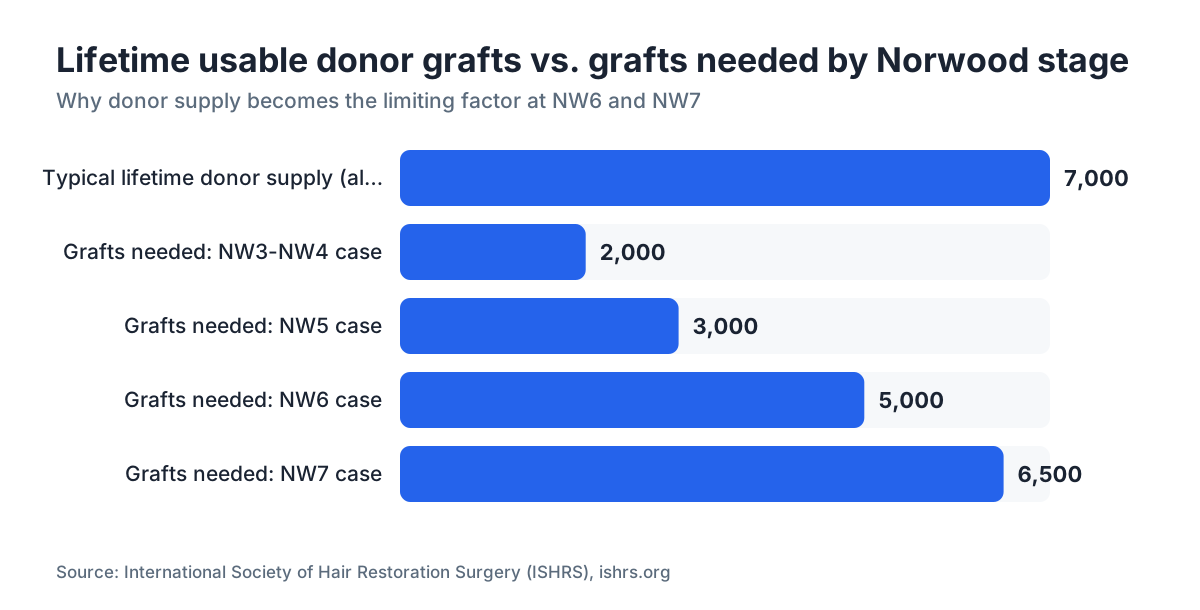
The core math problem is the donor-to-recipient ratio. A typical male donor zone (the permanent horseshoe) holds between 6,000 and 8,000 grafts that can be safely extracted over a lifetime without making the donor area look depleted [8]. To even partially cover an NW6 bald area you might need 4,000 to 6,000 grafts, sometimes across two sessions. That's a big chunk of your lifetime donor supply for one result that still won't look thick.
FUE (follicular unit extraction) is now the dominant technique. Individual follicular units come out one by one from the donor area, leaving no linear scar. FUT (follicular unit transplantation) uses a strip and leaves a linear scar but can yield slightly more grafts per session. At NW6, many experienced surgeons prefer FUT for the first large session to maximize graft count, with FUE saved for a later touch-up, but this varies by clinic. Hair transplant covers both procedures in detail.
Body hair transplant (BHT) supplements scalp donor hair with follicles from the beard, chest, or back. For NW6 and NW7 patients, BHT extends total available grafts meaningfully. Beard grafts in particular have a caliber close to scalp hair and tend to survive well in the recipient zone. Not every clinic has expertise in BHT. Ask directly.
Expect to spend $8,000 to $25,000 or more for a large NW6 case in the United States, depending on graft count, technique, and surgeon experience [8]. International clinics in Turkey or India advertise far lower prices, often $2,000 to $5,000 for large sessions. Some are excellent. Some are not. The risks of an inexperienced surgeon are scar-tissue damage and poor graft survival, both of which permanently shrink your future options. Research before going cheap.
One of the most useful questions to ask any surgeon: "What will my scalp look like at NW7, after I've spent my donor supply?" A good surgeon answers honestly. A bad one only shows you the before-after of their best cases.
What does a hair transplant result look like at NW6?
Realistic outcomes for NW6 transplants fall into three scenarios.
The first is hairline restoration only. The surgeon rebuilds a defined frontal hairline and fills the front third of the scalp, leaving the crown uncovered. This gives a frame to the face, which reads as a strong improvement even with a visible bald crown. Most men who see photos of this result are satisfied. It's arguably the best use of limited grafts.
The second is partial coverage of both zones. The surgeon spreads grafts across the front and crown at lower density, giving thin but present coverage over a larger area. Results look natural when density expectations are set right, but some men find the low-density midscalp look underwhelming at close range.
The third is a combined scalp-plus-beard-hair approach for fuller coverage. More invasive, longer extraction sessions, but it extends what's achievable.
Growth takes time. Transplanted hairs shed around weeks 2 to 6 post-op, and visible growth usually shows up around 4 to 6 months. Final results are judged at 12 to 18 months [8]. Plan accordingly and do not read the result at 3 months.
Surgeons should have you on finasteride and possibly minoxidil after transplant to protect native follicles in the fringe. A transplant into a scalp where loss keeps going untreated eventually looks odd as the surrounding hair thins further.
Are there non-surgical options worth trying at NW6?
A few have real evidence behind them. Most do not.
Low-level laser therapy (LLLT), sold as helmets and combs with FDA clearance for hair growth, has modest evidence in early-to-moderate loss [9]. At NW6 the large follicle-dead zone is unlikely to respond. If you want to try LLLT, use it to support the fringe, not to regrow the bald area.
Platelet-rich plasma (PRP) injections are popular in hair clinics. The evidence is mixed and mostly from small studies. A 2019 meta-analysis in Dermatologic Surgery found PRP improved hair density in androgenetic alopecia, but most included studies were on earlier-stage loss [10]. At NW6, PRP as an adjunct to transplant may help graft survival, but as a standalone treatment for large bald zones the data are thin.
Hair loss supplements like biotin, saw palmetto, and assorted nutraceuticals are marketed hard. Biotin deficiency is rare in healthy adults eating a normal diet, and supplementing it does nothing for pattern baldness. Saw palmetto has weak DHT-blocking activity but far less than finasteride. Nobody has good data on most supplement combinations in NW6 specifically.
Scalp micropigmentation (SMP) deserves a mention. It's not a hair growth treatment at all. It's tattooing the scalp with dots that mimic the look of a closely shaved head. For NW6 men who don't want surgery, or whose donor supply is exhausted, SMP can create a credible, attractive shaved-head look. Many men find it genuinely satisfying. It fades over 3 to 5 years and needs touch-ups.
How does the Norwood 6 scale rating affect transplant donor planning?
Donor planning is the central technical challenge at NW6, and it earns its own section, because this is where a lot of men get misled by clinics willing to extract more than is safe.
The safe donor area is the permanent zone, where follicles carry enough androgen-resistance to survive regardless of DHT levels. For most men this is a roughly 15 to 18 cm wide strip centered on the back of the scalp, between about 1 cm above the ear and the occipital protuberance [8]. Below that zone or above it, follicles can be DHT-sensitive, meaning grafts pulled from there may eventually miniaturize even after transplant. An unscrupulous or inexperienced surgeon may mine outside the safe zone to hit a higher graft count. The grafts look fine for years, then thin. That's a real risk at NW6, when the pressure to find donor hair is highest.
Donor density matters as much as total graft count. A man with low donor density (fewer follicular units per cm squared) may be technically NW6 but have far fewer usable grafts than another NW6 man with dense donor hair. Get a donor density assessment, usually done with trichoscopy or a handheld densitometer, as part of any surgical consultation.
If you're still progressing (under 35, say) a conservative surgeon may suggest waiting, or using finasteride to stabilize before committing donor grafts to a scalp that may keep losing ground. Spending 4,000 grafts at age 28 on a borderline NW6 trajectory could leave nothing for a smarter plan at age 35.
What should someone at NW6 realistically expect long-term?
Honest long-term outlook: without treatment, NW6 can progress to NW7 in some men. The rate varies. Some men stabilize at NW6 for decades. Others move to NW7 within a few years. Finasteride and minoxidil cut the odds of progression but don't erase them.
With a transplant and ongoing medical therapy, a committed NW6 man can reach a result that looks genuinely good in photos and in person at social distances. It won't fool a barber at close inspection, but that's not the right benchmark. The right benchmark is simple: does this make me look better and feel better? For most well-planned NW6 transplant cases, the answer is yes.
The psychological impact is real and worth naming. A 2001 study in Dermatology found that hair loss significantly affected self-image and quality of life, particularly in men under 40 [11]. At NW6, men often report that the decision to either commit to treatment or fully accept the shaved look dropped their anxiety far below the years of gradual loss with no plan. Both paths are valid. Not everyone needs to pursue treatment.
If you want a free baseline read of your current stage before talking to a surgeon, MyHairline's AI scan maps your scalp pattern against the Norwood grid and gives you a starting point for the conversation.
For younger men noticing early signs that might lead here, reading about receding hairline progression and DHT blockers can clarify whether early intervention makes sense.
How is Norwood 6 diagnosed, and could you be misclassified?
Norwood staging is a clinical assessment, not a blood test. A dermatologist or hair surgeon looks at your scalp, identifies the pattern, and assigns a stage. No imaging required. It sounds simple, and mostly it is, but misclassification happens.
The most common error is staging someone as NW6 when they're actually NW5 with a very sparse bridge. This matters because NW5 donor planning is slightly more favorable. The second common error runs the other way: calling a patient NW5 when the bridge is so thin it's functionally absent and the surgical plan should be NW6-level.
Variants like NW6A get missed entirely, especially by surgeons who trained mostly on the classic pattern. If the recession moved straight back without a vertex island, the pattern looks different and the fringe may sit in a different spot.
Trichoscopy, which uses a magnifying dermatoscope, can reveal miniaturized hairs in the transitional zone that are invisible to the naked eye. Finding miniaturized hairs in the bridge zone might mean a patient is NW5 trending toward NW6 rather than a settled NW6, which can change the timing of treatment decisions.
If you're unsure about your staging, a second opinion from a different board-certified dermatologist or hair restoration surgeon is completely reasonable. Surgeons have financial incentives to operate. A non-surgical dermatologist can give a staging opinion without that pressure.
Sources
- Norwood OT. Male pattern baldness: classification and incidence. Southern Medical Journal, 1975.
- American Academy of Dermatology (AAD) - Hair loss overview
- Rexbye H et al. Influence of genetics on hair loss in twins. Twin Research and Human Genetics, 2005. PubMed.
- Rhodes T et al. Prevalence of male pattern hair loss at various ages. Journal of the American Academy of Dermatology, 1998. PubMed.
- Kaufman KD et al. Finasteride in the treatment of men with androgenetic alopecia. Journal of the American Academy of Dermatology, 1998. PubMed.
- FDA - Minoxidil 5% topical foam (Men's Rogaine) approval information
- Ramos PM et al. Minoxidil plus finasteride combination trial. Journal of the American Academy of Dermatology, 2022. PubMed.
- International Society of Hair Restoration Surgery (ISHRS) - Practice guidelines and patient resources
- Avci P et al. Low-level laser therapy for hair loss. Lasers in Surgery and Medicine, 2014. PubMed.
- Giordano S et al. A meta-analysis on evidence of PRP for androgenetic alopecia. Dermatologic Surgery, 2018. PubMed.
- Williamson D et al. The effect of hair loss on quality of life. Dermatology, 2001. PubMed.