
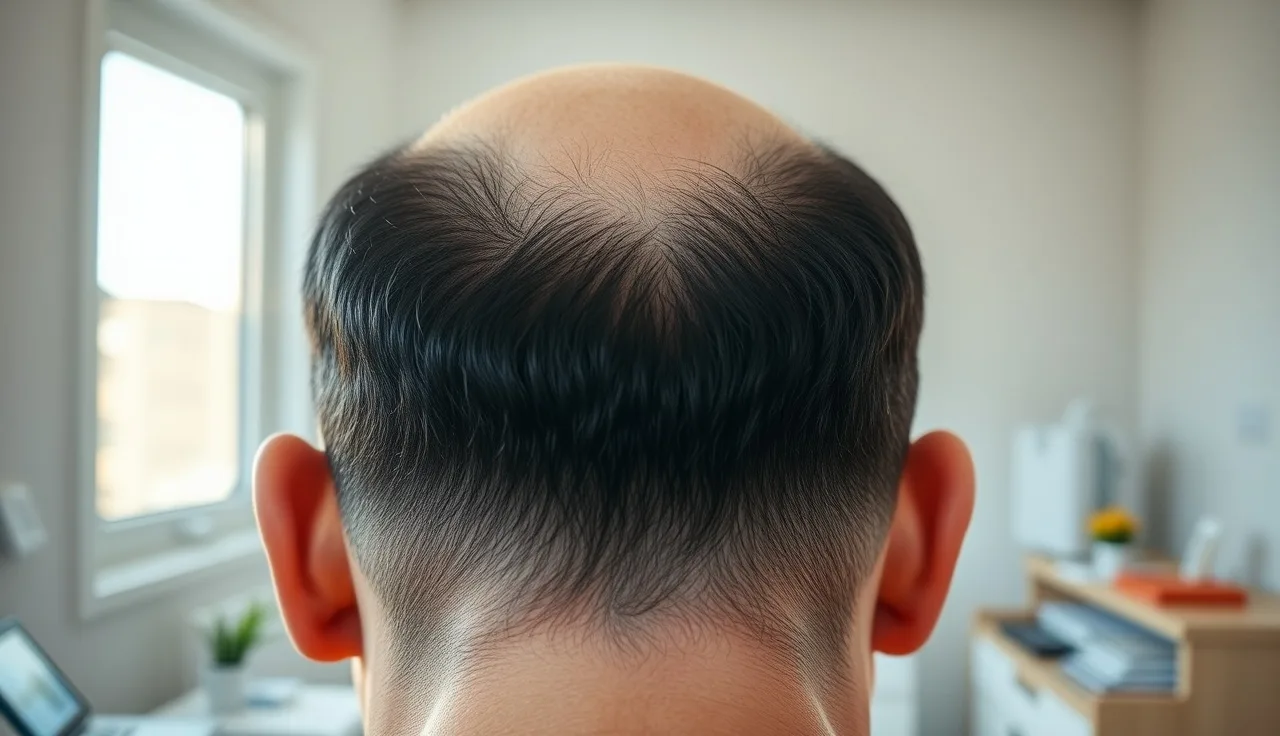
TL;DR: Norwood scale 7 is the final stage of male pattern baldness. The top of the scalp is fully bald, leaving a thin horseshoe of hair above the ears and around the back. Treatments can protect that remaining hair and, in some cases, restore partial coverage through transplant. Full restoration is not realistic. Setting expectations early saves money and heartache.
What is Norwood scale 7 and what does it look like?
The Norwood-Hamilton scale is the most widely used classification system for male pattern baldness, running from Type 1 (no visible loss) through Type 7 (the most advanced stage) [1]. Norwood 7 means all the hair across the top, mid-scalp, and crown is gone. What remains is a narrow band that wraps around the back and sides, from ear to ear. That band is often thinner and finer than it was in youth. In some men it keeps receding inward over time.
The defining feature of Norwood 7 is that the two zones of loss you see in earlier stages, the receding temples and the thinning crown, have fully merged [1]. There is no island of hair left on top. The scalp is bare across the entire vertex.
A common misconception is that the horseshoe fringe is always stable. It is not. The follicles in the permanent zone at the back and sides are generally resistant to dihydrotestosterone (DHT), the hormone behind androgenetic alopecia, but they are not immune [2]. Men who reach Norwood 7 in their 40s still have decades of potential follicle miniaturization ahead.
For a broader look at how genetics and hormones drive each stage of loss, see our guide on what causes hair loss.
How does Norwood 7 compare to earlier stages?
Where you sit on the scale matters, because treatment options and realistic outcomes shift a lot between stages. The table below breaks down the differences.
| Norwood Stage | Crown Status | Temple Recession | Top of Scalp | Transplant Donor Concern |
|---|---|---|---|---|
| 3 | Thinning begins | Moderate | Mostly intact | Low |
| 4 | Significant loss | Significant | Bridge of hair remains | Low-moderate |
| 5 | Large bald zone | Severe | Thin bridge only | Moderate |
| 6 | Crown and front merged | Very severe | None | Moderate-high |
| 7 | Total top loss | Complete | None | High |
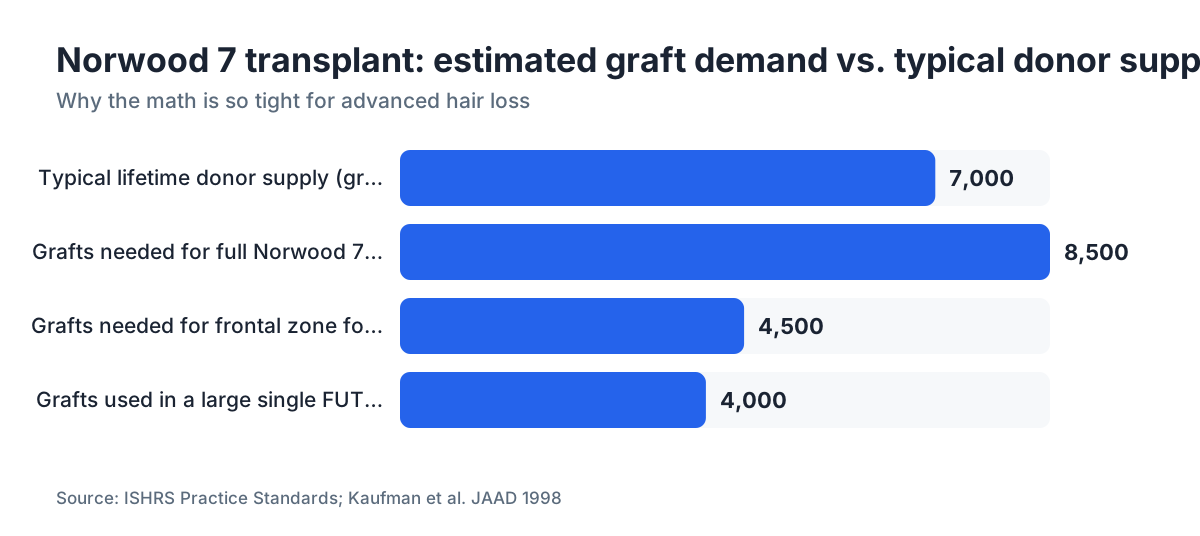
The jump from Norwood 6 to 7 is more than cosmetic. It is the point where donor hair supply becomes the central limit on any surgical plan. A typical scalp holds roughly 6,000 to 12,000 grafts in the permanent zone, depending on hair density and scalp laxity [3]. Covering a Norwood 7 scalp to a natural-looking density would need far more grafts than most donors can safely give.
Men at earlier stages, say Norwood 3 or 4, can often get results that look genuinely full in photographs. Norwood 7 results look better than complete baldness but will not look like a 25-year-old's hairline. That is not pessimism. That is arithmetic.
What causes someone to reach Norwood 7?
Androgenetic alopecia, commonly called male pattern baldness, is the cause in the overwhelming majority of cases [2]. It runs on a genetic sensitivity of follicles to DHT, a byproduct of testosterone made by the enzyme 5-alpha reductase. Sensitive follicles slowly miniaturize, producing thinner and shorter hairs until they stop producing visible hair at all.
Genetics are the strongest predictor of how far loss goes. If your father and maternal grandfather both reached Norwood 7, your odds are meaningfully higher, though the inheritance pattern is polygenic and not perfectly predictable [2]. Age matters too. Most men who will reach Norwood 7 start losing hair in their 20s or early 30s.
Other factors can speed up progression: chronic stress, nutritional deficiencies (particularly iron or protein), and certain medications can trigger telogen effluvium, a temporary form of shedding that piles onto the look of androgenetic loss. But telogen effluvium alone does not cause Norwood 7. That final stage is androgenetic.
For men curious about lifestyle contributors, the research on does creatine cause hair loss is one frequently searched question worth reading separately.
Can minoxidil or finasteride still help at Norwood 7?
Yes, both drugs can still do something useful at Norwood 7. But what they do is different from what many men hope for.
Minoxidil (topical or oral) works by prolonging the growth phase of follicles and increasing blood flow to the scalp [4]. At Norwood 7, there are no active follicles on top to stimulate. Minoxidil cannot wake up follicles that have been dormant for years. What it can do is help hold the horseshoe of remaining hair, slowing continued thinning of that fringe. That is not nothing. Losing the fringe makes any future surgical plan much harder.
Finasteride works by inhibiting 5-alpha reductase, cutting DHT levels in the scalp by roughly 70% [5]. Clinical trials show it slows or stops progression in most men and regrows hair in a meaningful subset. The 5-year trial published in the Journal of the American Academy of Dermatology found that 48% of men on finasteride had some increase in hair count, while 42% had no further loss [5]. But those trials enrolled men with Norwood 2 through 5. The data for Norwood 7 specifically is thin.
So here is the practical answer. If you are at Norwood 7, finasteride is still worth considering to protect your donor zone. Losing density in the back and sides shrinks your transplant options permanently. Learn more about how finasteride works and what side effects to expect.
For men who want to run both together, the combination is common and studied. See finasteride and minoxidil for a breakdown of the evidence.
Topical minoxidil is generally safe. Oral minoxidil carries different considerations. Our minoxidil side effects article covers both, and minoxidil for men covers dosing and application.
Is a hair transplant possible at Norwood 7?
Yes, hair transplants are done on Norwood 7 patients. Whether they should be is the harder question, and any surgeon who says it is straightforward is not being honest with you.
The core limit is donor supply. Hair transplant surgery, whether FUT (follicular unit transplantation) or FUE (follicular unit extraction), moves follicles from the permanent zone at the back and sides to the bald areas on top [6]. The bald surface of a Norwood 7 scalp is roughly 150 to 200 square centimeters. Building even modest coverage across that area at a density of 30 to 40 grafts per square centimeter would need 4,500 to 8,000 grafts [3]. Most men have 5,000 to 8,000 grafts to spend in a lifetime before the donor area looks visibly thin.
That means a Norwood 7 transplant often burns the entire lifetime donor supply in one or two procedures. You get one shot. If the result is not what you hoped, there is nowhere to go back for more.
Body hair transplant (BHT), usually beard or chest hair, can supplement scalp donor hair in some cases [6]. Results are all over the map. Body hair follicles behave differently than scalp follicles, grow at different rates, and carry different curl and texture. Some surgeons use BHT to add density behind a hairline built from scalp grafts. Others doubt the long-term cosmetic outcome.
For a full look at the surgery itself, FUE vs FUT tradeoffs, costs, and recovery, read our hair transplant guide.
What do Norwood scale 7 hair transplant results actually look like?
Realistic Norwood scale 7 hair transplant results show meaningful coverage but not the look of a naturally full head of hair. The goal for most surgeons is the illusion of density, not actual density.
A skilled surgeon will put grafts into the frontal zone and mid-scalp first, because that frames the face and reads as hair at a conversational distance. The crown often gets left partially or fully untreated in a first procedure. Filling it pulls grafts away from where they do the most visual work.
Photos of Norwood 7 transplant results can look impressive under ideal lighting. Part of that is photography compressing visual cues. In person, under direct overhead light, the result looks thinner. Scalp micropigmentation (SMP) is often combined with transplant surgery for Norwood 7 patients to improve visual density and soften the contrast between transplanted hair and bare scalp.
Graft survival is not the problem. Well-performed FUE and FUT procedures reach roughly 90 to 95% graft survival in experienced hands [6]. The problem for Norwood 7 is the raw math: how many grafts you have versus how much area needs covering.
If you are evaluating surgeons, ask three things directly. How many grafts do I have available? How many do you plan to use in this session? What is your plan if I want more procedures later? A surgeon who cannot answer those plainly is not the right surgeon for this situation.
At MyHairline, the free AI scan at myhairline.ai/scan helps you see where you sit on the Norwood scale before you walk into a consultation, so you are not relying only on what a surgeon with a financial interest tells you.
How much does a Norwood 7 hair transplant cost?
Cost is one of the most searched questions for Norwood 7, because the graft count is high and the price rises with it.
In the United States, hair transplant surgery typically costs between $4,000 and $15,000 for a single session [7]. That range reflects graft count, technique (FUT usually runs cheaper per graft than FUE), location, and surgeon experience. A Norwood 7 patient needing 4,000 to 6,000 grafts in one session should budget at the top of that range, often $10,000 to $20,000 for a full session with an experienced surgeon.
Medical tourism has become common for hair transplant patients, particularly Turkey. Clinics in Istanbul routinely quote all-in prices of $2,000 to $5,000 for large sessions [7]. Quality varies enormously. Some clinics produce excellent results. Others have high complication rates or hand the extraction and placement work to technicians rather than surgeons. The savings are real. So is the risk if something goes wrong and you are not near the treating clinic.
Health insurance does not cover hair transplants. They are classified as cosmetic. Financing through CareCredit or similar medical credit products is commonly offered by clinics.
Then there is medication. Finasteride is now a cheap generic, roughly $15 to $30 per month in the US. Minoxidil is even cheaper. If you are spending $15,000 on a transplant and skipping the $20/month drug that protects your donor zone and your existing hair, you are making a poor financial decision.
Is scalp micropigmentation a better option than transplant for Norwood 7?
For some men, yes. Scalp micropigmentation (SMP) is a cosmetic tattooing technique that deposits pigment into the scalp to mimic the look of shaved hair follicles [8]. It works at any Norwood stage but fits Norwood 7 especially well, because it needs no donor supply.
SMP can cover the entire bald area, creating the look of a shaved head with natural stubble. The limit is that it does not create real hair. It looks best when a man keeps his remaining horseshoe hair very short, ideally the same length as the simulated stubble. If the real hair is long and the SMP is dark dots, the contrast looks fake.
SMP in the US runs roughly $2,000 to $4,000 for a full scalp treatment, with touch-up sessions every few years as pigment fades [8]. That is much cheaper than a large transplant and carries no surgical risk.
Some men combine SMP with a partial transplant. Surgery builds some real hair in the frontal zone for texture and movement, while SMP fills the rest for density and coverage. This hybrid can look more natural than either technique alone.
What DHT blockers and supplements are worth considering at Norwood 7?
The evidence hierarchy is pretty clear. Finasteride is the only oral treatment with strong clinical evidence for slowing androgenetic alopecia, and it is FDA-approved for that use [5]. Dutasteride, which inhibits both type 1 and type 2 5-alpha reductase (finasteride hits only type 2), is used off-label and suppresses DHT more, though it carries a heavier side effect profile. Neither brings back follicles that have been gone for years.
Past prescriptions, the supplement market is crowded and mostly underpowered. Saw palmetto has some mechanistic plausibility as a DHT blocker, but the trials are small and the effect size is far below finasteride [9]. Biotin gets marketed hard for hair, yet it only helps people with a documented biotin deficiency, which is uncommon [9]. Our hair loss supplements article covers the evidence on the full slate of popular options.
At Norwood 7, the honest framing is this. Medications protect what you have. They do not reverse a decade of follicle loss. If you start finasteride at Norwood 7, you are mostly protecting your donor zone, not your hairline.
What should you realistically expect from here?
If you have reached Norwood 7 and wonder what comes next, the short answer is that most of the progression has already happened. The bigger near-term risk is continued thinning of the horseshoe fringe, which can drag out slowly over decades.
Medical treatment (finasteride, minoxidil, or both) is a reasonable move whether or not you pursue surgery, because protecting the donor zone keeps options open. Surgery is possible and can improve appearance meaningfully, but it demands careful surgeon selection, honest graft planning, and realistic expectations going in.
Scalp micropigmentation is underrated. Many men who research it dismiss it as a tattoo and move on. That is usually a mistake. For someone comfortable with a shaved or very short look, SMP can look more natural day-to-day than a sparse transplant.
The worst outcome at Norwood 7 is spending $15,000 on a transplant that uses every available graft, produces mediocre density, and leaves nothing for future procedures. The second worst is spending years researching and stalling while the fringe keeps thinning. Get a clear read on your current hair density and donor capacity from a qualified dermatologist or hair restoration specialist. That is the right first step.
If you want an objective starting point before you sit across from someone who profits from selling you a procedure, the free AI scan at myhairline.ai/scan analyzes your photos and gives you a Norwood estimate and hair loss pattern read at no cost and no sales pitch.
Can a receding hairline at Norwood 7 ever be addressed specifically?
The idea of a receding hairline as a distinct feature does not really apply at Norwood 7, because the hairline is entirely gone. There is no line to fix. What surgeons build for Norwood 7 patients is a new hairline, designed from scratch.
This is where artistic skill matters enormously. A hairline that sits too low looks wrong in 20 years when the patient is older. One placed too high looks like a patch. The standard recommendation is a conservative hairline, higher than youth, matched to the patient's age and facial structure [6].
For men at earlier stages worrying about a receding hairline before it reaches this point, the receding hairline guide covers what to watch for and when to start treatment.
Sources
- American Academy of Dermatology, Hair Loss Types: Androgenetic Alopecia
- National Library of Medicine, StatPearls: Androgenetic Alopecia
- International Society of Hair Restoration Surgery (ISHRS), Practice Standards
- U.S. FDA, Minoxidil (Rogaine) Drug Label
- Kaufman KD et al., Journal of the American Academy of Dermatology, 1998: Finasteride 5-year trial
- International Society of Hair Restoration Surgery (ISHRS), Hair Transplant Techniques
- American Board of Hair Restoration Surgery, Cost Information
- U.S. National Institutes of Health, Office of Dietary Supplements: Biotin Fact Sheet
- U.S. FDA, Finasteride (Propecia) Drug Label