

TL;DR: The Norwood scale runs from Stage 1 (no visible loss) to Stage 7 (only a horseshoe rim of hair remains). Stages 2 and 3 respond best to medication. Stages 4 through 6 often combine medication with transplant planning. Stage 7 leaves too little donor hair for most transplants. Identifying your stage early gives you the most options.
What is the Norwood scale and who created it?
The Norwood scale is the most widely used classification system for male pattern baldness. A dermatologist named James Hamilton first published a grading scheme in 1951, and O'Tar Norwood revised and expanded it in 1975, which is why you'll see it called the Hamilton-Norwood scale in clinical papers [1]. The revised version added a "Type A" variant to capture patterns where hair loss progresses straight back across the top rather than leaving an island of hair in the middle.
The scale runs from Stage 1 to Stage 7, with a handful of substages (2A, 3A, 3 Vertex, 4A, 5A) that cover the messier real-world patterns that don't fit neatly into the main sequence. Most men fall somewhere on the main ladder; the A variants show up in roughly 10 to 13 percent of cases depending on the population studied [1].
Why does it matter? Because the stage you're at changes which treatments are on the table. A man at Stage 2 has a completely different set of realistic outcomes than a man at Stage 6. Knowing the stage is step one before spending money on anything.
What does each Norwood stage look like? A full diagram breakdown
Here is what each stage means in plain terms. Think of it as the diagram translated into words.
Stage 1: No meaningful recession. The hairline is at or very close to where it was in your teens. This is considered the baseline for a mature male hairline. No treatment is needed or recommended at this stage [2].
Stage 2: A slight recession at the temples. The hairline has moved back in a triangular pattern on both sides but the recession is minor, typically less than 2 centimeters from the original hairline. Many men notice Stage 2 in their mid-20s and it does not always progress quickly.
Stage 2A (variant): The recession moves straight back uniformly rather than forming temple triangles. The front hairline recedes as one band.
Stage 3: The first stage Hamilton and Norwood considered "cosmetically significant" [1]. The temple recession has deepened noticeably. Some men describe it as a visible "M" or "V" shape when looking straight at a mirror.
Stage 3A (variant): Like 3 but the recession is front-to-back rather than temple-focused.
Stage 3 Vertex: The main recession is on the crown (vertex) rather than the temples. The front hairline may look close to normal while a bald spot develops on top. This one catches men off guard because they don't see it without a hand mirror.
Stage 4: More extensive recession at the front and temples, plus significant thinning or a bald patch at the vertex. A band of hair still connects the two sides across the top of the head. It's sparse but present.
Stage 4A (variant): No vertex involvement; the hairline has simply moved further back in a straight band.
Stage 5: The bridge of hair connecting the front and the crown is now very thin or nearly gone. The two bald areas are almost merging. This is the stage where hair looks thin from every angle.
Stage 5A (variant): Same pattern as 5 but without meaningful crown loss, just extensive front recession.
Stage 6: The bridge of hair is gone. The temporal and crown areas have merged into one large bald zone. Only the horseshoe band on the sides and back remains.
Stage 7: The most advanced stage. The horseshoe band of hair on the sides and back is all that remains, and even that band may be thin or narrow. The entire top of the scalp from front to back is bald.
One thing worth saying clearly: these stages describe the pattern of loss, not the density of remaining hair. Two men at Stage 4 can look quite different depending on how thick or fine their remaining hair is.
How prevalent is each Norwood stage? Real numbers by age
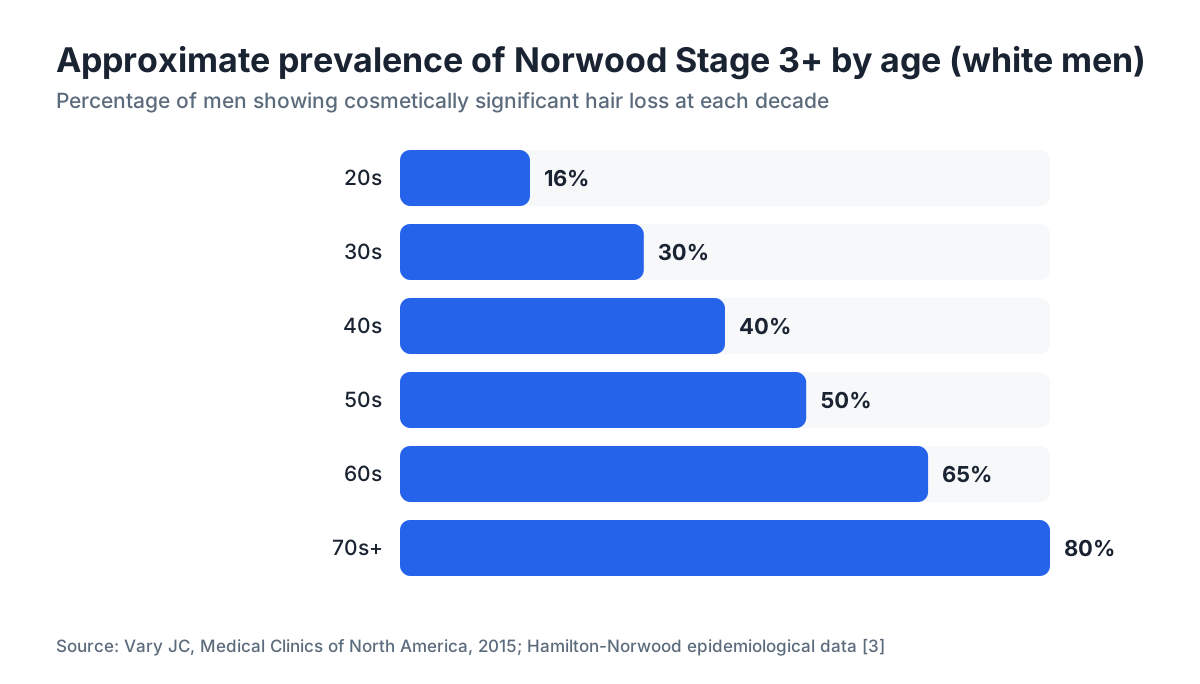
A large cross-sectional study published in the Journal of Investigative Dermatology (Norwood 1975, reanalyzed in Hamilton 1951 and subsequent epidemiological work) found that by age 50, roughly half of white men show Norwood Stage 3 or above [1]. By age 70, that figure climbs to about 80 percent [3]. The numbers vary meaningfully by ethnicity: Asian and African-American men show lower overall rates and tend to reach advanced stages less frequently, though the scale itself was built on predominantly white male populations, which is a real limitation [3].
The table below summarizes approximate prevalence by decade based on published population data.
| Age group | Estimated % with Stage 3 or higher (white men) |
|---|---|
| 20s | ~16% |
| 30s | ~30% |
| 40s | ~40% |
| 50s | ~50% |
| 60s | ~65% |
| 70s+ | ~80% |
These are rough population estimates, not precise trial data, and the underlying studies had methodological differences in how they assigned stages. Take them as directional, not definitive [3].
What causes the hair loss the Norwood scale measures?
The Norwood scale describes pattern baldness, which is androgenetic alopecia. The cause is a combination of genetic susceptibility and the hormone dihydrotestosterone (DHT). DHT is converted from testosterone by the enzyme 5-alpha reductase. In men with a genetic predisposition, DHT binds to receptors in scalp follicles and progressively miniaturizes them, producing thinner and shorter hairs until the follicle stops producing visible hair altogether [4].
The follicles on the top and front of the scalp are genetically sensitive to DHT. The follicles on the sides and back (the donor area used in transplants) are largely DHT-resistant, which is why the horseshoe of hair at Stage 7 survives. That genetic difference is also why transplanted hair from the back tends to keep growing in its new location.
If you want to understand the biology in more depth, the what causes hair loss and DHT blocker articles cover the mechanism in detail. The short version: it's hereditary, DHT-driven, and starts earlier than most people expect.
Which Norwood stages respond best to minoxidil and finasteride?
This is where the staging system earns its keep. Medication works best when there is still living, miniaturized hair to rescue. Once a follicle is completely gone and the scalp is smooth and shiny, topical or oral treatments cannot regrow hair there.
Stages 1 to 3: This is the sweet spot for medical treatment. Finasteride (1 mg/day oral) reduced hair loss progression in 83 percent of men over two years in the Merck Phase III trials, and 66 percent saw some regrowth [5]. Minoxidil 5% topical solution increased hair count in a randomized controlled trial by roughly 12 to 15 hairs per square centimeter above placebo after 48 weeks [6]. Starting at Stage 2 rather than waiting until Stage 4 gives you more follicles to preserve.
Stages 3 Vertex to 4: Still a reasonable zone for medication, though expectations should be tempered. You can slow or stop progression and may see some regrowth on the crown. The front hairline at Stage 4 is harder to recover fully with medication alone.
Stages 5 to 6: Medication can protect remaining hair and prevent reaching Stage 7, which matters enormously for transplant candidacy. But expecting significant cosmetic reversal from pills and topicals at this stage is unrealistic. Most men here are having the transplant conversation alongside medication.
Stage 7: Medication is still worth using to preserve the donor area, but the cosmetic options narrow sharply. Hair transplant candidacy depends on whether the remaining horseshoe has enough density to harvest grafts, and at Stage 7 that's often marginal or insufficient for full coverage [7].
The combination of finasteride and minoxidil for men together outperforms either alone, according to a randomized trial published in Dermatology and Therapy [8]. The minoxidil side effects article covers what to watch for. For a combined approach overview, see finasteride and minoxidil.
At what Norwood stage should you consider a hair transplant?
The honest answer is that most surgeons want to see a stable pattern before transplanting, because operating too early on a man who will progress to Stage 6 means the transplanted hairline eventually floats in a sea of bald scalp. That looks worse than doing nothing.
Most experienced transplant surgeons prefer to operate on patients who are at Stage 3 to 5 with a stable donor area, have been on medication for at least a year (which also shows they're serious about maintaining results), and have realistic expectations about what a transplant can achieve [7]. A Stage 3 Vertex candidate with good donor density can get a very natural result. A Stage 6 candidate needs a frank conversation about how much donor hair exists and whether it's enough to cover the recipient area acceptably.
At Stage 7, the donor horseshoe is narrow. Some surgeons will use body hair (beard grafts, chest hair) to supplement, but outcomes are less predictable and the procedures are more expensive. The hair transplant article covers FUE vs FUT and what to expect from the procedure itself.
One number worth knowing: a typical hair transplant session places 1,500 to 3,500 grafts. A full Stage 6 or 7 scalp may need 6,000 to 8,000 grafts for reasonable coverage, which often requires multiple sessions and depletes the donor area significantly [7].
How do you accurately identify your own Norwood stage?
Identifying your own stage is harder than it looks. The most common mistake is underestimating because you're not checking your crown. Stage 3 Vertex often goes unnoticed until someone else mentions it.
The practical approach: use two mirrors or a phone camera with a selfie stick to photograph the top of your head in natural light. Compare the photo to the Hamilton-Norwood diagram. Look at the hairline at the temples (receded how far back from the original line?), the crown (is there a bald spot or thinning?), and the bridge between the two areas (is it intact, thin, or gone?).
Density matters too. If you can see scalp through your hair when it's dry and styled normally, that's thinning even if the hairline hasn't moved dramatically. That puts you on the scale somewhere even if you can't pin it to a clean stage number.
For a quicker assessment, MyHairline's free AI scan at myhairline.ai/scan analyzes photos of your hairline and crown and maps the result to Norwood stages. It won't replace a dermatologist's in-person evaluation, but it gives you a starting point before booking an appointment or spending money on treatments.
If you want a clinical opinion, a board-certified dermatologist or a dermatologist specializing in hair loss (trichologist) can stage you accurately, assess miniaturization under a dermoscope, and run bloodwork to rule out other causes like telogen effluvium.
Is the Norwood scale used for women, and what are its limitations?
No. The Norwood scale was built on male pattern baldness data. Women lose hair differently: female pattern hair loss (also called androgenetic alopecia in women) typically presents as diffuse thinning across the crown with a preserved frontal hairline, which is why dermatologists use the Ludwig Scale or the Sinclair Scale for women [9]. Applying Norwood staging to a woman's hair loss pattern gives misleading results.
Even for men, the Norwood scale has real limitations that the research community has noted. It was derived mostly from white men in mid-20th century populations. It doesn't capture hair density or caliber, two things that affect cosmetic appearance as much as the pattern of recession does. It treats hair loss as a linear progression when many men bounce between stages depending on stress, illness, or medication use. And the vertex variant system is somewhat ad hoc, added to patch gaps rather than built from a systematic model.
The Norwood scale is a useful communication tool between patients and surgeons, and it's the lingua franca of hair transplant planning. But it's a map, not the territory. Two men at "Norwood 4" can look completely different and have very different treatment outcomes. Use it as a rough guide, not a deterministic sentence about your future.
Can you slow or reverse Norwood progression?
Slow, yes. Reverse meaningfully, sometimes. Stop completely in every case, no.
Finasteride is the most studied option. The FDA approved finasteride 1 mg (Propecia) for androgenetic alopecia in men in 1997, and the label states the drug works by inhibiting Type II 5-alpha reductase, which reduces scalp DHT by about 60 percent [5]. In the Phase III trials, 83 percent of treated men maintained or improved their hair count versus 28 percent in the placebo group over 24 months [5].
Minoxidil's mechanism is different (it's a vasodilator that extends the growth phase of the hair cycle) and its effect on DHT is zero, but it produces measurable increases in hair density [6]. The FDA has approved both 2% and 5% topical minoxidil for men [6].
What neither drug does is restore follicles that have been fully gone for years. The window during which miniaturized follicles can be rescued is finite, which is the core argument for acting earlier on the Norwood scale rather than waiting until you're bothered by the mirror.
Some men add DHT blockers, hair loss supplements, or oral minoxidil to their stack. The evidence for supplements is generally weak compared to the evidence for finasteride and minoxidil. Oral minoxidil at low doses (0.625 to 2.5 mg/day) shows promising results in small trials but isn't FDA-approved for hair loss specifically [10].
One thing that won't cause progression but sometimes gets blamed for it: creatine. The evidence there is thin and largely based on one small 2009 study that didn't measure hair loss at all. The does creatine cause hair loss article covers what that study actually found.
What do dermatologists and surgeons actually use the Norwood scale for?
In clinical practice, the Norwood scale does three things.
First, it creates a shared language. When a surgeon says "he's a Norwood 4 with good donor density," every other surgeon in the room knows immediately what the scalp looks like without seeing photos. That's genuinely useful.
Second, it guides transplant planning. The number of grafts needed scales roughly with the Norwood stage and the patient's aesthetic goal. Surgeons use the staging to estimate sessions required, project long-term donor depletion, and set realistic expectations [7].
Third, it's used in research to compare populations and treatment outcomes across studies. A finasteride trial that specifies "Norwood 2 to 4 at baseline" is much more interpretable than one that just says "mild to moderate hair loss."
The American Academy of Dermatology's clinical practice guidelines on alopecia reference the Hamilton-Norwood classification as the standard staging tool for androgenetic alopecia in men [2]. That endorsement is why it persists despite its limitations: it's embedded in decades of clinical literature and there's no widely-adopted replacement.
What should you actually do after identifying your Norwood stage?
Stage 1: Nothing urgently required. Take a baseline photo so you can track changes over the next year or two. If baldness runs in your family, consider talking to a dermatologist before you notice significant change.
Stage 2 to 3: This is the best window for medication. A board-certified dermatologist can prescribe finasteride and help you choose between topical and oral minoxidil based on your medical history. Expect to give treatment 12 months before judging results. The receding hairline article covers the Stage 2 to 3 experience specifically.
Stage 3 Vertex to 4: Medication is still first-line. If you want a faster or more definitive cosmetic improvement, add a transplant consultation to the agenda, but be on medication for at least a year first so the surgeon can see a stable pattern.
Stage 5 to 6: Medication to protect what's left. Transplant consultation with a realistic conversation about coverage and number of sessions. A second opinion is smart at this stage because managing expectations is the hard part.
Stage 7: Limited surgical options. Be cautious of surgeons who offer sweeping promises. Scalp micropigmentation (SMP) is worth researching as a non-surgical option that creates the appearance of a closely shaved head. Some men genuinely prefer to shave and move on.
Across all stages: the right next step is a dermatologist visit, not buying a product based on an Instagram ad. Blood tests can rule out thyroid issues, iron deficiency, and other reversible causes of hair loss that can layer on top of androgenetic alopecia and accelerate apparent progression.
If you want to know where you stand before that appointment, the free AI scan at myhairline.ai/scan can give you a stage estimate from photos in a few minutes.
Sources
- Norwood OT, Male pattern baldness: classification and incidence, Southern Medical Journal, 1975
- American Academy of Dermatology, Hair loss types: Androgenetic alopecia
- Vary JC, Selected Disorders of Skin Appendages, Medical Clinics of North America, 2015; PubMed
- Sinclair R, Male pattern androgenetic alopecia, BMJ, 1998
- FDA, Propecia (finasteride) prescribing information / drug approval
- Olsen EA et al., A randomized clinical trial of 5% topical minoxidil versus 2% and placebo in men, Journal of the American Academy of Dermatology, 2002; PubMed
- International Society of Hair Restoration Surgery, Hair Restoration Surgical Guidelines
- Hu R et al., Combined treatment with oral finasteride and topical minoxidil in male androgenetic alopecia, Dermatology and Therapy, 2015; PubMed
- Olsen EA, Female pattern hair loss and the Ludwig-Norwood scale, Journal of the American Academy of Dermatology, 2001; PubMed
- Randolph M, Tosti A, Oral minoxidil treatment for hair loss: a review of efficacy and safety, Journal of the American Academy of Dermatology, 2021
- Hamilton JB, Patterned loss of hair in man: types and incidence, Annals of the New York Academy of Sciences, 1951; PubMed