

TL;DR: The Norwood scale runs from stage 1 (no loss) to stage 7 (a narrow horseshoe of hair). Early signs, stages 1 through 3, show as temple recession, a widening M-shape, or thinning at the crown. Most men can self-assess with a good photo and a few reference points, though a dermatologist or trichologist gives the most accurate read.
What is the Norwood scale and why does it matter for early hair loss?
The Norwood scale, formally the Hamilton-Norwood scale, is the standard classification system for male-pattern baldness. Dr. James Hamilton built the original model in the 1950s, and Dr. O'Tar Norwood revised and expanded it in 1975, adding the type A variants that show a different frontal pattern [1]. It maps hair loss into seven main stages, plus several sub-types, based on where recession appears and how far it has progressed.
Why does it matter? Because treatment response is tied to stage. Finasteride and minoxidil have the best evidence for stages 2 through 4, where the follicles are miniaturizing but not yet dead. By stage 6 or 7, the bald areas are mostly scar tissue with no viable follicles, and medication has almost nothing to work on. Knowing your stage is the first real decision you have to make.
The scale is not perfect. It was designed for men and does not map cleanly onto female-pattern hair loss, which has its own Ludwig scale. It also treats the pattern as more uniform than it actually is: plenty of men have a hybrid presentation that sits between two stages. Still, it is the language dermatologists, transplant surgeons, and clinical trials all use, so understanding it is practically useful even if your pattern is a little unusual.
One thing to say upfront: the scale describes pattern, not speed. A man who looks like a Norwood 2 at 22 might stay there for decades or move to a 5 in five years. The rate depends on genetics, DHT sensitivity, and factors we honestly do not fully understand yet.
What do Norwood stages 1 through 7 actually look like?
Here is a plain-language description of each stage. Cross-reference it against a reference photo from a dermatology source [2] while you read, because words only get you so far.
Stage 1: No meaningful recession. The hairline sits where it was in your late teens. Some skin is visible at the temples, but the line is roughly straight or only slightly rounded inward. This is the baseline.
Stage 2: The hairline has moved back slightly at the temples, creating a mild triangular recession on each side. The temples look a bit more open than before, but from the front the forehead still looks mostly normal. Many men do not notice they are at stage 2 until they look at old photos.
Stage 3: This is the first stage the Norwood classification formally calls baldness. The temple recessions have deepened noticeably, and the hairline now has a clear M-shape or U-shape when viewed from above. Stage 3 vertex is a sub-type where the crown also shows thinning. This is usually when men start worrying in earnest.
Stage 4: The temple recession is deep, and there is significant thinning or an obvious bald patch at the crown (vertex). The band of hair connecting the top of the head to the sides is narrow and may look thin even from the front.
Stage 5: A wider band of loss. The island of hair between the temples and crown is narrower and thinner. The two areas of loss are nearly touching.
Stage 6: The temples and crown have merged into one large bald area across the top and front of the head. A band of hair still runs along the sides and back.
Stage 7: The most advanced stage. Only a narrow horseshoe strip of hair remains around the sides and back. This is also where the safe donor zone for transplants sits.
The type A variants run parallel to this scale but show recession that spreads from front to back in a band, rather than the classic M-shape plus crown pattern. They are less common.
How do you accurately assess your own Norwood stage from photos?
Self-assessment from photos is genuinely possible, but it takes more than one casual bathroom selfie. Lighting, angle, and hair length all change what you see. Follow this process to get a reliable read.
Take three specific photos. First, a direct front-facing shot with your hairline fully visible, in bright, even light (daylight near a window beats a single overhead bulb, which throws harsh shadows). Second, a top-down photo, either your phone's front camera held above your head or someone shooting from directly above. This is the most useful angle for seeing M-shape recession and crown thinning. Third, a side profile from each side.
Wet your hair or pull it straight back. Dry, styled hair hides a lot. Wetting it or combing it straight back strips out the styling volume and shows the real density and hairline position. Not flattering. Accurate.
Use your index finger to mark the hairline. Place your fingertip at the corners of your hairline and see where the recession extends relative to the center of your head. Stage 2 recession is mild and roughly symmetrical. Stage 3 recession reaches more than 2 centimeters above the upper temple crease in some classification guidelines [1].
Compare the crown. Have someone photograph the top of your head, or use two mirrors. Crown thinning often shows up as a circle where the scalp is visible through the hair, or where the swirl shows more skin than it used to. That is stage 3 vertex territory even if the front looks like a stage 2.
Watch the trajectory, not the snapshot. A single photo tells you where you are. Photos taken six or twelve months apart tell you whether you are moving and how fast. No old photos? Ask family members or scroll back through your social media.
One caution worth repeating: lighting alone can make the same head of hair look like two different stages. Overhead fluorescent light exposes every thin patch. Soft directional light fills everything in. Do not compare a harsh-lit photo from today to a soft-lit photo from two years ago and conclude you have lost half your hair.
What are the earliest visual signs of hair loss before stage 2 is obvious?
Stage 1 grades into stage 2 slowly, and most men miss the transition for a year or two. These are the signs to look for before the M-shape is obvious.
Temples widening. The very corners of the hairline, where the hair meets the sideburn, start to look more open. The hair in this triangle gets finer and sparser before it visibly recedes. Shine a flashlight at a low angle across the scalp here and you will see miniaturizing hairs (thin, short, pale) rather than full terminal hairs if the process has started.
The forelock holds while the sides move. Androgenetic alopecia often preserves the center of the hairline while the temples pull back. If your hairline looks mostly fine from the front but the top-down view reveals a slight M shape, that is early stage 2.
Hair falling in specific places. Androgenetic alopecia sheds hairs from the affected zones. If you keep finding short, thin hairs (not long shed hairs) on your pillow, that points to follicle miniaturization rather than normal shedding. Normal daily shedding is 50 to 100 hairs, and most of those are full-thickness [3].
Scalp showing more after a shower. When wet hair is combed back and you can see scalp through it in areas that used to look dense, the density is dropping.
These early signals are worth catching, because that is when treatment does the most. A receding hairline caught at this stage has real options. Waiting until the M-shape is deeply set does not erase your options, but it narrows them.
How does androgenetic alopecia cause the Norwood pattern in the first place?
The root cause is dihydrotestosterone, or DHT. An enzyme called 5-alpha reductase converts testosterone into DHT, mostly in the scalp's dermal papilla cells. In men who are genetically sensitive to it, DHT binds to androgen receptors in those cells and shrinks the follicle over successive hair cycles [4]. Each cycle produces a shorter, finer hair until the follicle eventually produces nothing visible.
The pattern is not random. The follicles on the top and front of the scalp (the Norwood zones) carry more androgen receptors than the follicles on the sides and back. That is why the horseshoe zone survives even at stage 7, and why hair from that zone is used for transplants: it is genetically resistant to DHT.
Genetics decide who is susceptible. The relevant genes are polygenic and come from both sides of your family, more than the maternal grandfather of the old myth. If multiple relatives on either side have significant hair loss, your risk is meaningfully higher [5].
This mechanism matters for reading your Norwood stage correctly. If you are losing hair all over (diffuse loss, not the M-shape and crown pattern), that is more likely telogen effluvium or another cause than classic androgenetic alopecia. The Norwood pattern is specific: it starts at the temples and crown, and it progresses predictably. Diffuse loss that ignores the pattern deserves a different workup.
For a fuller look at the causes, what causes hair loss covers the main categories with the evidence behind each one.
Which Norwood stages respond best to finasteride and minoxidil?
The honest answer is stages 2 through 4, with the evidence strongest for stages 2 and 3.
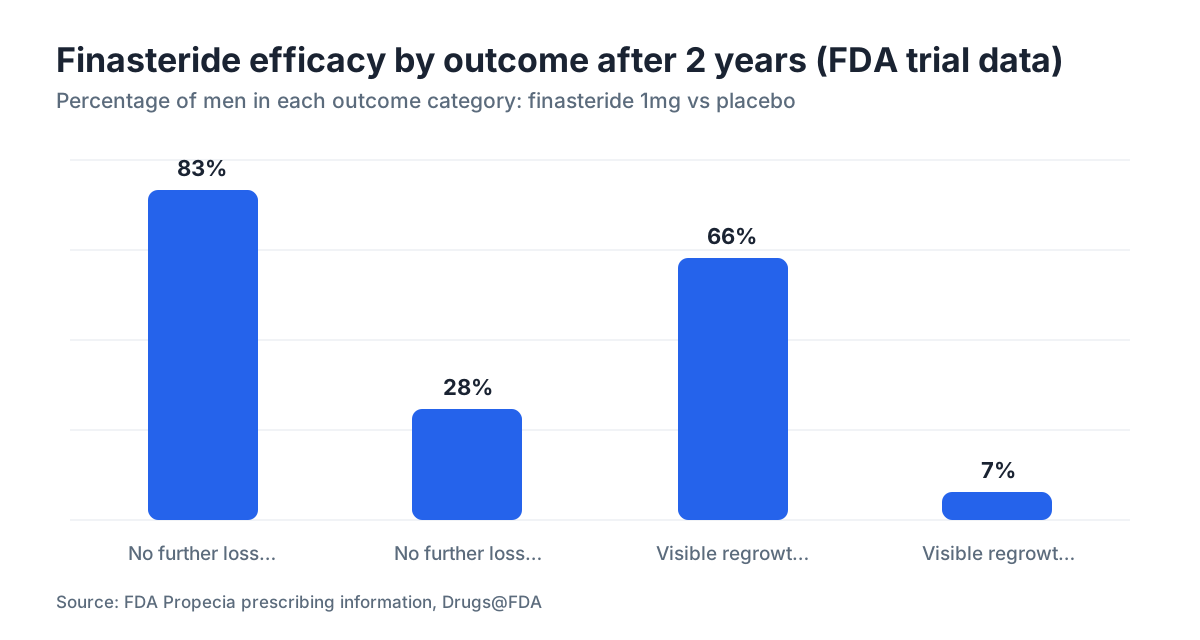
Finasteride 1 mg daily (sold as Propecia and in generics) blocks 5-alpha reductase type II, which cuts scalp DHT by roughly 60 percent [6]. The trials that led to FDA approval enrolled men aged 18 to 41 with mild to moderate hair loss, which lines up with Norwood 2 through 4. After two years, 83 percent of men on finasteride had no further loss versus 28 percent on placebo, and about 66 percent showed visible regrowth [6]. The label is specific about the population studied, and transplant surgeons will tell you stage 6 and 7 patients get very little from it.
Minoxidil (topical 5% or 2%, or oral at 0.25 to 2.5 mg) works differently. It is a vasodilator that extends the anagen (growth) phase of hair follicles and may partly reverse miniaturization. The FDA-approved indication for men is androgenetic alopecia at the vertex (crown), not the temples [7]. That matters for Norwood staging: topical minoxidil has better evidence for crown thinning (stage 3 vertex and 4) than for temple recession. Many dermatologists still use it for both.
Used together, the two drugs hit different parts of the mechanism: finasteride cuts the DHT signal, minoxidil stimulates the follicle directly. The combination has better evidence than either drug alone for stages 2 through 4. You can read more about how finasteride and minoxidil work together, or check the specifics on minoxidil for men and finasteride separately.
For stage 5 and beyond, the math shifts toward whether there is enough donor hair to consider a hair transplant, though medication can run alongside surgery to protect the remaining hair.
| Norwood Stage | Finasteride Evidence | Minoxidil Evidence | Transplant Typically Considered? |
|---|---|---|---|
| 1 | Not indicated | Not indicated | No |
| 2 | Strong | Moderate | Rarely |
| 3 / 3V | Strong | Strong (3V especially) | Sometimes |
| 4 | Strong | Strong | Yes |
| 5 | Moderate | Moderate | Yes |
| 6 | Weak | Weak | Primary option |
| 7 | Minimal | Minimal | Primary option (if donor is adequate) |
Can women use the Norwood scale to assess their hair loss?
No, not meaningfully. The Norwood scale describes male-pattern androgenetic alopecia, which follows the temple-and-crown pattern driven by DHT sensitivity. Female-pattern hair loss almost never looks like this. Women typically lose density across the top of the scalp in a diffuse way while keeping the frontal hairline, a pattern classified by the Ludwig scale (grades 1 through 3) or the Sinclair scale [8].
A woman who sees the Norwood scale and tries to map herself onto it will usually find she does not fit any stage cleanly, because the pattern is different. The exception is women with hyperandrogenism (elevated androgens, as in some cases of polycystic ovary syndrome), who can develop a more male-pattern recession, but that is the minority.
If you are a woman losing hair, the Ludwig or Sinclair scale is the right tool, and the workup is different: hormonal panels, ferritin, thyroid function, and a scalp biopsy if needed. The causes overlap with male hair loss but are not identical.
How accurate is photo-based AI hair loss assessment compared to a dermatologist?
Honest uncertainty is warranted here. In-person dermatologist evaluation is still the gold standard, because it includes physical examination of individual follicles (sometimes with a dermatoscope), a pull test to check the telogen-to-anagen ratio, and judgment built from seeing thousands of cases.
Photo-based assessment, whether done by eye or by AI, has real limits. Lighting, hair length, styling, and camera angle all introduce variation. A 2021 study in the Journal of the American Academy of Dermatology found that even trained physicians showed meaningful interrater variability when staging hair loss from photographs rather than live examination [9]. AI tools trained on photo data run into the same confounders.
That does not make photo assessment useless. For someone trying to decide whether they are stage 2 or stage 3, the answer often does not change the first-line treatment anyway. It matters more at the edges: telling stage 4 from stage 5, or judging whether a donor zone is adequate for transplantation, which really does need an in-person look.
If you want a fast starting point from photos, the free AI scan at MyHairline uses your selfie to estimate your Norwood stage and flag the pattern, which helps you decide whether the next step is watching, starting medication, or booking a dermatologist. It is a triage tool, not a diagnosis.
For anything past initial orientation, especially if you are considering finasteride (which has systemic effects and needs a prescription) or surgery, see a board-certified dermatologist or a hair restoration specialist.
What's the difference between a receding hairline and normal hairline maturation?
This trips up a lot of men in their early twenties. The juvenile hairline, the one you had as a teenager, sits low on the forehead with a fairly straight, soft edge. Most men's hairlines naturally move back a little and turn slightly more angular between ages 17 and 25. This is hairline maturation, and it is not the same thing as androgenetic alopecia.
The key differences:
Pattern of recession. Maturation produces a slight, roughly symmetrical rounding or lifting of the whole frontal hairline. Androgenetic alopecia goes after the temples first, producing the M-shape. If your temples are receding faster than your center, lean toward androgenetic alopecia.
Hair quality at the hairline. In maturation, the hairs at the new edge are full-thickness terminal hairs. In androgenetic alopecia, the hairs at the receding edge are often miniaturizing: thinner, shorter, lighter in color.
Family history. If your father and maternal grandfather both have significant hair loss and you are seeing temple recession, take it more seriously than a man with no family history seeing the same change.
Rate of change. Normal maturation happens and then stops. If your hairline looks visibly different in photos taken six months apart, that is not maturation.
A dermatoscope exam can settle the question by showing miniaturization directly. If you cannot get to one, the receding hairline guide covers the distinguishing features in more detail.
When should you stop watching and start treating?
The honest answer: earlier than most men do. Androgenetic alopecia is a slow ratchet. Follicles miniaturize over years, and once a follicle is permanently scarred (the histology literature calls it fibrous streaming), no medication brings it back. Treatment protects what you have. It does not reliably restore what is gone.
A reasonable threshold for most men: if photos six to twelve months apart confirm your hairline or crown is visibly changing, and the change bothers you, that is when to act. Waiting another two years to be sure costs you two years of follicles you will not get back.
The first step is a dermatologist or a hair-loss telehealth provider who can confirm androgenetic alopecia (rather than another cause), log baseline photos, and talk through finasteride and minoxidil. Both drugs ask for patience: you will not see meaningful results for three to six months, and you have to continue them indefinitely to keep the benefit. Stop either one and you typically lose the gains within six to twelve months.
If you are worried about finasteride's side effects, which are real but statistically uncommon, read the full evidence on finasteride and weigh the risk-benefit with your doctor. Some men do better with DHT blockers that include supplements like saw palmetto, though the evidence for those is far weaker. For concerns about minoxidil specifically, minoxidil side effects breaks down what the data actually shows.
If you are a stage 5, 6, or 7 and thinking about surgery, have the conversation with a transplant surgeon before the donor zone deteriorates further. A good surgeon will also recommend medication to protect the native hair you keep after surgery.
Does the Norwood stage predict future hair loss, or just describe the present?
It describes the present. The scale is not a prediction model. Two men can both be Norwood 3 at 28 and look completely different at 45.
That said, early onset is a meaningful signal. Research has consistently found that men who start losing hair before 30 tend to reach more advanced stages than men who start after 40, even though the rate is highly variable [5]. The earlier the onset, the longer the disease has to run. If you are 22 and clearly a Norwood 2, you probably have more road ahead of you than a man who first noticed recession at 45.
Family history is the most useful predictor available. If your father is a Norwood 6, your odds of progressing significantly are higher than if he is a Norwood 2 at 70. But genetics are not destiny: DHT sensitivity is polygenic, and plenty of men beat or fall short of their family pattern.
Some researchers have tried prediction models built on genetics (the AR gene on the X chromosome plus several autosomal loci), but none is accurate enough at the individual level to be clinically reliable yet [5]. The best current practice is periodic photo monitoring every six to twelve months so you can watch your own trajectory clearly.
Sources
- Norwood OT. Male pattern baldness: classification and incidence. Southern Medical Journal, 1975.
- American Academy of Dermatology – Hair Loss overview
- American Academy of Dermatology – Hair loss types and shedding
- Sinclair R et al. Androgenetic alopecia: new perspectives. Journal of Investigative Dermatology, 2002.
- Ellis JA et al. Androgenetic alopecia: polygenic inheritance and identification of risk genes. Journal of Investigative Dermatology, 2007.
- FDA – Drugs@FDA database, Propecia (finasteride 1 mg) prescribing information
- FDA – Drugs@FDA database, Rogaine (minoxidil 5% topical) OTC label
- Sinclair R. Female pattern hair loss classification. British Journal of Dermatology / Sinclair scale reference.
- Dhurat R et al. Evaluation of interrater reliability in hair loss grading from photographs. Journal of the American Academy of Dermatology, 2021.
- van der Merwe J et al. Three weeks of creatine monohydrate supplementation affects dihydrotestosterone to testosterone ratio in college-aged rugby players. Clinical Journal of Sport Medicine, 2009.