

TL;DR: The Norwood scale runs from Stage 1 (no loss) to Stage 7 (only a horseshoe fringe remains). Doctors use it to classify male pattern baldness, predict progression, and decide whether medication or a transplant makes sense. Most men who notice thinning are at Stage 2 or 3, where finasteride and minoxidil have the strongest evidence.
What is the Norwood scale and why do doctors use it?
The Norwood scale, formally called the Hamilton-Norwood scale, is the standard classification system for male pattern baldness. James Hamilton first published a version in 1951, and O'Tar Norwood revised it in 1975 into the seven-stage system still used today [1]. It gives doctors and researchers a shared language. When a transplant surgeon says "he's a Norwood 4," every other surgeon knows exactly what that hairline looks like without seeing a photo.
The scale matters for practical reasons more than academic ones. Treatment response is tied to stage. Finasteride has strong evidence at early stages but can't regrow hair where follicles have been dead for years. Transplant surgeons use Norwood staging to weigh donor supply against the area that needs covering, which decides whether a procedure is feasible at all.
One thing to know: the scale was built on studies of white men. Some researchers have noted it may not map perfectly onto hair loss patterns in men of other ethnicities, though no universally adopted alternative exists yet [2].
The scale also has a "Type A" variant for men whose hairline recedes straight back without the typical island of hair on top first. About 3 percent of men with male pattern baldness follow the Type A progression, according to Norwood's own data [1].
What does each Norwood stage look like? A stage-by-stage breakdown
Stage 1 is a baseline. There's no meaningful recession. The hairline sits where it did in adolescence. Most men at Stage 1 aren't losing hair. They're just seeing what a mature adult hairline looks like next to a teenage one.
Stage 2 is where most men first get worried. The hairline pulls back slightly at the temples, forming very mild triangular recessions. The overall hairline still looks nearly full. This is the most common stage at which men seek advice, and it's also where treatment is most effective.
Stage 3 is the first stage Norwood classified as "clinically significant" baldness [1]. The temple recessions deepen noticeably. Stage 3 Vertex is a sub-classification where the temples are only mildly affected but there's obvious thinning at the crown. Many men in their late 20s and early 30s land here.
Stage 4 means the temple recessions have grown larger and the crown has a distinct bald patch. A band of hair separates the two areas, but both are clearly visible and both are growing. The hairline has moved well back from where it started.
Stage 5 is when that separating band of hair starts to thin. The temple and crown zones begin to connect. Stage 5 is often described as a tipping point. Donor hair supply for a transplant becomes a real constraint, not a theoretical one.
Stage 6 means the band has broken. The temple and crown bald areas have merged into one large zone. A horseshoe of hair around the sides and back is all that remains on top.
Stage 7 is the most advanced classification. Only a narrow horseshoe fringe survives along the lowest sides and back of the scalp. The hair in that fringe is often finer than in earlier stages.
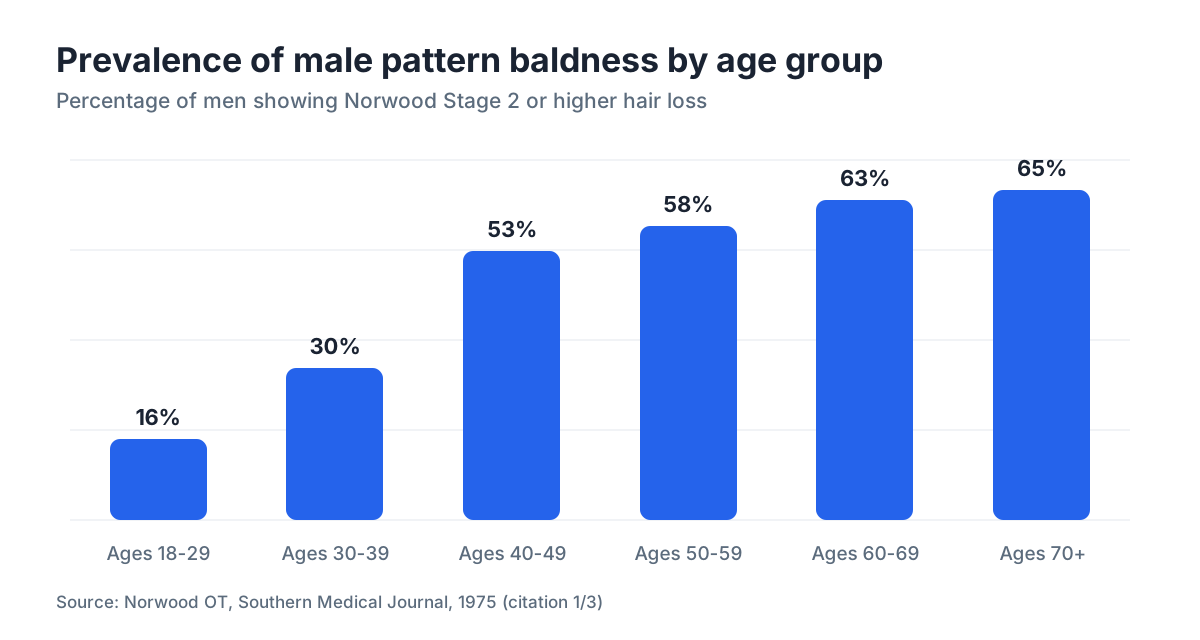
Here's a useful frame. A large epidemiological study published in the Journal of Investigative Dermatology found that roughly 16 percent of men aged 18 to 29 show at least Stage 2 hair loss, rising to about 53 percent of men in their 40s and about 65 percent of men over 70 [3].
| Norwood Stage | Hairline status | Crown status | Typical age range (rough) |
|---|---|---|---|
| 1 | No recession | Full | Any |
| 2 | Slight temple recession | Full | Late teens to 30s |
| 3 | Deeper temple recession | Full or early thinning | 20s to 40s |
| 3 Vertex | Mild recession | Visible bald spot | 20s to 40s |
| 4 | Major temple recession | Distinct bald patch | 30s to 50s |
| 5 | Connecting zones | Thin band separating | 30s to 50s |
| 6 | Merged bald zones | No separation | 40s to 60s |
| 7 | Horseshoe fringe only | Completely bald on top | 50s+ |
How fast does hair loss progress between Norwood stages?
Nobody has perfectly clean data here. Progression speed varies enormously between individuals. Genetics, stress, hormones, and whether someone is on treatment all move the rate.
What research does show: a five-year follow-up of untreated men in the placebo arm of the original finasteride trials found that men with Stage 2 or 3 loss progressed by at least one full Norwood stage over five years without treatment [4]. Men who started finasteride maintained or improved their stage in roughly 83 percent of cases over two years in the same trials.
The fastest progression usually happens in the 20s and early 30s. Men who lose significant ground before age 25 tend to reach higher Norwood stages by middle age than men whose loss started later. Early onset doesn't always mean a worse endpoint, but it's a fair signal to act sooner.
Some men plateau at Stage 3 or 4 for a decade. Others move from Stage 2 to Stage 5 in five years. There's no reliable individual predictor beyond looking at close male relatives on both sides of the family, and even that's imperfect since male pattern baldness is polygenic, meaning dozens of genes contribute [5].
Which treatments work best at each Norwood stage?
Stage matters a lot here. The earlier you are on the scale, the more options you have and the better they work.
Stages 2 and 3 are the sweet spot for medication. Finasteride (1mg daily) has the best evidence base of any oral treatment for male pattern baldness. The original Merck trials showed it stopped progression in about 86 percent of men and produced visible regrowth in 65 percent over two years [4]. The FDA approved it for androgenetic alopecia in men in 1997. Minoxidil for men, applied topically twice daily or taken as oral minoxidil, is often added alongside finasteride at these stages for extra benefit.
Stage 4 still responds to medication, but results are more modest. The area to cover is larger, and some follicles may already be miniaturized past the point of recovery. Finasteride and minoxidil combined is a reasonable standard approach. Some men at Stage 4 start planning a transplant while using medication to slow further loss in the donor area.
Stages 5 and 6 are where transplant conversations get serious. Hair transplants move follicles from the permanent horseshoe zone to bald areas. A Norwood 5 typically needs 2,500 to 3,500 grafts for reasonable coverage. A Norwood 6 may need 4,000 or more, which pushes against what a single session can deliver [6]. Medication is still worth using to protect remaining native hair.
Stage 7 is the hardest to treat surgically. Donor supply is the limiting factor. Some men pursue a transplant for frontal coverage only, accepting the crown will stay bald. Others use DHT blockers to hold on to what little they have. Realistic expectations matter more here than at any other stage.
If you're unsure of your exact stage, a tool like the free AI hair scan at MyHairline can analyze photos and give a Norwood estimate to anchor the conversation with a dermatologist.
One honest caveat: no treatment reverses advanced loss completely. The FDA label for finasteride states it works at "the vertex (top of the head) and anterior mid-scalp area," with efficacy not established at the hairline or temples [4].
Can you use Norwood stage images to self-diagnose at home?
Yes, with some caveats. Comparing your hairline to a Norwood diagram is a reasonable first step and far better than guessing. The main limitation is that the standard diagrams show top-down schematics, not photographs of real hair under real lighting. Schematics compress a lot of variation into one drawing.
Self-assessment tips that actually help:
Take photos from the top down (wet or dry hair, consistent lighting), from the front, and from each side. Compare these to reference images over time rather than just once. A single snapshot tells you your current state. A series taken every three to six months tells you whether you're progressing.
The most common self-assessment mistake is confusing a mature hairline for a Norwood 2. A mature hairline is the slight upward shift that happens between ages 17 and 25 in nearly all men and then stops. It doesn't keep moving. If recession continues past the mid-20s, that's pattern baldness, not maturing.
A board-certified dermatologist can usually classify your stage in one office visit, often with a dermatoscope that shows miniaturization of follicles before thinning is visible to the naked eye. If you're under 25 and worried, that visit is genuinely worth the cost.
What's the difference between Norwood stages and Ludwig stages?
The Norwood scale is for men. The Ludwig scale is the standard classification for female pattern hair loss, published by Erich Ludwig in 1977 [7].
Female pattern hair loss looks different. Rather than a receding hairline, women usually lose density across the top and crown while the frontal hairline stays mostly preserved. The Ludwig scale has three stages: Grade I (widening part, mild thinning at the crown), Grade II (more pronounced diffuse thinning), and Grade III (near-total loss at the crown with a retained frontal hairline).
Women whose hair loss looks like a Norwood pattern (significant hairline recession) should see a dermatologist sooner rather than later, since that presentation in women sometimes signals an underlying hormonal or medical cause beyond simple pattern baldness. What causes hair loss covers this in more detail, including the role of telogen effluvium, which can mimic or speed up pattern loss in both sexes.
Does a receding hairline always mean you'll reach a high Norwood stage?
No. A receding hairline at Stage 2 or 3 doesn't guarantee you'll reach Stage 6 or 7. Some men stabilize. The problem is there's no reliable test to tell you where you'll end up.
The strongest predictive factor is family history, particularly your paternal grandfather and maternal grandfather, since male pattern baldness is inherited through multiple pathways. If both grandfathers were Norwood 6 or 7 by their 50s, your odds of getting there are meaningfully higher than average.
Starting treatment early, at Stage 2 or 3, gives you the best chance of slowing or stalling progression. This isn't a cure claim. It's what the clinical data consistently shows. Finasteride reduces serum DHT by roughly 70 percent and scalp DHT by about 65 percent [4], which slows the miniaturization process that drives pattern baldness. Slowing that process early protects more follicles than starting late.
A receding hairline at 22 is not the same as a Norwood 7 at 22. One is a starting point. The other is an endpoint. The distance between them depends partly on genetics and partly on what you do.
How do hair transplant surgeons use Norwood staging?
Surgeons use Norwood staging as a planning tool for two things: estimating how many grafts a patient needs now, and predicting how many they'll need later as loss continues.
A Norwood 3 patient asking for a transplant presents a problem that his own donor supply can handle. A Norwood 3 patient who will likely progress to Norwood 6 in ten years is a different conversation, because placing grafts in the frontal area now may leave the crown bald later and create an unnatural result.
A good surgeon factors in the patient's age, family history, and current medication before operating. The International Society of Hair Restoration Surgery (ISHRS) advises caution with transplants in patients under 25 for exactly this reason: the final Norwood stage is unknown [6].
Graft estimates by stage (approximate, single session):
| Norwood Stage | Approximate grafts needed |
|---|---|
| 2 to 3 | 800 to 1,500 |
| 4 | 1,500 to 2,500 |
| 5 | 2,500 to 3,500 |
| 6 | 3,500 to 5,000+ |
| 7 | Often requires multiple sessions |
The average donor zone in a typical male scalp holds roughly 6,000 to 8,000 grafts total, though this varies with hair density and texture [6]. A Norwood 7 patient trying to cover the entire top of the head can burn through available supply fast. That's why managing expectations honestly matters more in advanced stages.
For more on what the procedure involves, hair transplant covers technique, cost, and realistic outcomes.
Are Norwood scale images the same for different hair types and ethnicities?
The original Hamilton-Norwood diagrams were developed on predominantly white male populations. The pattern of loss (temples first, then crown, then connecting) is broadly similar across ethnicities, but the visual appearance in reference images may not match men with tightly coiled hair, very fine hair, or dark skin.
For men with afro-textured hair, a few practical differences matter. Thinning can be harder to see in photos when hair is in its natural coiled state. Wet or stretched photos give a cleaner picture. The Norwood stages still apply as a classification framework, but dermatologists who work often with Black patients lean more heavily on dermatoscopy to catch early miniaturization.
For men with very fine, light-colored hair, the contrast between scalp and hair makes thinning visible earlier than it appears in dark-haired men at the same stage. That can lead to overestimating your stage from photos alone.
The core point: Norwood staging describes the spatial pattern of loss, not the density. Two men who are both Norwood 4 can look dramatically different depending on hair caliber, color, and texture. That's one reason a dermatologist's in-person assessment (or a calibrated photo-based tool) beats a quick comparison to a schematic.
What's the Norwood Type A variant and how is it different?
The Type A variant was added by Norwood to capture a minority of men whose hair loss doesn't follow the typical front-to-back progression.
In the standard pattern, the hairline recedes at the temples first, leaving a forelock or island of hair at the front-center. That island eventually retreats too. In Type A, there's no forelock. The entire frontal hairline recedes straight back, uniformly, without the island. Crown thinning tends to come later in Type A and is often less severe.
Norwood estimated Type A occurs in about 3 percent of men with androgenetic alopecia [1]. It matters because Type A patients can look more dramatically bald at earlier stages (the missing forelock makes the recession more obvious from the front) but may not progress to Stage 7 as often.
Type A stages run parallel to the standard stages: Type A 2, 3, 4, 5. The classification logic is the same. The geometry is different.
How does MyHairline's AI scan fit into Norwood staging?
If you're trying to stage yourself at home, the hard part is getting consistent, well-lit, top-down photos and comparing them accurately to reference images. Small differences in lighting or camera angle can make a Stage 3 look like a Stage 4 or the reverse.
MyHairline's free AI scan is built to take the guesswork out of that comparison. You upload a photo, and the model analyzes hairline recession, crown thinning, and overall pattern against a trained reference set, then returns a Norwood stage estimate along with what that stage typically means for treatment.
It's not a replacement for a dermatologist's exam. But if you want to know whether you sit at Stage 2 or 3 before booking an appointment or deciding to start medication, it gives you a calibrated starting point.
Sources
- Norwood OT, 'Male pattern baldness: classification and incidence,' Southern Medical Journal, 1975
- Norwood OT, Journal of Investigative Dermatology: prevalence of male pattern baldness by age group
- Hagenaars SP et al., PLOS Genetics, 'Genetic prediction of male pattern baldness,' 2017
- International Society of Hair Restoration Surgery (ISHRS), Practice Standards and Patient Guidance
- Ludwig E, 'Classification of the types of androgenetic alopecia (common baldness) occurring in the female sex,' British Journal of Dermatology, 1977
- Hamilton JB, 'Patterned loss of hair in man: types and incidence,' Annals of the New York Academy of Sciences, 1951
- Kaufman KD et al., Journal of the American Academy of Dermatology, 'Finasteride in the treatment of men with androgenetic alopecia,' 1998
- American Academy of Dermatology, Hair loss: tips for managing