

TL;DR: The Norwood scale (officially the Hamilton-Norwood scale) classifies male pattern baldness into 7 stages, from a full hairline at Stage 1 to near-complete hair loss at Stage 7. Roughly 50% of men show significant loss by age 50. Knowing your stage helps you pick treatments that actually have evidence behind them, because Stage 2 and Stage 7 are very different problems.
What is the Norwood scale and why does it matter?
The Norwood scale is the most widely used classification system for male pattern baldness (androgenetic alopecia). It was first described by James Hamilton in 1951 and revised by O'Tar Norwood in 1975, which is why you'll see it called the Hamilton-Norwood scale in most clinical literature [1]. The system maps hair loss into seven main stages, with a couple of variant patterns (the "A" variants) that track hairlines which recede straight back rather than at the temples first.
Why does it matter? Because not all hair loss is the same problem. A man at Stage 2 has a mildly receding hairline and good donor density. A man at Stage 6 has lost most of the top of his scalp. The treatments that make sense, the urgency to start, and what a surgeon can realistically do with a hair transplant all depend heavily on where you fall on this scale. Doctors, researchers, and surgeons all use the Norwood stages as a shared language when they report outcomes in clinical trials, so if you want to read the evidence on finasteride or minoxidil for yourself, you need to know what the stages mean [2].
One honest caveat: the scale was designed for men. Women's hair loss usually follows a different pattern (diffuse thinning across the crown) and is better described by the Ludwig or Sinclair scale. The Norwood scale can still give you rough orientation if you're a woman with pattern loss that starts at the hairline, but it was never validated in that population.
What does each Norwood stage look like?
Here is a plain-language description of each stage. If you're trying to figure out your own stage, look at the hairline at the temples, the crown, and the bridge of scalp between them.
Stage 1 No recession. The hairline is the same as it was in adolescence. Most dermatologists treat this as the baseline, not a diagnosis.
Stage 2 Slight recession at the temples. The hairline takes on a very mild M-shape. Most people outside your family won't notice. Hair density on the crown is still normal.
Stage 2A (variant) The hairline recedes evenly across the front rather than pulling back at the temples first. Same amount of loss as Stage 2, different geometry.
Stage 3 The temple recession is now obvious and the hairline M is deep. The areas at the temples are either bare or have only sparse, miniaturized hairs. This is typically the first stage that brings men into a dermatologist's office [1].
Stage 3 Vertex Recession at the temples is mild (similar to Stage 2-3) but a distinct bald spot is opening at the crown (vertex). The temple and crown areas are still separated by a bridge of hair.
Stage 4 Heavy recession at the front and a large bald patch at the crown. A band of hair still runs across the top of the head connecting the sides, but it's thinning. The two bald zones (front and crown) are still separate.
Stage 5 The band of hair separating the front and crown zones has narrowed significantly. Both bald areas are large. From above, the hair looks like a horseshoe that's starting to close.
Stage 6 The bridge of hair between the front and crown is gone. The two zones have merged into one continuous area of loss. The remaining hair is the classic horseshoe fringe around the sides and back.
Stage 7 The most advanced stage. The horseshoe fringe is the only hair left, and even that has thinned and sits lower on the head. This is the end state of androgenetic alopecia for most men with a genetic predisposition to it [1].
About 96% of cases fit one of the main seven stages or the A variants. The other roughly 4% show unusual patterns that the scale doesn't map cleanly, which is one of its known limitations [3].
How common is each Norwood stage? The prevalence data
Androgenetic alopecia is the most common cause of hair loss in men worldwide [2]. The numbers get large quickly with age. A frequently cited study in the Journal of Investigative Dermatology Symposium Proceedings put the overall prevalence at roughly 50% of men by age 50, rising to about 80% by age 70 [4].
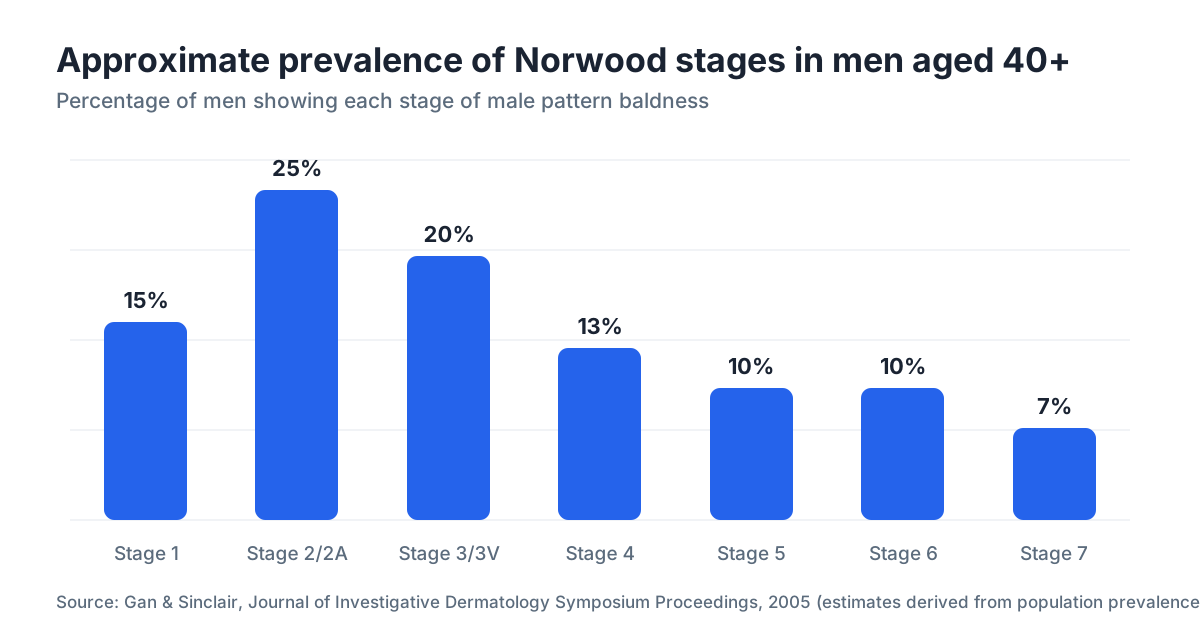
Breaking it down by stage is harder because most population studies report broad categories rather than individual stages. The best available data from the Norwood and Hamilton papers, combined with more recent population surveys, suggests the following distribution among men over 40:
| Norwood Stage | Approximate prevalence in men 40+ |
|---|---|
| Stage 1 | ~15% |
| Stage 2 / 2A | ~25% |
| Stage 3 / 3 Vertex | ~20% |
| Stage 4 | ~13% |
| Stage 5 | ~10% |
| Stage 6 | ~10% |
| Stage 7 | ~7% |
These figures are rough estimates. Different ethnic populations have meaningfully different prevalence rates. Studies from East Asia consistently show lower rates of advanced Norwood stages compared to studies from Northern European populations [4]. Nobody has done a single global head-to-head study that controls for ethnicity, age, and geography simultaneously, so treat these percentages as orientation rather than hard fact.
Age of onset matters too. Men who start losing hair before age 20 are more likely to reach Stage 6 or 7 by their 50s. Men who don't notice recession until their 40s often plateau at Stage 3 or 4. This isn't a rule, but the earlier the loss starts, the more aggressive the eventual pattern tends to be [3].
How fast does hair loss progress through the Norwood stages?
This is the question everyone asks and nobody has a clean answer to. The honest version is: it varies enormously and the research on progression rates is thin.
What the data does suggest is that androgenetic alopecia is not a steady linear decline. Many men experience periods of faster loss followed by years of relative stability. A study tracking untreated men found median progression of roughly one Norwood stage per decade, but the variance was huge. Some men moved two stages in five years; others stayed at Stage 3 for twenty years [3].
The factors most strongly associated with faster progression are early onset (before age 25), a strong family history on either side (more than the maternal grandfather, the old wives' tale about maternal inheritance is wrong), and high circulating dihydrotestosterone (DHT) sensitivity in the follicles [2]. None of those factors are reliably testable in a routine clinical visit. DHT blood levels don't predict progression well because it's follicular sensitivity that matters, not serum DHT concentration.
If you're at Stage 2 or 3 and trying to decide whether to start treatment, the practical answer is this: waiting six to twelve months to "see what happens" usually costs you real hair you won't get back without a transplant. The treatments that work best, particularly finasteride and minoxidil for men, are far more effective at preserving existing hair than at regrowing lost ground.
What causes the Norwood stages to progress?
Androgenetic alopecia is driven by DHT, a hormone derived from testosterone by the enzyme 5-alpha reductase [5]. DHT binds to receptors in genetically susceptible hair follicles and causes them to miniaturize over repeated hair cycles. Thick terminal hairs gradually become thin, unpigmented vellus hairs, and eventually the follicle stops producing visible hair entirely.
The pattern on the Norwood scale reflects where on the scalp follicles are most sensitive to DHT. The frontal hairline and crown are the most vulnerable zones. The sides and back of the scalp (the "safe zone" surgeons use for transplant donor hair) have follicles that are largely DHT-resistant, which is why the horseshoe fringe survives even at Stage 7 [6].
Genetics determine your sensitivity level, but the specific mechanism is polygenic, meaning dozens of genes contribute, not one. This is also why the condition doesn't follow simple Mendelian inheritance. A man with a bald father and bald maternal grandfather is at high risk, but men with no family history still develop pattern loss, and men with universally bald relatives sometimes keep their hair.
Understanding this mechanism is why DHT blockers are the most logically sound pharmacological approach to slowing progression. You can also read more about what causes hair loss beyond DHT, including conditions like telogen effluvium that can accelerate apparent Norwood progression temporarily.
Which treatments work at each Norwood stage?
Treatment effectiveness is genuinely stage-dependent. Here's the honest breakdown based on published trial data.
Stages 1-2: You have a lot of hair to protect and limited loss to treat. This is where medical therapy earns its keep. Finasteride 1mg daily has the most evidence: a randomized controlled trial published in the Journal of the American Academy of Dermatology showed 83% of men on finasteride maintained or increased their hair count at the vertex over 2 years versus 28% on placebo [7]. Topical minoxidil is commonly combined with it. Starting early at Stage 2 gives you the best shot at a stable hairline for decades. The downside risk of finasteride's sexual side effects is real but occurs in roughly 3.8% of users in controlled trials [7]. Read the full breakdown in our article on finasteride and minoxidil together.
Stages 3-4: Medical therapy is still the first line, but if you've already lost ground at the temples or vertex, you may be considering a transplant eventually. Surgeons generally recommend stabilizing with medication for at least a year before transplanting, because planting grafts into an unstable loss pattern wastes donor hair. Oral minoxidil is increasingly used at this stage for patients who don't respond adequately to topical; see the evidence at oral minoxidil.
Stages 5-6: Medical therapy can slow further loss but is unlikely to restore what's gone. Hair transplant becomes the primary conversation. A surgeon will assess your donor density (the hair in that DHT-resistant back and sides zone) against the area needing coverage. At Stage 5, most patients have enough donor hair for meaningful restoration. At Stage 6, the math gets tighter. Realistic expectations matter here: you can get a defined hairline and crown coverage, but full density is usually not achievable [6].
Stage 7: Donor hair is limited. A skilled surgeon can create a natural-looking result on the frontal zone, but full scalp coverage isn't realistic for most patients. Some Stage 7 men choose the shaved-head look rather than transplantation, which is a completely valid decision. If you're exploring transplant options, our full guide to the hair transplant procedure covers what's actually achievable.
A note on supplements: the evidence for things like saw palmetto, biotin, and other marketed products is weak at every Norwood stage. The hair loss supplements article covers what the trials actually found.
Can you accurately self-diagnose your Norwood stage?
Roughly, yes. Precisely, probably not. The eight categories aren't difficult to understand, but applying them to your own scalp has real limitations.
The main problem is that early miniaturization is invisible to the naked eye. A follicle can be 50% miniaturized before you notice thinning. This means a man who looks like Stage 2 by hairline shape may have the follicular damage of Stage 3 or even 4 across the crown, which only shows up under dermoscopy or trichoscopy in a clinical setting [3].
The second problem is bias. Most people looking at their own hair underestimate their stage in their 20s (denial) and overestimate it in their 30s (panic). Taking photos under consistent lighting from directly above, the front, and each side gives you better information than a mirror glance.
If you want a quick starting point, MyHairline's free AI scan at /scan uses photo analysis to estimate your Norwood stage and flag whether your pattern is consistent with androgenetic alopecia or something else worth investigating. That's not a diagnosis. It's a way to get oriented before a dermatology appointment.
For a definitive staging, a board-certified dermatologist with a trichoscope is what you want. The American Academy of Dermatology has a find-a-dermatologist tool and guidance on what to expect from a hair loss evaluation [2].
What are the limitations and criticisms of the Norwood scale?
The scale is useful, but it was built in 1951 and revised in 1975. It has real gaps.
First, it only covers men. Women's pattern hair loss typically presents as diffuse thinning that keeps the frontal hairline intact, which the Norwood stages simply don't capture [2].
Second, it wasn't validated in diverse populations. Most of the original work was done in white American and European patients. East Asian and African-descent populations have different rates of follicular sensitivity and different patterns of progression that the scale can blur together [4].
Third, it's categorical where nature is continuous. Hair loss is a gradual biological process. Forcing it into seven buckets loses information. Two men can both be Stage 4 with very different amounts of remaining donor hair, different degrees of miniaturization, and very different surgical candidacy.
Fourth, the scale says nothing about rate of loss. A slow-progressing Stage 4 at age 60 and a fast-progressing Stage 4 at age 28 are clinically different situations, but the scale treats them identically.
Researchers have proposed refinements. The BASP (Basic and Specific classification) system, developed in 2007, tries to add front hairline type and specific density information. It's used in some Asian dermatology literature but hasn't displaced Norwood in Western clinical practice or research [3]. For now, Norwood is the lingua franca because decades of trial data are built on it.
One thing the scale does not do: it doesn't predict your final stage. Knowing you're at Stage 3 tells you where you are today. It tells you very little about whether you'll stay there or reach Stage 6. That uncertainty is genuinely uncomfortable, and the honest answer is that predicting individual trajectories remains beyond current clinical tools.
How does the Norwood scale relate to hair transplant planning?
Hair transplant surgeons use Norwood staging as the starting point for almost every consultation, but they never stop there.
The surgeon's core question is: how much area needs to be covered (the recipient zone) versus how many viable grafts can be taken from the donor zone? At Stage 3 or 4, the math usually works well. At Stage 6 or 7, available donor supply often falls short of total bald area, which forces surgeons to prioritize the frontal zone and create the illusion of density rather than literal full coverage [6].
There's also the future-proofing problem. If a 25-year-old at Stage 3 gets a transplant today, those grafts are permanent. But if his underlying loss continues to Stage 6 over the next twenty years, the transplanted hairline will eventually look like an island of hair floating above a bald scalp. Surgeons call this an "unnatural" result. Good surgeons design hairlines conservatively for this reason and insist on concurrent medical therapy to slow the progression [6].
Average graft counts by Norwood stage (these are approximate; individual anatomy varies significantly):
| Norwood Stage | Typical grafts needed for coverage |
|---|---|
| Stage 2-3 | 1,000 to 2,000 |
| Stage 4 | 2,000 to 3,000 |
| Stage 5 | 3,000 to 4,500 |
| Stage 6 | 4,500 to 6,000 |
| Stage 7 | 5,000 to 8,000+ (often limited by donor supply) |
The hair transplant article goes into graft counts, FUT vs FUE, and realistic cost ranges in more detail.
Does the Norwood scale apply to women?
No, not reliably. The Norwood scale was built on male pattern baldness, which follows a predictable hairline-and-crown progression driven by DHT-sensitive follicles in specific zones. Women with androgenetic alopecia typically lose hair differently: diffuse thinning across the top of the scalp while the frontal hairline remains largely intact [2].
The standard classification for women is the Ludwig scale (three grades) or the more detailed Sinclair scale (five grades). Both capture the diffuse pattern better than Norwood does.
Some women do present with hairline recession that looks Norwood-like, particularly post-menopause when estrogen levels drop and the androgenic effect is less opposed. In those cases, clinicians sometimes use Norwood as a rough reference. But using it as the primary staging tool in women is not supported by the literature.
If you're a woman dealing with hair thinning, the more useful question isn't "what's my Norwood stage" but rather "is this androgenetic alopecia, telogen effluvium, or something else?" Those are different conditions with different treatments. Telogen effluvium is a common cause of sudden diffuse shedding that gets mistaken for pattern loss.
For women researching the cause of their hair loss, what causes hair loss is a better starting point than the Norwood scale.
What's the latest research on the Norwood scale and male pattern baldness?
The Norwood scale itself hasn't been substantially updated since 1975. The research focus has shifted from classification toward genetics, treatment, and cellular mechanisms.
On the genetics side, large genome-wide association studies (GWAS) have identified over 200 genetic loci associated with androgenetic alopecia. A 2017 study in PLOS Genetics analyzed data from roughly 53,000 men and identified 63 new loci [8]. Despite this, no commercially available genetic test reliably predicts your final Norwood stage or rate of progression. The polygenic complexity makes accurate individual prediction difficult.
On treatment, the biggest development of the last decade is the growing use of oral minoxidil at low doses (0.625mg to 5mg daily) as an alternative to topical. Studies out of Australia and Spain showed meaningful hair regrowth with a side-effect profile many patients find more manageable than topical [9]. This doesn't change Norwood staging but it expands the treatment menu at every stage.
Platelet-rich plasma (PRP) therapy has attracted serious trial activity. The evidence is still mixed. Some trials show modest hair count improvements; others don't clear placebo. A 2019 systematic review in Aesthetic Plastic Surgery found PRP statistically outperformed control conditions in most included studies but noted high heterogeneity across trials [10]. It's not yet a standard recommendation from the AAD.
JAK inhibitors (originally developed for autoimmune conditions) have shown dramatic results in alopecia areata but have not replicated that success in androgenetic alopecia. That distinction matters: alopecia areata and Norwood-pattern loss are different diseases with different mechanisms.
The free AI scan at myhairline.ai uses photo analysis to estimate Norwood stage and flag whether your pattern warrants a dermatology referral, which can save you time before your first clinical appointment.
If you're wondering about lifestyle factors that might be accelerating your progression, the question of does creatine cause hair loss gets asked a lot and the evidence is more nuanced than most gym forums suggest.
Sources
- Norwood OT. Male pattern baldness: classification and incidence. Southern Medical Journal, 1975
- American Academy of Dermatology, Hair Loss resource page
- Lee WS et al. 'Classifications of patterned hair loss: a review.' Journal of the American Academy of Dermatology, 2007
- Gan DC, Sinclair RD. 'Prevalence of male and female pattern hair loss in Maryborough.' Journal of Investigative Dermatology Symposium Proceedings, 2005
- MedlinePlus (US National Library of Medicine), Androgenetic alopecia
- International Society of Hair Restoration Surgery, ISHRS Practice Guidelines
- Kaufman KD et al. 'Finasteride in the treatment of men with androgenetic alopecia.' Journal of the American Academy of Dermatology, 1998
- Hagenaars SP et al. 'Genetic prediction of male pattern baldness.' PLOS Genetics, 2017
- Sinclair RD. 'Oral minoxidil for the treatment of hair loss.' Australasian Journal of Dermatology, 2022
- Gupta AK et al. 'Platelet-rich plasma as a treatment for androgenetic alopecia.' Aesthetic Plastic Surgery, 2019