

TL;DR: The Norwood scale (officially the Hamilton-Norwood scale) classifies male pattern baldness into 7 stages, from a full hairline at Stage 1 to near-total baldness at Stage 7. Doctors use it to pick treatments, set transplant expectations, and track progression. Stages 1-3 respond best to medication; Stages 5-7 usually require surgery or acceptance.
What is the Norwood scale and where did it come from?
The Norwood scale is the standard classification system for male pattern baldness (androgenetic alopecia). It maps hair loss into seven stages based on two things: how far the hairline has receded and how much crown coverage has been lost. Clinicians, hair transplant surgeons, and researchers all use it to talk quickly about where a patient is in their hair loss journey.
The original framework came from Dr. James Hamilton, a physician who studied androgen-related hair loss in the 1950s. Dr. O'Tar Norwood revised and expanded it in 1975, splitting some categories into subtypes and refining the visual criteria [1]. The result is the Hamilton-Norwood scale, though most people just call it the Norwood scale.
It's not perfect. The scale was built on observations of predominantly white men, and there is evidence that progression patterns differ across ethnicities. It also doesn't cover female pattern hair loss well at all, which is why women get a separate tool: the Ludwig scale. But for men dealing with a receding hairline or thinning crown, the Norwood scale remains the most widely used and recognized framework in clinical dermatology [2].
What does each Norwood stage actually look like?
Here's a straight description of each stage. The boundaries between stages are not sharp lines. A lot of men sit between two stages, and that's normal.
Stage 1 is a full hairline with no visible recession. It's the starting point, not a sign of loss. Most teenage boys start here.
Stage 2 shows slight recession at the temples. The hairline takes on a more mature shape, moving back slightly on each side. This is sometimes called a mature hairline rather than true baldness, and many men stay here permanently [3].
Stage 3 is where most doctors consider actual hair loss to have begun. The temples are clearly receded, leaving a deep M or U shape. Stage 3 Vertex is a subtype where recession starts at the crown instead of (or in addition to) the front.
Stage 4 combines significant frontal recession with a bald spot or heavy thinning at the crown. The two areas of loss are still separated by a band of hair.
Stage 5 is a real jump in severity. The band of hair between the front and crown gets thinner and narrower. Seen from above, the head has a horseshoe pattern starting to form.
Stage 6 means the frontal and crown areas have merged into one large zone of loss. The horseshoe pattern is well established, with hair remaining only on the sides and back.
Stage 7 is the most advanced stage. Only a thin band of hair remains on the sides and back of the head, and even that hair is often finer and sparser than it was. This is the endpoint of androgenetic alopecia.
| Stage | Hairline | Crown | What it looks like from above |
|---|---|---|---|
| 1 | Intact | Full | Full coverage |
| 2 | Slight temple recession | Full | Mild M-shape |
| 3 | Clear recession | Minimal or none | Defined M or U |
| 3V | Variable | Thinning spot | Crown spot visible |
| 4 | Significant recession | Thinning | Two separate zones of loss |
| 5 | Severe recession | Large bald spot | Thin bridge connecting front and crown |
| 6 | Front and crown merged | Merged | Horseshoe clearly formed |
| 7 | Horseshoe only | Gone | Thin rim of hair on sides and back |
How fast does hair loss progress through the Norwood stages?
This is where most men get anxious. The honest answer: it varies enormously, and nobody has great data to predict any one person's path.
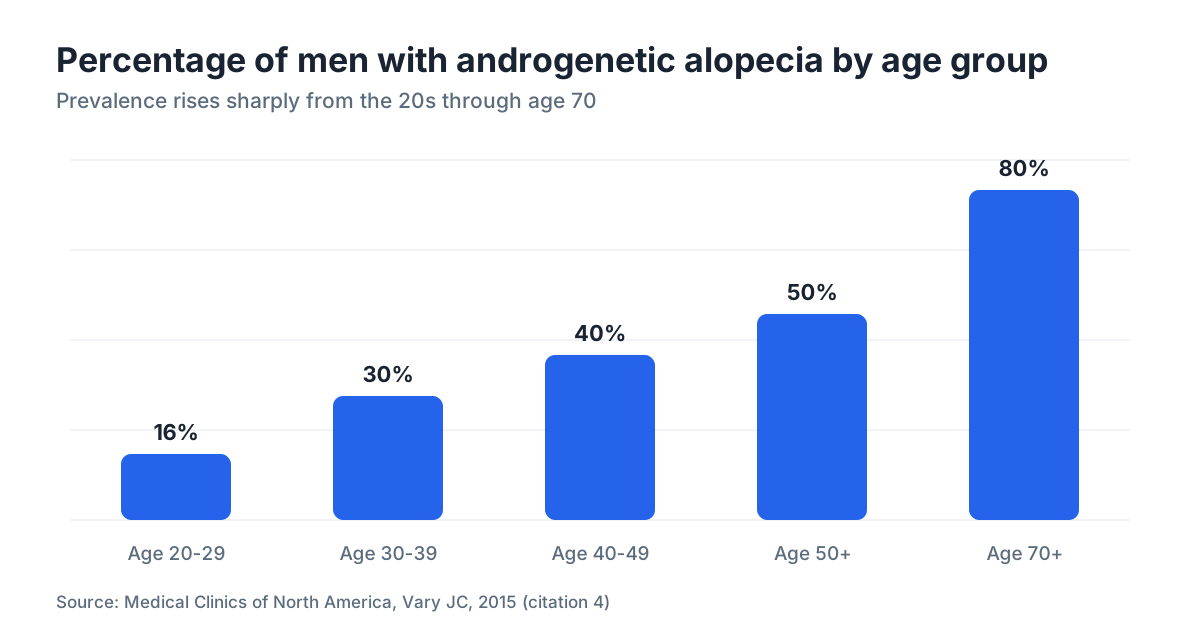
What we do know from population studies is that by age 50, roughly 50% of men have noticeable androgenetic alopecia, and by age 70, that number climbs to about 80% [4]. But the rate at which any individual moves from Stage 2 to Stage 5 can range from a few years to a couple of decades. Some men hit Stage 3 in their early 20s and stay there for years. Others progress steadily through every stage.
Family history is the strongest predictor available. The genetics of male pattern baldness are polygenic, meaning dozens of genes contribute, and it's inherited from both sides of the family, more than just the maternal grandfather as the old myth claims [5]. Men whose fathers and maternal grandfathers both had significant loss tend to progress further and faster.
Age of onset matters too. Earlier onset, especially before 25, generally predicts more aggressive progression over a lifetime. That's not guaranteed. It's the pattern clinicians see most often.
DHT (dihydrotestosterone) is the androgen driving follicle miniaturization. If you want to understand why progression happens at all, the what causes hair loss breakdown covers the DHT pathway in detail.
Which treatments work at which Norwood stage?
Stage matters a lot for treatment decisions. Here's the honest breakdown.
Stages 1-2: No medical treatment is needed or indicated. You might be noticing early recession and feeling anxious, but treating Stage 1-2 with medications that carry side effect risks is hard to justify. Monitoring makes sense here.
Stage 3: This is where most dermatologists start recommending intervention if a man wants to preserve what he has. Minoxidil (topical or oral) and finasteride are both FDA-approved for androgenetic alopecia and work best when started early, before follicles miniaturize completely [6]. The FDA approved topical minoxidil for men in 1988, and finasteride (1mg, branded as Propecia) for male pattern hair loss in 1997 [7].
If you're at Stage 3 and considering medication, finasteride and minoxidil for men are the two most studied options. Using them together tends to produce better results than either alone, which is covered in detail at finasteride and minoxidil.
Stage 4-5: Medication can still slow progression and sometimes produce some regrowth, but the realistic expectation shifts from regrowth to holding the line. Hair transplants become a conversation worth having here. A transplant at Stage 4 or 5 requires careful planning around donor supply and future loss, because you may keep losing native hair after surgery.
Stage 6-7: Medications have limited impact on extensive loss. Transplants are possible but technically demanding, and donor hair from the back and sides of the head is finite. A surgeon's honest read on your donor density matters enormously at this stage. The hair transplant article walks through what surgery at advanced stages actually involves.
One thing worth knowing: minoxidil doesn't work equally across stages, and the evidence for regrowth is strongest for men who still have plenty of miniaturized (thin, wispy) hair rather than completely bare scalp. Completely bald areas almost never regrow with topical minoxidil alone. Minoxidil side effects are worth reviewing before starting, especially if you have cardiovascular concerns.
The American Academy of Dermatology recommends minoxidil and finasteride as first-line treatments for androgenetic alopecia in men [2].
Can you predict what Norwood stage you'll reach?
You can't predict your endpoint with any real precision. No genetic test currently on the market gives you a reliable, validated prediction of final Norwood stage. Some direct-to-consumer genetics companies offer this, but the science is not there yet.
What does give useful (if imperfect) signal: your father's and both grandfathers' hair at age 60-65, your own rate of change over the past 2-3 years, and your age of onset. If you started receding at 19 and you're at Stage 3 by 23, the trajectory is more aggressive than someone who first noticed recession at 40.
DHT sensitivity varies person to person, and blockers like finasteride work by reducing DHT levels roughly 70% in the scalp [7]. Whether that's enough to stop progression depends on how sensitive your follicles are, which varies genetically. You can read more about how these medications work at dht blocker.
If you want a current baseline to track against, MyHairline's free AI scan (/scan) maps your hairline and crown against the Norwood stages using photos from your phone. It won't predict your future. Knowing exactly where you are now is the first step in any useful plan.
Is the Norwood scale used for women?
No, not meaningfully. Women experience androgenetic alopecia differently. Instead of a receding frontal hairline, women typically lose density across the top of the scalp in a diffuse pattern while keeping the frontal hairline relatively intact.
The Ludwig scale (published in 1977) is the standard tool for female pattern hair loss, with three grades describing that diffuse thinning pattern [8]. Some women do experience some frontal recession, and a modified Norwood-Ludwig classification exists for those cases, but it's not widely used clinically.
If you're a woman researching hair loss and stumbled onto Norwood information, the telogen effluvium article is also worth your time, since diffuse shedding in women is often telogen effluvium rather than androgenetic alopecia, and the treatments differ.
How do dermatologists use the Norwood scale in clinical practice?
In a real clinical setting, the Norwood scale does a few specific jobs.
First, it gives doctors a shorthand for a patient's status without describing it from scratch every visit. "He's a Norwood 4, stable for two years" tells a covering physician everything they need to know in seconds.
Second, it helps set realistic expectations. A dermatologist telling a Stage 6 patient that minoxidil will restore a full hairline would be misleading. The scale makes those expectation conversations easier and more honest.
Third, transplant surgeons lean on it hard in surgical planning. Donor hair on the back and sides of the head is finite, typically around 6,000-8,000 grafts available lifetime for the average man (though this varies with density and scalp laxity) [9]. A Stage 3 patient who might progress to Stage 6 needs a conservative, future-proof plan. A Stage 7 patient needs to understand that the goal is improvement, not full restoration.
Fourth, it's used in clinical trials as an enrollment criterion and an outcome measure. When a study says finasteride produced "significant improvement" versus placebo, what they're measuring is change in hair count and Norwood stage over time [7].
The scale has real limits here too. It wasn't designed as a precise measurement instrument, so classifying someone between Stage 4 and 5 involves judgment calls. Some researchers prefer the more granular BASP (Basic and Specific) classification, but Norwood remains dominant in published literature.
What's the difference between a mature hairline and a receding hairline?
This distinction causes more confusion and anxiety than almost anything else in hair loss.
A mature hairline is a normal adult hairline. Teenage boys typically have a hairline that sits very low and flat across the forehead. Between the late teens and mid-20s, almost every man's hairline moves back slightly, particularly at the temples, settling into an adult position roughly 1-1.5 cm higher than the juvenile hairline. This is Norwood Stage 2, and it's not a sign of impending baldness.
A receding hairline (Norwood Stage 3 and beyond) involves deeper, ongoing recession, usually progressing over months to years. The key question is whether the recession is active and continuing or whether it's stable [3].
The receding hairline article goes through how to tell the difference in detail, including what to look for in photos over time. Short version: if your hairline changed noticeably in the last 12 months, that's more concerning than a temple recession that's been the same for three years.
Does the Norwood scale apply to hair loss from other causes?
No. The Norwood scale is specific to androgenetic alopecia, the pattern driven by genetics and DHT. It doesn't apply to other forms of hair loss.
Telogen effluvium causes diffuse shedding across the whole scalp, not a patterned recession. Alopecia areata causes patchy loss in unpredictable spots. Traction alopecia follows the direction of tension on the hair. None of these look like a Norwood pattern.
If your hair loss doesn't follow the classic frontal and crown recession pattern, a dermatologist visit matters more than reading a Norwood chart. Misidentifying the type of hair loss leads to the wrong treatment. Some causes of hair loss are reversible (nutritional deficiencies, hormonal shifts, stress) and some are not. The what causes hair loss article covers the full differential.
One that comes up a lot in online forums: creatine supplementation. The concern is real enough to have generated studies, and the does creatine cause hair loss article goes through the evidence honestly.
How do you figure out your own Norwood stage?
The most reliable way is a dermatologist visit. They'll examine your scalp, often with a dermatoscope (a handheld magnifying device that can see follicle miniaturization before it's visible to the naked eye), and give you a clinical assessment. If you want to monitor over time, baseline photos and regular appointments every 6-12 months are the standard approach.
At home, you can make a reasonable estimate with good photos: one straight-on, one of each temple, and one of the top of your head (taken by someone else or with your phone camera raised overhead). Compare those photos to the standard Norwood diagrams from the American Academy of Dermatology or published dermatology resources.
The challenges with self-assessment are lighting, angle, and the fact that most of us are bad at judging ourselves objectively. Hair looks thinner under bright overhead light and in photos than it does in a mirror at normal distance. That's not a reason to panic every time you see a scalp in a photo. It's a reason to take assessment seriously.
MyHairline's AI scan (/scan) is a free option that analyzes your hairline from phone photos and places you on the Norwood scale, which can be a useful starting point before a clinic visit. Like any photo-based tool, it works better in some lighting conditions than others, and it's not a substitute for a clinical examination.
Are there treatments being studied for advanced Norwood stages?
Yes, though most are not yet approved for clinical use.
Dutasteride, which blocks both types of 5-alpha reductase (finasteride only blocks one type), is approved for benign prostatic hyperplasia and is used off-label for hair loss in some countries. A 2022 systematic review found dutasteride produced significantly greater hair count increases than finasteride, though with a similar side effect profile [10]. It's not FDA-approved for hair loss as of this writing.
Platelet-rich plasma (PRP) injections have been studied for androgenetic alopecia with mixed results. A 2019 meta-analysis in the Journal of the American Academy of Dermatology found statistically significant improvements in hair density, but noted significant heterogeneity across studies, meaning the evidence base is inconsistent [11]. It's used clinically, but it's not a first-line recommendation from major dermatology bodies.
Low-level laser therapy (LLLT) devices (combs, helmets) have FDA clearance as medical devices for hair loss, but clearance is not the same as FDA approval based on efficacy trials. The evidence is modest. For early stages, some men add LLLT to finasteride and minoxidil, but the added benefit over medication alone isn't clearly established.
Stem cell and follicle cloning research is ongoing. The idea is to grow new follicles from a patient's own cells, which would end the donor supply problem at Stages 6-7. Clinical results at scale don't exist yet. Worth watching, not worth counting on in the next few years.
For most men at advanced Norwood stages right now, the realistic options are: hair transplant surgery with good surgical planning, continued medication to protect remaining hair, or well-fitted hairpieces, which have improved dramatically in quality and are genuinely underrated as an option.
Sources
- Norwood OT. Male pattern baldness: classification and incidence. Southern Medical Journal, 1975
- American Academy of Dermatology – Hair loss: diagnosis and treatment
- Vary JC. Selected Disorders of Skin Appendages. Medical Clinics of North America, 2015. PubMed
- Heilmann-Heimbach S et al. Meta-analysis identifies novel risk loci for androgenetic alopecia. Nature Communications, 2017
- FDA – Minoxidil (Rogaine) prescribing information and OTC label history
- FDA – Finasteride (Propecia) prescribing information, NDA 020788
- Ludwig E. Classification of the types of androgenetic alopecia (common baldness) occurring in the female sex. British Journal of Dermatology, 1977. PubMed
- American Academy of Dermatology – Hair transplant: what to expect
- Franca K et al. Dutasteride vs finasteride for androgenetic alopecia: systematic review. Journal of Drugs in Dermatology, 2022. PubMed
- Gupta AK et al. Platelet-rich plasma in androgenetic alopecia: a systematic review. Journal of the American Academy of Dermatology, 2019. PubMed