

TL;DR: A receding hairline usually starts with a higher forehead, temple thinning, or a widening part. You might spot more forehead skin in photos, shorter hairs at the hairline edge, or heavier shedding in the drain. These signs often show up years before visible baldness. Catch them early, because minoxidil and finasteride work best while the follicles are still alive.
What does a receding hairline actually look like at first?
Most men miss a receding hairline because they're watching for obvious baldness. Wrong thing to watch for. The early signs are quiet, and by the time they're loud in the mirror, the hairline has often already backed up a centimeter or more.
The classic first sign is temple recession. Your hairline pulls back at the corners first and starts forming a slight M. The peak at the center of the forehead holds roughly in place while the sides creep backward. A lot of men wave this off as a 'mature hairline,' and sometimes that's exactly what it is. The tell is whether it keeps moving.
A second common early pattern is a higher-looking forehead in photos you never studied before. Overhead lighting and camera angles read hairline position with brutal honesty. Line up photos from two or three years apart, and if your forehead looks taller now, pay attention.
Short, fine hairs at the hairline border are another early flag. These are miniaturized hairs. The follicle is shrinking under dihydrotestosterone (DHT), so it pushes out a thinner, shorter hair each cycle instead of a full terminal one. Good lighting and a hand mirror will sometimes let you see them. They feel different too. Softer, and they barely stand up. [1]
What are the early signs of a receding hairline to watch for?
Here's the concrete list of signs that show up before the hairline is visibly gone:
1. Temple thinning. The area just above your temples gets sparser. Hold a comb flat against your temple and look in the mirror. If scalp shows clearly through the hair in that zone, the process has started.
2. Miniaturized hairs at the border. Run a finger slowly along your hairline. Feel for very fine, short hairs that are obviously thinner than the ones an inch further back. This is follicular miniaturization, and it's one of the most reliable early biological signs [1].
3. A widening part. If your hair is longer, you may notice the part getting wider as density drops along the front of the scalp. Women with androgenetic alopecia often catch this before anything else.
4. More forehead in the mirror. Compare photos from two to five years ago against recent ones. Same lighting, same angle. If your hairline sits higher, the line has moved.
5. More hair in the shower drain or on your pillow. Losing 50 to 100 hairs a day is normal [2]. Consistent clumps, or a drain clogging faster than it used to, points to a rate increase worth watching.
6. A receded widow's peak or a hairline that lost its straight edge. Some men never had a straight hairline. But if yours used to be defined and now looks uneven or soft at the edges, that can flag early recession.
7. Scalp sensitivity or itching along the hairline. Some men report mild tingling or sensitivity in the recession zone. The evidence here is thin, but a 2018 study in the Journal of the American Academy of Dermatology found scalp inflammation on histology in androgenetic alopecia samples even at early stages [3]. It's not reliable on its own. Stacked with the others, it counts.
Nobody gets all seven. Some men get one or two and hold there for years. Others run through the whole list fast.
Is a receding hairline the same as male pattern baldness?
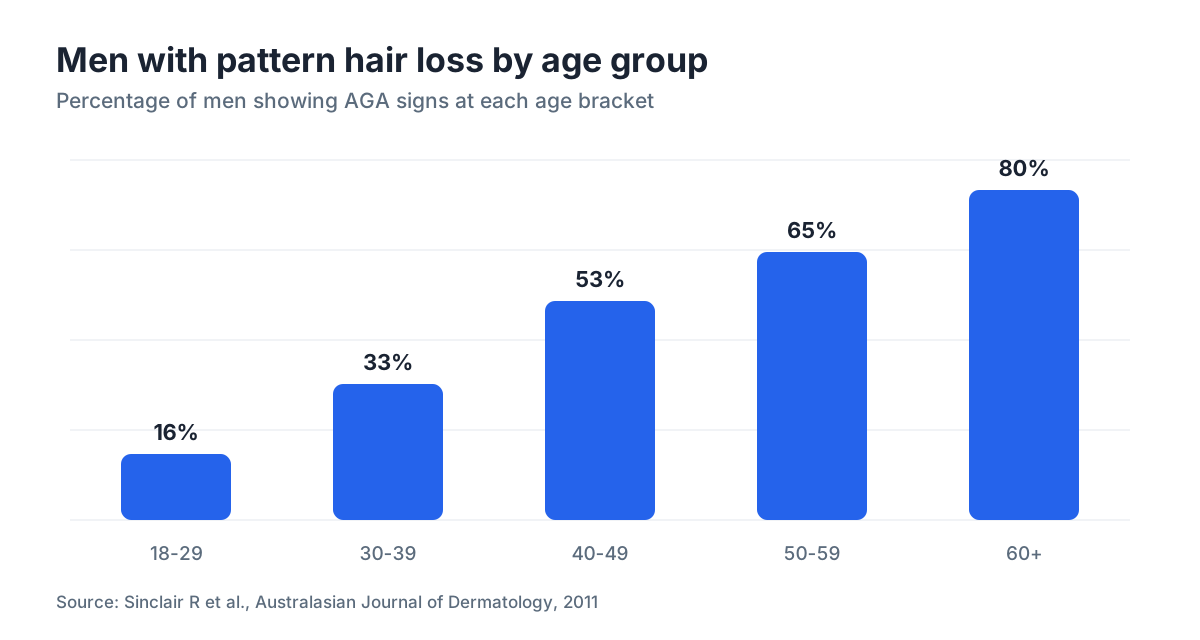
A receding hairline is usually the first stage of androgenetic alopecia (AGA), which is what most people call male pattern baldness. They aren't two conditions. The receding hairline is simply where AGA starts on most men.
AGA gets classified on the Norwood-Hamilton scale, which runs from Stage 1 (no visible recession) to Stage 7 (only a horseshoe of hair at the sides and back). A typical receding hairline sits between Norwood Stage 2 and Stage 3. Stage 2 shows slight recession at the temples. Stage 3 shows deeper temple recession, and that's often the point where men start to worry. [4]
Underneath it all: DHT binds to androgen receptors in genetically susceptible follicles, shortens the hair growth cycle over time, and eventually the follicle produces only fine vellus hairs or stops producing hair at all. There's more on the biology at what causes hair loss.
One caveat matters. Not every receding hairline is AGA. Traction alopecia from tight hairstyles, scarring alopecia, and even bad dandruff can shift the frontal hairline in ways that mimic early AGA. When you're unsure, a dermatologist can usually tell the difference without a biopsy.
How do you tell the difference between a receding hairline and a mature hairline?
This is one of the harder calls in early hair loss. A mature hairline is a normal change most men go through between their late teens and mid-twenties. The hairline drifts back about half an inch from where it sat in childhood and settles into a slightly higher spot. It's symmetric, and it stops.
A receding hairline keeps moving. That's the whole difference.
A few practical ways to sort them out:
- Photograph your hairline every three to six months in the same lighting and from the same angle. A mature hairline looks identical across two years of photos. A receding one sits clearly higher or more temple-heavy.
- Look at the shape. A mature hairline stays fairly even across the top. A receding one forms a sharper M or shows noticeably deeper temple recession on one or both sides.
- Check for miniaturized hairs at the border. A mature hairline doesn't have them. Very fine, short hairs along the leading edge point to miniaturization from DHT.
Still genuinely unsure? That's a fair reason to see a dermatologist or run a digital hair analysis. MyHairline's free AI scan (/scan) can flag miniaturization patterns from a photo, a useful first data point before you decide whether to treat.
Age matters here too. At 19, a hairline one finger-width above your highest forehead wrinkle may well be a mature hairline. At 30, if it's moved another centimeter in two years, that's the concerning kind.
How fast does a receding hairline progress?
Speed varies enormously. Some men go from Norwood 2 to Norwood 5 in five years. Others sit at Stage 2 or 3 for decades. A 2005 longitudinal study of Finnish men found the degree of vertex and frontal loss at age 40 predicted final extent well, but the timing of onset and the rate of change ranged widely across individuals [5].
Genetics drives a big share of the speed. If your father or maternal grandfather had rapid, early-onset pattern baldness, your risk of a similar path runs higher, though nothing's guaranteed. AGA inheritance is polygenic. It comes from multiple genes, not a single 'baldness gene' handed down from your mother's side, which is the old myth [6].
Hormone levels, general health, stress, and nutrition all nudge the pace. Telogen effluvium, a temporary shedding condition triggered by stress, illness, or crash dieting, can speed up the appearance of an underlying receding hairline. More at telogen effluvium.
The practical read: you can't predict your exact rate from genes alone. That's why monitoring with regular photos, and treating early if you plan to treat at all, beats waiting to see how bad it gets.
What Norwood stage does a receding hairline correspond to?
The Norwood-Hamilton scale is the standard classification for male androgenetic alopecia. A receding hairline usually lands at Norwood 2 or 3. Here's how the signs map onto the scale:
| Norwood Stage | What you see | Receding hairline present? |
|---|---|---|
| 1 | No visible recession, juvenile hairline | No |
| 2 | Slight temple recession, forehead slightly higher | Early signs begin |
| 2A | Recession spreads across front, minimal temple loss | Yes |
| 3 | Deep temple recession, M-shape visible | Yes, clear |
| 3 Vertex | Front relatively intact but crown thinning starts | Possible concurrent sign |
| 4 | Deep frontal recession plus crown thinning | Yes, significant |
| 5-7 | Extensive loss, horseshoe pattern | Well established |
Most men who search 'signs of a receding hairline' sit between Stage 2 and Stage 3. That's also the window where treatment is most likely to work, because a meaningful number of follicles are miniaturized but not yet dead. [4]
For a closer look at each stage and what to expect, see receding hairline.
Can women have a receding hairline?
Yes, though it looks different from the male version. Women with androgenetic alopecia usually see diffuse thinning across the top of the scalp rather than a dramatic M-shape at the temples. The frontal hairline often stays roughly intact even as overall density drops, which is why a widening part is often the first thing women notice.
Some women do get frontal fibrosing alopecia (FFA), a scarring condition that drives a progressive band-like recession of the hairline at the front and sides. FFA diagnoses appear to be climbing, though researchers are still arguing over why. A 2014 review in the British Journal of Dermatology of 355 patients described a marked rise in FFA over the previous two decades, with most cases in postmenopausal women. [7]
For women noticing a widening part, less density at the crown, or hairline recession that doesn't fit a simple stress-shedding pattern, a dermatologist visit is the right first move. Doctors use the Ludwig scale for female pattern hair loss, and a scalp biopsy when scarring alopecia is on the table.
Signs to watch in women: a part that looks wider than it used to, more scalp showing at the top center of the head, or a hairline drifting back at the temples or front.
What actually causes a hairline to recede?
The main driver in androgenetic alopecia is DHT (dihydrotestosterone). The enzyme 5-alpha reductase converts testosterone into DHT. In follicles with androgen receptors coded to be sensitive to it (a genetic trait), DHT slowly shortens the anagen, or growth, phase of the hair cycle. Each new hair grows for less time, comes in thinner, and eventually the follicle miniaturizes completely. [1]
This is why DHT blockers like finasteride work. Finasteride inhibits 5-alpha reductase, drops DHT levels in the scalp and blood, and slows or stops the miniaturization in many men. More on that at finasteride.
Other contributors:
- Age. DHT effects stack over time. Most genetically predisposed men start seeing signs in their 20s or 30s, though the late teens is possible.
- Stress. Chronic stress raises cortisol, which can disrupt the hair cycle and push more follicles into resting phase at once.
- Nutritional gaps. Iron deficiency and low ferritin are documented drivers of shedding. Low protein intake matters too.
- Scalp inflammation. Seborrheic dermatitis and chronic scalp inflammation can worsen DHT-related miniaturization.
Some men ask whether creatine causes hairline recession. There's one 2009 study (van der Merwe et al.) showing a significant rise in DHT among rugby players taking creatine versus placebo, but the sample was tiny (20 men) and no study has yet measured actual hair loss as an outcome [8]. The does creatine cause hair loss article covers this in full.
What should you do if you notice early signs of a receding hairline?
First, document it. Take a clear photo from above (ask someone or rig a mirror) and a straight-on shot with consistent lighting. Date it. Repeat every three months. This gives you real data instead of memory, which is useless for slow changes.
Second, confirm it's actually receding. One photo tells you nothing. Three photos over nine months under the same conditions tell you plenty. If the hairline has clearly moved across those three points, you have your answer.
Third, if you want to treat it, start early. The two treatments with the best evidence are minoxidil (topical or oral) and finasteride (oral).
Minoxidil is FDA-approved for hair loss in men and women. It's thought to work by extending the anagen growth phase and increasing blood flow to the follicle. Clinical trials show meaningful regrowth or stabilization in roughly 60 to 80 percent of men who use it consistently for at least a year [9]. More at minoxidil for men.
Finasteride is FDA-approved for male androgenetic alopecia at 1mg daily. In a 5-year trial, 90 percent of men on finasteride held or improved their hair count against baseline, while the placebo group kept losing [10]. It's prescription-only in the US. See finasteride and minoxidil for how the two work together.
Neither drug regrows a fully lost hairline. They work best on follicles that are miniaturized but still pushing out some hair. That's the whole point of the early signs. Catching recession at Stage 2 or 3 gives you a far better treatment window than waiting until Stage 5.
MyHairline's AI hair analysis tool (/scan) can help you gauge where your hairline sits and whether the pattern fits early androgenetic alopecia, a useful step before deciding on treatment.
If you've already lost real ground, or you want to rebuild a hairline that's moved back substantially, a hair transplant is the surgical option worth understanding.
Are there any other conditions that cause hairline recession that aren't AGA?
Yes. A handful of conditions cause hairline changes that look like early AGA but need completely different treatment.
Traction alopecia comes from chronic tension on the hairline from tight styles (braids, ponytails, extensions). The hairline recedes where the tension lands, usually at the temples and front. Unlike AGA, miniaturized hairs are less common in pure traction alopecia, and the follicle can recover if you drop the tension early enough. Keep pulling and it scars into permanent loss. [2]
Frontal fibrosing alopecia (FFA) is a scarring alopecia that drives a band-like recession with a pale scar at the advancing edge. It often comes with loss of eyebrow and eyelash hairs. Unlike AGA, immune-mediated inflammation destroys the follicle. Treatment aims at slowing progression, not regrowth. [7]
Alopecia areata sometimes shows up along the hairline instead of the usual round scalp patches. It's autoimmune and needs its own management.
Seborrheic dermatitis along the hairline can drive real shedding, and paired with underlying AGA it can speed up visible recession. Treating the seborrhea with ketoconazole shampoo or similar agents removes one contributor from the picture.
Why this matters: take finasteride for a hairline that's actually receding from traction alopecia, and you're treating the wrong problem. A dermatologist's exam, or a trichologist's, earns its keep when the cause isn't obvious.
When should you see a doctor about a receding hairline?
Most early receding hairlines don't need an urgent visit. But some situations call for a dermatologist rather than waiting or self-treating.
See a doctor if the loss is patchy or asymmetric (could be alopecia areata or scarring alopecia), if there's redness, scaling, or pain at the recession line (could be FFA or seborrheic dermatitis), if shedding is sudden and severe rather than gradual (could be telogen effluvium from a medical trigger like thyroid dysfunction or anemia), or if you're a woman under 50 with hairline recession (may need hormonal evaluation).
For a typical man in his 20s or 30s with gradually receding temples and a family history of pattern baldness, the efficient path is a dermatologist visit to confirm the diagnosis, rule out non-AGA causes, and talk through whether prescription finasteride fits your situation and health profile.
The American Academy of Dermatology recommends that anyone with noticeable hair loss see a board-certified dermatologist for evaluation, especially before starting treatment, so the correct underlying cause gets addressed. [2]
Blood tests a doctor might order: ferritin, a full iron panel, thyroid stimulating hormone (TSH), complete blood count, and sometimes a hormonal panel for women. These rule out systemic causes that mimic or worsen AGA.
Sources
- American Academy of Dermatology, Hair loss types and causes
- American Academy of Dermatology, Hair loss: who gets it and causes
- Journal of the American Academy of Dermatology, histologic study of early androgenetic alopecia (2018)
- Hamilton JB. Patterned loss of hair in man: types and incidence. Annals of the New York Academy of Sciences, 1951
- Longitudinal study of hair loss patterns in Finnish men, Acta Dermato-Venereologica, 2005
- Hillmer AM et al. Genetic variation in the human androgen receptor gene is the major determinant of common early-onset androgenetic alopecia. American Journal of Human Genetics, 2005
- Vañó-Galván S et al. Frontal fibrosing alopecia: a review of 355 patients. British Journal of Dermatology, 2014
- van der Merwe J et al. Three weeks of creatine monohydrate supplementation affects dihydrotestosterone to testosterone ratio in college-aged rugby players. Clinical Journal of Sport Medicine, 2009
- FDA, Drugs@FDA database (Rogaine minoxidil 5% labeling)
- Kaufman KD et al. Finasteride in the treatment of men with androgenetic alopecia. Journal of the American Academy of Dermatology, 1998
- Sinclair R et al. Prevalence of male pattern hair loss in Australian men, Australasian Journal of Dermatology, 2011