

TL;DR: Telogen effluvium runs through four stages: a trigger event, a quiet latent phase of 6-12 weeks before any shedding starts, active shedding that lasts up to 6 months, and regrowth. Most people get their full density back within 6-12 months of the trigger. Shedding past 6 months is chronic and needs a different workup.
What is telogen effluvium and why does it happen in stages?
Telogen effluvium is diffuse hair shedding that starts when a big batch of follicles gets pushed out of their growth phase (anagen) into the resting phase (telogen) all at once. On a normal scalp, only about 10-15% of follicles sit in telogen at any given time [1]. A hard enough physical or emotional shock can push that up to 30% or more, and suddenly you're shedding hundreds of hairs a day instead of the usual 50-100 [2].
The reason it arrives in waves, not all at once, is the hair cycle itself. The trigger doesn't drop your hair overnight. Every affected follicle has to sit through the full telogen resting phase before the old hair actually lets go. That built-in delay, plus the regrowth that follows, is what carves out the predictable arc most people go through.
Staging matters because people panic at the wrong moment and quit hope at exactly the wrong one. They freak out when shedding peaks. They give up right as regrowth begins. Knowing your stage changes what you should do next. For the full list of reasons hair falls out, see what causes hair loss.
What are the four stages of telogen effluvium?
The condition follows a consistent arc. The exact timing shifts person to person, but the sequence almost never changes.
Stage 1: The trigger event Something knocks the hair cycle off course. Common triggers: major surgery, childbirth, rapid weight loss (usually more than 20 lbs over a few months), a high fever or serious illness, thyroid dysfunction, severe nutritional deficiencies (iron, ferritin, and protein especially), or long stretches of psychological stress [3]. The trigger is usually obvious in hindsight and invisible at the time, because your hair still looks fine.
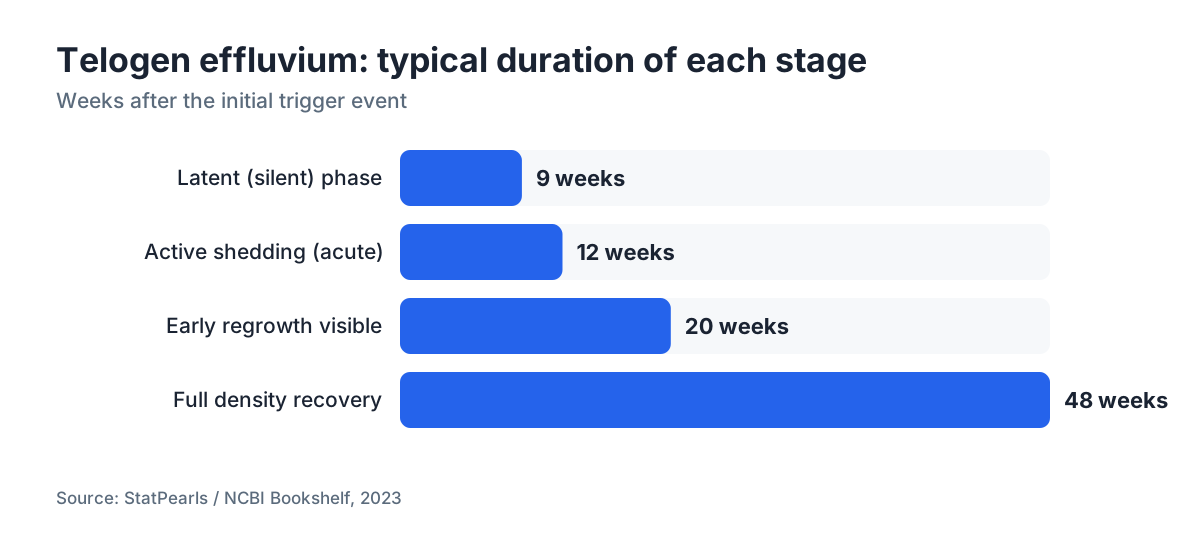
Stage 2: The latent (silent) phase This is the stage that fools everyone. Nothing looks different. Your hair seems totally normal. But underneath, a large group of follicles has quietly slipped into telogen and is sitting dormant. This phase usually runs 6 to 12 weeks after the trigger [1]. The window exists because the average telogen phase lasts about 100 days before the hair sheds and a new anagen hair starts pushing it out. Some follicles enter telogen a little early, some a little late, which is why shedding ramps up gradually instead of dumping all at once.
Stage 3: Active shedding Now you notice. Hair on the pillow, clumps in the drain, handfuls when you wash. Clinically, acute telogen effluvium means shedding under 6 months; chronic telogen effluvium runs past 6 months [3]. The American Academy of Dermatology says losing more than 100 hairs a day can point to this condition, though counting to the exact strand is a fool's errand [2]. The shedding is diffuse across the whole scalp, not patterned, which is one of the clearest ways it splits from androgenetic alopecia. The shed hairs carry a small white bulb at the root end, visible without a microscope, proof they left in telogen.
Stage 4: Regrowth Once the stressor clears and the wave of telogen follicles has shed, new anagen hair pushes through. Regrowth hairs come in short and fine, often feeling like fuzz or baby hairs along the hairline and part. Most people with acute telogen effluvium see real regrowth within 3 to 6 months of shedding stopping, and full density back within 6 to 12 months of the original trigger [1]. Chronic telogen effluvium (past 6 months) moves slower and usually means an ongoing cause still needs fixing.
How long does each stage last?
Timing is where people get lost. Here's an honest breakdown with the ranges the evidence actually backs.
| Stage | What's happening | Typical duration |
|---|---|---|
| Trigger event | Follicles pushed into telogen | Days to weeks |
| Latent/silent phase | Follicles resting, no visible change | 6-12 weeks post-trigger |
| Active shedding | Telogen hairs shed daily | 4-16 weeks (acute); >6 months (chronic) |
| Regrowth | New anagen hairs emerge | 3-6 months; full density at ~12 months |
The 6-12 week latent phase is the most documented number in the whole timeline [1]. It's why a good doctor asks what happened two to three months before your shedding started, not what happened last week. Postpartum shedding is the textbook example: it peaks around 3-4 months after delivery, which lines up exactly with the estrogen crash at birth kicking off a mass telogen shift, then the standard 3-month delay [4].
Acute telogen effluvium clears on its own once the stressor is gone. Chronic telogen effluvium, past 6 months, is less common, hits women aged 30-60 far more than anyone else, and usually ties back to a persistent problem like low ferritin, untreated thyroid disease, or ongoing caloric restriction [3]. Nobody has clean population-level data on exact shedding durations. Most published figures come from dermatology clinic cohorts, not large randomized trials, so read the numbers as solid estimates rather than gospel.
How do you know which stage you are currently in?
No blood test says "you're in stage 3." Staging is clinical. It rests on your history and what you can see. Here's a practical way to sort it out.
If your hair looks completely normal but you had a real stressor 2-6 weeks ago, you're almost certainly in the latent phase. Brace yourself. Shedding is coming.
If you're losing noticeably more hair than usual and it's been 6-16 weeks since a clear trigger, you're in active shedding. The signal to watch is whether the loss is diffuse (all over) or patterned (temples, crown only). Diffuse points to telogen effluvium; patterned points to androgenetic alopecia or a mix of both. The pull test, done by gently tugging a small bundle of about 40-60 hairs from different spots, normally releases 1-2 hairs; pulling out 6 or more suggests active effluvium [3].
If shedding has slowed and you spot short, wispy regrowth hairs (the "baby hairs") along the hairline especially, you're moving into regrowth. This is the most missed sign of recovery, because overall hair still looks thin while density is quietly climbing back.
A dermatologist can confirm your stage with trichoscopy (dermoscopy of the scalp) and a trichogram (a microscope look at shed hairs) to check the telogen bulb [3][8]. Basic bloodwork, ferritin plus a thyroid panel, a complete blood count, and zinc, can flag correctable triggers.
What does the shedding look like at its worst?
Peak shedding in telogen effluvium is frightening. Not subtle. People describe clogging the drain in a single wash, leaving visible piles on the pillow, and finding hair on their clothes all day.
Hair counts at peak can top 300-400 strands a day, against a normal baseline of 50-100 [2]. Because the follicle itself isn't destroyed (unlike scarring alopecias), the scalp usually looks healthy. No inflammation, no scaliness from the shedding, and the lost hairs carry that white bulb at the root.
Here's the part most people don't expect. The scalp can look thinner than the hair count alone would predict, because many follicles that haven't shed yet are also in the short early-anagen stage at the same time. Some hairs falling out, others just starting to grow back, and the combined effect is a stretch of maximum thinning around 3-4 months post-trigger. This is often the scariest moment. It's also often the turning point.
For postpartum women, this month 3-4 peak is so reliable that the AAD treats it as a normal event, separate from any pathological hair loss [4].
Can telogen effluvium become permanent?
True telogen effluvium doesn't cause permanent hair loss. The follicle is dormant, not dead, so regrowth is possible once the stressor is removed [1]. That's the honest reassurance.
Here's the catch. Telogen effluvium can unmask or speed up androgenetic alopecia (genetic pattern baldness) in people who were already headed that way. What looks like a temporary shed can expose an underlying pattern that never fully recovers. This happens more than people expect. A review in the Journal of the American Academy of Dermatology reported that the two conditions often co-exist, particularly in women in their 40s and 50s [3].
So if your hair isn't recovering on the expected 6-12 month timeline, it's worth asking whether there's an androgenetic component under it. That's a different conversation, about treatments like minoxidil for men or a DHT blocker, depending on the cause.
Chronic telogen effluvium that drags on for years with no clear persistent trigger is its own thing. Studies show it tends to wax and wane, rarely strips more than about 30% of overall density, and often stabilizes or remits on its own, though the timeline is anyone's guess [3].
What triggers move telogen effluvium into chronic territory?
Chronic telogen effluvium (past 6 months of active shedding) almost always has an ongoing cause. Here are the common ones, in rough order of how often clinics see them.
Low ferritin is the most missed trigger of all. Ferritin under 30 ng/mL correlates with hair shedding, though the level at which topping it back up actually helps hair is still argued. Some researchers say anything under 70 ng/mL is suboptimal for follicle function [5]. Ask for ferritin specifically, more than hemoglobin, because you can run normal hemoglobin with low ferritin.
Thyroid dysfunction, both hypothyroidism and hyperthyroidism, is a classic chronic driver. TSH alone can miss subclinical cases; a full panel with free T3 and free T4 gives a cleaner picture.
Ongoing caloric restriction or protein deficiency keeps the body in a state where it deprioritizes hair. Common in people running very low calorie diets (under about 1,200 kcal/day) or extreme low-protein diets.
Medication side effects fly under the radar. Drugs tied to telogen effluvium include retinoids, beta-blockers, anticoagulants like heparin and warfarin, lithium, some antidepressants, and hormonal contraceptives (especially when starting or stopping) [6]. If you're on any of these and shedding chronically, the drug is a prime suspect.
Chronic illness, including autoimmune and inflammatory disease, can keep the physiological stress response running and the effluvium going.
Does telogen effluvium resolve on its own, or does it need treatment?
Acute telogen effluvium usually clears without treatment once the trigger is gone. The evidence that any specific treatment speeds up resolution is thin. No FDA-approved drug targets telogen effluvium specifically [6].
That said, some supportive steps make sense. Correcting an identified deficiency (iron, ferritin, zinc, protein, thyroid hormone) is the best-backed move, because you're removing the cause rather than papering over the symptom [5]. Nutritional fixes aren't exciting. They're often the actual answer.
Minoxidil gets used off-label to help regrowth during recovery. It prolongs anagen and may speed up how fast density comes back, though it does nothing for the root cause of the effluvium. One quirk: when you first start topical minoxidil, it can trigger a brief shed of its own as follicles shift from telogen to anagen. This is a known, temporary effect covered in minoxidil side effects, and it doesn't mean the treatment is hurting you [9].
For people with real androgenetic alopecia underneath their effluvium, finasteride and minoxidil together are the best-backed combination for long-term stabilization. But that's a separate condition with its own risk-benefit talk.
Supplements marketed for effluvium have weak evidence. A few small trials on biotin, marine protein supplements, and Viviscal show modest benefit, but the studies are tiny and industry-funded. If your diet is genuinely short on something, a supplement helps. If it isn't, the evidence for benefit is weak. More at hair loss supplements.
If you want an objective read on how much density you've actually lost and whether regrowth is happening, a free AI hair analysis at MyHairline gives you a baseline so you're not guessing off drain counts.
How is telogen effluvium different from androgenetic alopecia?
These two get confused constantly, and they often run together, which muddies everything.
Telogen effluvium is diffuse, usually temporary, tied to a clear trigger, spread roughly even across the whole scalp, and the shed hairs carry telogen bulbs. The follicle stays intact and can regrow. It clears once the cause is gone.
Androgenetic alopecia (AGA, or male and female pattern hair loss) is patterned, progressive, genetic, driven by DHT sensitivity, and hits certain scalp zones first. Men lose the hairline and crown; women more often see thinning at the crown and a widening part. In AGA the follicles progressively shrink (miniaturize) instead of just resting [10]. See receding hairline for the male progression.
The practical tell is the pattern. Telogen effluvium doesn't spare the back and sides. AGA almost always spares those zones because the follicles there don't respond to DHT [10]. If your sides and back are thinning too, effluvium is the better bet. If thinning is stacked at the crown and temples while the back stays thick, AGA is more likely. Overlap is common.
A dermatologist uses trichoscopy to spot miniaturized hairs (AGA) versus uniformly sized hairs at staggered lengths (effluvium in recovery). Get a real diagnosis before you spend money, because the treatments split hard between the two.
What regrowth looks like and how to track your progress
Regrowth after telogen effluvium is real, and easy to miss. The new hairs come in short, fine, and sometimes a slightly different texture at first. All normal. People describe a "fuzzy" feel across the scalp, or short upright hairs along the hairline and part that weren't there before.
Regrowth is almost always patchy early on. You might see obvious regrowth on one side before the other. That's normal, and it reflects follicles entering telogen at slightly different times and regrowing on staggered schedules.
Tracking is harder than it sounds. Daily photos in the same lighting, same angle, same part are the most useful self-monitoring tool you have. Hair counts (collecting shed hairs in a paper bag over several days and averaging) can confirm shedding is dropping. Anything under about 100 a day during recovery is heading the right direction.
If you're three months past the end of shedding and see zero regrowth, go back to the cause. Either the trigger isn't resolved, there's an androgenetic overlay, or, rarely, another diagnosis is in play, like alopecia areata, which can mimic diffuse effluvium [7]. That's a dermatologist visit, not more waiting.
For people who had effluvium on top of existing pattern hair loss and aren't recovering to prior density, a talk about hair transplant options is sometimes right, though transplants do nothing for the effluvium itself and need stable hair loss as a baseline.
Are women or men more affected, and does it differ by stage?
Both sexes get telogen effluvium. The common presentations differ.
Postpartum telogen effluvium is nearly universal to some degree. During pregnancy, high estrogen holds more follicles in anagen, so hair looks thicker. After delivery, estrogen drops sharply and shoves a large cohort into telogen. The latent phase then puts peak shedding around 3-4 months postpartum [4]. It clears on its own, usually within 6-12 months, and needs no treatment in most cases.
Chronic telogen effluvium hits women aged 30-60 far more than anyone else, per dermatology clinic data [3]. The reason isn't well understood. Fluctuating hormones, more frequent dieting, and a higher rate of iron-deficiency states are all suspected.
Men get acute telogen effluvium too, especially after serious illness (COVID-19 triggered a documented wave), major surgery, or rapid weight loss. Men's cases go underrecognized because moderate diffuse shedding gets brushed off as normal male pattern loss. Men are also more likely to carry underlying androgenetic alopecia that gets exposed, so their recovery looks incomplete when it's really two conditions stacked on each other.
For men especially, working out how much of the thinning is effluvium versus early AGA is genuinely worth doing, because the management paths split. The telogen effluvium overview covers the gender breakdown in more depth.
When should you see a doctor about telogen effluvium?
You don't need a doctor for mild, brief shedding after an obvious trigger, like a rough illness or surgery, that's already improving. Several situations do warrant a real evaluation.
See a dermatologist if shedding is heavy and has run past 2 months with no clear trigger, if it's continued past 6 months even with a known trigger, if you're seeing real scalp visibility or a noticeably wider part, if the pull test keeps releasing more than 6 hairs, or if you have scalp symptoms like burning, itching, or pain (those point to a different diagnosis entirely).
Ask for labs that include ferritin (more useful than iron alone), a full thyroid panel (TSH, free T4, free T3), a complete blood count, and a metabolic panel. Some dermatologists also check zinc, vitamin D, and DHEA-sulfate depending on the picture. The American Academy of Dermatology publishes guidance on hair loss workup your doctor can reference [2].
Stuck partway through your research, unsure whether this is effluvium or something else? A free AI hair analysis at MyHairline helps you document your current state and spot patterns before your appointment, so you walk in with something concrete to show your dermatologist.
Sources
- StatPearls (NCBI Bookshelf), Telogen Effluvium
- American Academy of Dermatology, Hair Loss
- Journal of the American Academy of Dermatology, Telogen Effluvium review
- American Academy of Dermatology, Hair loss in new mothers
- Journal of the American Academy of Dermatology, Trost et al., The diagnosis and treatment of iron deficiency and its potential relationship to hair loss
- U.S. National Library of Medicine MedlinePlus, Drug information
- NIH National Institute of Arthritis and Musculoskeletal and Skin Diseases, Alopecia Areata
- DermNet, Telogen Effluvium
- FDA, Drugs@FDA (Minoxidil Topical Solution label)
- StatPearls (NCBI Bookshelf), Androgenetic Alopecia