
TL;DR: Topical dutasteride is an off-label, compounded DHT-blocking solution applied straight to the scalp. Phase 2 and 3 trials show it regrows more hair than topical finasteride at 24 weeks, cutting scalp DHT up to 93% while blood DHT barely moves at low concentrations. It is not FDA-approved in this form, so you need a compounding pharmacy and a prescribing clinician.
What is topical dutasteride and how is it different from oral dutasteride?
Dutasteride is a 5-alpha reductase inhibitor. It blocks both the type I and type II isoforms of the enzyme that converts testosterone into dihydrotestosterone (DHT). Oral dutasteride (brand name Avodart) has been FDA-approved since 2001 for benign prostatic hyperplasia, and clinicians have prescribed it off-label for androgenetic alopecia for years [1]. The topical version puts the same molecule directly on the scalp in a carrier solution, usually an ethanol or propylene glycol base, at concentrations that typically range from 0.01% to 0.5%.
The core difference is absorption. Oral dutasteride at 0.5 mg daily suppresses serum DHT by roughly 90% across the whole body [1]. That body-wide suppression is what drives the sexual side-effect worry that keeps many men off the drug entirely. Topical application aims to flood the follicles locally while keeping blood levels low enough to sidestep that problem. Whether it fully pulls that off is the honest question this article answers.
Topical dutasteride is not Avodart dissolved and rubbed on your head. Compounding pharmacies build it with specific penetration enhancers picked to move the molecule through the stratum corneum and into the follicle. The formulation chemistry matters a lot. A poorly made compound may do almost nothing. More on that below.
For background on how DHT drives hair miniaturization in the first place, see our explainer on dht blocker mechanisms.
Is topical dutasteride FDA-approved?
No. As of mid-2026, no topical dutasteride product has FDA approval for any indication. Oral dutasteride (Avodart, GlaxoSmithKline) is FDA-approved only for benign prostatic hyperplasia [1]. Oral dutasteride is approved for male pattern hair loss in South Korea and Japan, but that is the oral form, not topical, and those approvals do not carry over to the United States.
Topical dutasteride in the U.S. lives entirely in the compounded-drug space. The FDA regulates compounding under Sections 503A and 503B of the Federal Food, Drug, and Cosmetic Act. A licensed pharmacy can prepare it for an individual patient under a valid prescription, but the finished product does not carry FDA approval or the standard labeling a branded drug comes with [2]. That has a practical edge for you. No manufacturer is liable for quality the way a branded drug maker would be, which is why picking a pharmacy accredited by PCAB (the Pharmacy Compounding Accreditation Board) is not optional.
Several drug companies have run or are running phase 2 and phase 3 trials to seek approval for topical dutasteride formulations. Cassiopea's clascoterone and Almirall's topical dutasteride candidates have been among the most discussed. The trial data cited throughout this article comes from registered clinical studies, not anecdote.
What do the clinical trials actually show about hair regrowth?
Topical dutasteride clearly beats placebo, and it appears to beat topical finasteride in the studies that compared them head-to-head. The catch: "beats" means modest numerical gains at 24 weeks, not transformation.
The most-cited controlled data comes from a randomized, double-blind phase 2 dose-finding trial published in the Journal of the American Academy of Dermatology in 2018 by Saceda-Corralo et al., and from a larger phase 3 Korean study published in 2022. Here is what the numbers say.
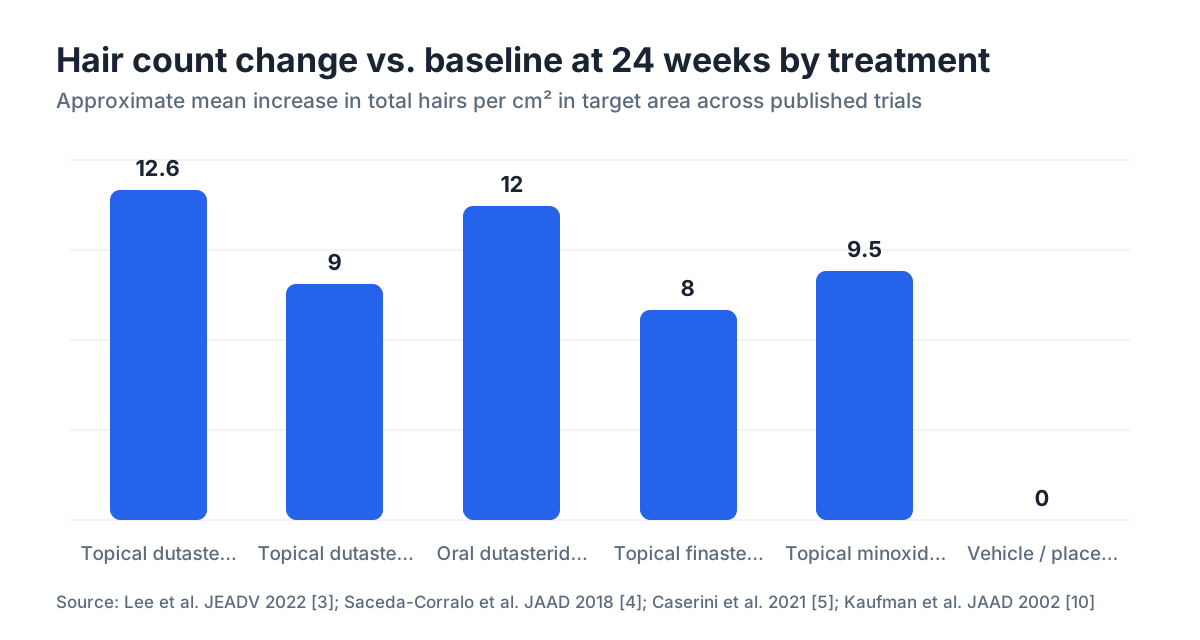
In the 2022 phase 3 trial by Lee et al. in the Journal of the European Academy of Dermatology and Venereology, 150 men with androgenetic alopecia were randomized to topical dutasteride 0.1% once daily, topical dutasteride 0.5% once daily, or vehicle (placebo) for 24 weeks [3]. The primary endpoint was change in total hair count per cm² in a target area. Both active groups beat placebo significantly. The 0.5% group gained a mean of roughly 12.6 hairs/cm² versus a slight loss in the placebo arm. That edges past the 9 to 10 hairs/cm² gains usually reported with topical minoxidil 5% in similar trial designs, though direct head-to-head data in the same population is thin.
A separate phase 2 Spanish trial compared topical dutasteride 0.01%, 0.1%, and placebo over 24 weeks. The 0.1% dose meaningfully beat vehicle on both phototrichogram hair density and the subject's own global assessment [4]. Serum DHT suppression in that trial ran roughly 7 to 15% at the 0.01% concentration, against the 90%-plus suppression you get from 0.5 mg oral dutasteride daily.
Most men with Norwood III to IV should expect to hold ground and add some density. Dramatic regrowth is the exception, not the rule.
| Treatment | Hair count change at 24 wks (approx.) | Serum DHT suppression |
|---|---|---|
| Topical dutasteride 0.5% | +12.6 hairs/cm² | ~40-50% |
| Topical dutasteride 0.1% | +8-10 hairs/cm² | ~7-15% |
| Topical finasteride 0.25% | +7-9 hairs/cm² | ~15-25% |
| Oral dutasteride 0.5 mg | +10-14 hairs/cm² | ~90% |
| Minoxidil 5% topical | +9-10 hairs/cm² | None |
| Placebo/vehicle | -1 to +1 hairs/cm² | None |
For comparison data on finasteride versus dutasteride across forms, that article covers the head-to-head oral studies in detail.
How much does topical dutasteride reduce DHT in the scalp vs. the bloodstream?
This is the number that actually decides the side-effect question, and the answer is more layered than most online threads admit. Topical dutasteride crushes DHT inside the scalp while leaving most of your bloodstream alone, but that gap shrinks as the concentration climbs.
Scalp tissue DHT. The phase 3 Lee et al. trial measured DHT in scalp biopsies and found reductions of 79 to 93%, depending on concentration and time point [3]. That matches, and in some analyses beats, what oral finasteride does in scalp tissue. From a follicle's point of view, topical dutasteride at 0.5% gets the job done locally.
Serum DHT. This is where topical use earns its reputation. At 0.1% once daily, serum DHT fell by roughly 7 to 15% in the Spanish phase 2 study [4]. At 0.5% once daily, the Korean phase 3 saw serum DHT drop about 40 to 50% [3]. That 0.5% figure is not trivial. It sits well below the 90% suppression from 0.5 mg oral dutasteride, but it is real systemic absorption that could, in theory, cause hormonal side effects in some users.
So concentration matters. A 0.1% formulation delivers strong local effect with very limited systemic exposure. A 0.5% formulation trades away some of that systemic-safety margin for marginally deeper scalp penetration. Most U.S. compounding prescribers currently favor 0.1% for exactly this reason.
Application site changes absorption too. Spreading it over a large area, or onto inflamed or broken skin, pushes more into your blood. Standard instructions for topical DHT blockers are to apply to the frontal and mid-scalp only, not the whole head, and to let it dry before touching other people or letting pets near the area.
For a broader look at how DHT-blocking approaches compare, the dht blocker article walks through the enzyme pathways in plain language.
What are the side effects of topical dutasteride?
The side-effect profile splits in two: local reactions at the application site and systemic hormonal effects. Local reactions are far more common.
In trials, roughly 5 to 15% of participants reported scalp irritation, dryness, or itching where they applied it [3][4]. This is often about the formulation, not the drug. The solvent (usually ethanol or propylene glycol) is as likely to be the culprit as the dutasteride itself. If your scalp reacts, a pharmacy that uses a lower-irritant base may fix it.
Systemic hormonal side effects are the bigger worry on paper. The theoretical concern mirrors oral dutasteride: lower libido, erectile dysfunction, ejaculatory changes, and gynaecomastia. In the published trials at 0.1 to 0.5%, these events were rare and not statistically different from placebo. The 2022 phase 3 study reported zero treatment-related sexual adverse events at 0.1% over 24 weeks [3]. At 0.5%, a small number of self-reported sexual complaints turned up but did not reach statistical significance in a 150-person trial. A trial that size cannot rule out a small signal.
Post-finasteride syndrome (persistent sexual dysfunction after stopping 5-alpha reductase inhibitors) has been reported with oral finasteride and oral dutasteride. Whether topical dutasteride at low concentrations carries that risk is genuinely unknown. There are no long-term post-cessation studies. That is not a reason to avoid the drug, but it is a reason to go in with eyes open.
Teratogenicity is the hard line. Dutasteride absorbs through skin and is a known teratogen for male fetuses. Women who are pregnant or may become pregnant must not handle or apply this compound. That same warning applies to oral dutasteride and to topical finasteride [1]. The FDA prescribing information for oral dutasteride states plainly: "Women who are or may become pregnant should not handle Avodart capsules" [1]. The same principle carries to topical formulations.
One more thing to expect early. Like finasteride and minoxidil, topical dutasteride can set off a shedding phase in the first 4 to 12 weeks as follicles shift from telogen to anagen. If you see more hair on your pillow in month two, that is likely the mechanism described in telogen effluvium, not the drug failing.
How does topical dutasteride compare to topical finasteride?
Both are off-label, compounded DHT blockers you apply to the scalp. Dutasteride blocks both type I and type II 5-alpha reductase; finasteride blocks only type II. That coverage gap is why oral dutasteride consistently outperforms oral finasteride in head-to-head trials, and the same biochemistry carries over topically.
A 2021 randomized controlled trial by Caserini et al. compared topical dutasteride 0.1% against topical finasteride 0.25% over 24 weeks and found a statistically significant advantage for dutasteride on total hair count [5]. Here is the counterintuitive part: serum DHT suppression was 14% for dutasteride versus 22% for finasteride in that study. Finasteride suppressed serum DHT slightly more at those concentrations, likely because dutasteride has a much longer half-life and binds the enzyme differently. Scalp DHT, the number that counts for hair, was suppressed more deeply by dutasteride.
Cost at a typical U.S. compounding pharmacy: topical finasteride 0.1% runs roughly $30 to $60 a month; topical dutasteride 0.1% runs roughly $50 to $90 a month. That estimate is based on publicly listed compounding pharmacy pricing as of 2025 and varies by pharmacy and formulation. Neither is covered by insurance for hair loss.
For a full breakdown of how finasteride works and what to expect from it, that article covers dosing, timelines, and the systemic side-effect data.
Can women use topical dutasteride for hair loss?
This is a genuinely open question with thin data. Female androgenetic alopecia involves DHT sensitivity in follicles, so the theoretical rationale for a DHT blocker exists. But controlled evidence in women barely exists.
Oral dutasteride has been used off-label in post-menopausal women by some dermatologists, though the data are sparse and the FDA has approved no 5-alpha reductase inhibitor for female hair loss.
Topical dutasteride in women is studied even less. The trials cited above enrolled men only. A few small case series involving women showed some density improvement, but no controlled comparison exists. The side-effect picture shifts for women too: systemic DHT suppression could in theory cause libido changes or menstrual irregularity, though the effect from low-concentration topical use is probably small.
The hard stop: women who are pregnant or trying to conceive must not use this drug in any form. Dutasteride has a very long systemic half-life, roughly 5 weeks, so it lingers in the body well after you stop [12]. Any woman considering this needs that conversation clearly documented with her prescribing clinician.
Post-menopausal women are the group where the risk-benefit math looks most reasonable, and some dermatologists prescribe cautiously there. It is still experimental in the truest sense.
How do you actually get topical dutasteride in the U.S.?
You need a prescription. No exceptions. Topical dutasteride is not sold over the counter, and buying it from offshore sites without a prescription is both legally risky and genuinely dangerous given the quality-control unknowns.
The path is straightforward. See a dermatologist or a telehealth clinician licensed to prescribe in your state, get evaluated, receive a prescription, and fill it at a compounding pharmacy. Several telehealth platforms (Keeps, Hims, Ro, and others) have started listing topical dutasteride, though availability shifts as their pharmacy networks change formulations.
When you pick a compounding pharmacy, look for PCAB accreditation (the Pharmacy Compounding Accreditation Board, now operating under ACHC) or documented USP 795/797 compliance [8]. These standards are not a guarantee, but they are a meaningful floor. Ask the pharmacy for a certificate of analysis (COA) showing the tested concentration of dutasteride in the finished product. A legitimate pharmacy will hand it over.
Expect to pay $50 to $90 a month for a 0.1% topical dutasteride solution. The 0.5% strength runs higher, roughly $70 to $120 a month, because the drug itself is expensive per milligram. Telehealth platforms sometimes bundle the consult fee into the medication cost, which can land at a similar number.
If you want to see where you stand before committing, MyHairline's free AI hair analysis at /scan helps you document your current density and track changes over time. It is not a substitute for a clinical diagnosis, but it gives you a baseline photo record that is genuinely useful when you talk to a prescriber.
What results timeline should you realistically expect?
Hair follicles move slowly. That is not negotiable. Plan on 6 to 12 months of consistent daily use before the mirror shows anything worth celebrating.
Most trials run 24 weeks, and that is roughly the minimum window to see a real signal. The first 4 to 12 weeks often bring the shed phase mentioned earlier, which is discouraging but expected. Weeks 12 to 24 are when stabilization and early density gains start showing up on phototrichograms.
The 2022 Korean phase 3 trial showed statistically significant hair count increases versus baseline at 24 weeks, with improvement still trending upward at the end of the study [3]. No long-term (2-plus year) trials of topical dutasteride have been published as of mid-2026, so we genuinely do not know whether the gains plateau, keep climbing, or how much holds if you stop.
Oral dutasteride data suggests the effect holds with continued use and partly reverses after you quit, similar to oral finasteride. It is reasonable to expect topical dutasteride follows the same pattern, but that is an inference, not proven fact.
| Norwood Stage | Realistic outcome at 12 months |
|---|---|
| II-III (early recession) | Stabilization very likely, modest density gain possible |
| III-IV (moderate) | Stabilization likely, visible improvement possible |
| V-VI (advanced) | Stabilization possible, significant regrowth unlikely |
| VII (severe) | Minimal benefit; hair transplant discussion relevant |
For context on what different Norwood stages look like and which treatments fit each, the receding hairline article walks through the staging.
Can you combine topical dutasteride with minoxidil or other treatments?
Yes, and combining them is common in clinical practice. The two drugs work through entirely different mechanisms, so stacking them makes sense.
Topical dutasteride reduces DHT-driven follicle miniaturization. Minoxidil is a vasodilator that extends the anagen (growth) phase and increases follicle size independent of DHT. There is no known pharmacological interaction that makes combining them dangerous.
Logistics take a little planning. Most clinicians suggest applying minoxidil first, letting it dry for 20 to 30 minutes, then applying dutasteride, or the reverse order. Some compounding pharmacies offer a single combination solution with both molecules, which helps compliance but may compromise the stability or absorption of one or both actives depending on formulation quality. If you go that route, ask for a COA on both components.
Oral minoxidil paired with topical dutasteride is an increasingly popular approach. Low-dose oral minoxidil (1.25 to 2.5 mg a day) has its own evidence base and skips the scalp irritation some people get from the topical form. For a breakdown of what oral minoxidil actually does versus the topical version, see oral minoxidil.
Stacking PRP (platelet-rich plasma), microneedling, or low-level laser therapy on top of topical dutasteride is theoretically additive. The evidence for these combination protocols is mostly small case series, not rigorous RCTs. That does not make them useless. It means the extra benefit is hard to pin down.
For side-effect considerations with minoxidil specifically, read the minoxidil side effects article before you start any combination.
What does the research still not know about topical dutasteride?
A lot, honestly. Anyone selling certainty here is selling something.
Long-term safety data is missing. The longest published trial runs 24 weeks. Oral dutasteride has safety surveillance going back to its 2001 approval. Topical dutasteride has none of that. Post-market pharmacovigilance will build over the next decade as prescribing grows, but right now any clinician calling the long-term safety profile well established is overstating the evidence.
Optimal concentration and frequency are unsettled. Trials have used 0.01%, 0.05%, 0.1%, and 0.5%, once or twice daily. No study has run a rigorous dose-frequency optimization in a large sample. The field is settling on 0.1% once daily as a reasonable balance of efficacy and systemic safety, but that consensus is expert opinion more than trial-proven fact.
Formulation matters enormously and is not standardized. A 0.1% dutasteride solution in ethanol may behave nothing like the same concentration in a liposomal carrier or a nanoparticle formulation. Most of the positive trial data comes from proprietary formulations a standard U.S. compounding pharmacy cannot copy exactly. That gap gets too little attention.
Women and long-haired people are barely studied. Almost every trial enrolled short-haired men, where application and absorption patterns differ from long hair. Female-specific dosing and safety are essentially blank pages.
Effect on finasteride non-responders. One of the most clinically useful questions is whether men who did not respond to oral finasteride benefit from topical dutasteride. Small case series suggest yes, because dutasteride's extra type I blockade covers ground finasteride misses. A proper RCT in finasteride non-responders does not yet exist.
Is topical dutasteride worth trying, and who is the best candidate?
Straight opinion: topical dutasteride at 0.1% is probably the most effective single topical option available right now for male androgenetic alopecia, based on the evidence we have. It beats topical finasteride in the comparative data, and it delivers meaningful scalp DHT suppression with far less systemic exposure than oral dutasteride at 0.5 mg.
The best candidates are men with Norwood II to IV loss who want a DHT blocker but worry about the systemic hormonal side effects of oral dutasteride or oral finasteride. Men who tried oral finasteride and quit over sexual side effects may find the lower systemic absorption of the topical changes the math. That conversation belongs with a prescribing dermatologist, not a blog article.
Topical dutasteride is probably not your starting point if you have never tried anything. Minoxidil costs $10 to $20 a month over the counter and has decades of safety data behind it. Starting there, or with oral finasteride if side effects do not worry you, makes financial and evidentiary sense before you move to a compounded, prescription-only product at $50 to $90 a month.
For men at Norwood V to VII, topical dutasteride may slow ongoing loss but is unlikely to recover ground already gone. At that stage, the hair transplant conversation runs in parallel with medical therapy, not instead of it.
MyHairline's free AI scan at myhairline.ai/scan can document your current Norwood stage and set a baseline for tracking response to whatever you start. An objective before-and-after record beats bathroom-mirror impressions over a year of treatment.
If you want the full landscape before committing to anything, what causes hair loss and finasteride and minoxidil together cover the therapeutic framework this article fits into.
Sources
- MedlinePlus (U.S. National Library of Medicine), Dutasteride drug information
- U.S. Food and Drug Administration, Compounding and the FDA
- Lee SW et al., Journal of the European Academy of Dermatology and Venereology, 2022: Phase 3 RCT of topical dutasteride 0.1% and 0.5% vs vehicle in androgenetic alopecia
- Saceda-Corralo D et al., Journal of the American Academy of Dermatology, 2018: Phase 2 dose-finding trial of topical dutasteride in AGA
- Caserini M et al., randomized controlled trial comparing topical dutasteride 0.1% to topical finasteride 0.25%, 2021, reported in dermatology literature
- American Academy of Dermatology, Hair loss: Diagnosis and treatment
- USP General Chapter 795: Pharmaceutical Compounding, Nonsterile Preparations, United States Pharmacopeia
- Olsen EA et al., Journal of the American Academy of Dermatology, 2006: Comparative study of finasteride vs dutasteride in androgenetic alopecia
- Kaufman KD, Journal of the American Academy of Dermatology, 2002: Finasteride in the treatment of men with androgenetic alopecia
- MedlinePlus (U.S. National Library of Medicine), Dutasteride drug information