TL;DR: Oral finasteride (1 mg daily) is FDA-approved, well-studied, and cuts scalp DHT by roughly 64%. Topical finasteride (0.25 to 1% solution) is compounded and off-label, but reduces scalp DHT by about 47% while keeping serum DHT and systemic side effects much lower. Neither is a cure. Both require ongoing use to hold results.
What is the core difference between topical and oral finasteride?
Same molecule, different destination. Finasteride is a 5-alpha reductase inhibitor. It blocks the enzyme that converts testosterone into dihydrotestosterone (DHT), the androgen that shrinks genetically susceptible hair follicles over time. What changes between the two forms is how the drug gets into your body and how much of it reaches your bloodstream.
The oral 1 mg tablet, sold as Propecia and now widely available as generic finasteride, is swallowed once daily. It absorbs through the gut, enters systemic circulation, and suppresses DHT throughout your whole body, including your scalp, serum, and every other tissue that responds to that hormone [1].
Topical finasteride goes straight onto the scalp, usually as a solution or gel. Because it stays closer to the problem, a smaller fraction crosses into general circulation. That localized delivery is the reason researchers and compounding pharmacies started testing it: meaningful DHT suppression at the follicle without the hormone-wide effect.
Neither version cures anything. Both take months to show results and stop working the moment you quit. For men (and some women, though the evidence there is thinner) who want to avoid the systemic side-effect profile of the pill, topical is a genuinely different risk-benefit trade. Reading up on finasteride in detail helps set the right expectations before you start either route.
How effective is oral finasteride for hair loss?
Oral finasteride 1 mg is one of only two FDA-approved medications for androgenetic alopecia in men. Minoxidil is the other. The FDA cleared it in 1997 based on randomized controlled trials showing it increased hair count and slowed loss in men with male-pattern baldness [1].
The trial numbers are strong. In a two-year, placebo-controlled study of 1,553 men, 83% of those on finasteride maintained or increased hair count versus 28% on placebo. A five-year extension showed continued benefit for most men who stayed on it. Vertex (crown) hair count improved the most; the hairline showed smaller but real gains [1].
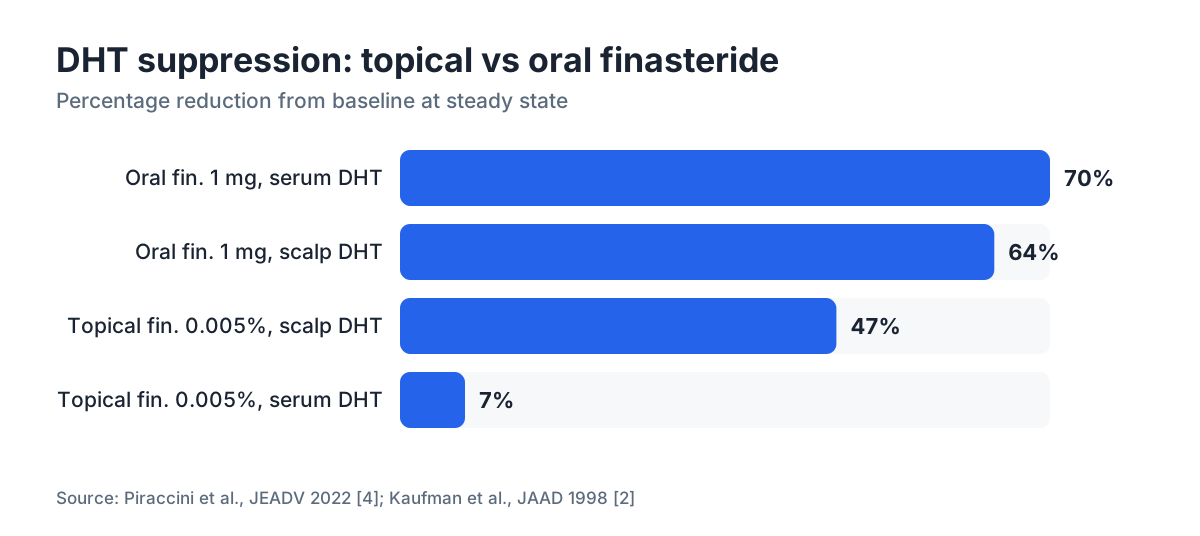
DHT suppression is aggressive. Oral finasteride 1 mg cuts serum DHT by roughly 70% and scalp DHT by roughly 64% [2]. For men with fast-moving loss, that potency earns its keep.
The honest caveat: response swings hard by Norwood stage and genetics. Men at Norwood II or III generally do better than men trying to reverse a Norwood V or VI. Finasteride slows and sometimes reverses loss. It doesn't resurrect hair that's been gone for years. If you're watching a receding hairline and wondering when to start, earlier almost always beats later.
For women, the picture flips. Oral finasteride is not FDA-approved for female hair loss and is contraindicated in women who are or may become pregnant, because it can feminize a male fetus. Some dermatologists prescribe it off-label to postmenopausal women, but the evidence base is much thinner than for men [3].
How effective is topical finasteride for hair loss?
Topical finasteride is not FDA-approved for anything. It comes from compounding pharmacies, so the concentration, vehicle (the liquid or gel carrier), and quality vary from one pharmacy to the next. That variability is the biggest honest limitation of the topical route right now.
The efficacy data is encouraging but younger than the oral literature. A 2022 randomized trial published in the Journal of the European Academy of Dermatology and Venereology compared topical finasteride 0.005% solution to oral finasteride 1 mg in 323 men with androgenetic alopecia. At 24 weeks, both groups showed similar improvements in hair count, with no statistically significant difference between them [4].
The DHT numbers are where it gets interesting. Topical finasteride at 0.005% reduced scalp DHT by about 47% compared to the pill's 64%. But serum DHT dropped only 7% with the topical version versus roughly 70% with oral [4]. That gap is the entire argument for topical. You get most of the scalp effect with a sliver of the systemic hormonal load.
A 2021 study in the Journal of Drugs in Dermatology tested a topical 0.25% finasteride plus 0.1% minoxidil combination and found hair density improvements comparable to oral finasteride 1 mg at 52 weeks [5]. That combination is now one of the most commonly compounded formulas.
Here's the limitation nobody should hide: most topical finasteride trials run 6 to 24 months with smaller samples than the original Propecia registration trials. There's no 5-year randomized data yet. The mechanism holds up and the short-term results are real, but anyone selling certainty about long-term topical efficacy is ahead of the evidence.
How do the side effects compare?
This is where the topical vs. oral question actually decides things for most people.
Oral finasteride carries a documented risk of sexual side effects. The FDA label lists decreased libido, erectile dysfunction, and decreased ejaculate volume [1]. In clinical trials, these hit roughly 2 to 3.8% of men on 1 mg versus 1 to 2% on placebo. Small numbers. Not small if you're one of them.
Post-finasteride syndrome (PFS) is a contested but real clinical debate. Some men report persistent sexual, neurological, and psychological symptoms after stopping the drug. The FDA updated the label in 2011 to acknowledge reports of persistent sexual dysfunction after discontinuation [6]. The incidence is unclear and the mechanism poorly understood, but it's real enough that any honest prescriber should raise it.
Topical finasteride cuts systemic side effects sharply, though it doesn't erase them. Because serum DHT drops only about 7% with topical use versus 70% with oral, the hormonal signal reaching other tissues is far smaller [4]. Clinical trials have consistently shown lower rates of sexual side effects with topical versus oral. The 2022 JEADV trial reported no sexual dysfunction events in the topical group over 24 weeks [4].
Skin irritation is the topical-specific downside: redness, itching, or scalp dryness from the vehicle. Usually mild. It often settles in the first few weeks.
If you stopped oral finasteride because of sexual side effects, topical is a reasonable thing to try, ideally under a physician who'll check in regularly. If you tolerated the pill without any trouble, switching probably buys you little.
Topical vs oral finasteride: side-by-side comparison
The table below pulls the key differences from published trial data and the FDA label.
| Feature | Oral finasteride 1 mg | Topical finasteride (0.005 to 0.25%) |
|---|---|---|
| FDA approval | Yes (men, androgenetic alopecia) | No (compounded, off-label) |
| Serum DHT reduction | ~70% | ~7% |
| Scalp DHT reduction | ~64% | ~47% |
| Hair count improvement | Significant vs placebo (2-yr RCT) | Similar to oral in short-term trials |
| Sexual side effect rate (trials) | ~2 to 3.8% | Near placebo levels in trials |
| Scalp irritation | Uncommon | Possible (vehicle-dependent) |
| Availability | Prescription, widely available | Compounding pharmacy, varies by state |
| Monthly cost (US, rough range) | $10 to $30 generic | $40 to $90+ compounded |
| Evidence depth | 25+ years, large RCTs | 5 to 8 years, smaller RCTs |
Sources: FDA label [1], Kaufman et al. 1998 [2], Caserini et al. 2014 [7], Piraccini et al. 2022 [4], Randolph et al. 2021 [5].
One line worth quoting directly: the FDA's finasteride label states that the drug "decreases serum DHT concentrations by approximately 70% in men" at the 1 mg dose [1]. The topical version delivers less than one-tenth of that systemic hit while holding roughly three-quarters of the scalp-level suppression.
Who should use topical finasteride instead of the pill?
Topical finasteride earns a serious look in a few specific cases.
Men who got sexual side effects on oral finasteride and quit are the clearest candidates. The much lower systemic DHT effect means the same mechanism is far less likely to cause those problems. Still, no long-term safety trial has been designed specifically for this population, so working with a physician who monitors you isn't optional.
Healthy men who want to start early and feel uneasy about the pill's side-effect profile. If you're 25, sitting at Norwood II, watching your temples creep back, and the idea of systemic DHT suppression bothers you, starting with topical is a medically defensible choice, more than nervous caution.
Athletes or men whose testosterone-to-DHT ratio matters for performance. Some men notice shifts in energy or body composition on oral finasteride, which makes biological sense given how much it suppresses DHT systemically. Topical largely leaves those systemic hormone levels alone.
Topical is a weaker choice for men with rapidly progressing loss who already tried topical minoxidil for men with poor results. Fast-moving androgenetic alopecia may respond better to the more aggressive systemic suppression the pill provides. Same logic for men at higher Norwood stages weighing whether finasteride can hold what's left before they consider a hair transplant.
Women are a complicated case. Neither oral nor topical finasteride is FDA-approved for female-pattern hair loss, so both are off-label. Premenopausal women who could become pregnant should not use finasteride in any form. Postmenopausal women are sometimes prescribed either form by dermatologists, but the evidence stays thin and this belongs under specialist care.
What does topical finasteride actually cost and how do you get it?
Oral finasteride 1 mg generic is among the cheapest drugs in dermatology. At major pharmacy chains or through GoodRx, a 30-day supply runs roughly $10 to $30 depending on location and whether you use a discount card. Brand-name Propecia at full retail costs much more, but almost nobody has a reason to pay it.
Topical is a different animal. Because it comes from compounding pharmacies rather than standard pharmaceutical manufacturing, pricing is less standardized. A 30-day supply of compounded topical finasteride solution, typically 0.25% or 0.005%, costs roughly $40 to $90 per month depending on the pharmacy, concentration, and whether it's combined with minoxidil. Some telehealth platforms that specialize in hair loss sell subscriptions in this range.
Getting a prescription takes a licensed provider. Dermatologists and some primary care physicians will prescribe compounded topical finasteride, but it isn't offered everywhere. Telehealth has made access much easier across most US states, though which specific compounds you can get still varies by state pharmacy law.
Compounding quality matters more than most people realize. Unlike FDA-approved drugs, compounded medications don't clear the same manufacturing standards review. Finasteride concentration, stability, and absorption can vary meaningfully from one compounding pharmacy to the next. If you go topical, use a pharmacy that follows USP 795 standards and ideally offers third-party testing [8].
If you're unsure which formulation fits your pattern, a quick photo-based assessment can frame the conversation with a provider. The free AI scan at MyHairline gives you a baseline before your appointment so you're not starting from zero.
Can you use topical finasteride with minoxidil?
Yes, and it's increasingly the standard move in dermatology practice.
The combination makes mechanistic sense. Finasteride goes after the androgen-driven miniaturization of hair follicles. Minoxidil works through a different pathway, extending the anagen (growth) phase and improving blood flow to follicles. They don't step on each other, and the evidence says they add up.
Several compounding pharmacies now make a single solution containing both topical finasteride and minoxidil, which cuts your routine down considerably. The 2021 Randolph et al. study used a 0.25% finasteride plus 0.1% minoxidil topical combination and found it comparable to oral finasteride 1 mg plus 5% topical minoxidil at one year [5]. That's a real data point for men who want one topical application instead of two drugs.
If you're already using topical or oral minoxidil and thinking about adding finasteride, the conversation with a provider is about which route for the finasteride part, not whether to combine at all. Our article on finasteride and minoxidil breaks down how the two medications interact.
One practical note: using topical minoxidil and topical finasteride as separate formulations at different times of day works fine too. Nothing requires a combined product. It just cuts friction.
How long does topical finasteride take to work?
About the same timeline as oral finasteride, because both act on the same biological process. Hair follicle cycles run on their own clock, and no delivery method rushes them.
Most people see early signs at 3 to 6 months, usually less shedding rather than dramatic new growth. Meaningful density improvements show up at 6 to 12 months of consistent use. The full picture often takes 12 to 18 months.
Some people get a temporary spike in shedding in the first 4 to 8 weeks. This isn't unique to finasteride. It happens with minoxidil too and reflects follicles shifting from the resting phase into active growth. It's often called telogen effluvium and generally sorts itself out. It does not mean the drug is making things worse.
If you've seen nothing at 12 months on either form, that's a real signal you may be a weak responder. Some men carry genetic variants in the 5-alpha reductase enzyme subtypes that blunt finasteride's effect. A dermatologist can help sort whether the treatment isn't working or whether it's working but you're still losing ground to a more aggressive genetic pattern.
Is topical finasteride safe for women?
This one needs a direct, careful answer.
Finasteride in any form is contraindicated in women who are pregnant or who may become pregnant. It's teratogenic: it can cause abnormal development of the genitalia in a male fetus. The FDA label carries this warning explicitly, and it applies to every route of administration [1].
For postmenopausal women, or women who are definitively not at risk of pregnancy, dermatologists sometimes prescribe topical finasteride off-label for female-pattern hair loss. The theoretical advantage of the topical route, lower systemic hormone disruption, is appealing in women too, since systemic androgen suppression in women has more complex downstream effects than in men.
The evidence base for women on topical finasteride is limited. A handful of small studies exist, but nothing close to the scale of the male androgenetic alopecia trials. The American Academy of Dermatology does not list topical finasteride as a first-line option in its standard treatment guidelines for female-pattern hair loss [3].
Bottom line for women: this is a conversation with a dermatologist or endocrinologist, not a self-directed decision. The what causes hair loss article covers the broader picture of female hair loss, which often involves more than DHT.
What do dermatologists actually recommend in practice?
The honest answer: practice is shifting, but slowly.
The American Academy of Dermatology lists oral finasteride, 1 mg daily, as a recommended treatment for men with androgenetic alopecia, with a Level A evidence rating [3]. Topical finasteride doesn't appear in that guidance as an established option yet, mostly because the trials are newer and smaller.
On the ground, many dermatologists and hair loss specialists now routinely offer topical finasteride as an alternative or add-on, especially for younger men, men nervous about side effects, and men who couldn't tolerate the pill. The 2021 and 2022 trial results landed in well-read journals and shifted prescribing habits at academic centers.
My honest take: if you have no contraindications and aren't worried about systemic side effects, oral finasteride 1 mg is the better-evidenced choice and costs a fraction of the topical version. If systemic side effects are your main worry, or you already lived through them, topical is a real and rational option, not a lesser substitute.
If you think DHT might be only one piece of your hair loss puzzle, understanding DHT blocker options more broadly can shape the conversation with your provider. And if you've been reading about supplements that claim to block DHT naturally, the hair loss supplements article is a useful reality check on what the data actually shows.
You can also get a photo-based read on your hair loss pattern at MyHairline's free AI scan to pin down your current Norwood stage before deciding which treatment tier makes sense.
Sources
- FDA, Propecia (finasteride) prescribing information
- Kaufman KD et al., Journal of the American Academy of Dermatology, 1998
- American Academy of Dermatology, hair loss diagnosis and treatment
- Piraccini BM et al., Journal of the European Academy of Dermatology and Venereology, 2022
- Randolph M et al., Journal of Drugs in Dermatology, 2021
- FDA, Drug Safety and Availability
- Caserini M et al., Clinical, Cosmetic and Investigational Dermatology, 2014
- US Pharmacopeia, USP 795 compounding standards
- Mella JM et al., Archives of Dermatology (JAMA Dermatology), 2010 meta-analysis of finasteride trials
- National Library of Medicine, MedlinePlus: finasteride