

TL;DR: Tension alopecia (traction alopecia) is hair loss from prolonged pulling on the follicles, usually from tight hairstyles. Caught early, it's largely reversible: stop the tension and most people regrow within months. Caught late, scarring sets in and the window closes. Minoxidil, anti-inflammatory treatments, and, for severe scarring, a hair transplant are the main clinical options.
What is tension alopecia and how does it differ from other hair loss?
Tension alopecia, also called traction alopecia, is hair loss caused by sustained mechanical pulling on the follicles. Tight braids, weaves, extensions, ponytails, dreadlocks, and cornrows are the usual culprits. The pulling stretches the follicle, sets off inflammation, and over enough time destroys it for good.
The mechanism is what sets it apart. Androgenetic alopecia (pattern hair loss driven by DHT) is hormonal. Telogen effluvium is stress pushing follicles into a resting phase. Traction alopecia is a physical injury, plain and simple. That one fact shapes everything about treatment. Stop the injury fast enough and the follicle recovers. Wait too long and scar tissue takes its place.
The American Academy of Dermatology (AAD) calls traction alopecia one of the most preventable causes of permanent hair loss. [1] It shows up across every background, though the numbers skew toward Black women who wear tight braided styles and Sikh men whose turbans pull the hairline. A survey-based study in the Journal of the American Academy of Dermatology estimated traction alopecia affects up to one-third of women of African descent who wear tight hairstyles. [2]
The pattern gives it away. Loss shows up along the frontal hairline, temples, and nape, exactly where styling tension runs highest. Early on you see broken short hairs at the margin, scalp redness, and sometimes small pustules around the follicles. Later, the hairline just retreats and the skin turns smooth and shiny. That shine is scarring.
How do dermatologists diagnose traction alopecia?
Diagnosis is mostly clinical. A dermatologist reads the pattern of loss, takes your styling history, and examines the scalp with a dermatoscope. No blood test confirms traction alopecia, though blood work helps rule out other causes of hair loss like thyroid disease, iron deficiency, or pattern hair loss running alongside it.
The dermatoscope does the heavy lifting. In early disease it shows perifollicular erythema (redness around the follicles) and hair casts along the shaft. In late disease it shows white fibrotic patches, missing follicular openings, and honeycomb scarring. That split between non-scarring and scarring is the most useful thing a diagnosis tells you, because it sets your treatment ceiling. [3]
A scalp biopsy isn't always needed. When the picture is murky, a punch biopsy shows whether follicles are intact and inflamed (early, reversible) or replaced by fibrous tissue (late, permanent). The report uses terms like "perifollicular fibrosis" or "follicular dropout" once scarring has set in.
One thing worth knowing: traction alopecia and androgenetic alopecia can travel together. A woman with female-pattern loss who also wears tight styles can have both at once. Each needs its own plan, which is why a proper exam beats guessing before you spend a dollar on treatment.
What is the single most important step in treating tension alopecia?
Stop the tension. Everything else is secondary.
It sounds obvious. It's also the step people fight hardest, because it means giving up hairstyles they've worn for years or that carry real cultural meaning. The evidence leaves no wiggle room. If you don't remove the mechanical cause, no topical or pill will outrun the ongoing damage. A 2018 review in Clinical, Cosmetic and Investigational Dermatology concluded that "cessation of the offending hairstyle remains the cornerstone of management." [4]
In practice that means:
- Loosening or removing braids, weaves, and extensions
- Skipping styles that pull the hairline back tight
- Rotating your part so no single zone carries constant load
- Moving to low-tension protective styles (loose twists, wigs mounted without hard pulling)
- Avoiding chemical relaxers stacked with heat or tight styles, since a chemically weakened shaft breaks under tension more easily
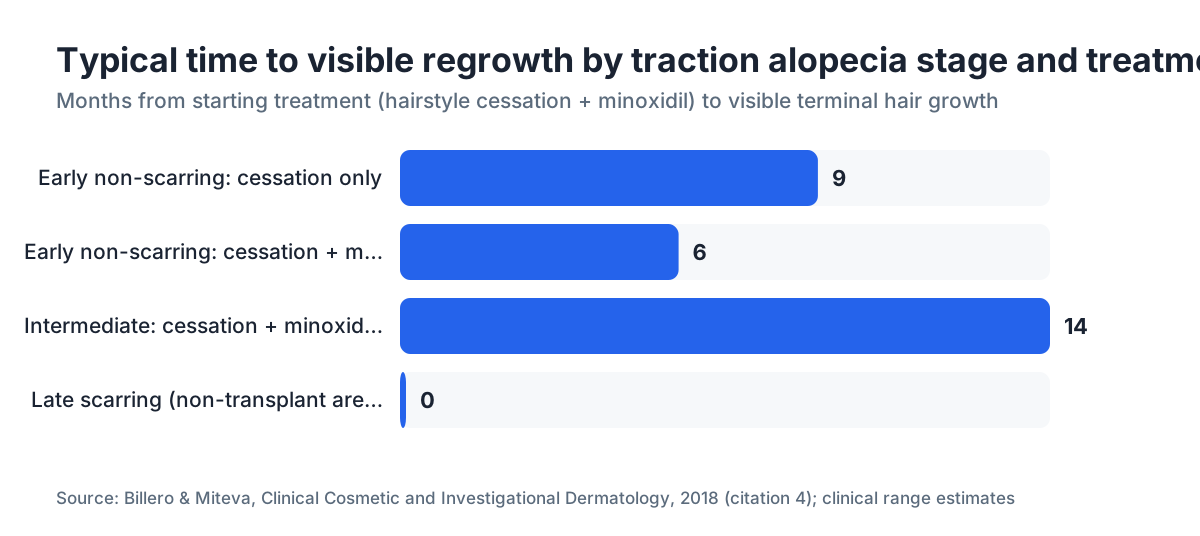
For a lot of people caught in early non-scarring disease, cessation alone brings visible regrowth in 3 to 6 months. Nobody has a clean randomized trial pinning down exactly how much regrowth to expect from cessation by itself. The traction alopecia evidence base has far fewer controlled trials than pattern hair loss does. But case series keep reporting real improvement in patients who quit the causative styling before scarring begins. [4]
Can minoxidil treat tension alopecia?
Minoxidil is the most common topical for traction alopecia once the hairstyle changes. It's FDA-approved for androgenetic alopecia [5], so its use here is off-label, meaning doctors prescribe it on physiology and clinical experience rather than a dedicated traction alopecia trial.
The reasoning holds up. Minoxidil stretches the anagen (growth) phase, improves blood flow to the follicle, and reduces miniaturization. In early traction alopecia, where follicles are stressed but not yet dead, those effects can tip things toward recovery. Dermatologists usually recommend 5% minoxidil foam or solution once or twice a day on the affected areas.
If you're a man weighing topical minoxidil, minoxidil for men walks through application technique and real timelines. Low-dose oral minoxidil (0.25 to 2.5 mg/day) is also used off-label and has a growing track record in both scarring and non-scarring alopecias; oral minoxidil covers what that data actually shows.
Before you start, read up on minoxidil side effects: scalp irritation, an initial shed in the first 4 to 8 weeks (normal and temporary), and the need to keep using it to hold any gains.
Here's the honest limit. In late-stage scarring traction alopecia, minoxidil can't regrow follicles that are already gone. It may help the surviving follicles at the margins, but it won't reverse fibrosis. That's why timing decides so much.
What anti-inflammatory treatments do dermatologists use?
Traction alopecia inflames the follicles before it scars them, so anti-inflammatories have a real place, especially in the middle stage where some follicles are irritated but not yet lost for good.
Topical corticosteroids (clobetasol propionate 0.05% or betamethasone valerate 0.1%) go on the affected hairline margins to calm the inflammation around distressed follicles. These are prescription strength and used in short courses, because prolonged use thins the skin.
Intralesional corticosteroid injections, usually triamcinolone acetonide at 2.5 to 5 mg/mL, go straight into inflamed areas. Dermatologists reach for these when topicals aren't enough and the dermatoscope shows active perifollicular inflammation. Injections repeat every 4 to 8 weeks depending on response. [10]
When there are prominent follicular pustules, a short course of oral antibiotics (doxycycline, tetracycline) handles the secondary bacterial piece. That treats a complication, not the root cause, but it keeps infection from doing more follicular damage.
Platelet-rich plasma (PRP) has been studied across several alopecias, and some clinicians offer it here to nudge recovery along. The evidence is thin. A 2019 systematic review in Dermatologic Surgery found PRP promising for androgenetic alopecia but said the evidence base for other hair loss types was too weak to draw conclusions. [6] PRP runs $500 to $1,500 per session and needs multiple rounds. I'd call it a reasonable add-on if you have money to spare, not a first-line buy.
Does the stage of traction alopecia change what treatment is realistic?
Yes, and it does so dramatically. Stage sets your ceiling more than your treatment choice does.
Dermatologists split traction alopecia into early (non-scarring) and late (scarring), sometimes with a clinical staging scale. A widely cited 2011 paper by Samrao and colleagues in Dermatology Online Journal describes early disease by the "fringe sign", a surviving row of short broken hairs along the frontal hairline that tells you follicles are still there, just damaged. Late disease loses even that fringe. [3]
Here's the practical breakdown:
| Stage | Dermatoscopy findings | Follicle status | Realistic treatment outcome |
|---|---|---|---|
| Early (non-scarring) | Perifollicular redness, hair casts | Intact, inflamed | Good regrowth possible with cessation + minoxidil |
| Intermediate | Early fibrosis, some follicular dropout | Partial, mixed | Partial regrowth; anti-inflammatories may preserve remaining follicles |
| Late (scarring) | White fibrotic areas, absent follicular openings | Destroyed | No regrowth at lost sites; transplant only option for coverage |
The jump from non-scarring to scarring isn't a single moment. It builds over months to years of ongoing tension. That's the whole case for early evaluation. Someone who catches it at the fringe-sign stage and changes their styling has a genuinely good prognosis. Someone with a decade of tight styles and a smooth, shiny hairline is looking at a different reality.
If you're not sure what stage you're at, the free AI hair scan at MyHairline can give you a starting read on your hairline pattern before you see a dermatologist. It doesn't replace a clinical exam.
Is a hair transplant an option for tension alopecia?
A hair transplant is a real option for late-stage traction alopecia where scarring has made medical treatment pointless. The conditions are stricter than for pattern hair loss transplants.
The big one: the causative tension has to stop completely and permanently before surgery. A transplant into an area that's still being pulled will fail. Surgeons generally want to see 1 to 2 years of hairstyle change and stable, non-progressive loss before they operate. Transplanting into active scarring also risks poor graft survival, because blood supply in fibrous tissue is compromised.
In the right candidate, both follicular unit extraction (FUE) and follicular unit transplantation (FUT) have restored the frontal hairline. FUE is more common here because it skips the linear donor scar and the extraction pattern can be shaped to the loss.
Costs in the United States usually run $4,000 to $15,000 depending on graft count and surgeon, though prices swing hard and nothing in that range is guaranteed. Hair transplant covers the procedure, the graft survival data, and how to vet a clinic.
One honest caveat: transplant outcomes in scarred scalp are less predictable than in pattern hair loss, because fibrous tissue holds grafts less reliably and has less blood supply. Ask any surgeon you consult to show you photos from traction alopecia cases specifically, more than their best pattern-loss results.
What role do scalp health and nutrition play?
Nutrition doesn't cause traction alopecia, but a deficiency can slow recovery once you've removed the tension. Follicles have high metabolic demand. Iron deficiency in particular is common in women with hair loss and drags on the anagen phase no matter the cause. Get ferritin tested. Most trichologists aim for a ferritin above 40 ng/mL, though official guidelines don't set a hair-loss threshold; that commonly cited target comes from observational data. [7]
Vitamin D, zinc, and biotin deficiencies also turn up in hair loss patients, but the evidence tying supplements to regrowth is weak unless you're truly deficient. Extra biotin when you're not deficient does nothing for regrowth and can throw off thyroid lab results. Hair loss supplements sorts what's backed from what's marketing.
Scalp care matters in a practical way. Oils, heavy product buildup, and some relaxers can trigger folliculitis or contact dermatitis, adding chemical stress on top of the mechanical pull. A clean scalp with low product residue is a fair baseline during recovery.
Some patients ask about DHT blockers like finasteride or dutasteride for traction alopecia. Those make sense only if there's concurrent androgenetic alopecia; they do nothing for mechanical follicular damage. DHT blocker explains the mechanism. In pure traction alopecia with no androgenetic component, there's no reason to use them.
How long does it take to see regrowth after starting treatment?
Regrowth timelines in traction alopecia hinge on two things: how long the tension ran, and whether scarring has happened.
For early cases with cessation alone, clinical experience puts the first vellus (fine, baby) hairs at around 3 months. Visible terminal hair regrowth usually takes 6 to 12 months. Full density recovery, when it happens at all, can take 18 to 24 months.
Minoxidil cut the time to visible improvement in androgenetic alopecia by about 4 months versus placebo in registered trials [5]. There are no equal-powered trials for traction alopecia, but the same follicular biology drives the recovering phase.
Patience is the hardest part by far. People see what looks like more shedding in the first 4 to 8 weeks on minoxidil, panic, and quit. That early shed is almost always the drug doing its job, pushing out old telogen hairs to make room for new growth. Quitting is the worst move you can make.
For scarring cases, there's no regrowth timeline, because medical treatment won't bring it back. The straight truth: any remaining non-scarred margins may improve, but the scarred zones stay bald without surgery.
What's the evidence on newer treatments like JAK inhibitors or stem cell therapy?
JAK inhibitors (ruxolitinib, baricitinib, tofacitinib) have produced real results in alopecia areata, an autoimmune hair loss condition. The FDA approved oral baricitinib in 2022 as the first systemic treatment for severe alopecia areata. [8]
Traction alopecia isn't autoimmune. It's mechanical and fibrotic. So JAK inhibitors aren't the logical fit and aren't used for it clinically. If a clinic markets JAK inhibitors for traction alopecia, ask hard questions.
Low-level laser therapy (LLLT) is FDA-cleared as a device for hair growth based on androgenetic alopecia data, and some dermatologists use it as an add-on. [11] The photobiomodulation effect may lower inflammation and help follicular energy metabolism. The evidence for LLLT in traction alopecia specifically is anecdotal, not trial-based, and home devices cost $200 to $900. Reasonable to try in early disease, unlikely to be the deciding factor.
Stem cell therapies and exosome injections get marketed hard but lack peer-reviewed trial data good enough to recommend over established treatments. Nobody has solid controlled data on these for traction alopecia. The closest evidence is small, often industry-funded studies in pattern hair loss, and stretching that to mechanical scarring alopecia is a guess.
The evidence-based order for traction alopecia hasn't changed: stop the tension, add minoxidil, manage inflammation, consider transplant for end-stage disease. The novel therapies sit outside that stack for now.
How do you prevent traction alopecia from coming back after treatment?
Prevention after recovery looks like prevention before onset, but the stakes are higher, because scarred areas don't get a second chance to recover.
The AAD recommends wearing hair loose or in low-tension styles as much as possible, keeping tight styles to occasional use instead of daily wear, and rotating where you put parts and ponytails to spread the load. [1] Extensions and weaves should be lightweight, never installed too tight, and taken out before the attachment site turns tender or inflamed. Tenderness is an early warning and a reason to loosen or remove a style right away.
For people who can't drop tension styles for work or culture, the harm-reduction version is: cap tight styles at 6 to 8 week intervals, take breaks between installs, and eyeball the hairline margins. Lasting redness or new small bumps along the hairline are early signs and call for a dermatology visit, not another install.
Children are a specific worry. Tight braiding in young girls whose follicles are still maturing can cause damage that surfaces as adult hair loss. The AAD specifically warns against tight hairstyles in young children for exactly this reason. [1]
If you've had traction alopecia and recovered, treat it as chronic management, not a one-time fix. The follicles that came back aren't tougher now. They're the same ones that proved vulnerable to tension the first time.
When should you see a dermatologist rather than trying treatment on your own?
You can start hairstyle change and over-the-counter 5% minoxidil without a prescription in most cases. Both steps are low-risk and fine for someone who caught the problem early.
See a board-certified dermatologist if:
- Loss is progressing despite stopping the causative style for 3 or more months
- You see scalp scarring (smooth, shiny areas with no follicular openings)
- You have follicular pustules, heavy scalp redness, or pain
- You're not sure whether the loss is traction alopecia, androgenetic alopecia, or something else
- You're considering prescription treatments (topical corticosteroids, intralesional injections, oral minoxidil)
- You're evaluating hair transplant candidacy
A trichologist (non-medical hair specialist) can do scalp assessments and support lifestyle change, but they can't prescribe and can't biopsy. For intermediate or late-stage disease, you want a dermatologist with a trichology focus.
If you want a fast first look at your hairline before booking a consult, the MyHairline AI scan reads your photos for free and helps you describe what you're seeing more precisely. It doesn't diagnose. It gives you a sharper starting point.
One more thing: don't let the conversation stop at "it's traction alopecia." Push for staging. Ask your dermatologist directly whether they see active fibrosis and what that means for your prognosis. You deserve a straight answer before you decide how hard to treat.
Sources
- American Academy of Dermatology, Traction Alopecia overview
- Gathers RC, Jankowski M, Eide M, Lim HW. Hair care practices and their association with scalp and hair disorders in African American women. JAAD 2009
- Samrao A, Price VH, Zedek D, Mirmirani P. The fringe sign: a useful clinical finding in traction alopecia of the marginal hair line. Dermatology Online Journal 2011
- Billero V, Miteva M. Traction alopecia: the root of the problem. Clinical, Cosmetic and Investigational Dermatology 2018
- FDA, Minoxidil Drug Label (Rogaine), FDA.gov
- Gupta AK, Carviel J, MacFarlane N, Piguet V. Platelet-rich plasma in the management of alopecia: a systematic review. Dermatologic Surgery 2019
- Trost LB, Bergfeld WF, Calogeras E. The diagnosis and treatment of iron deficiency and its potential relationship to hair loss. JAAD 2006
- FDA, FDA approves first systemic treatment for alopecia areata (baricitinib), FDA.gov news release, June 2022
- National Institute of Arthritis and Musculoskeletal and Skin Diseases (NIAMS), Hair Loss (Alopecia Areata) overview
- Callender VD, McMichael AJ, Cohen GF. Medical and surgical therapies for alopecias in Black women. Dermatologic Therapy 2004
- MedlinePlus (U.S. National Library of Medicine), Hair loss overview