TL;DR: ULO minoxidil is a once-daily topical hair loss product, usually compounded with finasteride. Data on the ULO brand itself is thin, but its two ingredients, minoxidil and topical finasteride, both have real evidence behind them. It's a convenience formula, not a breakthrough. Expect 3 to 6 months before you see anything.
What is ULO minoxidil exactly?
ULO minoxidil is a once-daily topical hair loss product that mixes minoxidil, the only FDA-approved topical treatment for androgenetic alopecia, with one or more extra actives, usually topical finasteride. The name ULO stands for "once daily" (Unum Loco Omne, roughly "one place, once"), though the branding shifts by pharmacy and country. It's compounded. That means a licensed pharmacy mixes it to a specific formula rather than it being a single FDA-cleared finished drug.
The appeal is obvious. Standard minoxidil instructions call for twice-daily application, seven days a week. Most people miss doses. Folding minoxidil and finasteride into one once-daily drop cuts that friction. Whether the pharmacokinetics actually support once-daily dosing as well as twice-daily is a fair question, and we'll get into that.
Don't assume ULO is some proprietary breakthrough. It isn't. It's a convenience formula built on well-understood molecules. The minoxidil component has been FDA-approved for topical use since 1988 for men and 1991 for women [1]. The finasteride component, when included, is approved orally but used off-label topically. That matters for how you weigh the safety claims.
How does ULO minoxidil work on hair follicles?
Minoxidil's mechanism still isn't fully nailed down, but the leading explanation is that it opens ATP-sensitive potassium channels in vascular smooth muscle, increasing blood flow to the dermal papilla and stretching out the anagen (growth) phase of the hair cycle [2]. Follicles miniaturized by DHT can, with steady minoxidil exposure, grow thicker and longer hairs again, at least partially.
Add finasteride to the ULO formula and you're layering in a different mechanism entirely. Finasteride is a 5-alpha-reductase inhibitor. It blocks the conversion of testosterone to dihydrotestosterone (DHT), the androgen most responsible for shrinking follicles in people with androgenetic alopecia [3]. Topical finasteride at low concentrations (typically 0.1% to 0.25%) tries to deliver that DHT-blocking effect right at the scalp, on the theory that systemic absorption stays lower than the oral 1 mg pill. A 2021 randomized trial in JAMA Dermatology found that topical finasteride 0.25% solution applied once daily cut scalp DHT by about 50% while keeping serum DHT closer to baseline than oral finasteride does [4].
So the ULO combination hits hair loss from two directions: more blood flow to the follicle from minoxidil, less DHT attacking it from topical finasteride. That's a sound rationale. See our full explainer on finasteride and minoxidil for how these two work together.
A note on the "once daily" part. The original 2% and 5% minoxidil solutions were studied twice daily. Once-daily 5% foam came later, and FDA approval studies showed it was non-inferior to twice-daily 2% solution in women [1]. So once-daily use of a higher-concentration minoxidil is defensible, though with a compounded version you're largely working from extrapolation.
What concentrations does ULO minoxidil typically come in?
Compounding pharmacies vary, but common ULO-style formulas run like this:
| Component | Typical concentration range |
|---|---|
| Minoxidil | 5% (men) or 2%, 5% (women) |
| Topical finasteride | 0.1%, 0.25% |
| Vehicle | Propylene glycol-free ethanol base or liposomal carrier |
| Tretinoin (some formulas) | 0.01%, 0.025% |
Tretinoin shows up in some formulas because a 1986 study in Archives of Dermatology found that 0.01% tretinoin increased minoxidil absorption and produced an earlier clinical response [5]. Whether that concentration carries meaningful irritation risk depends on your skin.
The propylene glycol-free option matters because propylene glycol, the standard minoxidil carrier, causes scalp irritation and contact dermatitis in a meaningful minority of users. Plenty of compounded ULO formulas sell this as a feature. Check with the specific pharmacy for their exact vehicle ingredients.
For standard minoxidil for men dosing and evidence outside the ULO format, that article covers the full picture.
Is there clinical evidence specifically for ULO minoxidil?
Honest answer: not much branded as "ULO." What does exist is a growing body of evidence for the ingredient combination.
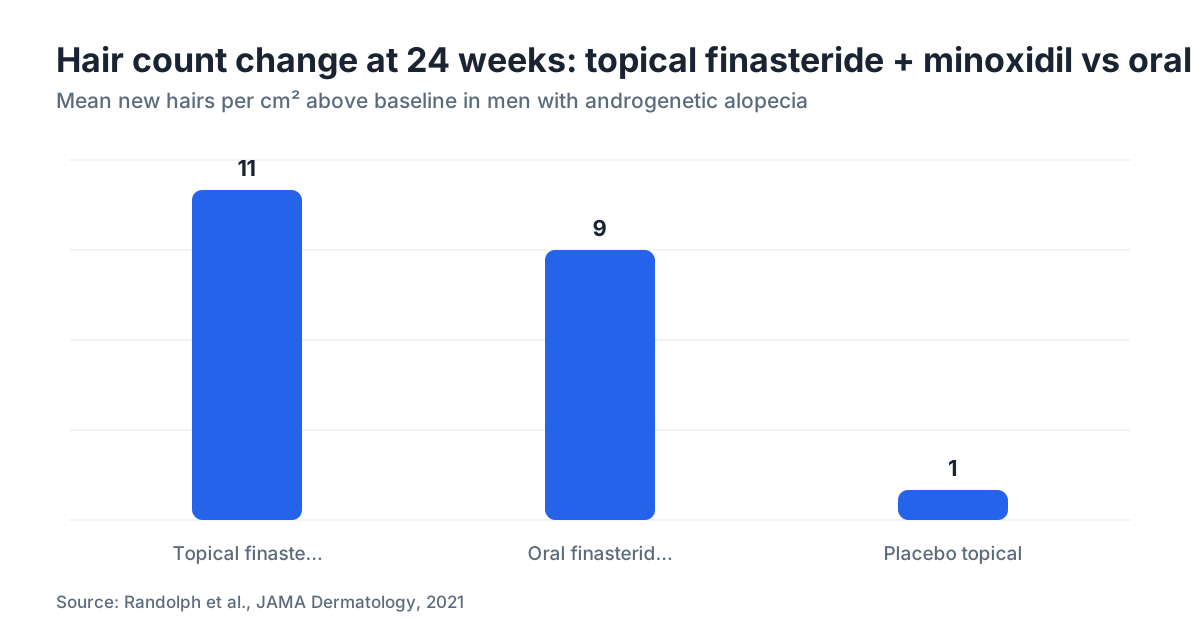
The JAMA Dermatology 2021 trial is the strongest piece of that evidence. It was a randomized, double-blind trial of 458 men with androgenetic alopecia comparing topical finasteride 0.25% plus minoxidil 3% once daily against oral finasteride 1 mg once daily. The topical combination produced similar hair count increases (roughly 10 to 12 hairs per cm² over 24 weeks) with less serum DHT reduction, which points to lower systemic exposure [4]. That's a real signal.
For minoxidil alone, the evidence base is huge. FDA-cleared trials showed 5% topical minoxidil in men produced significantly more regrowth than placebo at 48 weeks, with the agency noting "a mean increase of 14.9 target area hairs" in one of the key trials [1].
What you won't find is a published randomized controlled trial on a specifically branded ULO product. That's true of essentially every compounded hair loss formula. The pharmacy isn't required to run trials because it compounds under Section 503A or 503B of the Federal Food, Drug, and Cosmetic Act, which exempts compounded preparations from the standard drug approval process [6]. So potency testing, quality control, and sterility fall on the pharmacy, not the FDA. That's a real limitation.
Want to know whether what you're getting matches the label? Ask the pharmacy for a certificate of analysis.
How is ULO minoxidil different from standard topical minoxidil?
Three real differences.
First, the dosing schedule. Standard FDA-approved minoxidil is labeled twice daily. ULO targets once-daily use, which does better on adherence in practice. One systematic review of hair loss treatment adherence found twice-daily regimens had roughly 35% lower long-term compliance than once-daily ones, though the exact figure moves around by study [7].
Second, the combination actives. Off-the-shelf Rogaine or its generics are minoxidil only. ULO-style formulas usually add finasteride and sometimes tretinoin or caffeine. This is the real clinical advantage claim: stacking mechanisms.
Third, the regulatory category. Over-the-counter minoxidil is a finished FDA drug product with potency guaranteed to label. A compounded ULO formula is not. That doesn't make it ineffective. It does mean you're trusting the pharmacy's quality controls.
For a fuller look at the downsides of minoxidil in any form, read the minoxidil side effects article before you commit.
What side effects should you expect from ULO minoxidil?
The side effect profile mirrors its ingredients.
Minoxidil's most common topical side effects are scalp irritation, itching, and dryness. Systemic side effects from topical minoxidil are rare but real: fluid retention, heart palpitations, and unwanted facial hair have all been reported, more so with higher concentrations or when absorption climbs because of a broken skin barrier [2]. The FDA label warns of these.
The finasteride component adds the familiar sexual side effect risk. Oral finasteride carries a roughly 2 to 3% incidence of sexual dysfunction in clinical trials [3]. Topical finasteride is thought to carry lower risk thanks to reduced systemic exposure, but a 2022 review in the Journal of the American Academy of Dermatology noted that post-finasteride syndrome reports have shown up with topical use too and that more long-term data is needed [8]. That's not a reason to panic. It is a reason to watch yourself and have a straight conversation with a prescribing doctor.
The tretinoin in some formulas can cause peeling, redness, and photosensitivity, especially in the first weeks.
Shed warning: a minoxidil shed, where existing telogen hairs fall out as new anagen hairs push through, usually hits 2 to 8 weeks after starting. It's temporary and it means the drug is working, but it looks alarming. Read the telogen effluvium article if it happens to you.
Who is a good candidate for ULO minoxidil?
The strongest candidates are men with androgenetic alopecia (pattern baldness) who:
- Have already confirmed their diagnosis with a dermatologist
- Are comfortable with a compounded product and a prescribing telehealth or in-person doctor
- Want minoxidil and finasteride in one application instead of two
- Have had scalp irritation from propylene glycol-based standard minoxidil
Women can use ULO-style formulas, but only the minoxidil part. Finasteride isn't recommended for women who are pregnant or may become pregnant because of the risk of genital abnormalities in a male fetus [3]. Some telehealth prescribers will compound minoxidil-only once-daily formulas for women in a different vehicle.
You're probably not the right candidate if you're under 18, if your hair loss has a non-androgenetic cause (thyroid disease, nutritional deficiency, autoimmune alopecia), or if you have a history of low blood pressure, since minoxidil started life as a blood pressure drug [2].
Not sure what's driving your hair loss? The what causes hair loss explainer walks through the differential. For a quick starting point, MyHairline's free AI scan at myhairline.ai maps where you stand on the Norwood scale before you spend a dollar on treatment.
For people fighting both a receding hairline and diffuse thinning on the crown, a combination formula like ULO tends to cover both patterns better than minoxidil alone.
How long does it take for ULO minoxidil to work?
You won't see results fast. This is the expectation to get right.
The first 1 to 2 months often look worse, not better, because of the minoxidil shed. Hold your nerve.
At 3 months, most people notice less active shedding. At 6 months, you should be able to line up photos and see real change, whether that's new baby hairs, thicker existing hairs, or both. The FDA approval studies for 5% minoxidil used a 48-week endpoint (about 11 months) as the main measure of efficacy [1].
The JAMA Dermatology trial on topical finasteride plus minoxidil showed statistically significant hair count gains at 24 weeks versus baseline [4]. That's roughly 6 months.
Here's the part that surprises people: you can't stop. Androgenetic alopecia doesn't go away. Quit minoxidil and the hairs it was maintaining usually fall out within 3 to 6 months. Finasteride works the same way. This is a long-term commitment.
How much does ULO minoxidil cost compared to other options?
Pricing swings a lot depending on where you source it, but here's a realistic comparison:
| Product | Typical monthly cost (USD) |
|---|---|
| Generic 5% minoxidil topical (OTC) | $10, $20 |
| Brand Rogaine 5% foam | $35, $45 |
| Oral finasteride (generic, prescription) | $10, $25 |
| Topical finasteride only (compounded) | $30, $60 |
| ULO-style compounded minoxidil + finasteride | $50, $90 |
| Dutasteride topical (compounded) | $60, $100 |
Those numbers are estimates based on publicly listed telehealth pharmacy pricing as of mid-2025 and will move with pharmacy, location, and concentration. Most insurance plans won't cover compounded hair loss treatments.
Honest take: if money is tight, buy generic OTC minoxidil and a separate generic oral finasteride prescription from a regular doctor. That runs about $20 to $45 a month total and uses FDA-approved products with known potency. The ULO premium is real, but it buys convenience, not better odds of regrowth.
For people who've exhausted medical treatment, the hair transplant article covers surgical costs and realistic outcomes.
Where can you get ULO minoxidil, and do you need a prescription?
Because ULO-style formulas contain finasteride, they need a prescription in the United States, Canada, and most of Europe. Minoxidil alone at 5% is OTC in the US, but the finasteride component flips the regulatory category.
The usual route is a telehealth hair loss platform. You fill out a questionnaire, sometimes upload photos, a licensed doctor or PA reviews your case and writes a prescription, and that prescription goes to an affiliated or third-party compounding pharmacy. The whole thing can take 48 to 72 hours.
Common telehealth platforms that prescribe these formulas include Hims, Keeps, Forhair, and Nuvation Health, among others. Independent compounding pharmacies also fill them with a prescription from your own dermatologist.
The FDA has raised concerns about certain compounded drugs, especially from pharmacies not compliant with Current Good Manufacturing Practice standards. Under 21 CFR Part 211, compounding pharmacies must follow quality standards, but the oversight differs from the standard drug approval pathway [6]. If the source matters to you, check that the pharmacy holds PCAB (Pharmacy Compounding Accreditation Board) accreditation [11].
One more thing: some formulas sold outside the US go by "minoxidil plus finasteride" without ever using the ULO name. The name is mostly a marketing layer. The active ingredients are what matter.
How does ULO minoxidil compare to oral minoxidil?
Oral minoxidil is having a real moment in dermatology. A 2022 review in the Journal of the American Academy of Dermatology looked at 28 studies covering more than 1,400 patients and found that low-dose oral minoxidil (0.25 mg to 5 mg daily) produced regrowth in both androgenetic and non-androgenetic alopecia, with hypertrichosis (unwanted body or facial hair) and fluid retention as the most common side effects [9].
The comparison comes down to a few things.
Topical ULO-style formulas aim minoxidil at the scalp with lower systemic exposure, which matters most for people worried about blood pressure effects or hair sprouting where they don't want it. Oral minoxidil reaches the scalp through the bloodstream and reaches everywhere else too, which is exactly why it grows hair on arms and faces. Low-dose oral minoxidil is simpler (one pill) but needs a prescription and more blood pressure monitoring.
For a full side-by-side, see the oral minoxidil article.
Deciding between a topical ULO formula and oral minoxidil usually comes down to how well your scalp tolerates topical products and whether you have a prescribing doctor you can monitor with. Both are legitimate.
For the DHT-blocking side of things, the DHT blocker explainer covers finasteride, dutasteride, and the evidence for each.
Can you use ULO minoxidil if you're also taking other medications?
The main drug interaction flags for ULO formulas:
Minoxidil interacts with other blood pressure drugs. If you're already on an antihypertensive, adding topical minoxidil (which has some systemic absorption) can amplify the effect. The FDA minoxidil label calls out this interaction [1]. Tell your prescribing doctor everything you're on.
Finasteride interacts with drugs that hit the CYP3A4 enzyme pathway, though the interaction is usually minor with low-dose topical finasteride. More practically: if you're already taking a 5-alpha-reductase inhibitor for BPH (benign prostatic hyperplasia), like oral finasteride 5 mg (Proscar) or dutasteride (Avodart), adding topical finasteride stacks the DHT suppression and could push systemic DHT lower than you want.
Tretinoin, in formulas that include it, raises photosensitivity and can clash with other topical retinoids or exfoliants. Layering a glycolic acid or salicylic acid scalp serum on top of a tretinoin-containing ULO formula can cause serious irritation.
None of this is a reason to skip ULO minoxidil if it fits you. It's a reason to have a real conversation with whoever prescribes it, rather than clicking through a telehealth questionnaire on autopilot.
What do dermatologists actually think about ULO-style compounded formulas?
Opinion is genuinely split, which is the honest picture.
The American Academy of Dermatology's clinical guidelines call topical minoxidil a first-line treatment for androgenetic alopecia and name finasteride a first-line option for men [10]. The guidelines don't specifically address compounded combinations, which tells you where the research sits: there's more evidence for the individual ingredients than for combined formulas at the specific concentrations compounding pharmacies use.
Skeptical dermatologists tend to raise quality control. Without FDA oversight of the compounded product itself, you're trusting the pharmacy's potency testing. A solution that's actually 3% instead of 5% will underperform, and you'd have no easy way to know.
Enthusiastic ones point to the JAMA Dermatology trial showing real efficacy for the ingredient combination, and to adherence. If once-daily is the only regimen a patient will actually stick to, it beats twice-daily that they abandon after two months.
Honest summary: ULO-style formulas are a reasonable option when they come from a reputable, accredited compounding pharmacy and a doctor who actually reviewed your case. They aren't magic and they aren't scams. They're a delivery-vehicle upgrade on well-understood molecules. If you want an objective read on where you are and whether any treatment is likely to help, the MyHairline AI scan (myhairline.ai/scan) gives you a Norwood-stage assessment from your photos for free. That's a reasonable first move before spending on any product.
Sources
- FDA, Minoxidil Topical Solution prescribing information (label)
- StatPearls, Minoxidil (NCBI Bookshelf)
- FDA, Finasteride (Propecia) prescribing information
- Randolph M et al., JAMA Dermatology, 2021, Topical Finasteride and Minoxidil vs Oral Finasteride for Androgenetic Alopecia
- Bazzano GS et al., Archives of Dermatology, 1986, tretinoin and minoxidil absorption
- FDA, Human Drug Compounding (Section 503A/503B, FD&C Act)
- Blumeyer A et al., Journal of the German Society of Dermatology, 2011, adherence in hair loss treatment systematic review
- Zakhem G et al., Journal of the American Academy of Dermatology, 2022, topical finasteride safety review
- Vañó-Galván S et al., Journal of the American Academy of Dermatology, 2022, low-dose oral minoxidil for alopecia
- American Academy of Dermatology, Clinical Guidelines for Androgenetic Alopecia
- PCAB, Pharmacy Compounding Accreditation Board, accreditation standards