

TL;DR: Hair that has been gone for five years can sometimes regrow, but the odds depend on whether the follicle is dormant or permanently scarred. Androgenetic alopecia (pattern baldness) progressively miniaturizes follicles until they stop producing hair entirely. Caught early, minoxidil and finasteride can reverse miniaturization. After years of complete baldness, a hair transplant is usually the only realistic path to visible regrowth.
What actually happens to a follicle after years of hair loss?
A hair follicle is a living structure anchored in your scalp. It does not disappear the moment a hair falls out. What happens instead is a slow process called miniaturization, where the follicle shrinks over months and years, producing hairs that get finer, shorter, and lighter until the hair becomes invisible or stops emerging altogether [1].
The question that decides everything is whether that follicle is dormant or dead. A dormant follicle still has stem cells in the bulge region. A destroyed follicle, usually from scarring alopecia, an injury, or years of severe inflammation, has been replaced by fibrous tissue. No treatment on earth regrows hair from scar tissue. There is no follicle left to activate [2].
For the most common type of hair loss, androgenetic alopecia (male and female pattern baldness), follicles do not die quickly. They shrink. Research using scalp biopsies shows that even in long-standing bald areas, miniaturized follicles are often still present under the skin [1]. That is the biological reason treatments can sometimes work after years of thinning. The catch: the longer a follicle sits in its miniaturized, dormant state, the weaker its stem cell population gets, and the less it responds to any treatment.
So "hair gone for five years" is not one situation. It might be a fully smooth, shiny scalp with no visible follicle activity, which is much harder to treat. Or it might be an area that still shows fine vellus hairs, which is a much better sign. Understanding what causes hair loss in the first place is step one, because the cause determines how reversible the loss is.
Does the type of hair loss change whether regrowth is possible?
Yes. Dramatically. The cause of your hair loss is the single biggest factor in whether regrowth after five or more years is possible.
Androgenetic alopecia (pattern baldness): This is the most common cause, driven by dihydrotestosterone (DHT) shrinking follicles over time. It progresses slowly, and follicles in miniaturized areas can stay viable for many years. This is the type where minoxidil, finasteride, and transplants have proven track records [3].
Telogen effluvium: Telogen effluvium is a stress-triggered shedding that pushes large numbers of hairs into the resting phase at once. It is almost always temporary. Remove the trigger (illness, crash diet, surgery) and the follicles return to their normal cycle. Most cases resolve within three to six months without treatment. If yours has dragged on for five years, something is still driving it, and finding that cause matters more than any topical.
Alopecia areata: An autoimmune condition where the immune system attacks follicles. The follicles are not destroyed, just suppressed. Even patches bare for years can regrow, sometimes on their own, sometimes with treatment (JAK inhibitors like baricitinib are now FDA-approved for severe cases) [4]. Long duration lowers the odds, but regrowth is possible.
Scarring alopecias (lichen planopilaris, CCCA, and others): These actively destroy the follicle with inflammation. Once the scarring is set, regrowth in those areas is off the table. Treatment is about stopping further loss, not recovering what is gone.
Traction alopecia: Caused by prolonged tension from tight hairstyles. Early on it is fully reversible. After years of continued traction, the follicle can be permanently damaged. Releasing tension early is the treatment. Waiting five years without changing the hairstyle often means permanent loss in the affected areas [2].
How likely is regrowth after 5 years specifically, and what does the evidence say?
No single study directly answers "regrowth after five years of baldness." Most clinical trials on minoxidil and finasteride run for 12 to 48 months and enroll people who are actively thinning, not those with long-established bald areas [3][5]. So the honest answer: nobody has great data on this specific window, and the best evidence is indirect.
Here is what we do know.
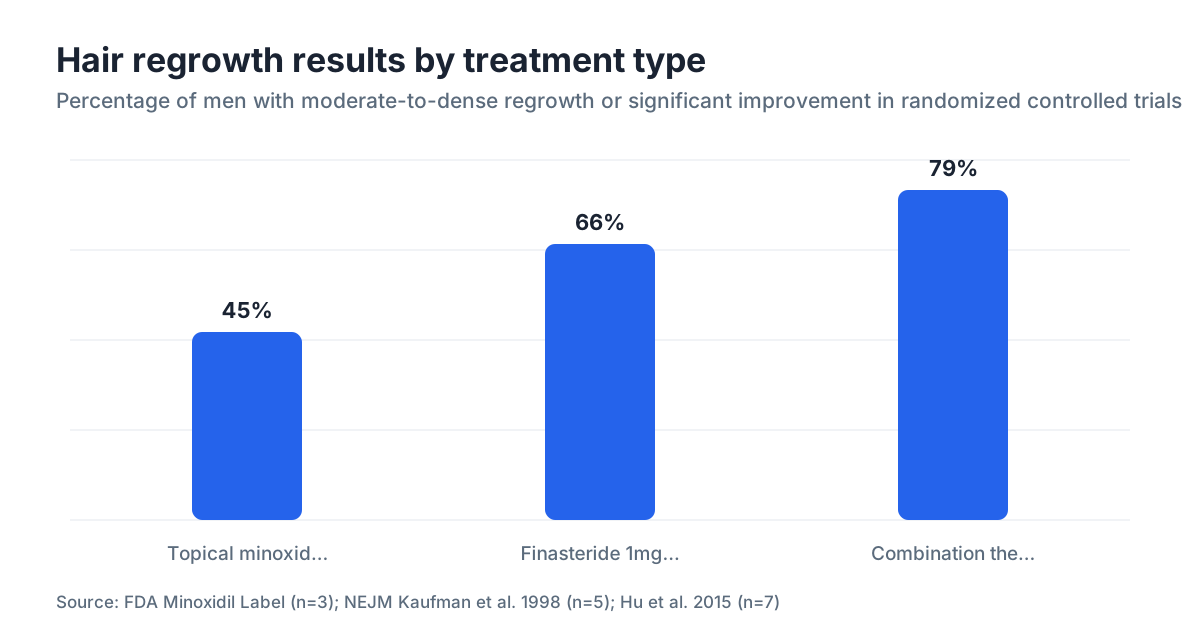
Minoxidil 5% solution in a 48-week randomized controlled trial produced moderate to dense regrowth in 45% of men [3]. That trial did not restrict enrollment to recent-onset loss, but it also did not break out results by how long an area had been bald. The men who respond best tend to be those who still have visible fine (vellus) hairs in the thinning area, which suggests a follicle that is miniaturized but alive.
Finasteride 1mg daily in a two-year placebo-controlled trial increased hair count by an average of 107 hairs per inch squared, compared with a loss of 50 hairs per inch squared in the placebo group [5]. Duration of baldness before starting was again not isolated as a variable, but dermatologists consistently report that smooth, long-standing bald areas respond poorly to medical treatment.
Scalp biopsy research on long-term bald areas found that while miniaturized follicles persist, their progenitor cell activity declines with time [1]. That is about as close as the literature gets to a direct answer: the follicles are still there, but they are quieter, and their response to stimulation is weaker.
Most dermatologists will tell you that treating a receding hairline in its early stages gives far better results than treating a fully smooth crown that has been bare for half a decade. Starting treatment the moment you notice thinning is the most effective move, not because five-year-old loss is untreatable, but because earlier is always better with follicle-dependent conditions.
What treatments can actually stimulate regrowth in long-standing hair loss?
Here is each option, honestly, with realistic expectations for someone dealing with years of established loss.
Minoxidil (topical and oral) Minoxidil is FDA-approved for androgenetic alopecia. It works by prolonging the anagen (growth) phase of the hair cycle and by widening blood vessels in the scalp. Minoxidil for men comes in 2% and 5% topical forms, and the 5% consistently beats the 2% in trials [3]. Oral minoxidil at 0.25mg to 5mg daily is increasingly used off-label and shows strong results, with one 2021 trial finding significant regrowth at doses as low as 1mg [6]. Read more about the oral minoxidil route if topical application is a hassle.
On a scalp with five years of established baldness, topical minoxidil may produce modest regrowth of fine hairs if miniaturized follicles remain. Do not expect dramatic density. Stop minoxidil and any gains reverse within a few months, so it is a long-term commitment.
Finasteride (and other DHT blockers) Finasteride 1mg daily is FDA-approved for male pattern baldness. It blocks the conversion of testosterone to DHT, the hormone behind follicle miniaturization in androgenetic alopecia. It is most effective at slowing further loss and moderately effective at regrowing miniaturized follicles [5]. In long-standing bald areas, it does more to prevent additional loss in still-thinning zones than to restore density where the scalp is already bare. Other DHT blockers like dutasteride work similarly but are not FDA-approved for hair loss.
Combination therapy (minoxidil plus finasteride) Using finasteride and minoxidil together is additive in most trials. One study showed combination therapy beat either drug alone over 12 months [7]. For someone with five years of established loss, combination therapy gives the best medical odds, though those odds stay modest for fully smooth areas.
PRP (Platelet-Rich Plasma) PRP means drawing your blood, spinning it to concentrate platelets, and injecting the result into the scalp. Several small studies show modest benefit, but the evidence base is thin and inconsistent. A 2019 systematic review in Dermatologic Surgery found most PRP trials had high risk of bias [8]. It is not FDA-approved for hair loss and costs $1,500 to $3,500 per treatment cycle. For long-standing loss, it is an uncertain bet.
Low-Level Laser Therapy (LLLT) FDA-cleared (cleared, not approved) devices exist for androgenetic alopecia. The evidence shows modest slowing of shedding and mild density improvement, but no study shows meaningful regrowth in multi-year established baldness. The American Academy of Dermatology (AAD) lists it as an option with limited evidence [2].
Hair transplant surgery Where follicles are truly gone from years of pattern baldness, a hair transplant is the only option that reliably restores visible density. The surgeon takes follicles from a donor area (usually the back and sides of the scalp, which are DHT-resistant) and implants them in the bald area. Those transplanted follicles keep their donor characteristics and keep growing permanently [9]. The AAD notes that transplanted hair grows for a lifetime in most patients [2]. Cost in the US typically runs $4,000 to $15,000 depending on graft count and technique [9].
Is a hair transplant the only real option for a bald area that has been bare for years?
For a genuinely smooth, fully bald area with no vellus hair activity, a hair transplant is the most predictably effective option. Medical treatments (minoxidil, finasteride) do their best work on thinning areas where miniaturized follicles are still present and active. They have a weak track record for restoring density to areas that have been completely bare for years.
Transplants have real limits too. You need adequate donor hair. The procedure does not treat the underlying cause of hair loss, so without concurrent medical therapy the areas around the transplant can keep thinning. A transplant into a five-year-old bald area is permanent and predictable, but if you do not address DHT with finasteride or a similar drug, you may eventually need another procedure as the surrounding native hair continues to thin [9].
A hair transplant is also irreversible. The donor follicles are gone from the donor area for good. Picking the right surgeon and holding realistic expectations about density are the two things that separate satisfied patients from disappointed ones. A good surgeon will tell you plainly what density is achievable with your donor supply.
Age matters here too. A transplant at 22 with aggressive pattern baldness is a bigger gamble than one at 45 when the pattern is stable and predictable. Young patients bald for five years may still be actively losing elsewhere, which means the transplanted island of hair could look strange years later as the surrounding hair thins further.
What does regrowth actually look like when it works? Realistic timeline
People starting treatment for the first time, even on established loss, need to understand the timeline or they quit too early.
Minoxidil causes an initial shedding phase in weeks two through eight. It happens because the drug pushes resting (telogen) hairs out to make room for new anagen growth. It feels like the treatment is making things worse. It is not. Most dermatologists say to push through it.
New growth from minoxidil starts appearing at three to six months, but the hairs are fine and easy to miss. Density you can actually see and feel usually takes 12 months of consistent use. Finasteride works more slowly on regrowth, with most of the benefit landing at 12 to 24 months of continuous use [5].
For a scalp with five years of established baldness, the honest timeline for medical treatment is: four to six months to know if the follicles respond at all, 12 months to see the best result you are going to get medically. If after 12 months of consistent dual therapy you have not regained satisfying density, the follicles in the fully bald zones are likely too far miniaturized, and a transplant consultation makes sense.
After a hair transplant, the transplanted hairs shed within two to three weeks of surgery (this is normal), regrowth begins around three to four months, and most of the final result is visible at 12 to 18 months [9].
| Treatment | When first results appear | Full result timeline | Works on 5-year bare scalp? |
|---|---|---|---|
| Topical minoxidil 5% | 3-6 months | 12 months | Possibly, if vellus hairs present |
| Oral minoxidil | 3-5 months | 12 months | Possibly, stronger effect than topical |
| Finasteride 1mg | 6-12 months | 18-24 months | Modest at best for fully bare areas |
| Combination (fin + min) | 3-6 months | 12-18 months | Better than either alone, still limited |
| Hair transplant (FUE/FUT) | 3-4 months (new growth) | 12-18 months | Yes, most reliable option |
Are there any signs that tell you whether your follicles might still be alive?
There are a few things you can look for, though none replace a dermatologist's assessment.
The most useful sign is vellus hair. These are the colorless, fine hairs that often remain in areas that look bald. Look closely at your scalp in good lighting. If you see fine, soft, short hairs, the follicles are still producing something. They are miniaturized but alive, and medical treatment has a real shot at reversing some of that miniaturization.
A completely smooth, shiny scalp with no visible hair of any kind is a worse sign. It does not prove the follicles are gone, but it points to deeper miniaturization or longer dormancy.
A trichoscopy (dermatoscopy of the scalp) is a non-invasive in-office test. A dermatologist uses a handheld magnifying device to assess follicle density, hair caliber diversity, and the presence of miniaturized hairs invisible to the naked eye. It is genuinely useful for deciding whether medical treatment is worth trying before committing to 12 months of medication [2].
A scalp biopsy is the gold standard for telling scarring from non-scarring alopecia. If there is any question about whether the loss is scarring (irreversible) or non-scarring (potentially reversible), a biopsy settles it. It is a minor in-office procedure.
If you want to start reading your scalp without an office visit, a free AI hair analysis is a reasonable first step. The tool at MyHairline uses photos to flag thinning patterns and give you a clearer picture of what stage you are at before you decide on next steps.
Bottom line: if you can see fine hairs, try treatment. If you cannot, get a trichoscopy before spending a year on medication that may not be reaching viable follicles.
What does not work for regrowing long-lost hair?
The internet is full of products aimed at people who are desperate about hair loss. Here is the honest breakdown.
Biotin and general hair supplements: Hair loss supplements like biotin only help if you have a genuine biotin deficiency, which is rare. Multiple systematic reviews found no evidence that biotin supplementation improves hair loss in people with normal biotin levels [10]. When a supplement brand cites "clinical studies," check the methodology. Most use self-reported outcomes with no placebo control.
Caffeine shampoos: Weak preclinical data, no solid human trial showing meaningful regrowth. Fine for washing your hair. Not a treatment.
Rosemary oil: One small 2015 study compared rosemary oil to 2% minoxidil and found similar (modest) results at six months [11]. The trial had 50 participants and no placebo arm, so the bar for extrapolating is low. It is not harmful and costs almost nothing. For someone with five years of established baldness, it is unlikely to do much.
Scalp massages: One Japanese study of 24 men showed modest increases in hair thickness after daily standardized scalp massage. That is it. A four-minute daily massage will not restore a bald scalp, but it costs nothing and cuts stress.
Stem cell serums and "follicle activating" topicals: No FDA-recognized category here, no RCT evidence. These are cosmetic products that live off vague language. Save your money.
The line between a serious treatment and a wishful one is FDA approval or a serious peer-reviewed RCT. Minoxidil has both. Finasteride has both. Almost everything else sold for hair loss has neither.
Does hair loss from DHT mean regrowth is permanently blocked?
DHT causes hair loss by binding to androgen receptors in the dermal papilla of the follicle, setting off a cascade that shortens the growth cycle and shrinks the follicle over successive cycles. This is not a switch flipped instantly. It is a gradual process that takes years, which is exactly why early intervention matters so much.
Blocking DHT with finasteride or dutasteride does not undo scarring. It stops the shrinking and, in follicles that are miniaturized but still active, can let the growth cycle lengthen and the follicle partially recover its size. The American Hair Loss Association notes that finasteride is most effective in the vertex (crown) area and less effective at regrowing the frontal hairline [12].
For follicles suppressed by DHT for five years or more, stopping DHT often stabilizes things but delivers less impressive regrowth than it would have if started earlier. Think of DHT miniaturization like a tire slowly deflating over five years. Removing DHT stops the leak, and the tire might reinflate a little on its own, but you usually need to actively pump it up (minoxidil) to get anywhere near full pressure.
That is why combination therapy beats either drug alone. Finasteride removes the cause. Minoxidil pushes the follicle toward the growth phase. Use one without the other and you leave results on the table.
When should you see a dermatologist instead of trying treatments on your own?
Most cases of androgenetic alopecia can be self-managed with over-the-counter minoxidil, but a dermatologist earns their fee by confirming your loss is even the type that responds to medical treatment.
See a dermatologist if:
The hair loss is diffuse (all over), rapid, or comes with scalp symptoms like scaling, itching, or pain. Those point to conditions like seborrheic dermatitis, scarring alopecia, or a systemic issue (thyroid disorder, iron deficiency, autoimmune disease) that need diagnosis before treatment.
You have patchy, not diffuse, loss. Patchy loss is more likely alopecia areata, tinea capitis, or traction alopecia, all of which call for different approaches.
You are a woman. Female pattern hair loss has a broader differential than male pattern loss. Hormonal causes (polycystic ovary syndrome, thyroid disease, post-partum shedding) are more common. A dermatologist, and often an endocrinologist, is worth seeing before committing to any treatment.
You have been treating yourself for six months with no response. That is a signal the diagnosis may be wrong or the follicles in the affected area are beyond medical treatment.
Finasteride and oral minoxidil both require a prescription in the United States. A dermatologist is the only route to those, which is one more reason to consult one before settling on a plan. Understanding what causes hair loss through proper diagnosis is the foundation everything else is built on.
What should you do right now if you have had hair loss for 5 years?
Start with an honest assessment of what you are working with. Look at the affected area in good light. Are there fine vellus hairs? That is a meaningful positive sign. Is the scalp completely smooth? Then your realistic options narrow toward a transplant, though a dermatologist's assessment should come first.
Get a trichoscopy or a dermatologist evaluation before spending money on 12 months of medication. If the bald area has no viable follicles, medical treatment will not produce meaningful regrowth there. It may still protect the surrounding thinning areas from getting worse, which is worth doing on its own.
If the evaluation shows miniaturized but surviving follicles, combination therapy (oral or topical minoxidil plus finasteride) gives the best odds. Commit to 12 months. Regrowth is slow, and quitting at three months because you cannot see results yet is the most common mistake people make.
If you want a quick starting point before your appointment, the free AI scan at MyHairline can help you map your current pattern and give you a visual baseline to track changes.
If medical treatment disappoints after a genuine 12-month trial, consult a board-certified hair restoration surgeon. Get more than one opinion on whether you have adequate donor supply, what density is realistic, and what the surgeon's actual case volume looks like. A hair transplant done well is one of the few genuinely permanent solutions. Done poorly, it is expensive and hard to fix.
The five-year mark is not a hard cutoff for hope. But it is a clear signal that the easy, fully reversible window is behind you, and the decisions you make now deserve more thought, not less.
Sources
- Journal of Investigative Dermatology, Whiting DA 1993 - Diagnostic and predictive value of horizontal sections of scalp biopsy specimens in male pattern androgenetic alopecia
- American Academy of Dermatology - Hair loss: Diagnosis and treatment
- FDA Drug Label - Minoxidil 5% topical solution (Rogaine), NDA 019501
- FDA - News release on baricitinib (Olumiant) approval for severe alopecia areata, 2022
- New England Journal of Medicine, Kaufman KD et al. 1998 - Finasteride in the treatment of men with androgenetic alopecia
- Journal of the American Academy of Dermatology, Sinclair RD et al. 2021 - Oral minoxidil 1 mg daily for female pattern hair loss
- Dermatology and Therapy, Hu R et al. 2015 - Combined treatment with oral finasteride and topical minoxidil in male androgenetic alopecia
- International Society of Hair Restoration Surgery (ISHRS) - 2022 Practice Census
- JAMA Dermatology, Patel DP et al. 2017 - A systematic review of the use of biotin for hair loss
- Skinmed Journal, Panahi Y et al. 2015 - Rosemary oil vs minoxidil 2% for the treatment of androgenetic alopecia
- American Hair Loss Association - Treatment (finasteride)