
TL;DR: DHT blocking serums are topical products that aim to cut dihydrotestosterone activity at the scalp follicle. The one topical DHT blocker with strong clinical evidence is topical finasteride. Ketoconazole shampoo has modest supporting data. Most 'DHT serum' products sold online mix unproven botanicals. None are FDA-approved to treat androgenetic alopecia on their own.
What is DHT and why does it cause hair loss?
Dihydrotestosterone, or DHT, is a hormone your body makes when testosterone meets an enzyme called 5-alpha-reductase. That conversion happens in many tissues, including the scalp. DHT binds to androgen receptors inside hair follicles and, in people who are genetically sensitive to it, slowly miniaturizes those follicles over years. Each hair cycle produces a thinner, shorter strand until the follicle stops making visible hair at all. [1]
This is the engine behind androgenetic alopecia, the most common form of hair loss in men and women. The follicles most exposed to DHT sit along the temples and crown, which is why the classic receding hairline and bald spot show up where they do. If you want the wider view, our guide on what causes hair loss covers the full spectrum. [2]
The genetic sensitivity angle deserves a pause. Two men can carry identical DHT levels. One goes bald by 30. The other keeps his hair at 70. Scalp DHT levels don't tell the whole story. What matters is how many androgen receptors a follicle has and how sensitive they are, traits inherited mainly through the maternal line, though the genetics are messier than any single-gene story. [1]
What exactly is a DHT blocking serum?
A DHT blocking serum is any leave-on topical marketed to reduce DHT activity at the scalp. The category is a marketing one, not a regulatory one. It covers products with actual 5-alpha-reductase inhibitors (like topical finasteride), products that mix plant compounds thought to have mild anti-androgenic effects, and products that stack both strategies with minoxidil.
Mechanism is the line that matters. A true DHT blocker inhibits the enzyme that turns testosterone into DHT, either systemically (finasteride as a pill) or locally at the scalp (topical finasteride). Plenty of products labeled 'DHT blocking serum' contain no 5-alpha-reductase inhibitor at all. They lean on ingredients like saw palmetto, pumpkin seed oil, caffeine, or rosemary oil, which may nudge DHT activity through weaker or less understood pathways. [3]
That line matters a lot when you're deciding whether to spend $40 or $120. An oral finasteride tablet has decades of randomized trial data behind it. A serum of saw palmetto extract and biotin does not. Neither is inherently bad. But they aren't the same thing, and calling both 'DHT blocking' hides a real gap in evidence quality.
Which DHT blocking serum ingredients have real clinical evidence?
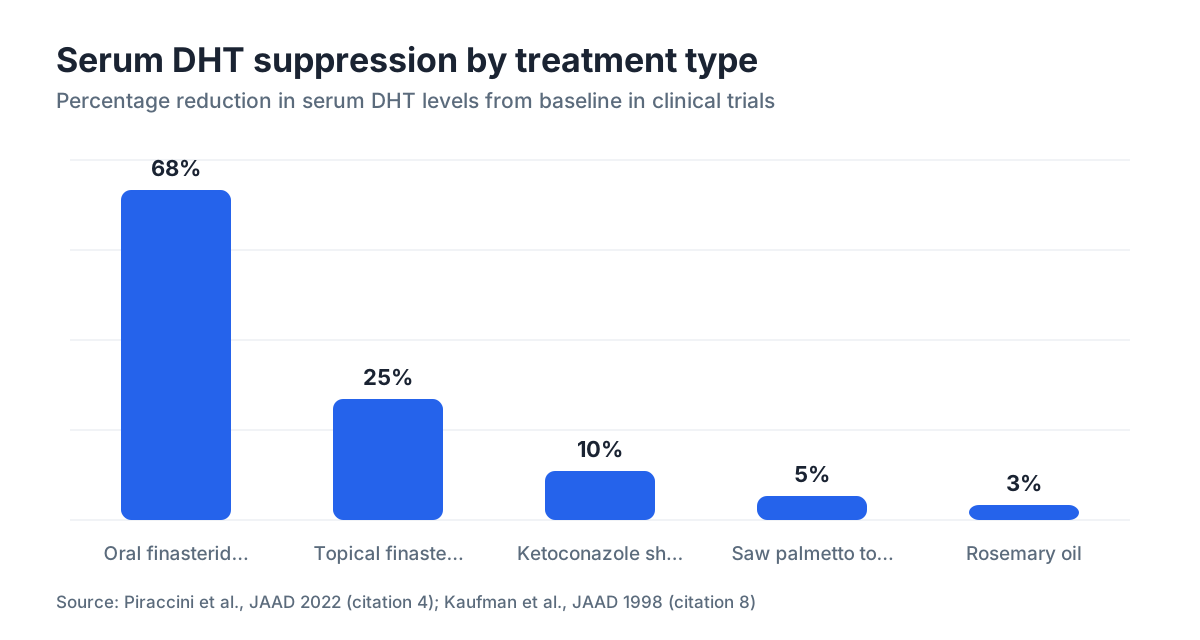
Topical finasteride: the strongest option in the topical category. A 2022 randomized trial in the Journal of the American Academy of Dermatology found topical finasteride 0.25% applied daily produced hair count gains comparable to oral finasteride 1 mg, while suppressing serum DHT far less (roughly 20-30% versus roughly 65-70% for the pill). [4] Lower systemic absorption is the main reason to pick the topical route, especially if sexual side effects worry you. Topical finasteride is not FDA-approved as a standalone product in the U.S. as of mid-2026, but compounding pharmacies formulate it legally under a physician's prescription.
Ketoconazole 2% (prescription) and 1% (OTC): originally an antifungal, ketoconazole seems to have anti-androgenic activity at the follicle. A small 1998 study in the journal Dermatology found a ketoconazole 2% shampoo used every 2 to 4 days gave hair density gains similar to 2% minoxidil over six months. [5] The data is thin and old, but ketoconazole shampoo is cheap and safe, which makes it a sensible add-on. It's a shampoo, not a serum, yet it gets pulled into DHT blocker conversations constantly.
Saw palmetto (topical): a 2020 randomized trial in the Journal of Cosmetic Dermatology pitted a topical saw palmetto preparation against minoxidil 5% in men with androgenetic alopecia. Minoxidil won by a meaningful margin, but saw palmetto still beat baseline with statistical significance at 24 weeks. [3] The honest read: saw palmetto is a mild, slow option, not a stand-in for proven treatments.
Rosemary oil: a 2015 randomized trial in Skinmed compared rosemary oil to 2% minoxidil over six months. Hair count gains landed statistically similar between groups, though both effects were modest. [6] Scalp itching was lower with rosemary. The sample was 100 patients and the study hasn't been replicated at scale, so read it with caution.
Pumpkin seed oil: one randomized placebo-controlled trial from 2014 in Evidence-Based Complementary and Alternative Medicine showed a 40% jump in hair count over 24 weeks in men taking oral pumpkin seed oil capsules versus 10% in placebo. [7] That was oral, not topical, and the study was small and industry-funded. Topical pumpkin seed oil data is basically nonexistent.
Caffeine: a handful of in-vitro studies suggest caffeine may counter testosterone-induced follicle suppression, and a few small human trials exist. The evidence is nowhere near what you'd need to call it a clinically meaningful DHT blocker. It might help a little. It probably doesn't hurt.
How do DHT serums compare to oral DHT blockers?
The honest comparison is topical finasteride versus oral finasteride, because those are the two options with real trial data on DHT pathway inhibition.
| Treatment | DHT suppression (serum) | Hair count evidence | FDA status | Main risk |
|---|---|---|---|---|
| Oral finasteride 1 mg/day | ~65-70% [4] | Strong (multiple RCTs) | FDA-approved | Sexual side effects, rare post-finasteride syndrome |
| Topical finasteride 0.25% | ~20-30% [4] | Moderate (growing RCT base) | Not FDA-approved standalone | Lower systemic exposure, same local mechanism |
| Oral dutasteride | ~90% | Moderate (approved in Japan/Korea) | Not FDA-approved for hair | Broader enzyme inhibition, longer half-life |
| Ketoconazole 2% shampoo | Unclear | Weak but positive | FDA-approved as antifungal | Minimal |
| Saw palmetto topical | Unclear | Very weak | Not approved | Minimal |
| Rosemary oil | Unclear | Very weak | Not approved | Minimal |
Oral finasteride's systemic DHT suppression is both its strength and its liability. It works well for most men. Roughly 83% saw no further loss at two years in the original two-year trial. [8] But about 1 to 2% of men in trials reported sexual side effects, which persisted in some after they stopped the drug. That figure is debated, and the post-finasteride syndrome discussion is still open.
Topical finasteride offers a middle path. Lower systemic exposure, similar local effect on the follicle, but less data and no FDA stamp. For a closer look at running both drugs together, see finasteride and minoxidil.
Are DHT blocking serums safe? What are the side effects?
Safety hangs entirely on what's in the bottle. Botanical serums (saw palmetto, rosemary, pumpkin seed oil) have a clean safety record in published trials. Serious adverse events are rare to nonexistent in the literature. The main risk is contact dermatitis or scalp irritation, which turns up occasionally with any leave-on product.
Topical finasteride serums carry the systemic risks of finasteride, just at lower levels. The 2022 JAAD trial measured serum DHT suppression at roughly 20-30% versus 65-70% for the pill. [4] That gap points to a lot less systemic absorption. But 'less' is not 'none.' Anyone worried about systemic finasteride exposure should talk it through with a dermatologist before starting a topical.
One practical concern with compounded topical finasteride is consistency. The FDA doesn't approve or inspect individual compounded preparations. A pharmacy's 0.25% solution may not deliver exactly 0.25% of active drug per dose, because compounding lacks the manufacturing quality controls of commercially made drugs. The FDA has published guidance on compounding standards, but batch-to-batch variability is real. [9]
For women with female pattern hair loss, any finasteride-based product is off-limits during pregnancy or for women who could become pregnant, because finasteride is a teratogen in male fetuses. [9] This applies to topical formulations too.
How long does a DHT blocking serum take to work?
Longer than most people expect. Hair follicles run on cycles measured in months, not days. Even a treatment that stopped DHT damage tomorrow wouldn't show visible regrowth for three to six months, because the follicle has to move through telogen (resting) phase before a fresh anagen (growth) phase kicks in.
In the 2022 topical finasteride trial, meaningful hair count increases showed up at six months. [4] The ketoconazole study used a six-month endpoint. The saw palmetto trial ran 24 weeks. Pick any of them and the pattern holds. Six months is the minimum meaningful trial period for any DHT-targeting treatment.
Plenty of people quit at week eight because they see nothing. That's the wrong moment to stop. The right check-in is a standardized scalp photo at six months, then again at twelve. Same lighting, same position, same camera distance, every time.
One warning. Some people go through a shedding phase in the first six to twelve weeks of any new hair treatment, minoxidil included. This is well-documented with minoxidil and less so with topical finasteride. An early shed usually isn't a sign the product is failing. Our article on telogen effluvium explains why that shed happens.
What ingredients should a good DHT blocking serum contain?
There's no single right answer, because the best formulation depends on your goal, your budget, and how much side-effect risk you'll accept.
If you want the most clinically supported topical DHT blocker: look for compounded topical finasteride (0.1 to 0.25%), formulated by a licensed compounding pharmacy under prescription. Some products blend it with minoxidil 5% or 10% in the same vehicle, which stacks two mechanisms (DHT reduction plus follicle stimulation). The minoxidil for men page covers the minoxidil half of that pairing.
If you want an OTC option with some evidence: look for saw palmetto extract (standardized to 85 to 95% fatty acids is the form used in most studies), ketoconazole 1% as a complementary shampoo step, and rosemary oil. Don't pay a premium for 'proprietary blends' that hide concentrations. Concentration matters. A product listing 'saw palmetto extract' without a number is vague for a reason.
Ingredients not worth paying extra for in a DHT serum: biotin (no DHT connection, only relevant for deficiency, which is rare), collagen peptides (no follicle mechanism for topical use), and copper peptides like GHK-Cu (interesting early data, but not a DHT blocker, mislabeled here by many brands).
For supplements you might take alongside a serum, see hair loss supplements for a straight review of what oral additions may or may not add.
Can women use DHT blocking serums?
Yes, with real caveats that depend on the specific product.
Women get androgenetic alopecia too. It usually shows as diffuse thinning across the crown rather than a receding hairline, and DHT sensitivity is one driver, though hormonal shifts like estrogen decline at menopause matter as well. A dermatologist can separate androgenetic alopecia from other causes like telogen effluvium through exam and blood work.
Botanical DHT serums (saw palmetto, rosemary oil) carry no pregnancy warnings and are generally safe for women. Topical finasteride is a different story. Finasteride is not approved for women in the U.S., is classified Pregnancy Category X (contraindicated in pregnancy), and the FDA label states that "women who are pregnant or may potentially be pregnant should not handle crushed or broken finasteride tablets." [9] That warning bites harder for a topical that absorbs through skin. Post-menopausal women sometimes use low-dose finasteride or dutasteride off-label under physician supervision, but that takes careful clinical judgment.
Minoxidil is the most evidence-backed topical for women with female pattern hair loss. The 2% concentration is FDA-approved for women. Some physicians prescribe 5%. The minoxidil side effects article covers what women specifically should know.
How do DHT blocking serums fit into a broader hair loss treatment plan?
No topical serum works alone as well as a stacked approach does. The highest-evidence protocol for androgenetic alopecia in men, as of current dermatology literature, pairs oral or topical finasteride (to slow further miniaturization) with minoxidil (to stimulate the follicle directly), and sometimes adds low-level laser therapy or microneedling as adjuncts. [10]
A DHT serum fits best two ways: as a monotherapy for people with early loss who want to skip systemic drugs, or as one layer in a stack alongside minoxidil. Running a botanical DHT serum and nothing else when you're already at Norwood 4 or 5 is unlikely to do much. Follicles that have fully miniaturized can't be revived by cutting DHT. You can slow further loss and possibly recover miniaturized (but not dead) follicles. Once a follicle is gone, the only option is a hair transplant.
If you're not sure what stage you're at, get a scalp read before you spend money on any stack. MyHairline's free AI scan (/scan) can assess your Norwood stage and pattern from photos, which at least gives you a starting point before you see a dermatologist.
For people with a receding hairline who caught it early, a topical DHT blocker plus minoxidil has a reasonable shot at stabilization and some regrowth. Don't wait until the loss is severe to start.
Is creatine linked to higher DHT levels, and does that matter for choosing a serum?
This one comes up constantly in gym circles. The worry traces to a 2009 study in the Clinical Journal of Sport Medicine, where college rugby players taking creatine for three weeks had a 56% rise in their serum DHT-to-testosterone ratio versus placebo. [11] The sample was 20 people. Testosterone itself didn't change much. No hair loss outcomes were measured.
So does creatine cause hair loss? Almost certainly not in people without genetic sensitivity to DHT. It might speed up miniaturization in people already headed for loss. Nobody has proven it either way in a well-powered trial built to answer that exact question. Our full article on does creatine cause hair loss works through the data.
If you take creatine and you're genetically prone to androgenetic alopecia, adding a DHT blocking serum as insurance isn't unreasonable. Just don't expect it to cancel a real DHT elevation if one exists. Topical finasteride lowers local scalp DHT. It doesn't meaningfully move serum DHT-to-testosterone ratios.
What does a DHT blocking serum cost, and are cheaper options worth it?
Prices swing wildly in this category and track poorly with evidence quality.
Compounded topical finasteride (0.1 to 0.25%) from a licensed U.S. compounding pharmacy usually runs $30 to $80 per month, depending on the formulation and pharmacy. Some telehealth platforms that prescribe and ship it charge $50 to $100 per month with the consultation included. These are real active-ingredient products.
OTC DHT serums from wellness brands run $25 to $90 per bottle, most in the $45 to $70 range. Most hold botanical blends with no listed concentrations. The $70 saw palmetto serum from a premium brand is almost certainly no better than a $25 equivalent from a less photogenic brand if both refuse to list the standardized extract concentration.
Ketoconazole 1% shampoo (OTC) costs $8 to $15. Nizoral 1% is the best-known brand. Prescription-strength ketoconazole 2% shampoo runs $30 to $60 without insurance, though it's sometimes covered.
Rosemary oil (diluted in a carrier oil like jojoba) can be built at home for under $15 per month. The 2015 Skinmed trial used a specific preparation. Off-the-shelf rosemary essential oil at 1 to 2% dilution in a carrier approximates it reasonably. [6]
The money order if you're building a rational stack: oral or topical finasteride (if appropriate and prescribed) first, minoxidil second, everything else third. Spending $80 on a botanical serum before trying the proven stuff gets the order backward.
What do dermatologists actually recommend for DHT-related hair loss?
The American Academy of Dermatology names oral finasteride and minoxidil as the two treatments with the strongest evidence for androgenetic alopecia in men. [10] The AAD lists no DHT serum brand or botanical as a recommended first-line treatment.
The AAD states that "finasteride is approved by the U.S. Food and Drug Administration (FDA) to treat men with male pattern hair loss." [10] Minoxidil holds a parallel FDA approval. Everything else in the topical DHT blocker category is adjunct, investigational, or mostly a business proposition.
That doesn't mean dermatologists never reach for topical finasteride or ketoconazole. Many do, especially topical finasteride for men who want to dodge systemic exposure. But they prescribe it as a compounded product, not as a branded 'DHT serum' from a supplement company.
The practical read from the dermatology literature: if your hair loss is progressing and it bothers you, see a board-certified dermatologist (or a dermatologist who specializes in hair, called a trichologist in some countries). Get a real diagnosis. Then build your stack on the evidence, starting with approved options and adding topical adjuncts if you want extra layers. Trying OTC serums for a year before seeing a doctor delays the interventions that actually work, and follicle loss in that year may be permanent.
If cost or access is the barrier to a professional opinion, MyHairline's free AI scan (/scan) can at least help you understand your pattern and stage before the appointment.
Sources
- National Institutes of Health, MedlinePlus: Androgenetic alopecia
- American Academy of Dermatology, Hair loss types: Androgenetic alopecia
- Journal of Cosmetic Dermatology, 2020: Topical saw palmetto vs minoxidil 5% for androgenetic alopecia
- Piraccini BM et al., Journal of the American Academy of Dermatology, 2022: Topical vs oral finasteride RCT
- Piérard-Franchimont C et al., Dermatology, 1998: Ketoconazole shampoo for androgenetic alopecia
- Panahi Y et al., Skinmed, 2015: Rosemary oil vs 2% minoxidil for androgenetic alopecia
- Cho YH et al., Evidence-Based Complementary and Alternative Medicine, 2014: Pumpkin seed oil for hair growth
- Kaufman KD et al., Journal of the American Academy of Dermatology, 1998: Finasteride 1 mg two-year RCT
- FDA, Propecia (finasteride) prescribing information and label
- American Academy of Dermatology: Treating male pattern hair loss
- van der Merwe J et al., Clinical Journal of Sport Medicine, 2009: Creatine supplementation and DHT:testosterone ratio