

TL;DR: A mature hairline is a normal shift that happens to roughly 96% of adult men, moving the hairline back up to about 1.5 cm from its teenage position and then stopping permanently. A receding hairline caused by male pattern baldness keeps moving. The difference comes down to pattern, speed, temple shape, and whether hair loss stops on its own.
What is a mature hairline and is it normal?
A mature hairline is the hairline you settle into as an adult, after the soft, rounded, low hairline of adolescence lifts slightly to sit in a more defined position. Almost every man gets one. A 2004 study published in Dermatologic Surgery found that approximately 96% of Caucasian men develop a mature hairline at some point during adulthood [1]. It is not a disease. It is not hair loss in the clinical sense. It is simply the final position your hairline takes once your scalp and hair follicles finish maturing.
The shift usually happens between the late teens and mid-twenties. The hairline moves back symmetrically, the temples may become very slightly more angular, and then it stops. That last word matters. It stops. The follicles do not miniaturize. The density behind the new hairline stays the same. You do not progress to a Norwood 2 or 3. The hairline just looks a little more "adult" than it did at sixteen.
A lot of men panic when this happens, especially because the shift can feel sudden when you notice it in photos. But noticing it is not the same as it being a problem.
What does a receding hairline look like compared to a mature one?
This is the real question, and the honest answer is that the two can look very similar in early stages. That is why so many men end up anxious and Googling at two in the morning.
A mature hairline typically sits about 1 to 1.5 cm above the highest forehead wrinkle [1]. It is usually fairly even across the front, with temples that may form a gentle angle or slight recession but remain symmetric. The hairline has a defined edge. The skin behind it is not thinning.
A receding hairline caused by androgenetic alopecia (male pattern baldness) follows a different pattern. It typically starts at the temples first, creating an "M" shape as the two corners pull back faster than the center. Over time the center catches up. The American Academy of Dermatology describes the progression as moving from the Norwood Stage 1 (essentially a mature hairline) through increasingly dramatic recession and crown thinning [2]. What separates a Norwood 1 from a Norwood 2 is more than position, it is continued movement and the beginning of miniaturization, where individual hairs become finer and shorter before disappearing.
One practical test: pull a small section of hair from near your temple between two fingers. If those hairs are visibly finer or shorter than hairs from the back of your scalp, miniaturization may already be occurring. That does not happen with a mature hairline.
| Feature | Mature Hairline | Receding Hairline (AGA) |
|---|---|---|
| Movement | Stops after settling | Continues over months/years |
| Symmetry | Symmetric across forehead | Often starts asymmetric at temples |
| Position above top wrinkle | ~1 to 1.5 cm | Varies; keeps increasing |
| Temple shape | Slight angle, stable | "M" shape, deepening over time |
| Hair density behind line | Normal, unchanged | May thin progressively |
| Hair shaft thickness | Normal | Miniaturization often present |
| Age of onset | Late teens to mid-20s | Any age, often early-to-mid 20s onward |
| Family history of baldness | Not predictive | Strongly predictive |
| Crown involvement | None | Often develops over time |
How far back does a normal mature hairline sit?
The most commonly cited threshold is roughly 1 to 1.5 centimeters above the uppermost forehead wrinkle [1]. Some dermatologists describe it as sitting about one finger-width above that crease. If your hairline is at or within that range and has not moved in a year or two, it is almost certainly just a mature hairline.
Beyond 1.5 cm starts to enter territory that could indicate early male pattern baldness, especially if you are also seeing temple recession and you are younger than 35. But position alone is not enough. A man with a naturally high forehead can have a mature hairline that sits higher than 1.5 cm and have no active recession at all. Position is a data point, not a diagnosis.
The more useful question is: has it moved in the last six to twelve months? Take a photo in consistent lighting, same angle, every two months. If the position is genuinely stable, you almost certainly have a mature hairline.
What causes a hairline to recede beyond the mature position?
Androgenetic alopecia is the main driver. It affects an estimated 50 million men in the United States, according to the American Academy of Dermatology [2]. The mechanism involves dihydrotestosterone (DHT), a hormone derived from testosterone via the enzyme 5-alpha reductase. In genetically susceptible follicles, DHT binds to androgen receptors and gradually shrinks the follicle, producing progressively thinner, shorter hairs until the follicle stops producing visible hair entirely.
Genetics is by far the strongest predictor. The gene variants most associated with male pattern baldness sit on the X chromosome, which is why the old advice about checking your maternal grandfather has some truth to it, though the inheritance is polygenic and your paternal side matters too [3]. If both grandfathers went bald, your odds are meaningfully higher.
Other things that can cause hairline changes but are distinct from AGA include telogen effluvium, which is a diffuse shedding often triggered by illness, stress, surgery, or rapid weight loss. Telogen effluvium typically causes diffuse thinning rather than a receding hairline pattern, and it usually reverses once the trigger is resolved. Traction alopecia from tight hairstyles can also pull the hairline back, but again, the pattern is different from AGA. See what causes hair loss for a broader breakdown.
DHT is the key hormone to understand here. A dht blocker approach like finasteride works by reducing DHT systemically, which is why it is effective at slowing AGA but also why it carries hormonal side effects.
How do I know if my hairline is still moving or has stabilized?
Serial photography is the most reliable method most people have access to. Set a reminder on your phone to take a photo in the same spot, same lighting (natural light from a window works well), same angle, on the first of every month. Compare across three to six months. If the position does not change, it is probably mature and stable. If it clearly moves, that is meaningful.
Dermatologists and trichologists use dermoscopy and sometimes phototrichography to measure hair shaft diameter and density with much more precision. Miniaturized hairs (shaft diameter below roughly 0.04 mm) are a sign of AGA even if the visible hairline has not moved much yet. This is not something you can easily assess yourself, but it is what a hair specialist will look for.
Another practical signal: shed hairs. Some shedding is normal (50 to 100 hairs per day is a widely cited figure, sourced to AAD guidance [2]). If you are consistently finding significantly more than that on your pillow or in the shower drain over multiple weeks, and especially if those shed hairs have tiny white bulbs attached (which is normal) but are noticeably short or thin-shafted, that warrants a look from a dermatologist.
For a fast initial read, the free AI scan at MyHairline (myhairline.ai/scan) can analyze a photo and flag early patterns consistent with recession versus stabilization. It is not a clinical diagnosis, but it is a reasonable first step before booking a doctor.
Can a mature hairline suddenly start receding later in life?
Yes, and this trips people up. Having a stable mature hairline at 25 does not guarantee it stays stable at 35 or 45. Androgenetic alopecia can begin or accelerate at any age in genetically susceptible men, though the most common onset is in the 20s and 30s. The Norwood scale documents progression that can continue for decades.
The way to think about it: a mature hairline and early AGA are not mutually exclusive categories. A man can have his hairline mature normally in his early twenties and then, because of his genetics and DHT sensitivity, begin experiencing true AGA-driven recession in his thirties. The hairline was mature for a while. Then it started moving again. That second phase is different.
This is why ongoing monitoring matters if you have a family history of significant baldness. The absence of progression today is good news, not a permanent guarantee.
What treatments actually work if your hairline is genuinely receding?
Two treatments have solid clinical evidence and FDA approval for male pattern hair loss: minoxidil (topical and oral) and finasteride. Everything else has much weaker data.
Finasteride (1 mg daily, oral) works by inhibiting 5-alpha reductase, reducing serum DHT by roughly 70% [4]. The original registration trials showed it stopped progression in about 83% of men and produced visible regrowth in about 66% after two years [4]. It is prescription-only. Side effects, though reported in a minority of users, include decreased libido and erectile dysfunction, and rare reports of persistent sexual side effects after discontinuation exist. See finasteride for the full clinical picture, or finasteride and minoxidil if you are considering combining both.
Minoxidil was originally a blood pressure medication and was noticed to cause hair growth as a side effect. Applied topically (2% or 5% solution or foam), it is the only topical treatment FDA-approved for hair loss [5]. It appears to work by prolonging the anagen (growth) phase and possibly increasing blood flow to follicles. Oral minoxidil at low doses (0.625 mg to 2.5 mg daily) is increasingly used off-label and some small trials suggest it may be more effective than topical for certain patients. Read more about oral minoxidil and minoxidil for men.
Hair transplant surgery (FUT or FUE) is not a treatment for active recession, it is a reconstruction tool for men who have already lost significant hair and want to restore density. Doing a transplant while AGA is still active without medical management often leaves the transplanted area looking isolated as surrounding native hair keeps receding. A hair transplant makes most sense after recession has been stabilized medically, or in combination with ongoing finasteride use.
Biotin supplements, shampoos marketed as DHT-blocking, and various hair loss supplements have very limited or no clinical evidence for reversing AGA-driven recession. Some nutrients (iron, zinc, vitamin D) matter if you are genuinely deficient, but supplementing beyond adequacy does not regrow a receding hairline.
Does a mature hairline affect everyone the same way, or are some men at higher risk?
The maturation itself is nearly universal among men regardless of ethnicity, though the exact timing and degree varies. The risk of that maturation continuing into clinical AGA is where ethnicity, genetics, and hormones diverge significantly.
Research from the International Society of Hair Restoration Surgery and various dermatological studies suggests AGA affects different populations at different rates. East Asian men, for instance, tend to show lower rates of AGA compared to men of European descent, though rates increase in second-generation immigrants in Western countries, suggesting both genetic and possibly environmental factors [3].
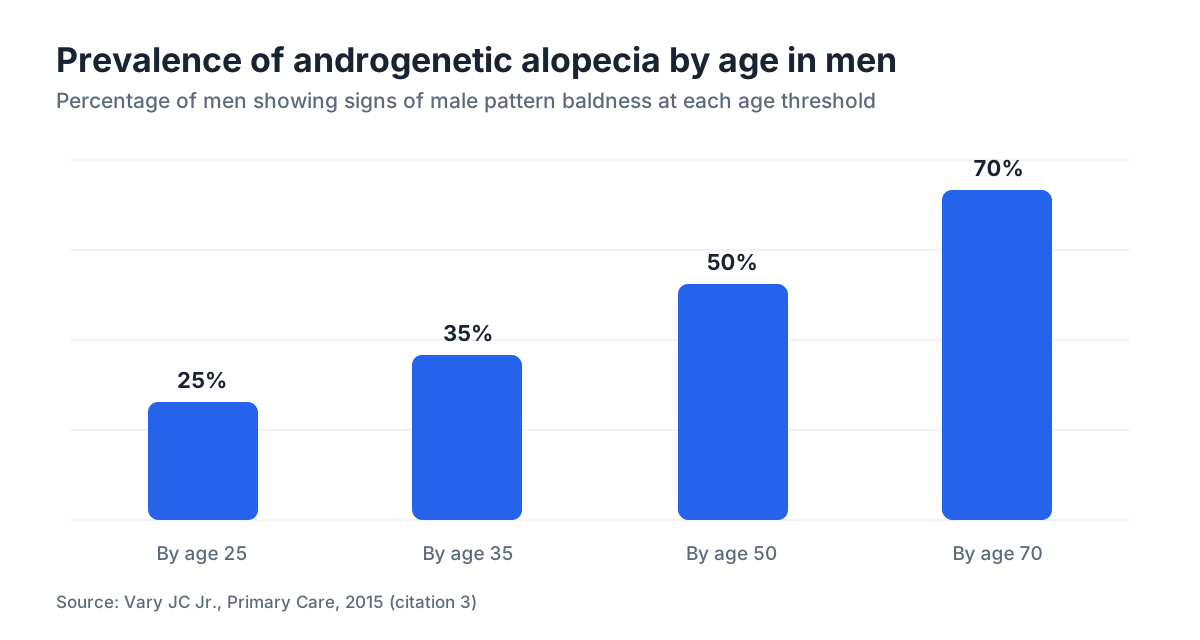
Age is the biggest crude predictor. Roughly 25% of men show signs of AGA by age 25, about 50% by age 50, and about 70% by age 70, according to figures cited in dermatological literature [3]. So the majority of men who experience a mature hairline will not go on to develop significant AGA. Most hairlines mature and stay put.
Family history remains the most actionable predictor you have. If your father was significantly bald by 40 and your maternal grandfather was too, your risk is substantially elevated. That does not mean recession is inevitable, but it means monitoring matters and early intervention (if you decide you want it) is more likely to be worthwhile.
Should I see a dermatologist, or can I figure this out myself?
For a lot of men, the serial photo approach and honest self-assessment is enough to tell the story. If your hairline has been in the same position for a year and you have no miniaturization you can notice, you probably have a mature hairline and can stop worrying.
But there are situations where seeing a board-certified dermatologist or a trichologist is genuinely worth it. If your hairline seems to be moving fast (visible change in three to four months), if you are under 22 and already seeing significant recession, if you have diffuse thinning across the scalp rather than a pattern-matching recession (which might suggest something other than AGA, including thyroid issues, iron deficiency, or telogen effluvium), or if you want to start finasteride and need a prescription, a professional visit has real value.
The American Academy of Dermatology has a find-a-dermatologist tool at aad.org [2]. If you want a faster preliminary read before the appointment, a hair analysis tool can help you arrive with more information rather than less. The MyHairline AI scan at myhairline.ai/scan does exactly that.
Mature hairline vs receding hairline: a direct side-by-side summary
If you have read this far and still want a clean comparison to reference, here it is.
A mature hairline moves back once, settles around 1 to 1.5 cm above your top forehead wrinkle, stays symmetric, maintains normal hair density behind it, and does not progress. It is a biological event that nearly all adult men experience. No treatment is needed or appropriate.
A receding hairline caused by AGA keeps moving. It typically starts at the temples, creates an M-shaped pattern, involves miniaturization of the hair shaft, and will continue without intervention in genetically susceptible men. It can be slowed or partially reversed with finasteride or minoxidil, both of which have FDA-approved status for this purpose [4][5]. It can be surgically reconstructed with a hair transplant once stabilized.
The honest reality is that early AGA (Norwood 1 to 2) and a mature hairline look nearly identical to the untrained eye, and even experienced clinicians rely on serial observation and dermoscopy rather than a single snapshot. If you are genuinely unsure, the single best thing you can do is track it with photos over six to twelve months and visit a dermatologist if you see movement.
Sources
- Norwood OT. Dermatologic Surgery, 2001. Male pattern alopecia: classification and incidence.
- American Academy of Dermatology Association, Hair Loss resource page
- Vary JC Jr. Selected Disorders of the Hair and Hair Follicle. Prim Care. 2015;42(4). NCBI PubMed Central.
- Kaufman KD et al. Journal of the American Academy of Dermatology, 1998. Finasteride in the treatment of men with androgenetic alopecia.
- FDA OTC monograph and label history for topical minoxidil (Rogaine), FDA Drugs@FDA database
- van Zuuren EJ et al. Cochrane Database of Systematic Reviews, 2016. Interventions for female pattern hair loss.
- Sinclair R. Male pattern androgenetic alopecia. The Lancet, 1998.
- Trüeb RM. Molecular mechanisms of androgenetic alopecia. International Journal of Trichology, 2010.