
TL;DR: Silica supplements show modest, short-term improvements in hair thickness in a small number of human trials, most notably a 2007 study finding significantly reduced hair loss and improved tensile strength after 9 months. But the trials are small, industry-funded, and silica is not FDA-approved to treat hair loss. It works best for nutritional deficiencies, not androgenetic alopecia.
What is silica and why do people think it helps hair?
Silica is the common name for silicon dioxide, a mineral that occurs naturally in the human body, mostly in connective tissues. Your hair shaft, nails, and skin all contain measurable amounts of silicon. The idea is simple: if silicon is structurally present in hair, maybe supplementing it makes hair stronger or thicker.
The biological case is not crazy. Silicon is thought to influence the cross-linking of collagen and glycosaminoglycans in the dermal papilla, the cluster of cells at the base of each follicle that drives hair growth [1]. Lower silicon concentrations have been measured in brittle or fine hair compared to normal hair in some tissue analyses. That association does not prove causation, but it gave researchers a reason to run supplementation trials.
The supplement itself usually comes in two forms: orthosilicic acid (OSA), a water-soluble form, and a plant-based extract from horsetail (Equisetum arvense). Choline-stabilized orthosilicic acid (ch-OSA) is the form used in most of the published human trials because it has higher bioavailability than silica gel or dried horsetail [2]. If you're comparing labels at a pharmacy, those differences matter.
What does the actual human trial evidence show?
Three controlled human studies are most cited. Here is what they actually found:
| Study | Year | Form | Dose | Duration | Primary finding |
|---|---|---|---|---|---|
| Wickett et al. | 2007 | ch-OSA | 10 mg Si/day | 9 months | Significant decrease in hair loss, improved tensile strength vs. placebo [3] |
| Barel et al. | 2005 | ch-OSA | 10 mg Si/day | 20 weeks | Improved nail brittleness; limited hair data reported |
| Araújo et al. | 2016 | Horsetail extract | 300 mg/day | 90 days | Improved hair brightness and reduced breakage (self-reported) [4] |
The Wickett 2007 study [3] is the strongest of the three. It was a randomized, double-blind, placebo-controlled trial in 48 women with fine hair. After nine months, the ch-OSA group had statistically significant improvements in hair tensile strength, elasticity, and cross-sectional diameter. The authors concluded that "oral intake of ch-OSA has a positive effect on skin and hair" and that the differences were not explainable by placebo alone.
But here is the honest problem. Forty-eight participants is a very small sample. The study was partly funded by the manufacturer of ch-OSA. And it has never been replicated at a larger scale by an independent group. Those are not reasons to dismiss it outright, but they are reasons not to treat it as settled science.
The Araújo 2016 trial on horsetail extract has even weaker methodology. Most of its hair outcomes were self-reported, which is notoriously unreliable data. And horsetail extract has poor bioavailability compared to ch-OSA, so the two should not be assumed equivalent.
Bottom line: there is preliminary, positive evidence, and it is genuinely encouraging. There is not enough evidence to call silica a proven hair treatment.
How does silica compare to proven hair loss treatments?
This is where the honest conversation gets harder for silica supplements.
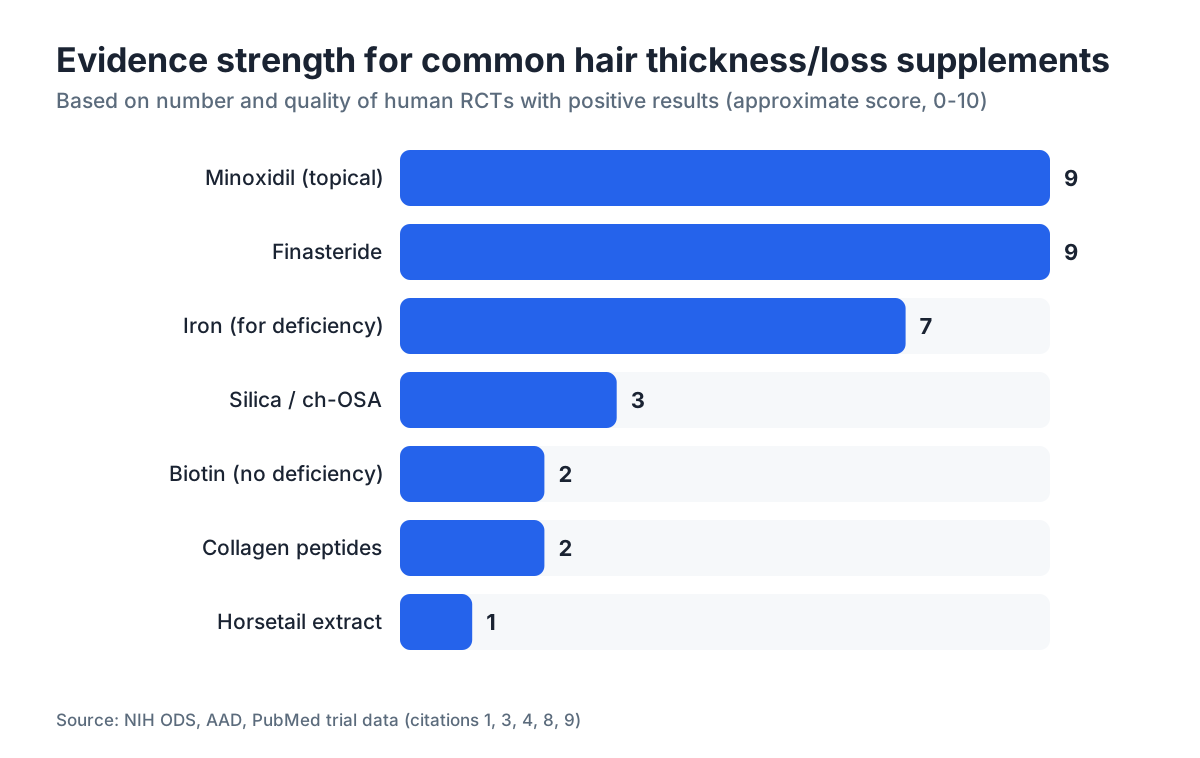
Finasteride and minoxidil are the two treatments with decades of large, replicated, randomized controlled trial data behind them. Finasteride reduces scalp DHT by roughly 60-70% and has been shown in a 2-year trial of over 1,500 men to halt or reverse androgenetic alopecia in the majority of users [5]. Minoxidil, applied topically or taken orally, has similarly strong evidence across multiple large trials. Neither is a miracle: both require ongoing use and have side effects worth knowing. You can read more about the tradeoffs in our article on finasteride and on minoxidil side effects.
Silica has one small trial showing modest improvement in fine hair. That is a meaningful gap.
For people with hair thinning driven by nutritional deficiency (low iron, low protein, specific vitamin deficits), correcting that deficiency can produce noticeable regrowth. Silica fits loosely in that category: if your diet is genuinely low in bioavailable silicon, supplementing may help. But most people eating a reasonably varied diet get silicon from drinking water, grains, and vegetables [1]. Genuine silicon deficiency severe enough to cause hair problems is not well-documented in otherwise healthy adults.
If you're dealing with a receding hairline or pattern hair loss rather than general fine hair, see what causes hair loss before spending money on supplements.
Is silica FDA-approved for hair loss or hair thickness?
No. Silica supplements are regulated by the FDA as dietary supplements under the Dietary Supplement Health and Education Act of 1994 (DSHEA). Under DSHEA, manufacturers do not need to prove a supplement is effective before selling it, and they cannot legally claim it treats or cures any disease, including hair loss [6].
The FDA has approved only two drugs specifically for androgenetic hair loss: topical minoxidil (OTC for both men and women) and oral finasteride (prescription, men only). No supplement, including silica, biotin, or collagen, is on that list.
This matters practically. When you see a silica supplement marketed with language like "supports healthy hair growth" or "promotes thicker hair," that is a structure/function claim, not a disease claim. It tells you nothing about whether the product has been tested against a placebo in a rigorous trial. Always look for a supplement with third-party testing certification (USP, NSF International, or ConsumerLab) so you at least know what you're getting is what the label says [6].
What dose of silica is used in studies and is it safe?
The most studied dose is 10 milligrams of elemental silicon per day as ch-OSA, which is the form used in the Wickett 2007 trial [3]. This is a low dose by any measure.
Silicon is generally considered safe. No tolerable upper intake level has been formally established by the National Institutes of Health Office of Dietary Supplements because toxicity from oral silicon in food or supplement form has not been demonstrated in humans at doses found in commercial products [1]. That said, the safety data for long-term high-dose supplementation (above 30-40 mg/day as OSA) in humans is thin simply because it has not been extensively studied.
The form matters for safety too. Crystalline silica (the kind in industrial dust) is a known lung carcinogen and is completely different from the food-grade or supplement-grade silicon dioxide or orthosilicic acid. Do not confuse them.
Horsetail-based supplements carry their own note: some horsetail products have been found to contain thiaminase, an enzyme that degrades vitamin B1 (thiamine), and a few cases of thiamine deficiency have been linked to high-dose, long-term horsetail use [4]. If you choose a horsetail product, look for one that specifies thiaminase has been removed or inactivated.
Pregnant or nursing women should avoid silica supplements in the absence of specific guidance from a physician, simply because no trials have been run in that population.
Does silica help with telogen effluvium or just androgenetic alopecia?
The published trials enrolled women with fine hair, not people diagnosed with telogen effluvium or androgenetic alopecia (AGA) specifically. That distinction matters because these are biologically different problems.
Telogen effluvium is diffuse shedding usually triggered by a stressor: illness, crash diet, surgery, postpartum hormonal shifts [7]. If the trigger is nutritional (very low protein, iron-deficiency anemia, for example), correcting it stops the shed. Silica is not known to directly address the triggers of telogen effluvium. If your shed started after a specific event, the more productive question is whether you have a nutrient deficit or an ongoing stressor, not whether you need a silica pill. Read more about that process in telogen effluvium.
Androgenetic alopecia is driven by DHT sensitivity at the follicle level [8]. Silica has no known mechanism for blocking DHT. If that is your situation, a DHT blocker like finasteride is the evidence-based choice. Silica could theoretically support the structural health of whatever hair you have, but it will not stop the miniaturization process.
General fine hair without a specific diagnosis is probably where silica has its best (if still modest) shot at helping, based on the available evidence.
How long does silica take to show results on hair?
The Wickett 2007 trial ran for nine months [3]. That is not an accident. Hair grows roughly 1 centimeter per month in the anagen phase, and measurable changes in hair shaft diameter or tensile strength take multiple growth cycles to detect reliably. Nine months is a reasonable minimum window.
You should not expect to see meaningful differences in three to four weeks, despite what some supplement marketing suggests. The claims of dramatic results in 30 days are not supported by any controlled trial data on silica.
If you're going to test a silica supplement honestly, plan for at least six to nine months, keep your other variables constant (diet, stress, any other supplements), and compare photos taken under consistent lighting. Hair thickness measured at a salon or dermatologist's office with a trichoscope gives you far more reliable feedback than eyeballing it in the mirror.
What do dermatologists actually say about silica for hair?
Most dermatologists do not recommend silica as a first-line treatment for hair loss. The American Academy of Dermatology's patient-facing guidance on hair loss focuses on FDA-approved treatments, addressing underlying medical causes, and in some cases low-level laser therapy (for androgenetic alopecia) [9]. Silica does not appear on the AAD's recommended treatment list.
That does not mean dermatologists universally dismiss it. Some are cautiously open to it in patients with fine, non-scarring hair who want to try something low-risk before committing to a drug. The logic is: the safety profile looks acceptable, the cost is low, and there is a plausible mechanism plus at least one decent small trial. For someone who can't take or doesn't want finasteride or minoxidil, that is a reasonable conversation to have.
If you want a personal opinion rather than a protocol: silica is one of the more defensible over-the-counter hair supplements compared to some of the wilder options. But it is still a minor-evidence supplement, not a treatment. If your hair loss is progressive and patterned, supplements alone will not hold the line.
For a broader look at where silica fits in the supplement landscape, hair loss supplements covers the evidence for biotin, collagen, iron, and other common options.
How much silicon do you already get from food and water?
Dietary silicon intake for adults in Western countries is estimated at 20 to 50 milligrams per day from food and water combined, with beer, whole grains, green beans, and tap water among the largest contributors [1]. Many people eating a normal diet are already hitting or exceeding the 10 mg/day dose used in the main silica trial.
This raises a practical question: if you are already getting 30-40 mg of silicon per day from your diet, will adding a 10 mg supplement do anything? Nobody has a good answer to that. The trial populations were not screened for baseline silicon status, so we do not know if benefits were driven by correcting a relative deficiency or by true pharmacologic effect at higher levels.
This is exactly the kind of gap that makes interpreting supplement trials frustrating. If you eat lots of whole grains and drink beer occasionally, you may already be saturated from a silicon standpoint, and a supplement could be money wasted. If you eat a very low-grain, low-vegetable diet, there may be more room for supplementation to matter.
If you're curious about whether your hair thinning has any nutritional component, a full panel (ferritin, vitamin D, zinc, thyroid) through your primary care doctor is more useful than guessing.
Should you try silica, or is there something better worth the money?
If you have fine hair and no clear diagnosis of androgenetic alopecia or telogen effluvium, silica is a low-risk thing to try. A good-quality ch-OSA supplement costs roughly $20-40 per month, has an acceptable safety profile at studied doses, and has one positive randomized controlled trial behind it. That puts it above most beauty supplements and below any FDA-approved drug in terms of evidence strength.
If you have patterned hair loss, a receding hairline, or significant shedding, silica is almost certainly not enough. See a dermatologist. Get a diagnosis. Treatments like minoxidil for men or oral finasteride have decades of evidence behind them and will do more for AGA than any supplement. If you are weighing combining approaches, finasteride and minoxidil together is worth reading.
For transplant candidates, hair transplant is the only option that adds permanent density, though supplements may help protect existing hair around the procedure.
If you're unsure what type of hair loss you're dealing with, running a quick pattern analysis before buying anything makes sense. The free AI hair analysis at MyHairline (/scan) can give you a baseline read on your hairline pattern, which at least tells you whether you're dealing with something nutritional and diffuse or something structural and patterned. That distinction changes what you should be spending money on.
One final point on opportunity cost: $40 per month on a silica supplement for nine months is $360. For the same money, you could cover several months of generic topical minoxidil, which has far stronger evidence. That is worth knowing before you fill your cart.
Sources
- Jugdaohsingh R, J Nutr Health Aging 2007 - Silicon and bone health
- Wickett RR et al., Archives of Dermatological Research, 2007
- Araújo LA et al., Journal of Clinical and Aesthetic Dermatology, 2016
- Finasteride (Propecia) prescribing information, FDA
- FDA, Dietary Supplement Health and Education Act of 1994 overview
- American Academy of Dermatology, Telogen Effluvium overview
- Barel A et al., Archives of Dermatological Research, 2005
- NIH National Library of Medicine, Equisetum arvense (horsetail) monograph