

TL;DR: A receding hairline in women is common and treatable. The most frequent causes are female-pattern hair loss (androgenetic alopecia), traction alopecia, and hormonal shifts. Topical minoxidil 2% or 5% is the only FDA-approved topical treatment. Timing matters: most women who act within the first year see stabilization or regrowth.
What does a female receding hairline actually look like?
Most people picture hairline recession as a man's problem, a slow march backward from the temples into an M-shape. Women lose it differently. Female recession is subtler at first, and that's exactly what makes it easy to dismiss.
The most common pattern is widening along the center part, often paired with thinning just behind the frontal hairline. The temples are another frequent starting point. Many women notice their temple hairline becoming more irregular, less dense, or shaped in a small triangular recession on one or both sides. That temple thinning can happen even when the rest of the hair looks fine.
A rarer but more dramatic pattern is a frontal band of diffuse thinning running across the whole front of the scalp, sometimes called the "Christmas tree" pattern when it extends into the part. This is characteristic of Ludwig-scale female-pattern loss.
What it does not usually look like is a sharp, clean hairline moving straight back uniformly. If that's what you're seeing, traction alopecia (from tight styling) or frontal fibrosing alopecia (a scarring form) is more likely than straightforward female-pattern loss. The distinction matters because treatment differs.
If you're unsure what pattern you have, a dermatologist or trichologist can diagnose it with a dermoscopy exam, and some AI-based tools (like the free scan at MyHairline) can give you a starting read before your appointment.
What causes a receding hairline in women?
There is no single cause, which is why treatment has to start with the right diagnosis. The major culprits break down like this:
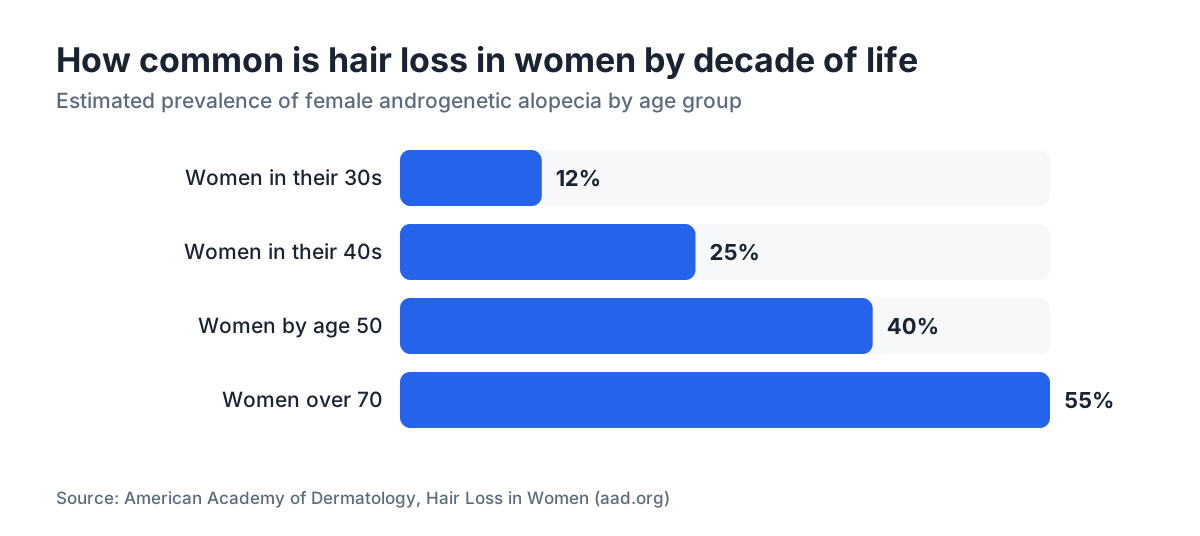
Female-pattern hair loss (androgenetic alopecia). This is the most common cause of progressive hairline changes in women. Genetic sensitivity to dihydrotestosterone (DHT) causes hair follicles to miniaturize over time. Unlike in men, women's frontal hairline often stays somewhat intact at first while the part widens, but temple recession is frequent. Androgenetic alopecia affects roughly 40% of women by age 50 [1]. See the full explainer on what causes hair loss for the genetic mechanism.
Traction alopecia. Repeated mechanical tension on follicles, from tight ponytails, braids, extensions, or weaves, can cause permanent recession at the temples and hairline margins over years. A 2016 study in the Journal of the American Academy of Dermatology found traction alopecia in 31.7% of African American women surveyed [2]. The damage starts reversible. Leave it long enough, and it isn't.
Frontal fibrosing alopecia (FFA). A slowly progressive scarring alopecia that causes a band of recession around the front and sides of the scalp. The hairline recedes in a relatively clean line, and the skin in that zone can look pale or slightly shiny. FFA is rising in incidence; its cause is not fully understood, but immune-mediated inflammation is involved [3]. It does not respond to minoxidil the same way androgenetic alopecia does.
Hormonal shifts. Postpartum hair shedding, perimenopause, thyroid dysfunction, and polycystic ovary syndrome (PCOS) all disrupt the hair cycle. Most postpartum shedding is telogen effluvium, a diffuse shed rather than true recession, but it can make an existing recession more visible. PCOS-related androgen excess can accelerate androgenetic alopecia.
Nutritional deficiency. Severe iron deficiency, ferritin below roughly 30 ng/mL, and low protein intake are documented contributors. These usually cause diffuse shedding rather than patterned recession, but they can worsen any underlying pattern.
A DHT blocker can address the androgenetic pathway, but it won't help traction or scarring loss, which is why getting the diagnosis right before spending money on treatment is worth the effort.
How is a receding hairline in women diagnosed?
A diagnosis requires more than looking in a mirror. The clinical workup usually includes:
A scalp examination with a dermatoscope. Under magnification, androgenetic alopecia shows miniaturized hairs of varying diameter. Frontal fibrosing alopecia shows follicular loss without the follicle openings. Traction alopecia shows broken or absent hairs along tension lines.
Blood work. A thoughtful clinician will check ferritin, full iron studies, a complete blood count, thyroid-stimulating hormone (TSH), free T3/T4, and, if androgen excess is suspected, total and free testosterone, DHEAS, and prolactin. These rule out reversible systemic causes.
A standardized pull test. Gentle traction on a bundle of about 60 hairs. More than 6 hairs pulled out is considered positive for active shedding.
Photographic documentation. Side-by-side photos under consistent lighting are the only reliable way to track slow progression over months.
Some dermatologists also do a scalp biopsy to distinguish scarring from non-scarring alopecia. It sounds dramatic but it's a small punch biopsy under local anesthetic, and it can completely change the treatment plan.
Dermatologists use the Ludwig scale for female-pattern loss (Grade I, II, III) and the Sinclair scale, which is a 5-point system based on center-part widening [4]. Grade I on either scale is the best time to start treatment, when follicles are still salvageable.
What treatments actually work for a female receding hairline?
Here's what has real evidence behind it, and honest notes on what doesn't.
Topical minoxidil. The only FDA-approved topical treatment for female-pattern hair loss. The FDA approved the 2% concentration for women in 1991 and the 5% foam in 2014 [5]. Clinical trials show that 2% minoxidil leads to meaningful hair count increases in about 60% of women who use it consistently for 6 months. The 5% formulation likely works faster and may be more effective, though it carries a slightly higher risk of facial hair growth. You apply it once or twice daily (check the label; the 5% foam is once daily). It does not work overnight. Most women don't see clear results before 4 months, and stopping it reverses the benefit. For a full look at what can go wrong with it, read about minoxidil side effects.
Oral minoxidil. Low-dose oral minoxidil (0.25 to 1 mg/day for women) is increasingly used off-label. A 2020 study in the Journal of the American Academy of Dermatology showed meaningful hair density improvement at 24 weeks with 1 mg/day in women [6]. It's not FDA-approved for hair loss in this form, but it's the same drug at a much lower dose than its approved cardiac use. The main concerns are fluid retention and, rarely, excess body hair. Oral minoxidil deserves serious consideration if topical application is difficult to maintain.
Finasteride. FDA-approved for male-pattern baldness at 1 mg/day. In women, it's used off-label, and the data are mixed. It is absolutely contraindicated in women who are pregnant or may become pregnant because it causes birth defects in male fetuses [7]. Postmenopausal women with androgenetic alopecia are the clearest candidates. A 2020 review in Dermatology and Therapy found benefit in postmenopausal women with doses ranging from 1 to 5 mg/day. See the full breakdown in our finasteride article.
Spironolactone. An aldosterone antagonist with anti-androgen effects, widely used off-label for female hair loss at 50 to 200 mg/day. It's not FDA-approved for hair loss, but it's FDA-approved for other indications and has a long safety record in women. Many dermatologists consider it their first-line systemic option for women with androgenetic alopecia who can't or won't use finasteride.
Low-level laser therapy (LLLT). FDA-cleared (not approved, a different standard) for hair growth promotion. Some devices have decent randomized controlled trial data; others are sold on weak evidence. Results are modest at best. Not a substitute for minoxidil or anti-androgens.
Platelet-rich plasma (PRP). Injections of concentrated growth factors from your own blood. The evidence base is growing but still inconsistent, and results vary widely by protocol and provider. Costs $500 to $2,500 per session, typically needing 3 sessions to start. Not covered by insurance.
Hair transplant. Surgical redistribution of follicles from a donor area to the thinning zone. Works well for traction alopecia and stable androgenetic alopecia. Does not work for active scarring alopecia (FFA) where the transplanted follicles can be destroyed by the same disease process. Read more about hair transplant candidacy and costs.
| Treatment | FDA status | Evidence grade | Typical cost/yr | Notes |
|---|---|---|---|---|
| Topical minoxidil 2% | Approved (women) | Strong | $120-$250 | Twice daily, generic available |
| Topical minoxidil 5% foam | Approved (women) | Strong | $150-$300 | Once daily, some facial hair risk |
| Oral minoxidil 0.25-1 mg | Off-label | Moderate-strong | $120-$360 | Rx required |
| Spironolactone | Off-label | Moderate | $200-$600 | Rx required, avoid in pregnancy |
| Finasteride | Off-label (women) | Mixed | $200-$600 | Contraindicated in pregnancy |
| LLLT devices | FDA-cleared | Modest | $300-$3000 one-time | Maintenance required |
| PRP injections | Not approved | Modest | $1,500-$7,500/yr | Protocol varies widely |
| Hair transplant | Surgical procedure | Strong (right candidate) | $4,000-$15,000 | Permanent, one-time cost |
Are there proven treatments for female receding hairline at the temples specifically?
Temple recession is particularly frustrating because it's visible, hard to hide, and often the first place women notice change. The good news is that temples respond to the same treatments as the rest of the scalp, with some nuances.
For androgenetic alopecia at the temples, topical minoxidil applied directly to that zone is appropriate. Some practitioners use a dropper formulation to target the area precisely rather than spreading foam across the whole scalp. Application technique matters.
For traction alopecia at the temples (from tight styles), the first treatment is stopping the traction. Full stop. If the follicles are still present and the area is not scarred, regrowth can happen over months without any medication. Minoxidil can help speed recovery. If the follicles are gone, no topical treatment brings them back, and a transplant consultation is the next honest step.
For frontal fibrosing alopecia affecting the temples, treatment is primarily anti-inflammatory: topical or injected corticosteroids, oral hydroxychloroquine, or 5-alpha reductase inhibitors. Minoxidil alone is not adequate.
Temple hairline irregularities from FFA also tend to involve the eyebrows and sometimes eyelashes. That pattern strongly suggests FFA versus androgenetic alopecia, and the treatment path diverges completely. Don't guess; get a dermoscopy exam.
One practical note: temple recession is often more visible in certain lighting and hairstyles. Progress there can be slow even with effective treatment, because the temple zone has a naturally lower follicular density than the crown.
What hairstyles work best for a female receding hairline?
Styling won't stop hair loss, but the right choices can reduce both visibility and further damage. This section is practical, not a cure.
What to avoid. Tight styles are the enemy: high ponytails, slicked-back buns, tight braids, cornrows, and extensions all put traction on the frontal and temple hairline. If you already have recession there, these styles accelerate it. The tension required to make them look polished is exactly the tension that destroys follicles over time.
What helps visually. Side-swept bangs are the most effective tool for temple recession. A soft, slightly off-center part draws the eye away from a receding temple. Layers at the front can create volume that camouflages a thinning hairline. A curtain bang works especially well because it frames the face without putting tension on the hairline margin.
Longer hair around the face (often called "face-framing layers") can cover temple thinning without tight styling. This is one case where longer hair genuinely works better than short, at least for concealment.
Low-tension updos. If you need hair up, a loose low bun or braided style with no tension at the roots is far safer than a tight ponytail. Accessories like clips and headbands can hold loose styles without putting hairline follicles under stress.
Scalp cosmetics and fibers. Products like Toppik, Caboki, or DermMatch can fill in visual thinning at the hairline with keratin fibers or pigmented powder. They won't stop hair loss but they make thinning much less visible and cause no harm to follicles. They wash out.
Hair density products. Volumizing sprays and dry shampoo at the roots can make existing hair appear thicker, which helps disguise mild recession. These are fine to use and are not a cause of further loss.
For female receding hairline hairstyles, the core principle is the same: keep tension off the hairline margin, create softness at the front, and avoid styles that require gels or adhesives directly on the hairline edge.
How fast does a female hairline recede, and can it be stopped?
The rate varies dramatically by cause. Androgenetic alopecia is typically slow, progressing over years or decades with periods of stability. Frontal fibrosing alopecia can be relatively fast, sometimes advancing several centimeters over 2 to 3 years before stabilizing. Traction alopecia pace depends entirely on styling habits.
For androgenetic alopecia, "stopping it" is realistic with treatment. Most women who start minoxidil maintain their hairline rather than continue to lose. Some achieve partial regrowth. What treatment rarely does is fully restore a significantly receded hairline without surgery, and that's an honest thing to know going in.
The American Academy of Dermatology notes that hair loss treatment works best when started early, before follicles miniaturize completely [8]. A completely miniaturized follicle is effectively dead tissue; topical treatments can't revive it. This is why acting when you first notice change, rather than waiting to see if it gets worse, produces better outcomes.
FFA doesn't always stop even with treatment, but treatment often slows it significantly. There's no drug that reliably reverses established FFA scarring.
Hormone-related shedding (thyroid, postpartum, PCOS) is the most reversible: treat the underlying cause, and the hair cycle often normalizes within 6 to 12 months.
Is a receding hairline in women a sign of a hormone problem?
Sometimes, but not always. The connection between hormones and female hair loss is real but often overstated in a way that leads women toward unnecessary testing or treatments.
Androgenetic alopecia in women is, by definition, androgen-influenced, but most women with it have normal androgen blood levels. The issue is follicle sensitivity, not excess hormones. Testing for elevated androgens makes sense if you have other signs of androgen excess: irregular periods, acne, excess facial or body hair, or metabolic changes that suggest PCOS.
Thyroid dysfunction is a common and entirely reversible cause of diffuse hair shedding. It's worth checking TSH at baseline, especially if you have other thyroid symptoms like fatigue, cold intolerance, or weight changes.
Postmenopausal women often see accelerated hair loss because estrogen's protective effect on hair follicles diminishes. This is a real hormonal driver, and it's one reason postmenopausal women are better candidates for anti-androgen treatments like finasteride than premenopausal women.
Iron deficiency deserves mention because it's extremely common in premenopausal women and frequently missed. Many clinicians check hemoglobin but not ferritin. A ferritin below 30 ng/mL is associated with hair shedding even in the absence of anemia. Getting ferritin to 70 to 80 ng/mL is a reasonable target if hair loss is a concern.
Before blaming your hairline on hormones, get a proper panel. Guessing and self-treating with supplements (biotin being the most oversold) rarely fixes an actual deficiency and is not a substitute for diagnosis. Check our review of hair loss supplements for an honest look at what the evidence says.
What does the research say about minoxidil for women with hairline recession?
Topical minoxidil has the strongest evidence base of any treatment for female androgenetic alopecia. The trials that supported FDA approval showed that 2% minoxidil produced a statistically significant increase in non-vellus hair count versus placebo at 32 weeks in women [5].
A 2004 meta-analysis in the Journal of the American Academy of Dermatology, examining data across multiple trials, found that topical minoxidil was significantly more effective than placebo for hair count and patient self-assessment of hair loss [9]. The effect is real. It is not dramatic for most people, and "significant" in a clinical trial means statistically distinguishable, not visually transformative.
The 5% formulation's advantage in women was examined in a 2004 trial comparing 2% vs 5% minoxidil. The higher concentration produced more rapid hair regrowth but also more adverse effects, particularly unwanted facial hair [10]. That trade-off is worth discussing with a physician, especially for women with lighter, finer hair where facial hair growth would be more noticeable.
One thing the research shows again and again: you have to keep using it. A 2019 review in the American Journal of Clinical Dermatology confirmed that discontinuation leads to hair loss returning to pretreatment levels within 3 to 4 months [11]. Minoxidil is a maintenance drug, not a cure.
For women who cannot apply topical formulations consistently (due to scalp sensitivity, styling constraints, or adherence), oral minoxidil at low doses is an emerging option with growing evidence. The MyHairline free AI scan can help you document your baseline and track changes over time before you begin, so you have something to measure against.
Combined regimens, like minoxidil plus an anti-androgen, are increasingly studied. See finasteride and minoxidil for how combination treatment works in practice.
When should a woman see a doctor for hairline recession?
The honest answer: sooner than most women do. The average delay between first noticing hair loss and seeking treatment in women is about 3 years, according to survey data in the British Journal of Dermatology [12]. That delay matters because it lets reversible loss become irreversible.
See a dermatologist if:
- Your hairline has visibly changed over 3 to 6 months.
- You're seeing a clean recession band at the frontal hairline (possible FFA, which has different treatment urgency).
- You have significant shedding alongside a receding hairline.
- You've tried over-the-counter minoxidil for 6 months without any change.
- You have other symptoms suggesting androgen excess, thyroid disease, or nutritional deficiency.
A general practitioner can order the basic blood work and is a reasonable first step. But for pattern recognition, dermoscopy, and treatment decisions beyond basic minoxidil, a board-certified dermatologist with a hair loss focus is the right referral. In the U.S., you can find one through the American Academy of Dermatology's Find a Dermatologist tool [8].
Waiting to see if it "just grows back" is occasionally the right answer (postpartum shedding often does resolve) but is usually not the right answer for true hairline recession. The difference between reversible shedding and structural recession is something a clinician can tell you in one appointment.
Can a female receding hairline grow back?
It depends almost entirely on what caused it and how long it's been going on.
Traction alopecia, caught early before scarring develops, can fully reverse once the mechanical tension is removed. Some women need only 3 to 6 months of rest from tight styling. Add minoxidil and recovery is faster.
Androgenetic alopecia does not fully grow back on its own, but treated appropriately, the hairline can stabilize and many women see meaningful regrowth, especially in the early stages. "Regrowth" in this context usually means thickening of miniaturized hairs and filling in of sparse areas, not restoration of the original density from your 20s.
Frontal fibrosing alopecia causes scarring. Scarred follicles don't regrow, period. The goal of treatment is halting progression, not recovering lost ground.
Telogen effluvium (shed triggered by illness, surgery, stress, or nutritional deficiency) does regrow. The follicles aren't damaged; they're just resting. Regrowth typically begins 3 to 6 months after the trigger resolves and is usually complete by 12 months.
Postpartum hair loss, which looks alarming because of the volume of shed, also regrows in the vast majority of cases without treatment. It's a feature of the normal hair cycle, not damage.
Here's the takeaway: early-stage, non-scarring hair loss is far more recoverable than late-stage or scarring loss. That's the strongest argument for not waiting.
Sources
- American Academy of Dermatology, Hair loss in women
- Gathers RC, Mahan MG. African American women, hair care, and health barriers. J Clin Aesthet Dermatol 2014; also Callender VD et al., JAAD 2017 survey data on traction alopecia prevalence
- Kanti V et al. Frontal fibrosing alopecia: clinical presentations and therapeutic approaches. J Dtsch Dermatol Ges. 2020
- Sinclair R et al. The Sinclair scale: a new tool for assessing female pattern hair loss. J Investig Dermatol Symp Proc. 2003
- FDA, Minoxidil topical solution prescribing information and approval history
- Randolph M, Tosti A. Oral minoxidil treatment for hair loss. J Am Acad Dermatol. 2021
- FDA, Finasteride (Propecia) prescribing information, contraindications
- American Academy of Dermatology, Find a Dermatologist and hair loss treatment guidance
- Olsen EA et al. A randomized clinical trial of 5% topical minoxidil versus 2% topical minoxidil and placebo in the treatment of androgenetic alopecia in men. J Am Acad Dermatol. 2002; also meta-analytic data cited in JAAD 2004
- Lucky AW et al. A randomized, placebo-controlled trial of 5% and 2% topical minoxidil solutions in the treatment of female pattern hair loss. J Am Acad Dermatol. 2004
- Badri T, Nessel TA, Kumar DD. Minoxidil. StatPearls. NCBI Bookshelf. 2023
- Williamson D et al. The effect of hair loss on quality of life. J Eur Acad Dermatol Venereol. 2001; survey data on delay to treatment-seeking cited in British Journal of Dermatology