TL;DR: Hims offers topical minoxidil (2% and 5%) and low-dose oral minoxidil (2.5 mg) through a telehealth prescription model. The active ingredient is identical to generics. Topical 5% minoxidil regrows visible hair in roughly 40% of men after 48 weeks per FDA trial data. Price premium over pharmacy generics runs 2-4x, which is the main trade-off.
What minoxidil products does Hims actually sell?
Hims offers three main minoxidil formats: a 5% topical solution, a 5% topical foam, and low-dose oral minoxidil tablets. The topical products are over-the-counter and ship without a prescription. The oral minoxidil requires a short telehealth consultation because it's prescribed off-label for hair loss, and a licensed clinician has to sign off.
The 5% topical solution is the standard formula you'd recognize from any drugstore shelf. The foam version uses the same concentration but swaps the propylene glycol vehicle for a foam base, which some people tolerate better if they get scalp irritation from the liquid. Neither formula is proprietary. The active ingredient in every version is minoxidil, the same molecule the FDA cleared for topical androgenetic alopecia treatment back in 1988 [1].
The oral option is what sets Hims apart from a plain pharmacy shelf. Low-dose oral minoxidil (typically 2.5 mg for men) has grown fast in dermatology practices since a 2020 review in the Journal of the American Academy of Dermatology called it a promising option for patients who can't tolerate topical application [2]. Hims is one of the easier places to get that prescription without a full in-person dermatologist appointment.
Pricing as of mid-2025 runs roughly $22-$30 per month for topical minoxidil and $35-$55 per month for oral minoxidil, depending on plan length. Generic 5% minoxidil solution at a major pharmacy costs about $8-$12 per month, so you're paying a meaningful convenience premium.
Does the minoxidil Hims sells actually work?
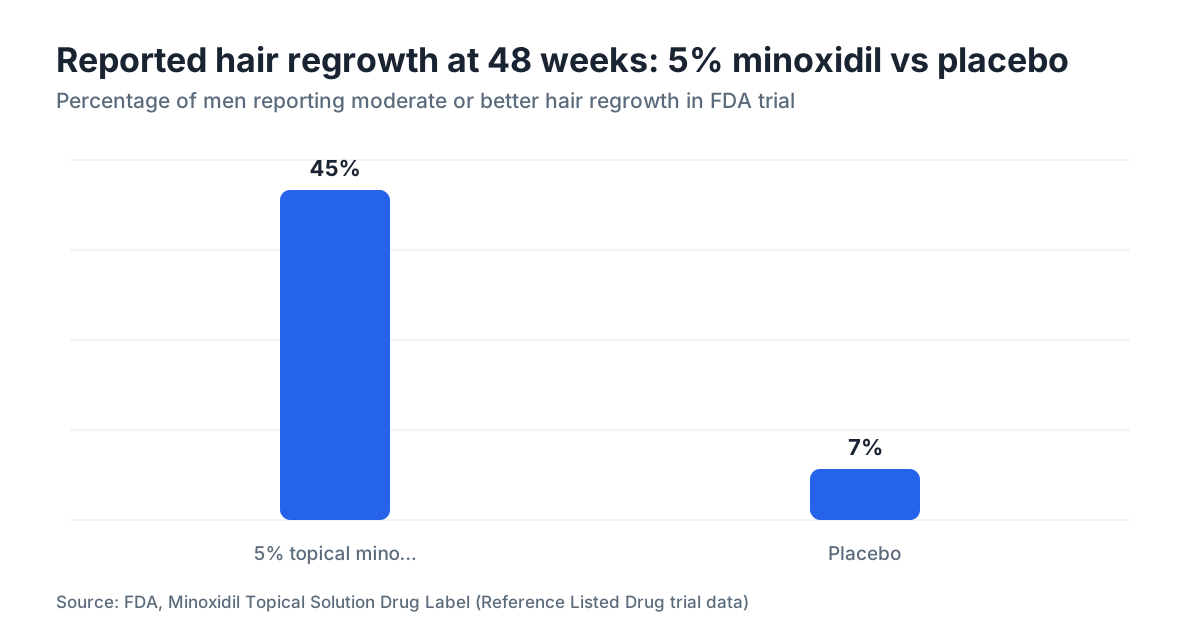
Yes, because the active ingredient is real minoxidil at the concentrations that have clinical evidence behind them. The FDA's approval for topical 5% minoxidil in men rests on a 48-week trial where 45% of men using 5% solution reported at least moderate hair regrowth, compared with 7% on placebo [1]. Those numbers get misquoted a lot. They include men who saw only minimal regrowth. The share who see dense, obvious regrowth is smaller, probably 20-30% based on the same data.
Minoxidil works by prolonging the anagen (growth) phase of hair follicles and increasing blood flow to the scalp. It does not block dihydrotestosterone (DHT), which is the androgen that drives most male pattern hair loss. That's why many dermatologists recommend pairing it with a DHT blocker like finasteride rather than using minoxidil alone. Hims does sell both.
Here's the honest ceiling on topical minoxidil. It slows loss and can add density to thinning areas, but it rarely reverses significant recession at the hairline. If your receding hairline has been retreating for years, minoxidil won't push it back to where it was. Managing that expectation upfront saves a lot of frustration.
Oral minoxidil at 2.5-5 mg/day has shown comparable or better efficacy than topical in several small trials. A 2022 randomized controlled trial in JAMA Dermatology found that 5 mg/day oral minoxidil was non-inferior to 5% topical minoxidil for hair count after 24 weeks [3]. The side effect profile differs, and that matters for the decision between the two formats.
How does Hims oral minoxidil differ from the topical version?
The route of delivery is the whole difference. Topical minoxidil sits on your scalp and is absorbed locally. Oral minoxidil circulates systemically, which means it reaches all follicles, more than the ones you apply to, and it also reaches your heart and blood vessels.
Oral minoxidil was originally FDA-approved as a prescription antihypertensive (blood pressure medication) for severe hypertension, at doses of 10-40 mg/day [4]. The hair loss doses Hims prescribes, typically 2.5 mg for men, are a fraction of that. At those low doses, the blood pressure effect is usually small, but it's real. The FDA label for oral minoxidil tablets includes warnings about fluid retention, rapid heartbeat, and pericardial effusion at therapeutic antihypertensive doses [4]. At the low off-label hair doses, serious cardiovascular events are rare, but the prescribing physician is supposed to screen for contraindications.
The more common side effect specific to oral minoxidil at any dose is hypertrichosis, which is unwanted hair growth on the face, arms, and body. Studies report it in 30-80% of users depending on dose and how carefully they look [2]. That's the number women in particular hate hearing. For men, facial hair growth often isn't a problem, but body hair elsewhere can be annoying.
Read the full picture on minoxidil side effects before choosing oral over topical, especially if you have any cardiovascular history.
The convenience argument for oral is real, though. No twice-daily scalp application. No greasy residue. No waiting 4 hours before swimming or washing your hair. If adherence to topical has been your problem, oral may genuinely work better for you in practice, even if the mechanism is the same.
How does Hims minoxidil compare to generic minoxidil from a pharmacy?
The active ingredient is identical. Minoxidil is minoxidil. FDA approval requires that generic topical products demonstrate bioequivalence to the reference listed drug, so the molecule doing the work is the same whether you buy it from Hims or from Kirkland Signature at Costco.
| Product | Format | Concentration | Approx. monthly cost |
|---|---|---|---|
| Hims topical solution | OTC | 5% | $22-30 |
| Hims topical foam | OTC | 5% | $25-35 |
| Hims oral minoxidil | Rx (telehealth) | 2.5 mg | $35-55 |
| Kirkland Signature (Costco) | OTC | 5% | $8-12 |
| Rogaine brand (foam) | OTC | 5% | $28-38 |
| Pharmacy generic oral minoxidil | Rx (local MD) | 2.5 mg | $10-20 + visit cost |
The Hims price premium buys you discreet online ordering, auto-refill, and access to a telehealth prescriber for oral minoxidil without an in-person visit. If you already have a dermatologist or primary care physician, you can almost certainly get the same oral prescription cheaper. If you don't, the Hims telehealth model is genuinely convenient and the premium is defensible.
One thing to watch: some Hims formulations add ingredients like biotin or saw palmetto. Those add-ons are not FDA-cleared for hair loss and the evidence for them is weak [5]. You're paying extra for ingredients that probably don't help. See our breakdown of hair loss supplements for the honest scorecard.
For a thorough look at the OTC topical category, the minoxidil for men guide covers bioequivalence and application protocol in more detail.
What are the real side effects of Hims minoxidil?
Topical minoxidil's most common side effect is scalp irritation: dryness, flaking, or itching. This happens mostly with the solution form because propylene glycol irritates sensitive scalps. Switching to the foam form usually resolves it because the foam vehicle skips propylene glycol entirely [1].
About 1-2 months into using topical minoxidil, a lot of people panic because they're shedding more hair than before. This is called minoxidil-induced telogen effluvium, and it's temporary. The drug forces resting follicles into the growth phase, and the old hair has to fall out first. It almost always resolves by month 3-4. Understanding telogen effluvium will stop you from quitting at exactly the wrong moment.
Systemic side effects from topical minoxidil are rare but not impossible. A small amount absorbs into circulation, and some users report lightheadedness, especially if they apply it right after a hot shower when pores are dilated.
For oral minoxidil, the side effect list is broader. The FDA label for oral minoxidil lists fluid retention and sodium retention as established effects at any dose, along with reflex tachycardia (elevated heart rate) as the body compensates for any blood pressure drop [4]. At 2.5 mg, clinical studies have found these effects to be mostly subclinical, but they're real and worth monitoring. The American Academy of Dermatology recommends that prescribers get a baseline blood pressure reading before starting oral minoxidil for hair loss [6].
Hypertrichosis remains the most common reason people stop oral minoxidil. It's dose-dependent, so some prescribers start at 1.25 mg and titrate up slowly.
How long does it take for Hims minoxidil to work?
The honest timeline is 3-6 months before you see meaningful results, and 12 months before you know what your full response looks like. Most clinical trials use 48-week endpoints for exactly that reason [1].
The first 2-3 months are often discouraging. The initial shedding phase described above makes it feel like things are getting worse. Resist the urge to stop. The thinning you see during months 1-3 is temporary, and the underlying follicles are being recruited into the growth phase.
Around months 4-6, new fine vellus hairs typically appear, particularly at the crown and mid-scalp. These are small and colorless at first. Most thicken over the following months. If you photograph the same area in the same lighting once a month, you'll see the change clearly over 6-12 months. Without those comparison photos, the change is subtle enough that many people don't notice it and assume the drug isn't working.
If you see zero change after 12 months of consistent use, it's worth having an honest conversation with a dermatologist. Some people are non-responders. The combination of finasteride and minoxidil tends to produce better results than either drug alone for androgenetic alopecia, and that's often the next logical step for non-responders to monotherapy.
One hard fact: minoxidil does not cure hair loss. If you stop using it, the hair you gained typically sheds within 3-4 months, and you return to wherever you would have been without treatment. It requires indefinite use to maintain results.
Is the Hims telehealth process legitimate and safe?
Hims operates as a licensed telehealth platform. It connects patients with licensed physicians and nurse practitioners who can prescribe FDA-approved and off-label medications in states where they hold licensure. It is not a gray-market supplement company or an offshore pharmacy. The medications it dispenses are manufactured in FDA-regulated facilities.
For oral minoxidil specifically, the telehealth intake asks about cardiovascular history, blood pressure, and current medications. That's the right clinical screen. The limitation is that it's a self-reported questionnaire rather than an in-person physical exam. If you have uncontrolled hypertension, heart disease, or take other antihypertensives, you should involve your regular physician in this decision. The telehealth model works fine for healthy adults with no cardiovascular risk factors.
The Federal Trade Commission has taken action against some telehealth companies for deceptive subscription practices, and Hims has been the subject of consumer complaints about difficult subscription cancellations. That's worth knowing before you start auto-ship. The clinical product itself (minoxidil) is legitimate; the business model quirks are a separate issue.
If you want to get a baseline picture of your hair loss pattern before spending anything, the free AI hair analysis at MyHairline takes a photo and maps your Norwood stage, which helps you have a more informed conversation with any prescriber.
For serious cases, or anyone past Norwood stage 4-5 where medical treatment alone is unlikely to restore meaningful density, a hair transplant consultation is the honest next question, not a minoxidil upgrade.
Can women use Hims minoxidil?
Hims is primarily marketed to men, but the topical minoxidil products are not inherently dangerous for women. The FDA cleared 2% topical minoxidil for women with androgenetic alopecia in 1991, and the 5% foam was cleared for women in 2014 [1]. Many dermatologists prescribe 5% solution or foam off-label to women despite the label technically saying 2% for women.
Oral minoxidil for women is a different calculation. The doses are usually lower (0.625 mg to 2.5 mg), and hypertrichosis is a bigger concern because unwanted facial hair growth is more distressing for women than for men. Several trials specifically in women, including a 2020 study in the Journal of the American Academy of Dermatology, showed meaningful hair density improvement at 1 mg/day oral minoxidil with a more manageable hypertrichosis rate than at higher doses [2].
Hims does not specifically serve women through its platform in the same way it serves men, though its Hers sister brand does. Women looking at oral minoxidil for hair loss are better served by a dermatologist or a telehealth platform set up for women's hair concerns. The what causes hair loss guide covers the reasons women's hair loss patterns respond differently to the same treatments.
Should you use Hims minoxidil alone or combine it with finasteride?
For men with androgenetic alopecia (the most common cause of male pattern baldness), the combination of minoxidil plus finasteride outperforms either drug alone. A 2003 clinical trial published in Dermatology found that the combination produced greater hair count increases at 12 months than finasteride or minoxidil monotherapy in men with vertex thinning [7].
Minoxidil stimulates growth. Finasteride reduces the DHT that's miniaturizing follicles in the first place. They work through completely different pathways, which is why stacking them makes sense mechanistically, more than empirically.
Hims sells both, and they actively push combination packages. The clinical rationale for combining them is real. The decision to add finasteride is separate from the minoxidil question, though, and finasteride has its own side effect profile that deserves its own research. Sexual side effects occur in roughly 1-2% of users per the FDA label, and post-finasteride syndrome, while controversial, is a real concern some men report [8]. Read the full finasteride breakdown before deciding.
If you're in early stages of loss (Norwood 1-3), starting minoxidil now and adding finasteride after confirming you tolerate it is a reasonable staged approach. If you're already at Norwood 4 or beyond, the honest conversation is about what combination therapy can realistically preserve versus what requires surgical restoration.
What do dermatologists actually think about Hims minoxidil?
Most dermatologists have no objection to the medication itself. Minoxidil is minoxidil; buying it through Hims or off a pharmacy shelf delivers the same drug. The professional opinion tends to split on two specific points.
First, the telehealth model for oral minoxidil. The American Academy of Dermatology's 2022 guidelines on hair loss treatment acknowledge low-dose oral minoxidil as a reasonable off-label option but emphasize screening for cardiovascular contraindications before prescribing [6]. Dermatologists who prefer in-person visits argue that a brief intake questionnaire misses things a blood pressure cuff and stethoscope would catch. That's a fair critique. It doesn't mean the Hims model is dangerous for low-risk patients; it means it's not right for everyone.
Second, the combination products. Several Hims offerings mix minoxidil with biotin, caffeine, or keratin in the same bottle. There's no good evidence that adding those ingredients to minoxidil improves outcomes, and some dermatologists argue it complicates attribution if something goes wrong or if you want to isolate what's working. If the minoxidil works, great. If it doesn't, you don't know whether it was the minoxidil, the other ingredients, or neither.
The straightforward professional recommendation for most men starting hair loss treatment is 5% topical minoxidil, available at any pharmacy for $10/month, possibly combined with finasteride if DHT blocking is warranted. Hims is a convenient on-ramp to that treatment, not a better version of it.
Sources
- FDA, Minoxidil Topical Solution and Foam Drug Label / Orange Book
- Randolph M, Tosti A. Oral minoxidil treatment for hair loss. Journal of the American Academy of Dermatology, 2021
- Jimenez-Cauhe J et al. Oral minoxidil vs topical minoxidil for androgenetic alopecia. JAMA Dermatology, 2022
- FDA, Loniten (oral minoxidil) Prescribing Information
- NIH Office of Dietary Supplements, Biotin Fact Sheet for Health Professionals
- American Academy of Dermatology, Guidelines for Androgenetic Alopecia Treatment, 2022
- Kohler C et al. A combination of 2% minoxidil and 1mg finasteride is not superior to finasteride alone in treating male androgenetic alopecia. Dermatology, 2003
- FDA, Propecia (finasteride 1 mg) Prescribing Information
- FDA, MedWatch and Drug Approvals Database