

TL;DR: Telogen effluvium reverses on its own once the trigger is gone, usually within 3 to 6 months. Find and fix the root cause, correct any nutritional deficiencies, manage ongoing stress, and add topical minoxidil if shedding is severe or slow to settle. Most people regain full density within a year.
What is telogen effluvium and is it actually reversible?
Telogen effluvium (TE) is diffuse hair shedding caused by a shock to the hair cycle. Normally, around 5 to 15 percent of scalp hairs sit in the resting (telogen) phase at any moment. A physical or emotional stressor pushes a much larger share of follicles into telogen at once. Six to twelve weeks later, those hairs shed together, and people lose 200 to 500 hairs a day instead of the normal 50 to 100 [1].
Here is the good news: yes, it reverses. The follicles are not destroyed. They are resting. Once the trigger is gone and the body settles, those follicles restart the growth (anagen) phase on their own. The American Academy of Dermatology notes that TE typically resolves without treatment once the underlying cause is addressed [2].
The catch is timing. Recovery takes real patience. You will not see full regrowth in six weeks. Most people need three to six months before shedding normalizes and another three to six months before density visibly improves. For a deeper look at how TE works before you start reversing it, read our guide to telogen effluvium.
Chronic telogen effluvium is a different animal. When shedding runs past six months, it is called chronic TE, and the triggers are harder to pin down, sometimes overlapping with female pattern hair loss or a low-grade stressor nobody has identified. Chronic TE still reverses. It just takes longer and usually needs a doctor's oversight.
What triggers telogen effluvium in the first place?
You cannot reverse TE without knowing what caused it. Sounds obvious. Plenty of people skip this step and then wonder why the shedding keeps going.
The most common triggers are:
- Major illness or high fever (COVID-19 has been one of the most documented causes in recent years; a 2021 study in JAAD found hair loss reported in 27% of COVID patients at 6-month follow-up) [3]
- Childbirth (postpartum TE is extremely common, typically starting 2 to 4 months after delivery)
- Rapid weight loss or caloric restriction, including crash diets
- Iron deficiency or ferritin levels below roughly 30 ng/mL (the threshold most dermatologists use, though the exact cutoff is debated)
- Thyroid dysfunction, both hypothyroid and hyperthyroid
- Major surgery or general anesthesia
- Severe psychological stress
- Starting or stopping certain medications, including oral contraceptives, blood thinners, retinoids, and some antidepressants
- Protein or zinc deficiency
The trigger usually happened two to three months before the shedding started. That lag confuses a lot of people, because they focus on what changed recently instead of what changed earlier. Think back three months, not three weeks.
For a broader picture of what drives hair loss beyond TE, what causes hair loss covers the full landscape.
How do you find and fix the root cause?
Start with blood work. A basic panel for suspected TE should include complete blood count, ferritin (more useful than serum iron), thyroid stimulating hormone (TSH), free T3 and T4, zinc, vitamin D, and a metabolic panel to check protein metabolism [4]. Some dermatologists also check B12, folate, and inflammatory markers like CRP.
Ferritin is the most consistently cited lab value in TE cases. Serum ferritin below 30 ng/mL is linked to increased shedding, and several observational studies suggest raising it above 70 ng/mL may improve recovery speed, though randomized trial data here is thin [4]. If yours is low, oral iron is the fix, typically ferrous sulfate 325 mg daily or every other day (every other day absorbs better, per research from Uppsala University) [5]. Take it with vitamin C and away from coffee or calcium, which block absorption.
Thyroid abnormalities go through your doctor. TSH outside the 0.5 to 4.5 mIU/L range is worth treating, and hair usually improves once levels normalize.
For medication-triggered TE, the fix is stopping or switching the drug, but only under medical supervision. Do not quit blood thinners or antidepressants on your own to save your hair.
Postpartum TE mostly needs time. Estrogen drops sharply after delivery, and that is the trigger. Correcting iron deficiency, which is common postpartum, can speed things along. Hair typically returns to normal by the baby's first birthday.
Does fixing nutrition actually reverse telogen effluvium?
It does, when nutrition is the problem. It does nothing when nutrition is not the problem. That distinction matters, because supplement marketing loves TE patients.
Iron and ferritin are the most evidence-backed nutritional factors. Protein comes next: hair is essentially keratin, which is protein, and if you eat fewer than about 50 grams of protein a day, shedding will persist no matter what else you do.
Zinc deficiency causes TE and shows up in cases of severe dietary restriction and in patients on long-term proton pump inhibitors. Zinc supplementation works in deficient patients. It does little if your levels are normal. Over-supplementing zinc actually backfires, because it can suppress copper absorption and worsen hair loss [9].
Vitamin D is complicated. Deficiency (under 20 ng/mL) is linked to TE in several studies, but pushing your levels above normal has not been shown to speed recovery [10]. Get to sufficiency and stop.
Biotin: almost certainly not the issue unless you have a genuine biotin deficiency, which is rare outside of certain genetic disorders or eating large quantities of raw egg whites. Biotin supplements are one of the biggest money-wasters in the hair loss space for most TE patients. There is no harm at normal doses, to be fair. For a full breakdown of what the evidence says about various options, hair loss supplements is worth reading before you spend anything.
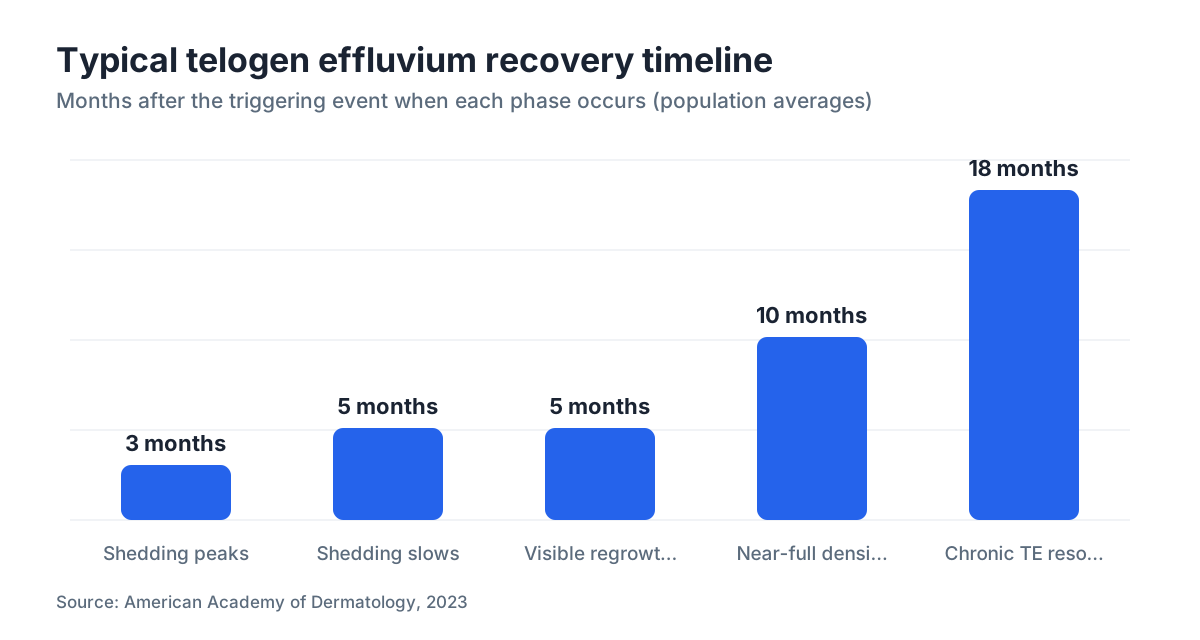
How long does it take for telogen effluvium to reverse?
Here is the honest timeline, because vague answers cause unnecessary panic.
| Phase | Typical timing |
|---|---|
| Shedding peaks | 2 to 4 months after trigger |
| Shedding slows | 4 to 6 months after trigger (once cause is resolved) |
| Visible regrowth starts | 4 to 6 months after trigger |
| Near-full density restored | 9 to 12 months after trigger |
| Chronic TE resolution | 12 to 24 months |
These are population averages. Individual variation is real. Younger people with no underlying conditions tend to recover faster. People with concurrent nutritional deficiencies or ongoing stress tend to recover slower.
One thing that tricks people: the regrowth hairs that first appear are short and fine, which can make density look worse before it looks better. That is not a sign recovery has stalled.
If shedding has not slowed at all by month six after removing the trigger, that is the point to push for a dermatology referral. You may be dealing with chronic TE, androgenetic alopecia riding on top of TE (which is common and often missed), or another diagnosis entirely.
Should you use minoxidil for telogen effluvium?
Minoxidil is not a cure for TE and it does not fix the root cause. But it is the most evidence-backed topical for shortening the recovery window and easing shedding during active TE [6].
Minoxidil works by shortening the telogen phase and pushing follicles back into anagen. It also increases blood flow to the scalp and has some anti-inflammatory effects. The FDA has approved topical minoxidil 2% for women and 5% for both men and women in its over-the-counter form [6]. Using it during TE can get follicles restarted faster.
The caveat matters: minoxidil causes its own initial shedding (the dread shed) in the first four to eight weeks, because it forces resting hairs out to make room for new growth. Starting it in the middle of acute TE can feel like the worst decision you have ever made. Many dermatologists prefer to wait until shedding is already slowing before adding it.
For men dealing with TE on top of androgenetic alopecia, minoxidil is more clearly indicated, because it also targets the underlying pattern loss. See minoxidil for men for dosing and application details, and minoxidil side effects before you start.
Oral minoxidil at low doses (0.25 to 1.25 mg daily for women, 2.5 to 5 mg for men) is increasingly used off-label for TE and can be more convenient than topical, though it carries more systemic side effect risk. See oral minoxidil for the full picture.
Do finasteride or DHT blockers help with telogen effluvium?
Finasteride and other DHT blocker medications target androgenetic alopecia, not TE. They block the conversion of testosterone to dihydrotestosterone (DHT), the androgen that miniaturizes follicles in pattern hair loss.
TE is not driven by DHT. The two conditions can and do co-exist, which is where it gets confusing. A man or woman can shed from TE while also carrying underlying pattern loss. If that is the case, treating the androgenetic component with finasteride (or the combination approach in finasteride and minoxidil) makes sense for the pattern loss piece. It will not speed up TE recovery on its own.
If your hair loss is purely TE with no androgenetic component, finasteride is not indicated and carries side effect risk for no benefit.
What lifestyle changes actually help reverse telogen effluvium?
Stress management is not a throwaway suggestion here. Psychological stress is a documented TE trigger, because it raises cortisol, which can shift follicles from anagen to telogen [7]. If chronic stress was the cause and you have not dealt with it, adding supplements and minoxidil will not get you far.
The interventions with the most real-world evidence for lowering cortisol are regular aerobic exercise (30 minutes, most days), adequate sleep (7 to 9 hours for adults, per the National Sleep Foundation) [11], and cognitive behavioral therapy or mindfulness-based stress reduction for people with clinical anxiety. None of this is glamorous. It is what the data supports.
Protein timing matters too. Getting 25 to 40 grams of protein per meal rather than in one large daily dump may improve amino acid availability for hair growth, though the evidence is mostly extrapolated from muscle protein synthesis research rather than direct hair studies.
Scalp massage has a small but real evidence base. A 2016 standardized scalp massage study published in ePlasty found that daily four-minute massages over 24 weeks increased hair thickness in a small group of healthy Japanese men [8]. The mechanism is thought to involve stretching of dermal papilla cells. It is low-risk and costs nothing.
Go easy on heat styling, tight hairstyles, and aggressive brushing during active shedding. These do not cause TE, but they stack mechanical hair loss on top of it, and the combination looks much worse.
When should you see a dermatologist about telogen effluvium?
See a board-certified dermatologist (ideally one who specializes in hair, called a trichologist in some countries) if any of these apply:
- Shedding has not improved after six months of addressing the known trigger
- You cannot identify the trigger despite trying
- Your hairline is receding or you are losing hair in a pattern rather than diffusely (this points toward androgenetic alopecia being part of the picture)
- Blood work comes back normal but shedding continues
- You notice patchy bald spots, which would suggest alopecia areata rather than TE
- Shedding comes with scalp pain, burning, or redness
A dermatologist can do a pull test (gently pulling 40 to 60 hairs and counting how many come out; more than 6 is a positive result indicating active shedding) and a trichoscopy exam to look at follicle structure under magnification. A scalp biopsy is occasionally used for chronic or unclear cases.
If you want a preliminary read on your hair loss pattern before booking, the free AI scan at MyHairline can help you understand what you are dealing with and whether it looks like diffuse TE or something with a clearer pattern.
What does a step-by-step reversal plan look like?
Here is a practical order of operations. This is roughly what a dermatologist would walk through with you, though your exact plan should fit your own labs and history.
Step 1: Identify the trigger (week 1 to 2) Think back three months. Major illness, surgery, birth, crash diet, new medication, extreme stress? Write it down. If you cannot identify it, go straight to Step 2.
Step 2: Get the right blood work (week 1 to 2) At minimum: ferritin, TSH, CBC, full metabolic panel, zinc, vitamin D. Ask your doctor to include free T3 and T4 if TSH is borderline.
Step 3: Fix what is deficient (week 2 onwards) Iron or ferritin low? Start ferrous sulfate every other day with vitamin C. Thyroid off? Work with your doctor on medication. Protein intake low? Get it above 1 gram per kilogram of body weight per day. Do not supplement what is not deficient.
Step 4: Remove or manage ongoing stress (ongoing) If psychological stress is a factor, treat it seriously. Exercise, sleep, therapy. This is not optional if stress is part of the picture.
Step 5: Consider minoxidil if shedding is severe or slow to resolve (month 2 to 3) If shedding has been heavy for more than eight weeks and you have addressed the root cause, topical 5% minoxidil applied once or twice daily is a reasonable next step. Talk to your doctor first. Minoxidil for men or the oral version (see oral minoxidil) may be preferred in some cases.
Step 6: Track, do not obsess (monthly) Take a monthly photo in consistent lighting. Hair loss looks catastrophic day-to-day, but the monthly photo often shows clear progress. Weighing shed hairs is useless. Counting individual shed hairs per day is useless too.
Step 7: Seek specialist care if no improvement by month 6 If shedding is still active at six months post-trigger removal, see a dermatologist. You may need a scalp biopsy to rule out chronic TE, alopecia areata, or concurrent pattern loss.
For an objective snapshot of where your hair is now, MyHairline's free AI hair analysis (/scan) can track your pattern over time and flag whether what you are seeing looks like TE, pattern loss, or a mix.
Can telogen effluvium come back after it resolves?
Yes. TE is not a one-time disease with lifetime immunity. If you hit another significant stressor, your hair cycle can be disrupted again. People who have had TE once seem to carry the same base risk as anyone else for future episodes, though some researchers have speculated the threshold for triggering it again may be lower in people with a history of it. That evidence is weak.
The practical takeaway: the habits that helped you recover (adequate protein, iron monitoring especially for women with heavy periods, stress management, decent sleep) are worth keeping long-term. Not because they prevent all future TE, but because they keep your nutritional baseline high enough that a moderate stressor is less likely to tip the scales.
Women who get postpartum TE with one pregnancy should know it can recur with later pregnancies. Planning for it cuts the panic considerably.
If you are also managing a receding hairline alongside TE, remember those are separate processes needing different approaches, and recovering from TE does not stop androgenetic alopecia from progressing during that time.
Sources
- Journal of the American Academy of Dermatology: COVID-19 and hair loss at 6-month follow-up (Mieczkowska et al., 2021)
- National Institutes of Health Office of Dietary Supplements: Iron Fact Sheet for Health Professionals
- Uppsala University / BMJ study on alternate-day iron dosing for absorption (Moretti et al., 2015)
- FDA Drug Database: Minoxidil topical solution labeling
- NIH National Library of Medicine: Stress and Hair Loss (Peters et al., 2006, PLoS Medicine)
- ePlasty: Standardized scalp massage results in increased hair thickness (Koyama et al., 2016)
- NIH Office of Dietary Supplements: Zinc Fact Sheet for Health Professionals
- NIH Office of Dietary Supplements: Vitamin D Fact Sheet for Health Professionals
- National Sleep Foundation: Sleep Duration Recommendations
- DermNet NZ: Telogen effluvium clinical review