

TL;DR: LLLT helmets shine low-energy red and near-infrared light on the scalp to wake up struggling follicles. Multiple randomized controlled trials show real hair count gains, usually 20 to 40 extra hairs per cm² after 16 to 26 weeks. The FDA has cleared several devices. The growth is genuine but modest, and it reverses once you stop using the helmet.
What is low level laser therapy and how does it work on hair follicles?
Low level laser therapy (LLLT), also called photobiomodulation, sends red or near-infrared light at wavelengths between about 630 nm and 670 nm into the scalp [1]. Cytochrome c oxidase inside the mitochondria of follicle cells absorbs that light and makes more ATP. More ATP means the cell has more fuel for its normal jobs, hair growth included [2].
Here's the theory. Follicles in the telogen (resting) or catagen (regressing) phase get an energy nudge that tips them back into anagen (active growth). Male pattern baldness usually isn't follicles dying outright. It's follicles shrinking and spending longer and longer resting. Anything that shifts the balance back toward growth has a plausible mechanism behind it.
The energy levels are genuinely low. These lasers don't cut or heat tissue. You feel essentially nothing during a session, which is why the marketing calls them "cold lasers" or "soft lasers." A helmet packs an array of laser diodes or LEDs against or near the scalp and covers far more area than a handheld wand.
One biological limit matters. LLLT cannot bring back a follicle that scar tissue has replaced. If a patch of your scalp is already smooth and slick after years of advanced androgenetic alopecia, those follicles are gone. LLLT works on miniaturized follicles that are still there but underperforming. Understanding what causes hair loss first sets the right expectations before you buy any device.
What does the clinical evidence actually say about LLLT helmets?
The evidence is better than most people expect and weaker than the device companies imply. Here's where it stands.
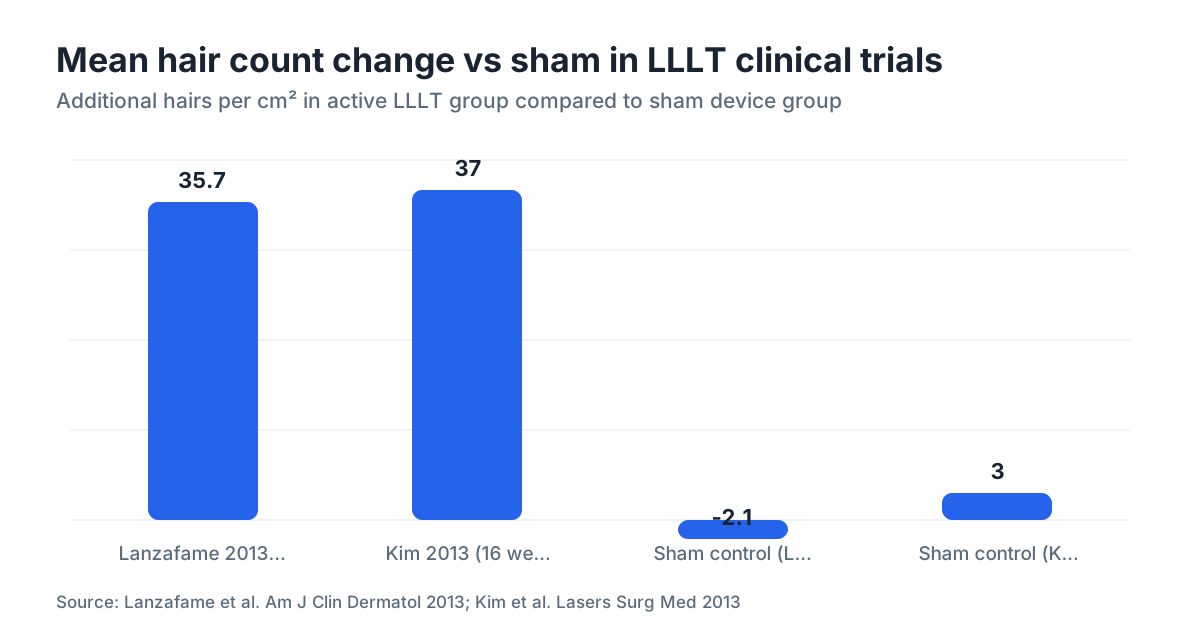
A randomized, double-blind, sham-controlled trial in the American Journal of Clinical Dermatology (Lanzafame et al., 2013) enrolled 44 men with androgenetic alopecia. The treatment group used an LLLT device three times a week. After 26 weeks the treated men showed a mean gain of 35.7 hairs per cm², while the sham group slightly lost ground [3]. That gap is real and statistically significant.
A 2013 study by Kim et al. in Lasers in Surgery and Medicine tested a 650 nm helmet in 40 men and 35 women with androgenetic alopecia. After 16 weeks, hair count in the active group rose by roughly 37 hairs per cm², well above the small gain in the sham group [4].
A 2017 systematic review and meta-analysis in Lasers in Medical Science (Afifi et al.) pooled multiple controlled trials and found LLLT produced statistically significant improvements in hair density and thickness in both men and women with androgenetic alopecia compared to sham [5]. The pooled picture is consistent: expect roughly 20 to 40 additional hairs per cm² after about 16 to 26 weeks of regular use.
So what's the catch? Sample sizes are small, most studies run under six months, and many are funded by device makers. Independent multi-year data are thin. There are no published head-to-head trials pitting LLLT against minoxidil or finasteride, so nobody can say with confidence where it ranks against the established drugs.
Here's the honest bottom line. LLLT produces modest, real, measurable growth. It doesn't match finasteride or minoxidil for men on the data we have, but it isn't snake oil either.
Has the FDA cleared LLLT helmets, and what does clearance actually mean?
Yes. Several LLLT devices for hair loss have FDA 510(k) clearance. That is not the same as FDA approval. Clearance means the agency decided the device is substantially equivalent to another legally marketed predicate device, not that it survived the efficacy gauntlet a new drug faces [1].
The FDA classifies these as Class II medical devices. Cleared examples include the HairMax LaserBand, Capillus helmets, iGrow, and Theradome. The FDA's public 510(k) database lists these clearances and the predicate devices behind them.
Clearance does guarantee a couple of things. The manufacturer has shown the device is safe for consumer use at the listed power levels, and the labeling (what the company is allowed to claim) has been reviewed. A cleared device can be legally marketed for hair growth in androgenetic alopecia. An uncleared device running the same wavelengths and power can't make those claims legally, even though the market is full of uncleared knockoffs.
Buying a helmet? Check the FDA's 510(k) database directly at fda.gov and confirm clearance for the exact model number. A marketing page that says "FDA cleared" is not proof. The database listing is.
The FDA's oversight of laser products sits under its Center for Devices and Radiological Health [1]. The agency has not approved any LLLT device as a drug or biologic, and no LLLT device is legally allowed to claim it cures androgenetic alopecia.
How do LLLT helmets compare to other male pattern baldness treatments?
You need honest framing before you spend several hundred dollars.
| Treatment | Hair count evidence | Requires prescription | Monthly cost (approx.) | Stops working if you stop? |
|---|---|---|---|---|
| Finasteride 1 mg/day | ~10-15% more hair than placebo at 12 months (Merck trial, n=1553) | Yes (in US) | $15-$50 generic | Yes |
| Minoxidil 5% topical | Significant hair count gains vs placebo at 48 weeks | No | $10-$30 | Yes |
| LLLT helmet | ~20-40 hairs/cm² vs sham at 16-26 weeks | No | Device cost amortized + $0 per session | Yes |
| Hair transplant | Permanent redistribution of existing hair | Requires surgical consult | $4,000-$20,000 one-time | No (transplanted hair permanent) |
Finasteride has the largest and longest evidence base for male pattern baldness. Merck's phase III trials in the late 1990s enrolled 1,553 men and showed statistically significant gains in hair count and hair weight after 12 months, with results improving further at 24 months [6]. Minoxidil has similarly solid trial data going back decades.
LLLT sits in a middle tier. Real evidence, no systemic drug side effects, no prescription, but a high upfront cost and weak comparative data. It works best as an add-on to established treatments, not a swap for them. Some dermatologists suggest it for people who can't tolerate minoxidil side effects or who want to avoid finasteride. Early evidence hints that pairing LLLT with minoxidil beats either alone, though those studies are small [5].
Deciding between this and a hair transplant? They solve different problems. A transplant moves permanent follicles. LLLT stimulates existing ones. They are not interchangeable.
What Norwood stages benefit most from LLLT?
The clearest wins show up in men at Norwood stages I through IV: early to moderate thinning with follicles still present and active enough to respond [3][4]. At these stages the follicles are miniaturized but not gone. LLLT can stretch out their anagen phase and modestly thicken individual hairs.
Norwood V and above is where the evidence thins and expectations need a hard reset. At advanced stages, large patches of scalp have lost follicles entirely. No light therapy grows hair from follicle-free skin. Dermatologists broadly agree that men with extensive, long-standing baldness see minimal to no response.
The same logic runs to the hairline. A receding hairline in early stages, where you can still feel fine, short hairs in the recession zone, is a reasonable LLLT target. A hairline that's been bare for five years or more is not.
Unsure which Norwood stage you're at? A scalp assessment calibrates expectations before you spend a cent. MyHairline's free AI scan (/scan) gives you a quick baseline read on your loss pattern, which is genuinely useful context for a decision like this.
How do you use a LLLT helmet correctly and how long before you see results?
Most FDA-cleared helmets call for 15 to 30 minute sessions, two to three times a week. Consistency beats marathon sessions. The devices ship with automatic timers precisely because more exposure doesn't mean faster results, and at very high doses it can even flip inhibitory [2].
The earliest you can realistically spot a difference is around week 12 to 16. That tracks the natural hair cycle: follicles need time to shift phases and push a visible shaft above the skin. Most clinical trials run 16 to 26 weeks for exactly this reason [3][4].
Photos are your best objective tool. Shoot under identical conditions (same room, same time of day, camera at the same distance) at baseline, week 8, week 16, and week 24. Hair count changes are subtle enough that memory will lie to you.
The results stop when you stop. Every trial that tracked patients after treatment shows the gains reversing over months to a year as follicles drift back to their old cycling. This isn't a quirk of LLLT. It's true of minoxidil and most non-surgical hair treatments. Budget for indefinite use if you want indefinite benefit.
Clean, dry scalp before each session is standard. No products, oils, or sunscreen during treatment. Most helmets are built to sit right on the skin for the best photon delivery.
What are the risks and side effects of LLLT helmets?
The safety record for LLLT at cleared consumer power levels is genuinely good. No serious adverse events turned up in any of the published randomized trials [3][4][5]. The usual complaints are mild warmth, scalp tingling, or a passing headache, all of which cleared up on their own.
LLLT is a poor fit for people with photosensitivity disorders, anyone on photosensitizing medications (some antibiotics and chemotherapy drugs included), or people who've had skin cancer on the scalp. Manufacturers list pregnancy as a contraindication too, not because harm has been shown, but because no safety data exists in pregnant people.
Eyes get the most attention. The lasers here aren't dangerous to skin at consumer power, but direct laser light into the eye is a different story. Every cleared helmet points its diodes at the scalp, not outward. Still, don't lean over and stare into a running device.
Because no systemic drug is involved, LLLT skips the whole-body side effects that come with pills. No risk of the sexual side effects tied to finasteride, no cardiovascular questions from oral minoxidil, no drug interactions to juggle.
How much do LLLT helmets cost and are cheaper ones worth buying?
FDA-cleared helmets generally run from about $500 to $3,000 at retail. The HairMax LaserBand line starts around $350. The Capillus Pro sits near $1,200 to $1,500. The Theradome Pro usually lands between $600 and $900. Prices bounce with sales, and buying from authorized resellers matters for warranty coverage.
The cheap end (think $50 to $200 helmets on Amazon from brands you've never heard of) is genuinely risky. Most use LEDs instead of laser diodes (different physics, less evidence for the follicle mechanism), skip FDA clearance, and often misstate their power density. A few watts of LED spread across a whole helmet can leave the scalp with barely any therapeutic photon density.
The premium end has its own murk. More diodes or higher listed power doesn't cleanly translate to better outcomes once the wavelength and power density already sit in the therapeutic window. The published trials don't consistently show a dose-response relationship inside the cleared range [5].
If you're spending money here, the defensible minimum is an FDA 510(k)-cleared device from a brand with published trial data behind its device category. Anything below that is a gamble.
For context: a cleared helmet at the $600 price point, used three times a week over two years, works out to under $1 per session. Ongoing cost after purchase is zero, which stacks up well against monthly medication if you'd rather avoid drugs.
Can LLLT be combined with minoxidil or finasteride?
Yes, and this is the most evidence-supported way to use LLLT. No guideline tells you to pick one treatment or the other.
A small randomized trial in Annals of Dermatology (Yoo et al., 2020) found that combining LLLT with 5% minoxidil produced greater hair thickness and density than minoxidil alone in androgenetic alopecia patients [7]. The logic holds up mechanistically. Minoxidil extends anagen and widens the blood vessels feeding follicles. LLLT may work through a separate intracellular energy pathway. The two aren't redundant.
Pairing LLLT with finasteride has rationale too. Finasteride cuts DHT-driven miniaturization. LLLT may add a growth stimulus on top. The combination hasn't been run in large trials, but with no known interaction, there's no pharmacological reason to avoid it. Our piece on finasteride and minoxidil covers how those two stack together.
The real question is cost and time. A daily minoxidil application plus a twice-weekly LLLT session plus a daily finasteride tablet is a lot of routine. People with complicated regimens tend to slip on all of them. If you're already staying consistent with DHT blockers and topical minoxidil, adding LLLT is a reasonable next layer. If you're on nothing yet, start with the medications and add LLLT as backup.
One note for people dealing with telogen effluvium rather than androgenetic alopecia: the LLLT evidence sits specifically in androgenetic alopecia populations. Telogen effluvium often clears on its own once the trigger is gone, and the LLLT mechanism applies less directly.
What questions should you ask before buying a LLLT helmet?
Before you spend several hundred to several thousand dollars, run this checklist.
First: is the specific device FDA 510(k)-cleared? Check the FDA's 510(k) database at fda.gov yourself. The manufacturer's marketing page is not the database.
Second: does the device use laser diodes or LEDs? Both show up in cleared devices, but the trials that make up the evidence base mostly used laser diodes at 650 nm to 670 nm. LED devices have thinner trial backing, even the cleared ones.
Third: what's the power density (mW/cm²) at scalp level, and how does it stack against the devices used in published trials? This number is often missing from marketing materials. The therapeutic window for photobiomodulation runs roughly 1 to 5 mW/cm² in most protocols [2].
Fourth: what's your Norwood stage? If you're Norwood V or VI with extensive established baldness, your expected return is low. The device companies won't say this plainly.
Fifth: can you sustain the routine for at least six months? A $900 helmet used four times before it gathers dust is worse than buying nothing. Be honest about adherence.
Sixth: what's your fallback plan? LLLT alone rarely does enough for men with meaningful androgenetic alopecia. Do you have a plan for established treatments if it falls short?
Myhairline.ai's free AI scan (/scan) gives you an objective look at your current pattern before you invest in anything. Knowing exactly what you're dealing with is the most useful first step.
Are there any LLLT options beyond helmets worth considering?
Helmets are the most convenient form factor because they cover the whole scalp at once. But the LLLT landscape has a few other options.
Handheld laser combs (like the HairMax LaserComb) are the oldest FDA-cleared LLLT category for hair loss, with the first clearances around 2007. They work, but you have to comb methodically across the scalp in sections, which many people find tedious next to putting on a helmet and sitting down.
In-office laser panels live at dermatology practices and hair loss clinics. Sessions usually cost $30 to $100 each, done two to three times a week. Over a year that runs $3,000 to $15,000 or more, well above the cost of a cleared home helmet. No comparative trial has shown these beat home devices.
Laser caps are a subset of the helmet category: smaller, baseball-cap-style, with diodes on the inside. Some are cleared, some aren't. Coverage matters most. A cap that only covers the crown misses the frontal hairline entirely, which is often the area people care about most.
For most men, a full-coverage cleared home helmet is the best balance of evidence, convenience, and long-term cost, assuming they'll actually use it regularly. The main reason to go in-office is access to clinical monitoring and professional add-ons like PRP (platelet-rich plasma), which has its own separate evidence base not covered here.
Sources
- FDA Center for Devices and Radiological Health, 510(k) Premarket Notification database
- Hamblin MR, Photobiomodulation for the Brain, Springer 2018 (summarized in NCBI Bookshelf)
- Lanzafame RJ et al., American Journal of Clinical Dermatology, 2013 - LLLT RCT in male AGA
- Kim H et al., Lasers in Surgery and Medicine, 2013 - LLLT helmet RCT in AGA
- Afifi L et al., Lasers in Medical Science, 2017 - Systematic review and meta-analysis of LLLT for AGA
- Kaufman KD et al., Journal of the American Academy of Dermatology, 1998 - Finasteride 1mg phase III trial
- Yoo KH et al., Annals of Dermatology, 2020 - LLLT plus minoxidil combination trial
- Avram MR et al., Journal of Cosmetic and Laser Therapy, 2009 - Review of laser devices for hair loss